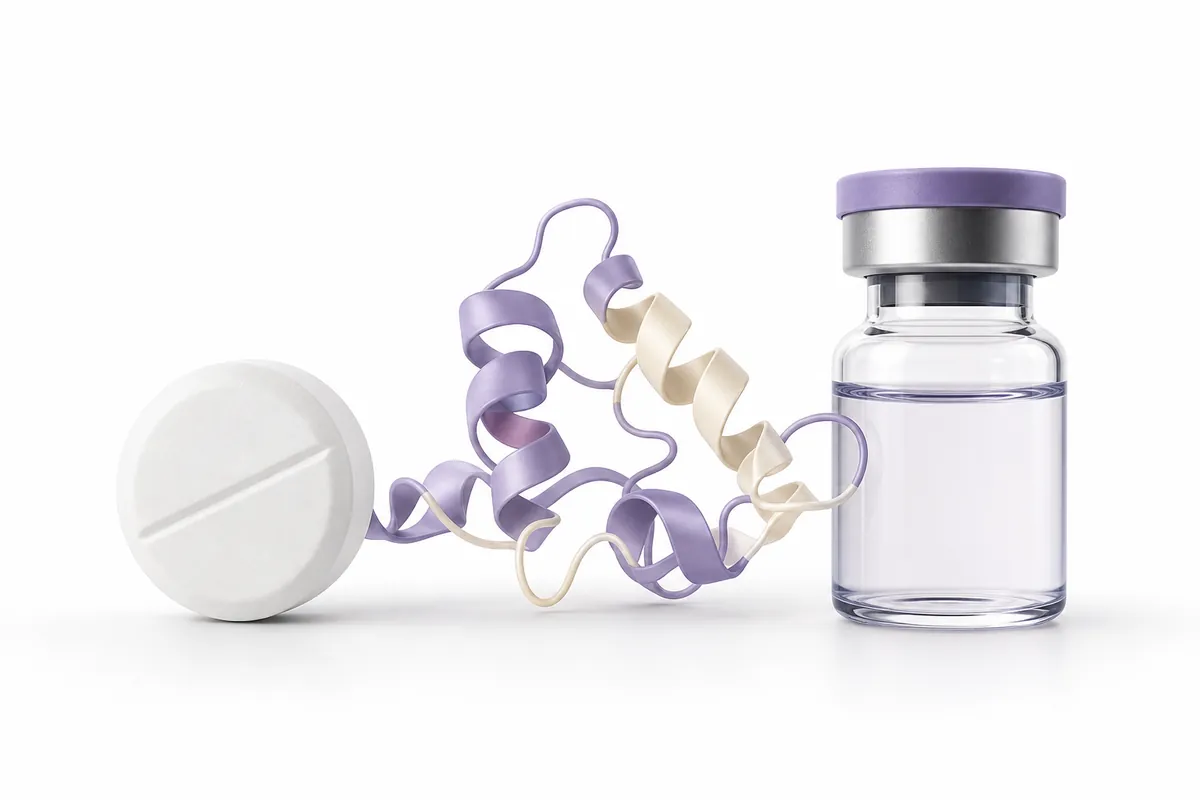
TL;DR: VK2735 is Viking Therapeutics’ dual GLP-1/GIP receptor agonist — the same receptor pair tirzepatide hits — and it is being developed in two forms at once: a subcutaneous injection and an oral tablet. The oral tablet is the headline. Viking presented 13-week oral data from its VENTURE-2 study at ECO 2026 in Istanbul in May 2026, and after an end-of-Phase-2 meeting with the FDA, is advancing oral VK2735 to Phase 3 in Q3 2026 — positioning it as a potential first oral GLP-1/GIP dual agonist. On the injectable side, the VANQUISH-1 Phase 3 trial is fully enrolled. Where orforglipron is an oral GLP-1-only small molecule, VK2735 is a dual agonist being pushed into a pill — a different bet on the same accessibility problem.
The headline: a dual agonist that Viking is trying to put in a pill
Most of the incretin field splits cleanly into two camps. On one side are the injectables — semaglutide, tirzepatide, retatrutide — peptides delivered by weekly subcutaneous pen. On the other are the emerging oral options, led by orforglipron, a small-molecule GLP-1 agonist that survives the stomach on its own. VK2735 doesn’t sit neatly in either camp, and that’s exactly what makes it interesting.
VK2735 is a dual GLP-1/GIP receptor agonist — it activates two gut-hormone receptors at once, the same pairing that underpins tirzepatide. Viking Therapeutics is developing it in both a subcutaneous injectable form and an oral tablet form, from the same molecular program. The oral tablet is the piece drawing the most attention, because a dual agonist you can swallow doesn’t exist on the market yet. If it clears, oral VK2735 would be positioned as a potential first oral GLP-1/GIP dual agonist — combining the dual-receptor mechanism usually reserved for injectables with the needle-free, once-daily convenience of a pill.
The dual GLP-1/GIP mechanism, and why two receptors
GLP-1 and GIP are both incretin hormones — gut peptides your body releases after eating that help regulate blood sugar and appetite. A single-agonist drug like semaglutide or orforglipron activates only the GLP-1 receptor. A dual agonist like VK2735 activates the GLP-1 receptor and the GIP (glucose-dependent insulinotropic polypeptide) receptor together.
That second receptor is the whole rationale for the dual class. Tirzepatide established the template: engaging GIP alongside GLP-1 was associated with larger weight and glycemic effects in its trial program than GLP-1 activation alone, and the dual mechanism is widely credited for it. VK2735 targets that same receptor pair, which is why it’s often described as being in tirzepatide’s structural class rather than semaglutide’s. The mechanistic bet is straightforward: two complementary incretin pathways, engaged at once, tend to move the needle further than one.
Why an oral dual agonist matters
The case for a pill is the same case that drives the entire oral-GLP-1 story: adherence and needle avoidance. Every dual agonist on the market today — tirzepatide most prominently — is a weekly injection. Injections work, but they ask something of the person taking them: handling a needle, storing pens, keeping to a schedule. A meaningful share of people who would benefit from incretin therapy never start, or don’t stay on it, and dosing friction is part of that gap.
An oral dual agonist attacks that friction from a different angle than orforglipron does. Orforglipron removes the needle but keeps a single receptor. VK2735’s oral tablet, if it delivers, would remove the needle and keep the dual mechanism — the fuller pharmacology usually locked behind an injection. That’s the pitch: the mechanism of a tirzepatide-class drug in the format of a daily pill.
VENTURE-2: the oral data at ECO 2026
The oral program’s most recent milestone came at ECO 2026 — the European Congress on Obesity — held in Istanbul in May 2026, where Viking presented 13-week data from its VENTURE-2 study of oral VK2735. VENTURE-2 is the oral tablet’s dose-ranging effort, and the 13-week readout is what Viking carried into its regulatory conversations about advancing the program.
Presenting oral dual-agonist data at a major obesity congress is itself a signal of where the program sits: the oral tablet has moved from early exploration into the kind of mid-stage dataset that regulators evaluate before green-lighting a pivotal trial. The 13-week window is a Phase 2-scale look — long enough to characterize the dose response and tolerability that inform Phase 3 design, short of the 52-to-72-week horizons the approved injectables and orforglipron were judged on.
The path to Phase 3: an end-of-Phase-2 FDA meeting
After the VENTURE-2 readout, Viking held an end-of-Phase-2 meeting with the FDA — the formal checkpoint where a sponsor and the agency align on whether, and how, a program proceeds to pivotal trials. Coming out of that meeting, Viking is advancing oral VK2735 to Phase 3 in Q3 2026.
That is the single most consequential fact about the oral program right now. Phase 3 is where a candidate either earns an approval case or doesn’t, and reaching it means the FDA and Viking have agreed on a pivotal design. It also sets the clock: a Phase 3 program starting in the third quarter of 2026 is the step that would, if successful, move oral VK2735 toward being an actual approved product rather than a promising mid-stage readout.
The injectable side: VANQUISH-1 fully enrolled
The oral tablet is the headline, but it isn’t the whole program. The subcutaneous injectable form of VK2735 is further along, and its pivotal trial — VANQUISH-1, a Phase 3 study — is fully enrolled. Full enrollment means the trial has recruited its complete participant cohort and is running toward its readout, the last major operational milestone before topline results.
Running both forms in parallel is a deliberate hedge. The injectable follows the well-trodden path that semaglutide and tirzepatide walked — a weekly dual-agonist pen competing directly in the established injectable market — while the oral tablet chases the harder, less-crowded prize of a swallowable dual agonist. If either form succeeds, Viking has a dual agonist on the market; the two tracks de-risk each other.
VK2735 vs the oral field: where it fits
It’s worth being precise about how VK2735 sits against the oral options it’s most often compared to, because the differences are mechanistic, not just branding.
| Factor | Oral VK2735 | Orforglipron | Oral semaglutide |
|---|---|---|---|
| Receptor targets | GLP-1 + GIP (dual) | GLP-1 only | GLP-1 only |
| Molecule class | Incretin dual agonist | Non-peptide small molecule | Peptide + SNAC enhancer |
| Also has injectable form | Yes (VK2735 subcutaneous) | No | Yes (same semaglutide molecule) |
| Development stage | Advancing to Phase 3 (Q3 2026) | FDA-approved (Foundayo) | FDA-approved (Wegovy pill) |
| Developer | Viking Therapeutics | Eli Lilly | Novo Nordisk |
The row that matters most is the first one. Orforglipron and oral semaglutide are both GLP-1-only oral drugs; the debate between them is largely about chemistry — small molecule versus peptide — not about which receptors they hit. VK2735 changes the axis of comparison by bringing GIP into an oral format. It’s the only candidate in that table chasing a dual mechanism in a pill.
Reading the program without overreaching
None of this makes oral VK2735 a settled product. It is advancing to Phase 3, not through it — the approved oral options above already have the long-horizon efficacy and safety datasets that VK2735’s oral form is still years from generating. A 13-week Phase 2 readout tells you enough to design a pivotal trial; it doesn’t tell you what a 68-week outcome looks like, and dual-agonist tolerability at scale is exactly the kind of question Phase 3 exists to answer.
What VK2735 does offer, concretely, is a distinct bet. The injectable dual agonists proved the two-receptor mechanism is worth pursuing; the oral single agonists proved the market wants a pill. VK2735 is the clearest current attempt to fuse those two lessons into one product. For how it sits against the broader pipeline of compounds arriving over the next couple of years, our next-gen weight-loss peptides guide maps the wider field, and our orforglipron vs oral semaglutide comparison covers the GLP-1-only oral options it will eventually compete with.
Frequently asked questions
What is VK2735?
VK2735 is Viking Therapeutics’ dual GLP-1/GIP receptor agonist, developed in two forms: a subcutaneous injection and an oral tablet. It activates the same two gut-hormone receptors as tirzepatide, and the oral tablet is positioned as a potential first oral GLP-1/GIP dual agonist.
Is VK2735 a pill or an injection?
Both. Viking is developing VK2735 in an oral tablet form and a subcutaneous injectable form from the same program. The oral tablet is the more closely watched of the two because a swallowable dual agonist doesn’t yet exist on the market; the injectable form is further along, with its VANQUISH-1 Phase 3 trial fully enrolled.
How is VK2735 different from orforglipron?
Both are oral drugs aimed at the same accessibility problem, but they engage different receptors. Orforglipron is a GLP-1-only non-peptide small molecule. VK2735 is a GLP-1/GIP dual agonist — it activates a second receptor, GIP, the same pairing tirzepatide uses. So VK2735’s oral tablet is chasing a dual mechanism in a pill, while orforglipron delivers a single-receptor mechanism in a pill.
What did the VENTURE-2 data show?
Viking presented 13-week data from its VENTURE-2 study of oral VK2735 at ECO 2026 in Istanbul in May 2026. It is a Phase 2-scale, dose-ranging readout — the dataset Viking carried into its end-of-Phase-2 meeting with the FDA before deciding to advance the oral tablet to Phase 3.
When is VK2735 going to Phase 3?
After an end-of-Phase-2 meeting with the FDA, Viking is advancing oral VK2735 to Phase 3 in the third quarter of 2026. On the injectable side, the VANQUISH-1 Phase 3 trial is already fully enrolled and running toward its readout.
Why does a dual GLP-1/GIP mechanism matter?
GLP-1 and GIP are both incretin hormones involved in blood sugar and appetite regulation. Activating both receptors at once — as tirzepatide and VK2735 do — was associated with larger effects in tirzepatide’s trial program than activating GLP-1 alone. An oral dual agonist would aim to bring that two-receptor pharmacology, usually reserved for injections, into a needle-free daily pill.
References
- Viking Therapeutics. “Viking Therapeutics presents 13-week data from VENTURE-2 study of oral VK2735 at the European Congress on Obesity (ECO 2026), Istanbul.” Company presentation, May 2026.
- Viking Therapeutics. Corporate update on VK2735 oral program: end-of-Phase-2 FDA meeting and plan to advance to Phase 3 in Q3 2026. Company announcement, 2026.
- Viking Therapeutics. VANQUISH-1 Phase 3 trial of subcutaneous VK2735: full enrollment update. Company announcement, 2026.
- Viking Therapeutics. VK2735 program overview: dual GLP-1/GIP receptor agonist in subcutaneous and oral formulations. Company pipeline materials, 2026.