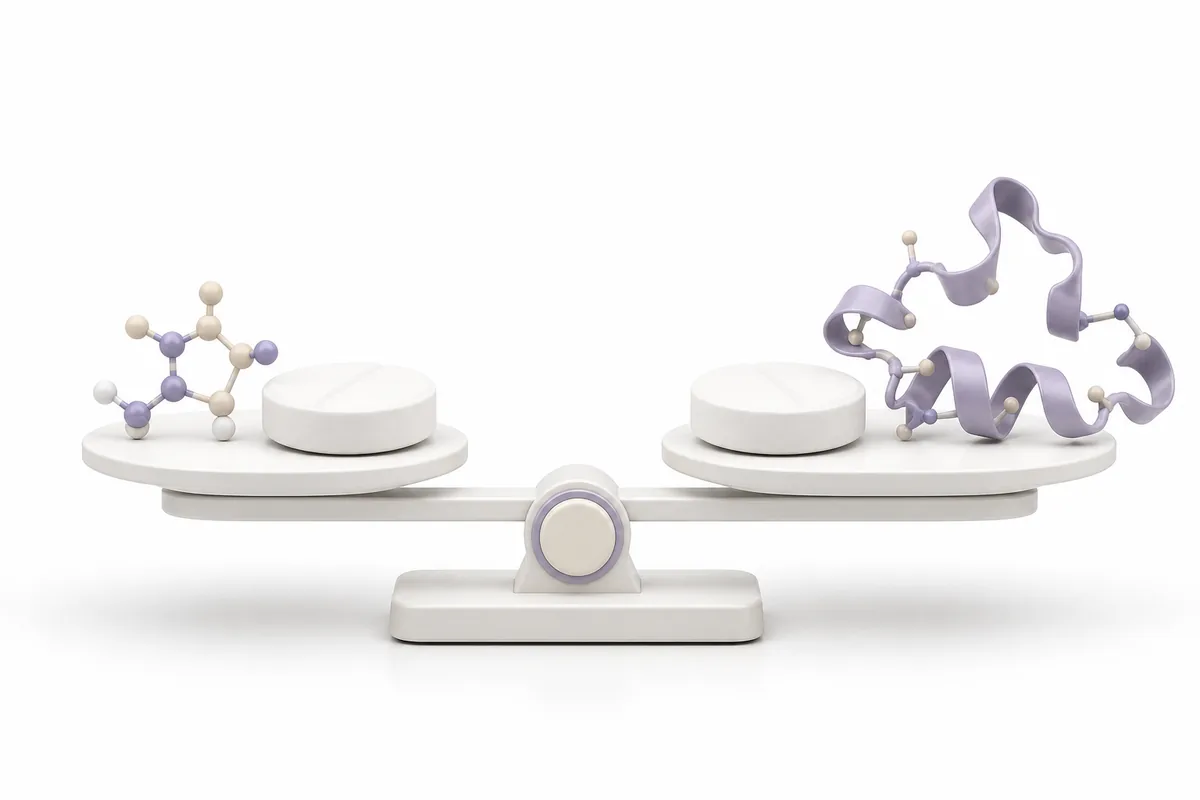
TL;DR: Orforglipron and oral semaglutide are both once-daily GLP-1 pills, but they are built from different kinds of matter. Oral semaglutide is the peptide semaglutide paired with an absorption enhancer called SNAC, taken fasted with minimal water. Orforglipron is a non-peptide small molecule that survives the stomach on its own, with no food or water restrictions. In the ACHIEVE-3 head-to-head trial in type 2 diabetes, orforglipron’s highest dose reduced HbA1c by about 2.2 percentage points and body weight by about 9.2%, versus roughly 1.4 points and 5.3% for oral semaglutide’s highest dose. Both are approved in at least one indication as of mid-2026.
Two pills, two different kinds of molecule
It is easy to lump “oral GLP-1” together as one category, but orforglipron and oral semaglutide solve the same problem — getting a GLP-1 receptor agonist past the stomach and into circulation — with fundamentally different chemistry.
Oral semaglutide is the same peptide used in injectable semaglutide, covered in our what is semaglutide overview, reformulated into a tablet. Peptides are chains of amino acids, and the stomach is built to digest exactly that kind of molecule. To survive the trip, oral semaglutide is co-formulated with SNAC (salcaprozate sodium), an absorption enhancer that locally raises gastric pH and eases the peptide across the stomach lining for a brief window after the tablet dissolves. Even with that assist, absolute bioavailability is low — generally cited in the sub-1% range — which is why the tablet dose is so much higher than the injectable dose. We walk through that arithmetic in detail in our oral vs injectable semaglutide piece, and the tablet’s regulatory path in our oral semaglutide (Wegovy pill) article.
Orforglipron is not a peptide at all. It is a non-peptide small molecule GLP-1 receptor agonist — chemically closer to a conventional tablet drug like a statin or an antihistamine than to a chain of amino acids. That structure is intrinsically stable in stomach acid, so orforglipron does not need an absorption enhancer, a fasting window, or a water limit to reach circulation intact. Our companion article, what is orforglipron, goes deeper on the molecule itself.
Side by side
The two molecules land in the same drug class and the same once-daily rhythm, but nearly everything under the hood differs.
| Factor | Orforglipron | Oral semaglutide |
|---|---|---|
| Molecule type | Non-peptide small molecule | Peptide + SNAC absorption enhancer |
| Route mechanism | Stable in stomach acid on its own | Depends on SNAC’s brief local pH shift |
| Dosing conditions | No food or water restrictions | Empty stomach, ≤120 mL water, 30-min wait before food or other oral meds |
| Frequency | Once daily | Once daily |
| Approx. half-life | Roughly 24 to 49 hours across doses studied | Roughly 1 week (as the semaglutide molecule itself) |
| ACHIEVE-3 HbA1c change (high dose) | About −2.2 points (36 mg) | About −1.4 points (14 mg) |
| ACHIEVE-3 weight change (high dose) | About −9.2% (36 mg) | About −5.3% (14 mg) |
| Approval status (mid-2026) | FDA-approved as Foundayo for obesity; type 2 diabetes filing pending | FDA-approved (Wegovy pill) for weight management; EMA CHMP positive opinion for the EU |
That table is the centerpiece of the comparison for a reason: the dosing-conditions row and the trial-results row are connected. A molecule that does not need a fragile absorption window is also a molecule that is easier to titrate, easier to take consistently, and — per ACHIEVE-3 — associated with a larger effect at its top dose in a head-to-head setting.
Why the chemistry class matters more than it sounds
This distinction is not a technicality. It explains, in one line, why one tablet comes with a strict morning ritual and the other does not. It also explains a quieter, practical angle the industry cares about: small molecules are generally made through standard chemical synthesis, which scales more predictably and cheaply than peptide manufacturing. That is not a claim that orforglipron will necessarily be cheaper to buy — pricing depends on far more than production cost — but it is a real reason manufacturers and health systems are watching non-peptide GLP-1 agonists closely as the class grows.
What ACHIEVE-3 actually measured
ACHIEVE-3 was a head-to-head trial in adults with type 2 diabetes, published in The Lancet, that randomized roughly 1,700 participants across four arms over 52 weeks: orforglipron at 12 mg and 36 mg, and oral semaglutide at 7 mg and 14 mg — doses in the range used for glycemic control rather than the 25 mg weight-management strength covered in our Wegovy pill article. At the matched high-dose comparison, orforglipron 36 mg reduced HbA1c by about 2.2 percentage points, versus about 1.4 points for oral semaglutide 14 mg. Body weight fell by about 9.2% on orforglipron 36 mg, versus about 5.3% on oral semaglutide 14 mg. At the lower dose tier, orforglipron 12 mg reduced HbA1c by about 1.9 points versus about 1.1 points for oral semaglutide 7 mg.
52-week head-to-head trial in type 2 diabetes, orforglipron 36 mg vs oral semaglutide 14 mg. Percentages and point changes are on different scales; shown together for reference.
The trial also tracked discontinuations due to adverse events, mostly gastrointestinal — nausea, diarrhea, vomiting, dyspepsia, decreased appetite — which occurred in both arms and rose somewhat with dose. This was one trial, in one population (adults with type 2 diabetes), over one duration. It tells you what happened in ACHIEVE-3, not a universal ranking that carries over to every dose, population, or outcome.
The dosing-ritual difference, day to day
Because oral semaglutide’s absorption depends on SNAC’s narrow window, the label asks for a specific sequence every morning: take it first, on an empty stomach, with no more than about 120 mL of plain water, then wait roughly 30 minutes before eating, drinking anything else, or taking other oral medication. Skip a step and the fraction of the dose that actually gets absorbed can shrink further.
Orforglipron carries none of that sequencing. Because it does not rely on a transient local pH shift to cross the gut wall, it can be taken with or without food, at any time of day, with any amount of water. For someone weighing which pill fits a given morning routine, that is a real, practical difference — separate from, and layered on top of, whatever the trial data shows about effect size.
Where each stands with regulators
As of mid-2026, both molecules have cleared at least one regulatory bar, though not the same one. Oral semaglutide’s 25 mg weight-management tablet — the Wegovy pill — is FDA-approved and holds a positive CHMP opinion recommending EU approval, detailed in our oral semaglutide (Wegovy pill) piece; a separate, lower-dose oral semaglutide product (Rybelsus) has long been approved for type 2 diabetes and is the version used in the ACHIEVE-3 comparison above. Orforglipron is FDA-approved under the brand name Foundayo for obesity, while Eli Lilly’s separate filing for a type 2 diabetes indication was still pending. Two molecules, two overlapping but distinct approval tracks — worth checking directly if a specific indication or region matters to you.
For a wider view of how these oral options sit next to the injectable incretins, our semaglutide vs tirzepatide vs retatrutide comparison covers the subcutaneous side of the same drug class.
Reading the comparison without a verdict
None of this is a case for one pill over the other. ACHIEVE-3 reports a larger HbA1c and weight change for orforglipron at matched high doses in one 52-week trial, in one population, and that is a specific, useful data point — not a universal ranking. The molecule-class difference is the more durable distinction: a small molecule that tolerates the stomach without help, versus a peptide that needs an enhancer and a ritual to get there. Which of those matters more depends on what you are optimizing for — a simpler daily routine, or a specific trial’s measured outcomes in a specific population.
Frequently asked questions
Is orforglipron a peptide like semaglutide?
No. Orforglipron is a non-peptide small molecule GLP-1 receptor agonist, chemically distinct from semaglutide, which is a peptide. That structural difference is why orforglipron does not need SNAC or a fasting window to survive the stomach, while oral semaglutide does.
Why does oral semaglutide need to be taken on an empty stomach and orforglipron does not?
Oral semaglutide depends on SNAC, an absorption enhancer that creates a brief, local pH shift right after the tablet dissolves. Food, extra water, or other pills taken too soon dilute that effect and reduce absorption. Orforglipron is a small molecule that is inherently stable in stomach acid, so it does not depend on that narrow window and carries no food or water restrictions.
What did the ACHIEVE-3 trial actually compare?
ACHIEVE-3 was a 52-week head-to-head trial in adults with type 2 diabetes, comparing orforglipron (12 mg and 36 mg) against oral semaglutide (7 mg and 14 mg). At the highest doses, orforglipron reduced HbA1c by about 2.2 percentage points and body weight by about 9.2%, versus about 1.4 points and 5.3% for oral semaglutide.
Is orforglipron approved for weight loss?
Yes. As of mid-2026, orforglipron is FDA-approved under the brand name Foundayo for adults with obesity or overweight with a weight-related condition. A separate filing for a type 2 diabetes indication was still under review at the same time.
Is oral semaglutide the same thing as Ozempic or Wegovy in pill form?
It is the same molecule, semaglutide, reformulated as a tablet rather than an injection. The 25 mg tablet (the Wegovy pill) is approved for weight management, while a separate, lower-dose oral semaglutide product, Rybelsus, is approved for type 2 diabetes — the version used in the ACHIEVE-3 comparison.
Why does the small-molecule vs peptide distinction matter beyond dosing rules?
Small molecules are generally sturdier against digestive enzymes and simpler to manufacture at scale through standard chemical synthesis, compared with the more complex production peptides require. That is part of why a non-peptide oral GLP-1 like orforglipron draws industry interest beyond its trial results — not a guarantee about eventual pricing, but a real structural reason the two classes are being watched differently.