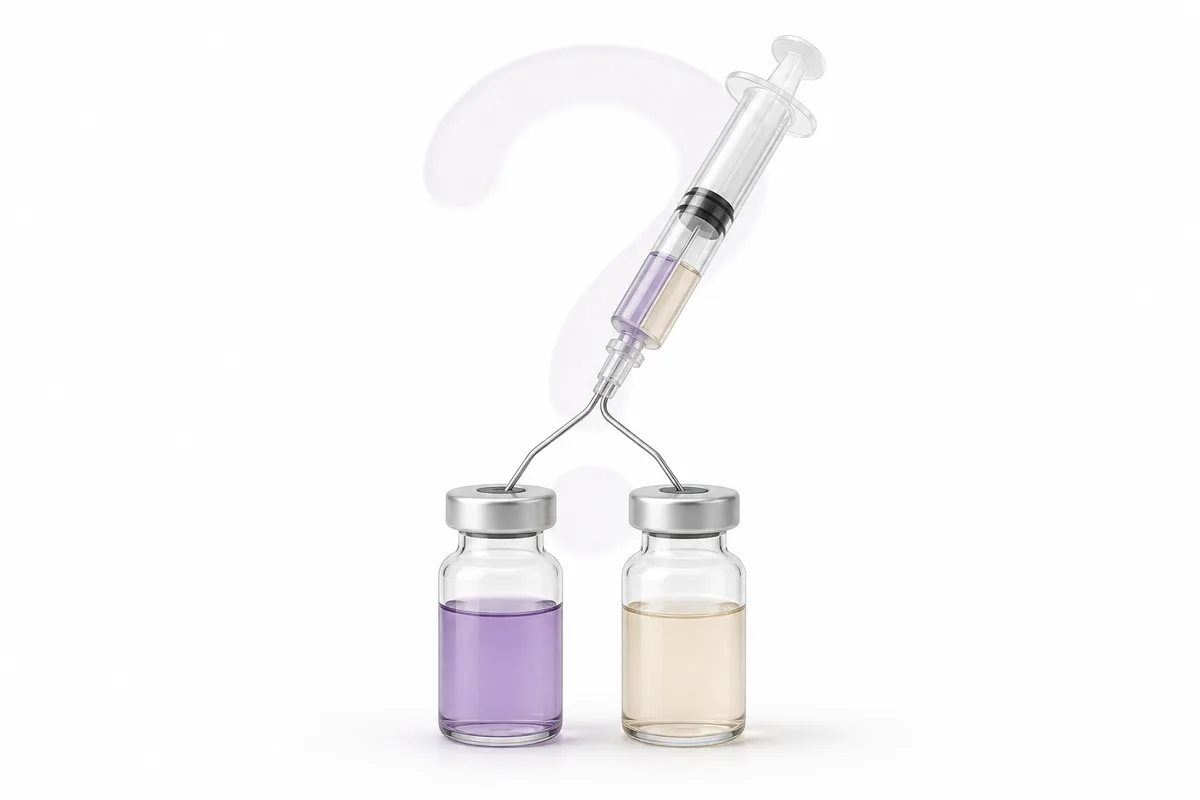
TL;DR: “Can I mix them?” is really three questions with three different answers. Drawing two compatible peptides into one syringe and injecting immediately is routine — contact time is measured in seconds. Co-reconstituting them in one shared vial is a different proposition, because they now sit together for weeks. And a pen cartridge is a shared vial by another name — the mixture is co-stored for as long as the cartridge lasts. Most of the confusion in the community comes from treating all three as the same question.
Somebody posts a photo of two vials and asks whether they can go in one barrel. Half the replies say “yes, people do CJC and Ipa in one shot all the time.” The other half say “no, you’ll degrade them.” Both replies are correct — they are just answering different questions. The variable nobody names is contact time.
The three cases, and why they are not the same question
Everything downstream follows from how long the two solutions are in contact with each other before the mixture leaves the picture.
| Case | Contact time | The honest default |
|---|---|---|
| Same syringe, injected promptly | Seconds to a minute | Commonly done for known-compatible class pairings |
| Same vial, co-reconstituted | Days to weeks | Don’t — unless it was formulated that way |
| Same pen cartridge | Two to three weeks | Same as a shared vial. Don’t. |
The first case is a transient mix. Two solutions meet in the barrel and are administered before any meaningful chemistry has time to happen. The second and third are co-storage, and co-storage is where peptides actually break down.
Case 1: one syringe, injected promptly
This is what most people mean when they ask the question, and it is the least fraught scenario. You reconstitute peptide A in its own vial and peptide B in its own vial, draw from each into the same insulin syringe, and inject. The two solutions coexist for under a minute.
The classic example is a GHRH analogue plus a GHRP — CJC-1295 with ipamorelin. This pairing is drawn together so routinely that the industry sells it pre-blended, which is a reasonable signal that the two tolerate each other’s company. Healing pairings like BPC-157 with TB-500 get the same treatment. If a combination already exists as a commercial blend, that is decent circumstantial evidence that a brief co-draw is unremarkable.
The practical logic researchers apply: if the alternative is two separate injections into the same site at the same moment, and the compounds are a well-established class pairing, combining them in one barrel is the common approach. It halves the punctures and the arithmetic is unchanged — see peptide blend dosing math for how to compute the per-compound units once two solutions share a barrel.
Case 2: one vial, co-reconstituted and stored
Here the calculus flips entirely. Once you reconstitute two separately-manufactured peptides into a single vial, they are roommates for however long that vial lasts — commonly two to four weeks in the fridge.
Three things now matter that did not matter in the syringe:
- pH. Every peptide has a pH window in which it is most stable. Two compounds whose optimal windows do not overlap will pull the shared solution somewhere neither of them likes, and prolonged exposure to the wrong pH accelerates hydrolysis and deamidation.
- Buffers and excipients. Lyophilised vials are not pure peptide. They carry buffers, bulking agents, and stabilisers chosen for that compound. Combine two and you get an unplanned formulation whose behaviour nobody has characterised.
- Degradation pathways. Breakdown products from one peptide become part of the chemical environment of the other. One compound can quietly accelerate the other’s decline.
The cleanest real-world illustration is NAD+ and MOTS-c. NAD+ is not a peptide at all, and it sits at a markedly different pH from most peptides in solution. Co-storing the two in one container is a well-known way to end up with a discoloured, degraded mixture — yellowing is a common report. That colour change is not cosmetic. It is a visible receipt that chemistry happened while you were not watching.
Case 3: the pen cartridge — the sleeper case
This is the one the community keeps getting wrong, and the reason is a category error: a pen looks like a delivery device, so people mentally file it with the syringe. It belongs with the vial.
A pen cartridge holds a multi-week supply. If you load two compounds into one cartridge, they are co-stored for the entire time it takes you to work through it — two to three weeks is typical. Every criterion from Case 2 applies in full. The device changes nothing about the chemistry; it only changes how the solution gets out.
So the rule is simple and worth stating plainly: if you would not co-reconstitute two peptides in one vial, do not put them in one pen cartridge. Use separate cartridges. Pens are cheap relative to the peptides in them, and our peptide injector pens guide covers running more than one device in parallel without confusing yourself.
Why commercial blends are a different animal
“But GLOW is three peptides in one vial” is the obvious objection, and it is worth answering carefully, because the answer is the crux of the whole article.
Pre-made blends — CJC-1295/ipamorelin, BPC-157/TB-500, GLOW and KLOW — are formulated and lyophilised together. The compatibility work was done upstream: the compounds were selected as a set, the buffer system was chosen for the combination, and they were freeze-dried as a single product. When you reconstitute a blend vial, you are hydrating a formulation, not improvising one.
That is categorically not the same as a researcher combining two separately-manufactured vials, each with its own buffer, its own excipients, and its own pH assumptions. The existence of a commercial CJC/Ipa blend tells you those two molecules can coexist in a properly designed formulation. It does not tell you that your CJC vial and your Ipa vial, from two different sources, will behave the same way when merged and left in a fridge for a month. See CJC-1295 and ipamorelin blends for how the pre-blended version differs from a self-assembled one.
GHK-Cu deserves its own paragraph
Copper peptides are a specific exception worth flagging. GHK-Cu is not just a peptide — it is a peptide-copper complex, and the copper is chemically active. A transition metal in solution is exactly the kind of thing that participates in oxidation reactions with whatever else is around.
That makes GHK-Cu a poor candidate for co-mixing generally, and a bad candidate for co-storage specifically. The conservative and common practice is to keep it in its own vial, its own syringe, and its own injection. It is one of the few cases where even the draw-and-inject scenario tends to get separated out.
The practical framework
Strip it down to two questions.
Are the compounds a known-compatible class pairing, and will they be injected within a minute of being drawn? Then combining them in one syringe is the common approach, and the main things to get right are the arithmetic and the technique — covered in injection best practices.
Are you contemplating co-storage, in a vial or a cartridge? Then the default is don’t. Not because it always fails, but because formal compatibility data for most of these pairings simply does not exist. Nobody has run a stability study on your two grey-market vials. Absent that data, the cost of being wrong (a silently degraded month of material) is much higher than the cost of being cautious (a second cartridge).
One last practical note that has nothing to do with chemistry: every additional puncture and transfer is another chance to introduce contamination. Drawing from two vials into one syringe means two stopper punctures instead of one. Swab both, use a fresh needle where the workflow allows, and keep the number of transfers to the minimum the protocol actually requires. Storage discipline does the rest — peptide storage covers the cold-chain side, and if something already looks wrong in the vial, reconstitution troubleshooting is the place to start.
Frequently asked questions
Can I draw two peptides into the same insulin syringe?
For a known-compatible class pairing — a GHRH analogue with a GHRP, or two healing peptides — drawing both into one barrel and injecting promptly is the common approach in research practice. The two solutions are in contact for well under a minute, which is not enough time for meaningful degradation chemistry. The arithmetic is the part that trips people up more often than the chemistry: each compound has its own concentration, so the units you draw from each vial are computed separately.
Is mixing in one syringe the same as mixing in one vial?
No, and conflating the two is the single most common mistake. A syringe mix lasts seconds. A vial mix lasts weeks. Co-storage is where differing pH optima, incompatible buffers, and cross-accelerated degradation actually have time to act. A pairing that is unremarkable in a barrel can be a genuinely bad idea in a shared vial, so the two scenarios need separate answers.
Can I put two peptides in one pen cartridge?
Treat a pen cartridge as a shared vial, because that is what it is. The mixture sits together for the two to three weeks it takes to work through the cartridge, which puts it squarely in the co-storage category. The default answer is to use separate cartridges. The pen is a delivery mechanism, not a chemistry-free zone, and loading it does not change how the solution behaves during storage.
Why can NAD+ and MOTS-c not share a pen?
NAD+ is not a peptide and sits at a markedly different pH from most peptides in solution. Held together in one container over weeks, the mismatch drives degradation, and the usual visible outcome is a yellowed, discoloured mixture. Discolouration is the tell: it means chemistry occurred during storage. Whether or not that specific pairing behaves this way in your hands, it illustrates the general principle that pH incompatibility only bites over time.
If commercial blends exist, why can’t I make my own?
Commercial blends are formulated and lyophilised together, with the buffer system and the compatibility worked out before the vial was ever filled. Combining two separately-manufactured vials produces an improvised formulation with two buffer systems and no stability data behind it. The existence of a CJC/Ipa blend proves those molecules can coexist in a designed formulation — it does not prove that any two vials of them will coexist in your fridge.
Research use only. This article discusses the physical and chemical compatibility of research compounds in laboratory contexts. It is not medical advice and does not recommend any dose, protocol, or human use.