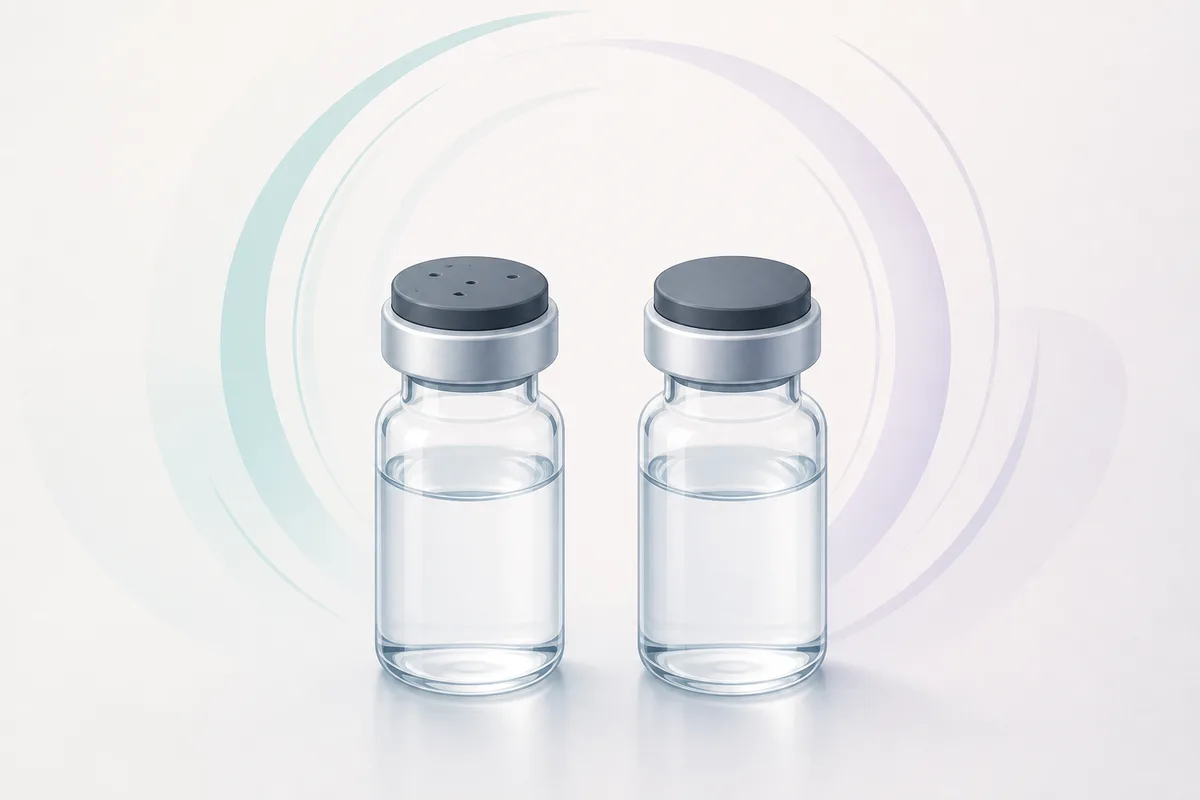
TL;DR: Both diluents arrive sterile. Only one stays usable after you puncture it. Bacteriostatic water carries 0.9% benzyl alcohol, which suppresses regrowth between entries and supports roughly a 28-day in-use window; sterile water has no preservative and is a single-use container. That single difference is a hard ceiling on doses per vial: a 10 mg vial that yields 40 paper doses at 250 mcg only delivers 28 of them on a daily cadence before the window closes. Run your own numbers through the reconstitution calculator and read the ceiling off the cadence, not the label.
Sterile is a starting condition, preserved is a duration
The mistake almost everyone makes is treating “sterile” and “bacteriostatic” as two grades of the same thing. They are not on the same axis at all.
Sterile Water for Injection is exactly what the name says: water, purified, sterilised, nonpyrogenic, with no antimicrobial agent whatsoever. Its own label is blunt about this — it is described as hypotonic and hemolytic, to be made approximately isotonic before injection, and it ships as a single-dose container. The sterility describes the state of the water at the moment the seal is intact. It says nothing about minute two.
Bacteriostatic Water for Injection is the same water plus 9 mg/mL of benzyl alcohol. Benzyl alcohol is bacteriostatic rather than bactericidal — it inhibits growth and reproduction rather than killing on contact. That is enough. The realistic contamination event during repeated entry is a handful of organisms carried in on a needle, and a few organisms that cannot multiply are a very different problem from a few organisms that double every twenty minutes. The label calls it a multiple-dose container from which repeated withdrawals may be made.
So the honest framing is: sterile water gives you a clean start. BAC water gives you a clock.
Where the 28 days actually comes from
The number is not a marketing round figure, and it is not arbitrary. It falls out of two places at once.
The first is pharmacopoeial preservative testing. European Pharmacopoeia chapter 5.1.3, Efficacy of Antimicrobial Preservation, challenges a preserved parenteral preparation with a defined inoculum and reads it at fixed intervals — 6 hours, 24 hours, 7 days, 14 days, and 28 days. The A criteria for bacteria in parenteral preparations require a 2-log reduction at 6 hours, 3-log at 24 hours, and no recovery at 28 days. 28 days is the last read point. The test simply does not make a claim past it, so neither does anyone else.
The second is compounding practice. USP General Chapter 797 assigns multiple-dose containers a beyond-use date of 28 days after initial entry unless the manufacturer specifies otherwise, and single-dose containers get hours, not days — 6 hours if opened in ISO Class 5 air, 1 hour if opened in anything worse.
Worth noting how modest real-world contamination actually is when technique is decent. Mattner and Gastmeier collected every multiple-dose vial in use on a single day in a 1300-bed German hospital and found 1 contaminated vial out of 227 — a 0.9% prevalence. The preservative is doing quiet, unglamorous work.
The arithmetic: cadence sets the ceiling, not vial size
Here is the part that people skip. You have two independent limits on how many doses come out of a vial, and the binding one is whichever is smaller:
usable doses = min( vial doses available , in-use days ÷ dosing interval )
The first term is the mass arithmetic everyone already does. The second term is the calendar. If your cadence is slow, the calendar wins and the leftover peptide gets binned.
Calendar ceiling only. Mass in the vial may cut it lower, but never higher.
Work a real vial. A 10 mg vial reconstituted with 2 mL of BAC water gives 5 mg/mL, so 50 mcg per unit on a U-100 syringe.
- 250 mcg daily. 250 ÷ 50 = 5 units per draw, 0.05 mL. Mass says 10 mg ÷ 0.25 mg = 40 doses. Calendar says 28 ÷ 1 = 28 doses. The calendar binds. You deliver 7 mg and discard 3 mg — 30% of the vial.
- 500 mcg every other day. 10 units per draw. Mass gives 20 doses; calendar gives 14. You deliver 7 mg, discard 3 mg. Same 30% loss, different route.
- 2 mg weekly. 40 units per draw. Mass gives 5 doses; calendar gives 4. Loss here is one dose, 2 mg — 20%, and it is mass that nearly binds.
The pattern is unintuitive: small, frequent doses out of a large vial are where the in-use window costs you most. The vial is sized for a total milligram load, but the window is denominated in days, and slow cadences with small draws simply run out of days first.
Cost per delivered dose, not per paper dose
Once you accept the calendar ceiling, the price arithmetic changes. Take that 10 mg vial at, say, €90.
- Paper maths: €90 ÷ 40 doses = €2.25 per dose
- Calendar maths: €90 ÷ 28 delivered doses = €3.21 per dose
That is a 43% increase, and it is invisible if you only ever divide price by label milligrams. It is also compounding on top of the losses you already have from overfill variance and syringe dead space, which are covered separately in how many doses are really in a 10mg vial. Stack a 30% calendar loss on a 10% dead-space loss and the delivered-dose cost drifts a long way from the sticker.
The fix is not more water or less water — concentration does not move either term in the equation. The fix is vial sizing. For 250 mcg daily, a 5 mg vial delivers 20 doses in 20 days and lands entirely inside the window with nothing discarded. Two 5 mg vials beat one 10 mg vial for that protocol even at a small per-mg price premium. This is where agua bacteriostática planning quietly becomes a purchasing decision rather than a technique decision.
Two clocks, not one
A detail that catches people: the BAC water vial has its own 28-day window, independent of the peptide you reconstituted with it.
Buy a 30 mL multiple-dose BAC vial, puncture it on day 1 to reconstitute a peptide, and that 30 mL is on the clock from that first entry — even if you only drew 2 mL. Come back on day 40 to reconstitute the next vial and you are drawing from expired diluent into fresh peptide. The peptide inherits the problem.
So the practical sequencing is:
- Date the BAC vial on first puncture. Not the day you bought it — the day you entered it.
- Date each reconstituted peptide vial on its first puncture, separately.
- Match diluent vial size to how fast you actually get through it. A 10 mL bakteriostatisches Wasser vial you will use twice is worse value than a 3 mL vial you finish.
When sterile water is genuinely the right call
There are real cases for it, and pretending otherwise is silly.
Single-session use. If a vial will be fully drawn in one sitting, the preservative buys nothing. Sterile water is the cleaner choice because it adds no excipient.
Benzyl-alcohol-sensitive material. Benzyl alcohol is not chemically inert toward proteins. It is the most widely used preservative in multidose protein formulations precisely because it usually behaves, but it induces aggregation in a concentration-dependent way by driving partial unfolding — documented for interferon α-2a by Bis and colleagues, and for chymotrypsinogen in work by Rodríguez-Martínez on PEGylation as a countermeasure. For small, robust peptides this is largely academic. For larger or aggregation-prone material it is a real consideration, and manufacturer guidance sometimes specifies sterile water or a dedicated solvent for exactly this reason.
Where evidence is thin, say so. There is very little published in-use stability data for research peptides specifically reconstituted in bacteriostatic water. The 28-day figure is inherited from preservative-efficacy testing and general compounding practice, not from a study of your compound in your vial. Treat it as the outer bound of a range whose inner bound you do not know.
The trade-off is stark in dose terms. That same 10 mg vial at 250 mcg daily, reconstituted with sterile water, is a single-session container. You get one dose, or you get whatever you can draw in one sitting, and 9.75 mg goes in the bin. That is the entire argument for eau bactériostatique in one line.
Choosing water volume with the window in mind
Concentration does not change your calendar ceiling — but it does change how gracefully you hit it. A few practical consequences:
- Do not over-dilute a vial you will not finish. More water means more draws to exhaust the vial, which pushes you further past day 28. If the calendar is binding, dilute less and dose in fewer, larger draws where the protocol allows.
- Do not under-dilute to the point of unreadable draws. A 2-unit draw on a U-100 barrel has terrible resolution. The ratio logic for picking a workable concentration is worked through in BAC water ratios and common mistakes, and the reconstitution chart gives you the standard volumes at a glance.
- Plan the whole vial before you add the first millilitre. Total doses, cadence, days elapsed. If days exceed 28, you have already decided to discard something — decide it deliberately rather than discovering it in week five.
The calculator handles the mg/mL and units side; the calendar side is a subtraction you do once and write on the cap.
Frequently Asked Questions
How long is bacteriostatic water good for after opening?
The conventional in-use window is 28 days from first puncture, stored refrigerated. That figure comes from preservative-efficacy testing, which reads out at 28 days as its final time point, and from compounding standards that assign multiple-dose containers a 28-day beyond-use date. It describes the preservative, not the peptide dissolved in it.
Can I use sterile water instead of bacteriostatic water for peptides?
You can, but the container becomes effectively single-use — no preservative means no protection against organisms introduced on a subsequent entry. For a vial you will finish in one session that is fine. For anything you intend to draw from repeatedly over days or weeks, it wastes most of the vial.
Does the 28-day limit apply to the peptide or the water?
Both, separately, and each from its own first puncture. The diluent vial starts its clock when you first enter it; the reconstituted peptide vial starts a fresh clock when you enter that. If the two disagree, the earlier close date governs the material you are actually injecting.
Why do I lose doses from a big vial on a slow schedule?
Because two ceilings apply and the lower one wins: total milligrams available, and in-use days divided by dosing interval. A 10 mg vial at 250 mcg daily has 40 doses of mass but only 28 days of window, so 3 mg is stranded. Smaller vials often deliver more usable doses per euro.
Does benzyl alcohol damage peptides?
Usually not at 0.9%, which is why it is the standard preservative in multidose protein products. But it is not inert — it promotes partial unfolding and concentration-dependent aggregation in some proteins. For small peptides this rarely matters; for larger or aggregation-prone material, follow whatever solvent the manufacturer specifies.
Can I extend the window by freezing the reconstituted vial?
Freezing is a different question from preservation, and the evidence for reconstituted research peptides is thin. Freeze-thaw cycling adds its own degradation pathway, and benzyl alcohol behaviour on thaw is not well characterised at this scale. Aliquoting before freezing is the usual approach, but treat any extension as unverified.
References
- European Pharmacopoeia, General Chapter 5.1.3, Efficacy of Antimicrobial Preservation. Criteria for parenteral and ophthalmic preparations; read points at 6 h, 24 h, 7 d, 14 d and 28 d.
- United States Pharmacopeia, General Chapter <797> Pharmaceutical Compounding — Sterile Preparations. Beyond-use dating for single-dose and multiple-dose containers after initial entry.
- Bacteriostatic Water for Injection, USP — manufacturer prescribing information (Hospira/Pfizer), DailyMed. Composition: 0.9% (9 mg/mL) benzyl alcohol; multiple-dose container designation; pH 5.7 (4.5-7.0).
- Sterile Water for Injection, USP — manufacturer prescribing information, DailyMed. Single-dose container; contains no bacteriostatic or antimicrobial agent; hypotonic and hemolytic without added solute.
- Mattner F, Gastmeier P. “Bacterial contamination of multiple-dose vials: a prevalence study.” American Journal of Infection Control, 2004;32(1):12-16.
- Bis RL, Singh SM, Cabello-Villegas J, Mallela KMG. “Role of benzyl alcohol in the unfolding and aggregation of interferon α-2a.” Journal of Pharmaceutical Sciences, 2015;104(2):407-415. doi:10.1002/jps.24105.
- Rodríguez-Martínez JA, Rivera-Rivera I, Griebenow K. “Prevention of benzyl alcohol-induced aggregation of chymotrypsinogen by PEGylation.” Journal of Pharmacy and Pharmacology, 2011;63(6):800-805. doi:10.1111/j.2042-7158.2011.01288.x.
- Centers for Disease Control and Prevention. Injection Safety: Questions about Multi-dose Vials. Aseptic technique requirements are not relaxed by the presence of a preservative.
This article is a research and educational reference only; the compounds and diluents discussed are not for human consumption and nothing here is medical advice.