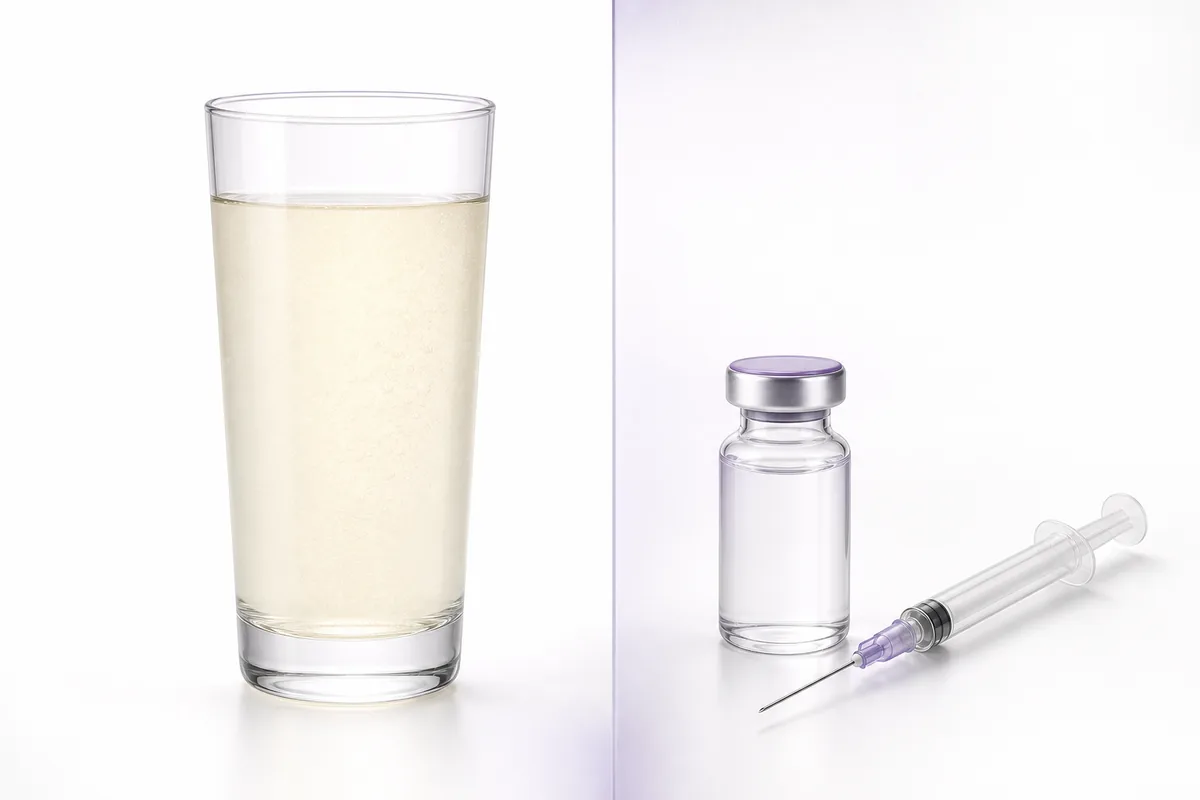
TL;DR: “Collagen peptides” and “research peptides” are two completely different categories that happen to share a word. Collagen peptides are hydrolyzed animal protein — a food ingredient you stir into coffee, dosed in grams, GRAS-listed under the FDA. Research peptides are synthetic, sequence-specific compounds — dosed in micrograms to milligrams, usually reconstituted and studied, sold for a different purpose entirely. Neither is better; they’re not even the same kind of thing.
Same word, two different worlds
If you searched “collagen peptides” and landed here expecting BPC-157 or GHK-Cu, you’re not lost — you just met the most confusing naming collision in the supplement-and-research world. Walk into any grocery store and “collagen peptides” is a tub of white powder you scoop into your morning coffee. Read a research forum and “peptides” means something reconstituted with bacteriostatic water and injected in microgram doses. Both are real. Both use the word “peptide” correctly. They are not the same category of anything.
The reason both get to claim the word honestly is that “peptide” just means a chain of amino acids linked by peptide bonds — nothing more specific than that. A dipeptide of two amino acids and a fragment of forty both qualify. Collagen hydrolysate is peptides. Semaglutide is a peptide. Insulin is a peptide. So is nearly every hormone your body makes. The word describes a chemical structure, not a use case, a dose, a route of administration, or a regulatory category — and those are exactly the things that differ completely between the drinkable kind and the research kind.
What drinkable collagen peptides actually are
Collagen peptides — also labeled hydrolyzed collagen or collagen hydrolysate on ingredient panels — start as intact collagen from an animal source: bovine hide, marine (fish skin and scale), porcine, or chicken cartilage. Manufacturers break that long structural protein down enzymatically, cutting it into short peptide fragments small enough to dissolve completely in water, coffee, or a smoothie and to be absorbed after you swallow them.
That’s the entire pitch: a food-grade protein source, taken by mouth, in gram-scale doses (typically 2.5 to 15 grams a day in the studies below), sold as a dietary supplement. In the United States it carries GRAS status — Generally Recognized As Safe — and is regulated under DSHEA, the same framework covering most vitamins and protein powders. Nobody reconstitutes it from a lyophilized vial, nobody injects it, and nobody needs a peptide calculator to dose it. You scoop, you stir, you drink it.
What research peptides are
The research peptides this site otherwise covers are a different animal entirely. Compounds like BPC-157 or GHK-Cu are synthetic and sequence-specific — built to match or mimic a precise amino-acid sequence that binds a particular receptor or signaling pathway. They’re supplied as lyophilized powder, reconstituted with bacteriostatic water, and dosed at a scale collagen never touches: micrograms to low milligrams, not grams. Most are injected subcutaneously rather than swallowed, specifically because oral peptide bonds get shredded by digestive enzymes before they’d ever reach a target receptor intact. They’re sold for research use, not as a food or a DSHEA-regulated supplement, and the whole point is receptor-level precision rather than nutritional bulk. If any of that vocabulary is new, our beginner’s guide to peptide research covers the handling and dosing basics from the ground up, and peptide dosing 101 walks through the concentration math these microgram doses require.
Side by side
Put the two categories in one table and the gap stops being about semantics and starts being about basic facts of use.
| Collagen peptides (drinkable) | Research peptides | |
|---|---|---|
| Source | Hydrolyzed animal collagen (bovine, marine, porcine, chicken) | Synthetic, lab-made to a specific amino-acid sequence |
| Typical dose | 2.5-15 grams per day | Micrograms to low milligrams |
| Route | Oral — mixed into a drink | Usually reconstituted and injected subcutaneously |
| Regulatory status | GRAS, regulated as a food/dietary supplement under DSHEA | Sold for research use, not a food or approved drug |
| Job | Structural protein / amino-acid and signaling-fragment source | Receptor-specific signaling — targeted biological effect |
Nothing in that table overlaps. That’s the whole disambiguation in one place: same root word, unrelated categories of product.
What the collagen evidence actually shows
Because the two get confused, it’s worth being precise about what drinkable collagen peptides are actually shown to do — no more, no less. A 2023 systematic review and meta-analysis published in Nutrients pooled 26 randomized controlled trials with a combined 1,721 participants, testing oral hydrolyzed collagen against placebo over supplementation periods ranging from 2 to 12 weeks. Across the studies that measured it, collagen supplementation produced a statistically significant improvement in skin hydration (pooled effect size 0.63, Z = 4.94, p < 0.00001) and in skin elasticity (pooled effect size 0.72, Z = 4.49, p < 0.00001) compared with placebo.
Pooled standardized mean difference, hydrolyzed collagen vs placebo. Nutrients, 2023 (26 RCTs, n=1,721).
The joint and cartilage side of the collagen literature points the same direction — less independently replicated, but directionally positive across the smaller trial base that exists. Worth naming honestly, though: “the collagen you drink becomes the collagen in your skin” is a simplification of what’s actually happening. Swallowed collagen doesn’t survive digestion as an intact structural molecule — it’s broken down like any other protein. What the hydrolysis process yields, and what shows up in blood after you drink it, are small di- and tripeptides such as prolyl-hydroxyproline. The working theory is that these fragments act partly as a signal that nudges dermal fibroblasts to synthesize more of their own collagen, and partly as plain amino-acid substrate for that synthesis — not that a scoop of powder gets bricklaid directly into your skin. It’s a real, measured effect on hydration and elasticity over about three months; it’s just a different mechanism than the marketing shorthand implies.
Why the mix-up happens (and where GHK-Cu fits)
Part of the confusion is pure vocabulary — “peptide” sounds technical and specific, so it’s easy to assume every product using it belongs to one category. Part of it is that collagen genuinely does show up on both sides of this site’s coverage, just via a different route. GHK-Cu, a copper-binding tripeptide studied for skin and wound-healing research, is itself a fragment that occurs naturally in the process of collagen breakdown and remodeling — which is a real biochemical connection, but it doesn’t make injectable GHK-Cu and a tub of drinkable collagen powder the same product. One is a specific three-amino-acid signaling peptide investigated at the research level; the other is a bulk hydrolyzed protein you drink for nutritional and dermal support. They share a family resemblance in the collagen story, not a category.
If you’re sourcing either kind of product, the fundamentals of vetting a seller still apply — ingredient sourcing claims, third-party testing, and clear labeling matter whether you’re buying a collagen tub or a research vial. Our guide to vetting a peptide vendor covers the checklist either way.
Which one is the right tool
This isn’t a competition, because they’re not solving the same problem. If the goal is a food-based nutritional habit — supporting skin hydration and elasticity, or adding a collagen protein source to your diet — drinkable hydrolyzed collagen is the category built for that, backed by a meaningful and growing trial base at a low-risk, food-grade dose. If the goal is investigating a specific biological pathway with a receptor-targeted compound, that’s the research-peptide side of this site, an entirely different scale of dosing, handling, and purpose. Confusing the two doesn’t make either one work better — it just means reading the wrong article for what you’re trying to do, which is precisely the mix-up this piece exists to clear up.
Frequently asked questions
Are collagen peptides the same as the peptides used in research?
No. They share the word “peptide” because both are chains of amino acids, but that’s where the overlap ends. Collagen peptides are hydrolyzed animal protein taken orally in gram doses as a food-grade supplement; research peptides like BPC-157 or GHK-Cu are synthetic, sequence-specific compounds dosed in micrograms to milligrams, typically reconstituted and injected for research purposes.
What exactly are collagen peptides made from?
They’re produced by enzymatically breaking down intact collagen — sourced from bovine hide, marine fish skin and scale, porcine, or chicken cartilage — into short peptide fragments small enough to dissolve in water and be absorbed after oral intake. This process is often labeled hydrolyzed collagen or collagen hydrolysate on packaging.
Does drinking collagen peptides actually do anything for skin?
A 2023 meta-analysis of 26 randomized trials (n=1,721) found statistically significant improvements in skin hydration and elasticity versus placebo after 2 to 12 weeks of oral hydrolyzed collagen. The mechanism isn’t collagen being rebuilt directly into skin — it’s broken down into small peptide fragments that appear to signal fibroblasts and supply amino-acid substrate for the body’s own collagen synthesis.
Is hydrolyzed collagen regulated the same way as research peptides?
No. Hydrolyzed collagen holds GRAS (Generally Recognized As Safe) status and is regulated as a food ingredient and dietary supplement under DSHEA. Research peptides are sold under an entirely different framework — as research-use compounds, not as an approved food, drug, or supplement category.
Why do collagen peptides and research peptides get confused so often?
Mostly vocabulary: “peptide” is a precise chemistry term that just means a short amino-acid chain, and it doesn’t specify dose, source, or intended use. Search interest in drinkable collagen has grown quickly, and shoppers land on peptide-related content expecting one category while finding the other.
Should I take collagen peptides, research peptides, or both?
That depends entirely on the goal, not on which is “better.” Drinkable collagen peptides are a food-based nutritional tool aimed at skin and joint support; research peptides are precision compounds studied for specific receptor-level effects, covered in depth in our beginner’s guide to peptide research. They’re not substitutes for one another, so the useful question is which category actually matches what you’re trying to investigate.
References
- Effects of Oral Collagen for Skin Anti-Aging: A Systematic Review and Meta-Analysis. Nutrients. 2023;15(9):2080.
- GRAS Notice for Hydrolyzed Collagen / Peptones. U.S. Food and Drug Administration, 21 CFR 184.1553.