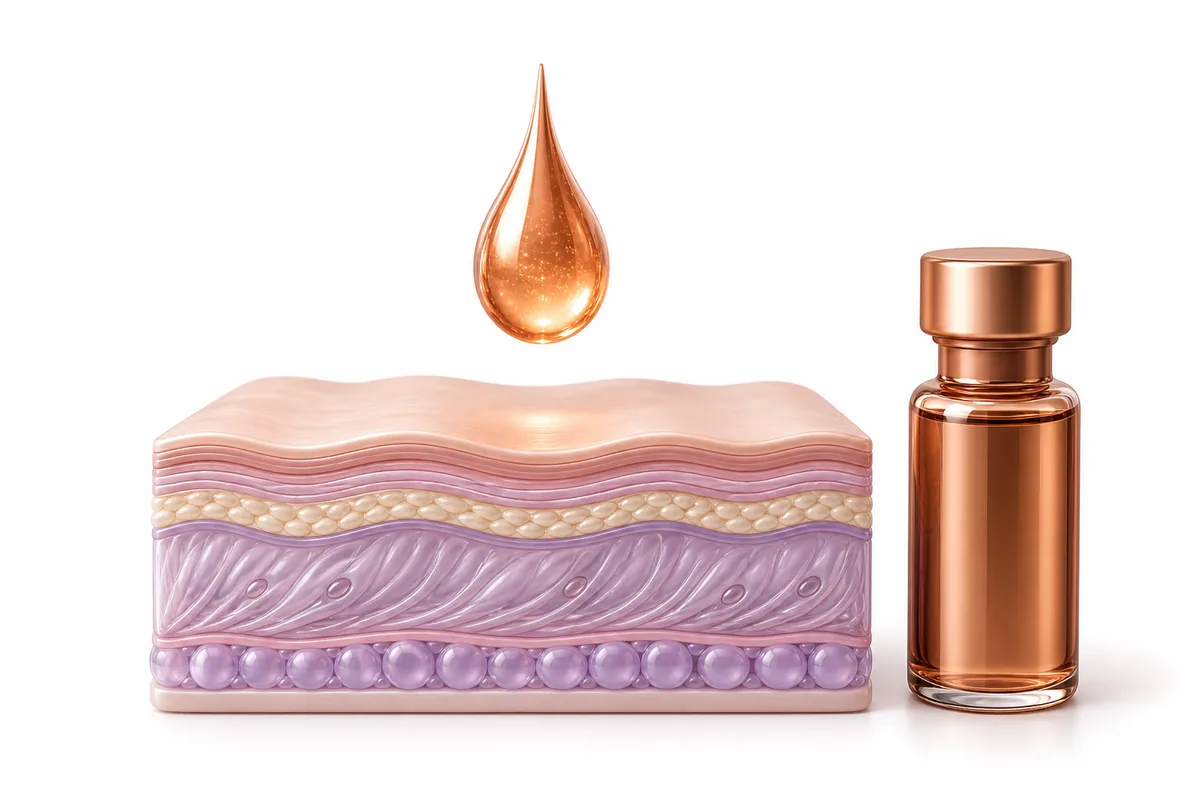
GHK-Cu — the copper complex of the tripeptide glycyl-L-histidyl-L-lysine (GHK) — is one of the longest-studied naturally occurring peptides in skin-biology research. First identified in human plasma decades ago, it has since become a recurring subject in preclinical and cosmetic-science literature exploring collagen turnover, antioxidant signaling, and tissue remodeling. This article summarizes what the research literature actually says, with an emphasis on separating well-documented laboratory findings from areas that remain preclinical or exploratory. Everything below is intended for research and educational purposes only.
What is GHK-Cu?
GHK is a tripeptide composed of three amino acids — glycine, histidine, and lysine — that occurs naturally in human plasma, saliva, and urine. It has a strong, specific affinity for copper(II) ions, and the resulting complex, GHK-Cu, is the form most often studied in laboratory and cosmetic-science contexts. Researchers first isolated GHK from human plasma and noted that its concentration appears to decline with age, which helped motivate decades of investigation into its biological roles in tissue maintenance and repair.
Because GHK-Cu is a small, water-soluble, copper-binding molecule, it has been studied both as a signaling peptide affecting cell behavior and as a delivery vehicle for bioavailable copper, an essential cofactor for several enzymes involved in connective-tissue formation.
Mechanism of Action
Copper delivery and enzyme cofactor activity
Copper is required for the activity of lysyl oxidase, an enzyme that cross-links collagen and elastin fibers, and for superoxide dismutase, an antioxidant enzyme. By binding copper in a stable, bioavailable complex, GHK-Cu is thought to support these copper-dependent processes more efficiently than free copper ions, which can be pro-oxidant and poorly tolerated by cells at higher concentrations.
Fibroblast signaling and extracellular matrix remodeling
In vitro and animal studies have reported that GHK-Cu can stimulate dermal fibroblasts — the cells responsible for producing collagen, elastin, and glycosaminoglycans (GAGs) — and can influence the balance between matrix synthesis and matrix-degrading enzymes (matrix metalloproteinases). This dual action, supporting new matrix production while helping regulate its breakdown, is central to the “remodeling” framing used throughout the literature.
Broad gene-expression effects
Later work using large-scale gene-expression datasets (the Broad Institute’s Connectivity Map) reported that GHK exposure was associated with expression changes across thousands of assayed human genes, with clusters implicated in DNA repair, antioxidant defense, anti-inflammatory signaling, and tissue remodeling. This kind of systems-level analysis is exploratory and correlational — it identifies patterns worth further mechanistic study rather than establishing a single, confirmed causal pathway.
Antioxidant and anti-inflammatory activity
Preclinical studies also describe antioxidant properties for GHK-Cu, including modulation of inflammatory signaling molecules in cell and tissue models. These properties are frequently cited as complementary to its proposed roles in wound-repair and skin-aging research, though — as with most peptide research — the majority of this evidence remains at the cell-culture and animal-model stage rather than large controlled human trials.
Research Background and Key Findings
The foundational and most-cited work in this space comes from Loren Pickart and colleagues, whose reviews remain the anchor references for GHK-Cu research:
- 1
2015 — Pickart et al.
BioMed Research International review on GHK modulating collagen, elastin, and GAG synthesis pathways in skin regeneration.
- 2
2018 — Pickart & Margolina
Int. J. Molecular Sciences review linking GHK gene-expression data to tissue remodeling and antioxidant defense.
- 3
2025 — Adnan et al.
Comprehensive tripeptide review covering GHK-Cu in wound healing, inflammation, and angiogenesis.
- 4
2025 — Ogórek et al.
Molecules study on liposome-encapsulated GHK-Cu and measuring its skin permeation.
- Pickart and Margolina’s 2018 review in International Journal of Molecular Sciences summarizes gene-expression data suggesting GHK influences pathways related to tissue remodeling, antioxidant defense, and cell protection, and discusses its potential relevance to skin and connective-tissue regeneration (Pickart & Margolina, 2018).
- An earlier 2015 review by Pickart, Vasquez-Soltero, and Margolina in BioMed Research International details how GHK modulates multiple cellular pathways implicated in skin regeneration, including collagen, elastin, and GAG synthesis by dermal fibroblasts (Pickart et al., 2015).
More recent literature situates GHK-Cu within the broader class of tripeptides studied for wound healing:
- A 2025 comprehensive review by Adnan, Maarof, Fauzi, and Md Fadilah in the International Journal of Medical Sciences surveys tripeptides — including GHK-Cu — in wound healing and skin regeneration, noting that topical copper-bound GHK has been investigated for effects on skin repair, inflammation, and angiogenesis, while emphasizing that many specific applications remain at an investigational stage (Adnan et al., 2025).
- A 2025 analytical study by Ogórek and colleagues in Molecules examined liposome-encapsulated GHK-Cu and the methodological challenges of measuring its skin permeation, reflecting ongoing interest in optimizing topical delivery formats for cosmetic and preclinical research (Ogórek et al., 2025).
Taken together, this literature supports GHK-Cu as a well-characterized research peptide with plausible, mechanistically grounded roles in collagen and GAG synthesis, antioxidant defense, and wound-repair signaling — while underscoring that robust, large-scale controlled human clinical data remain limited compared with the extensive preclinical and cosmetic-formulation literature. For a comparison with another widely studied repair-focused peptide, see our article on BPC-157.
Forms, Reconstitution & Handling
In research settings, GHK-Cu is typically supplied as a lyophilized (freeze-dried) powder in sealed vials, such as the 50mg or 100mg formats. As with most lyophilized peptides, it requires careful reconstitution with an appropriate diluent (commonly bacteriostatic water) before use in cell-culture or animal-model work. Because GHK-Cu carries a visible blue-violet color from its copper complex, researchers can often use color consistency as a rough visual check that the compound has been reconstituted and stored appropriately — a faded or discolored solution may indicate degradation.
Our general peptide reconstitution guide walks through calculating dilution volumes, mixing technique, and vial labeling practices that apply broadly across lyophilized research peptides, including GHK-Cu.
Research Considerations
Any protocol involving GHK-Cu in a laboratory setting should account for a few generic considerations that apply to copper-peptide handling:
- Concentration accuracy — Because the peptide’s biological activity is closely tied to its copper-binding stoichiometry, precise measurement and consistent reconstitution practices matter more than for many non-metal-binding peptides.
- Solution stability — Copper complexes can be sensitive to light and oxidation over time; researchers commonly note visible color as an informal integrity indicator.
- Model selection — Much of the existing literature relies on in vitro fibroblast or keratinocyte cultures and animal wound models; findings from these systems should not be extrapolated to human outcomes without appropriate further study.
- Documentation — As with any research peptide, batch, lot, and handling records support reproducibility across experiments.
These are general laboratory-practice notes, not instructions for human use.
Storage & Stability
Lyophilized GHK-Cu is generally reported to be relatively stable when stored correctly:
- Lyophilized (powder) form: Store frozen (around −20°C), protected from light and moisture, in a tightly sealed vial.
- Reconstituted solution: Refrigerate (2–8°C) and use within the timeframe recommended for the specific preparation; avoid repeated freeze–thaw cycles, which can degrade peptide integrity.
- Light sensitivity: Because the copper complex can be light-sensitive, amber vials or storage away from direct light are common practice in laboratory settings.
Consult our peptide reconstitution guide for more detail on general handling and storage practices for lyophilized peptides.
Safety, Legality & Research Disclaimers
GHK-Cu is not an approved drug for the treatment, cure, or prevention of any disease, and none of the information in this article should be interpreted as medical advice or a recommendation for human use. GHK-Cu does appear as an ingredient in some over-the-counter cosmetic formulations in certain jurisdictions, which is a distinct regulatory category from the research-grade material discussed here; regulatory status varies by country and can change over time.
Anyone conducting research involving GHK-Cu is responsible for confirming its current legal status in their jurisdiction and for complying with their institution’s ethics, biosafety, and research-governance requirements. Material intended for laboratory research should never be applied, injected, or otherwise administered to humans or animals outside of a properly approved research protocol.
Frequently Asked Questions
What is GHK-Cu, in simple terms? GHK-Cu is a naturally occurring copper complex of a small tripeptide (glycyl-L-histidyl-L-lysine) found in the human body. It has been studied for decades in laboratory contexts related to skin biology, connective-tissue remodeling, and antioxidant defense.
Is GHK-Cu the same as BPC-157? No. They are structurally and functionally distinct peptides studied in overlapping “healing and recovery” research areas. BPC-157 is a longer, gastric-derived pentadecapeptide studied primarily for tendon, gut, and general tissue-repair models, while GHK-Cu is a copper-binding tripeptide most associated with skin and collagen research. See our BPC-157 overview for a comparison point.
Is the evidence for GHK-Cu based on human trials? Some cosmetic-science literature involves human skin studies, but a substantial portion of the mechanistic evidence — particularly around gene-expression effects and specific signaling pathways — comes from cell-culture and animal-model research. Findings should be interpreted with that context in mind, and this article does not claim clinical efficacy for any condition.
Why is copper important in this context? Copper is a required cofactor for enzymes such as lysyl oxidase (collagen/elastin cross-linking) and superoxide dismutase (antioxidant defense). GHK-Cu is thought to help deliver copper in a more stable, bioavailable form than free copper ions.
How is GHK-Cu typically supplied for research? As a lyophilized powder in sealed vials, commonly available in 50mg or 100mg quantities, requiring reconstitution before use in laboratory work.
Is GHK-Cu legal? Its regulatory status varies by jurisdiction and by intended use (research material versus cosmetic ingredient). Researchers are responsible for verifying current local regulations before beginning any work.
References
- Pickart, L., & Margolina, A. (2018). Regenerative and Protective Actions of the GHK-Cu Peptide in the Light of the New Gene Data. International Journal of Molecular Sciences, 19(7), 1987.
- Pickart, L., Vasquez-Soltero, J. M., & Margolina, A. (2015). GHK Peptide as a Natural Modulator of Multiple Cellular Pathways in Skin Regeneration. BioMed Research International, 2015, 648108.
- Adnan, S. B., Maarof, M., Fauzi, M. B., & Md Fadilah, N. I. (2025). Exploring the Role of Tripeptides in Wound Healing and Skin Regeneration: A Comprehensive Review. International Journal of Medical Sciences, 22(16), 4175–4200.
- Ogórek, K., Nowak, K., Wadych, E., Ruzik, L., Timerbaev, A. R., & Matczuk, M. (2025). Are We Ready to Measure Skin Permeation of Modern Antiaging GHK–Cu Tripeptide Encapsulated in Liposomes? Molecules, 30(1), 136.
Disclaimer: This information is for educational and research purposes only. Peptides are research chemicals not intended for human consumption.