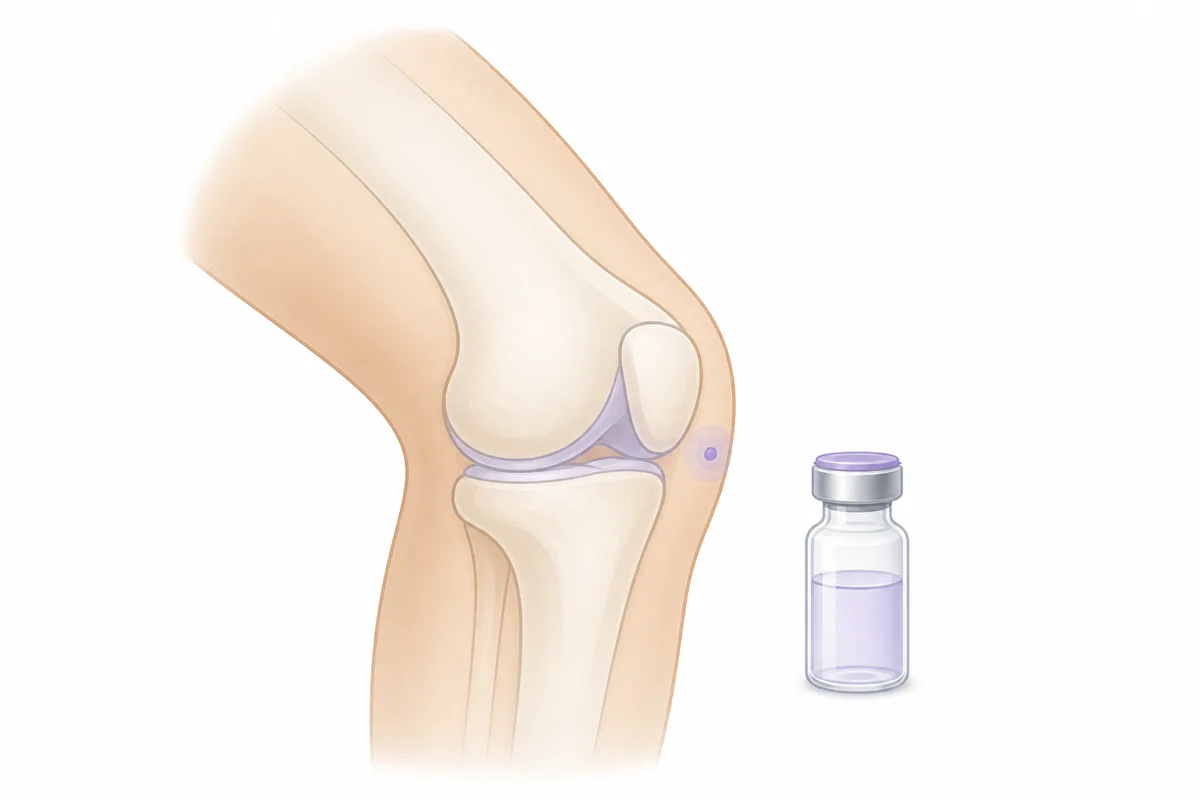
TL;DR: The BPC-157 injection site question — local near the injury versus systemic anywhere subcutaneous — leans toward systemic in the literature. Most positive tendon, muscle, and ligament results in rats came from injections given far from the injury (intraperitoneal) or even oral dosing, suggesting BPC-157 acts body-wide regardless of placement. Human data remains scarce.
One of the most repeated questions in peptide research forums is deceptively simple: does it matter where you put a BPC-157 injection? The folk wisdom says “inject subcutaneously as close to the injured tendon as possible.” The animal literature tells a more interesting story. This piece walks through the BPC-157 injection site debate — local versus systemic — through the lens of what the studies actually did and found, without prescribing a technique for anyone.
If you are new to this compound, our primer on what BPC-157 is and how it is studied is a useful starting point before the details below.
Why the “local vs systemic” question exists at all
The intuition behind local injection is borrowed from clinical procedures like corticosteroid or PRP injections, where a drug is deposited directly into or beside the target tissue so it acts where it is placed. People reason that if a tendon is injured, delivering the peptide as near to it as possible should concentrate the effect.
BPC-157 (a synthetic 15-amino-acid sequence derived from a protein found in human gastric juice) does not behave like a locally-deposited depot drug in the research. It is water-soluble, small, and — unusually for a peptide — comparatively stable in the gut and bloodstream, which is why researchers can dose it by so many routes and still see effects far from the delivery point. That stability is the whole reason the systemic hypothesis is credible.
What the research shows about the BPC-157 injection site
Here is the load-bearing observation: the animal studies that made BPC-157 famous for tendon and muscle healing rarely injected it at the injury. They dosed it systemically and measured healing at a distant site.
- Transected Achilles tendon (Staresinic et al., 2003). Rats with a surgically cut Achilles tendon healed faster with BPC-157 given intraperitoneally (into the abdominal cavity, nowhere near the ankle) at microgram-per-kilogram doses, and it was also effective given per-orally in drinking water. Neither route places the peptide at the tendon.
- Achilles tendon-to-bone healing (Krivic et al., 2006). Again, systemic dosing promoted tendon-to-bone reconnection and blunted the harmful effect of corticosteroids — with no local injection into the enthesis.
- Ligament healing (Cerovecki et al., 2010). Medial collateral ligament transection in rats healed better with BPC-157, dosed systemically.
- Muscle crush injury (Novinscak et al., 2008). This is the most direct head-to-head: BPC-157 was applied either intraperitoneally or locally as a thin cream layer. Both routes accelerated muscle healing and restored function. Local was not clearly superior — systemic worked just as well.
- 1
2003 — Staresinic
Transected rat Achilles tendon healed with BPC-157 given intraperitoneally and per-orally, neither route near the tendon.
- 2
2006 — Krivic
Systemic dosing promoted tendon-to-bone healing and blunted corticosteroid harm, with no local injection.
- 3
2008 — Novinscak
Muscle crush head-to-head: intraperitoneal vs local cream. Both worked; local was not clearly superior.
- 4
2010 — Cerovecki
Medial collateral ligament transection in rats healed better with systemic BPC-157.
- 5
2011 — Chang
Mechanism: drives tendon fibroblast outgrowth and migration via the FAK-paxillin pathway in vitro.
- 6
2019 — Gwyer review
Independent Loughborough review: consistently positive animal results, but no human trial data.
The mechanistic work fills in why distant dosing can still reach an injury. Chang et al. (2011) showed BPC-157 drives tendon fibroblast outgrowth, survival, and migration in vitro through the FAK-paxillin pathway — cellular machinery that responds to whatever peptide circulates to the tissue, not to where a needle was placed. A recurring theme across Sikiric’s group and independent reviewers is that BPC-157 supports angiogenesis and blood-vessel network recruitment, effectively improving the injury’s own supply lines rather than acting as a static local patch.
The honest caveat: this is animal evidence
Nearly all of the tendon, ligament, and muscle data is preclinical (rats and cell cultures). An independent 2019 review by Gwyer, Wragg and Wilson — from Loughborough University, outside the original Zagreb group — surveyed the musculoskeletal literature, found consistently positive animal results, and stated the key limitation plainly: there is no human trial data confirming these soft-tissue effects translate to people. The main human exposure on record is an older Phase 2 program for inflammatory bowel disease (PL 14736, Pliva), whose full results were never published in a standalone clinical paper. So “systemic vs local” is a question answered by rodent pharmacology, not by human dosing trials.
Local near the injury vs systemic anywhere: a side-by-side
| Consideration | Local (near the injury) | Systemic (anywhere subcutaneous) |
|---|---|---|
| Underlying assumption | Peptide must sit next to the tissue to work | Peptide circulates and reaches injured tissue via blood |
| What the studies did | Rarely used; muscle-crush cream was one exception | Dominant approach: intraperitoneal, oral, systemic injection |
| Head-to-head result (muscle crush) | Effective | Effective — not clearly worse than local |
| Proposed mechanism | Direct tissue contact | Angiogenesis, FAK-paxillin signaling, systemic vascular effects |
| Evidence strength | Sparse | Larger preclinical body of work |
| Human confirmation | None | None |
The pattern is not “local is wrong.” It is that the research does not show local placement is required or clearly better, while it repeatedly shows systemic dosing works. That asymmetry is why many people conclude the injection site may matter less than the community folklore implies.
Why people still inject near the injury anyway
Several reasons keep the near-the-injury habit alive, and they are worth understanding rather than dismissing:
- Comfort and intuition. Placing the shot near the sore spot feels targeted, even if the peptide ends up circulating.
- Minor, unproven local effects. A theoretical argument holds that a slightly higher local tissue concentration right after injection could add something — but no controlled study has isolated a local-only benefit over systemic dosing in tendon models.
- It is convenient. For an injury on the forearm or knee, the nearby subcutaneous tissue is simply an easy, accessible site.
None of these establish that local is necessary. They mostly explain why a practice persists once it spreads through forums. For the broader route debate — swallowing versus injecting — our breakdown of BPC-157 oral versus injectable absorption covers how the same “systemic reach” logic plays out across delivery methods.
What subcutaneous actually means here
“Subcutaneous” refers to the fatty layer just beneath the skin — not into muscle and not into a vein. In the research context, subcutaneous injection is a common systemic route because that layer has enough blood supply to move a small, stable peptide into circulation over time, giving relatively steady exposure. In rodent studies, intraperitoneal injection is the workhorse systemic route, while subcutaneous and intramuscular appear in various protocols; all three deliver the peptide to the whole body rather than trapping it at one spot.
General handling, siting, and hygiene principles are covered in our guide to subcutaneous injection best practices, and if you are looking at combined protocols, the BPC-157 and TB-500 dosing framework explains how researchers structure multi-peptide study designs. Product-specific details for the common research format sit on the BPC-157 10mg reference page.
The practical read on the BPC-157 injection site debate
Pulling it together: the weight of the (animal) evidence suggests BPC-157 behaves as a systemic agent. Positive tendon, ligament, and muscle outcomes appeared when the peptide was dosed far from the injury — into the abdomen or by mouth — and a direct comparison in muscle showed local and systemic delivery performing similarly. The most cited mechanisms (angiogenesis, FAK-paxillin-driven cell migration) are circulation-dependent, not needle-placement-dependent.
That said, this is not a green light or a technique recommendation. It is a summary of what the literature demonstrates in animals, framed so you can read forum claims critically. The clean, honest conclusion: in the research, the BPC-157 injection site appears to matter less than whether the compound reaches systemic circulation at all — and whether any of it maps onto human outcomes remains an open, untested question.
Frequently Asked Questions
Should I inject BPC-157 as close to the injured tendon or joint as possible?
The animal research does not show that local placement near the injury is required or clearly superior. Key tendon studies dosed BPC-157 systemically (into the abdomen or orally) and still saw faster healing at distant sites, suggesting circulation-driven effects rather than needle-position-dependent ones.
Does BPC-157 work systemically no matter where I inject it?
In preclinical rat models, the pattern strongly suggests yes. Effects appeared with intraperitoneal, oral, and injected dosing at sites remote from the injury, and proposed mechanisms like angiogenesis and FAK-paxillin signaling depend on the peptide circulating. Human confirmation of systemic soft-tissue effects does not yet exist.
Is subcutaneous or intramuscular used for BPC-157 in research?
Both appear in the literature, alongside intraperitoneal dosing, which is the most common systemic route in rodent studies. All three deliver the peptide into the body’s circulation rather than confining it locally. Study protocols vary, and none of these routes has been validated for human therapeutic use in published trials.
Where is a subcutaneous shot typically given?
Subcutaneous means the fatty layer just under the skin — not into muscle or a vein. Common sites in general subcutaneous technique include the abdomen and outer thigh, which have accessible fatty tissue and enough blood supply to move a small, stable peptide into systemic circulation gradually over time.
References
- Staresinic M, Sebecic B, Patrlj L, et al. Gastric pentadecapeptide BPC 157 accelerates healing of transected rat Achilles tendon and in vitro stimulates tendocytes growth. Journal of Orthopaedic Research. 2003;21(6):976-983.
- Krivic A, Anic T, Seiwerth S, et al. Achilles detachment in rat and stable gastric pentadecapeptide BPC 157: Promoted tendon-to-bone healing and opposed corticosteroid aggravation. Journal of Orthopaedic Research. 2006;24(5):982-989.
- Cerovecki T, Bojanic I, Brcic L, et al. Pentadecapeptide BPC 157 (PL 14736) improves ligament healing in the rat. Journal of Orthopaedic Research. 2010;28(9):1155-1161.
- Novinscak T, Brcic L, Staresinic M, et al. Gastric pentadecapeptide BPC 157 as an effective therapy for muscle crush injury in the rat. Surgery Today. 2008;38(8):716-725.
- Chang CH, Tsai WC, Lin MS, Hsu YH, Pang JH. The promoting effect of pentadecapeptide BPC 157 on tendon healing involves tendon outgrowth, cell survival, and cell migration. Journal of Applied Physiology. 2011;110(3):774-780.
- Gwyer D, Wragg NM, Wilson SL. Gastric pentadecapeptide body protection compound BPC 157 and its role in accelerating musculoskeletal soft tissue healing. Cell and Tissue Research. 2019;377(2):153-159.
- Sikiric P, Seiwerth S, Rucman R, et al. Stable gastric pentadecapeptide BPC 157 in trials for inflammatory bowel disease (PL-10, PLD-116, PL 14736, Pliva, Croatia). Current Pharmaceutical Design. 2011;17(16):1612-1632.
This article is for research-use-only educational purposes and is not medical advice or a dosing recommendation for humans.