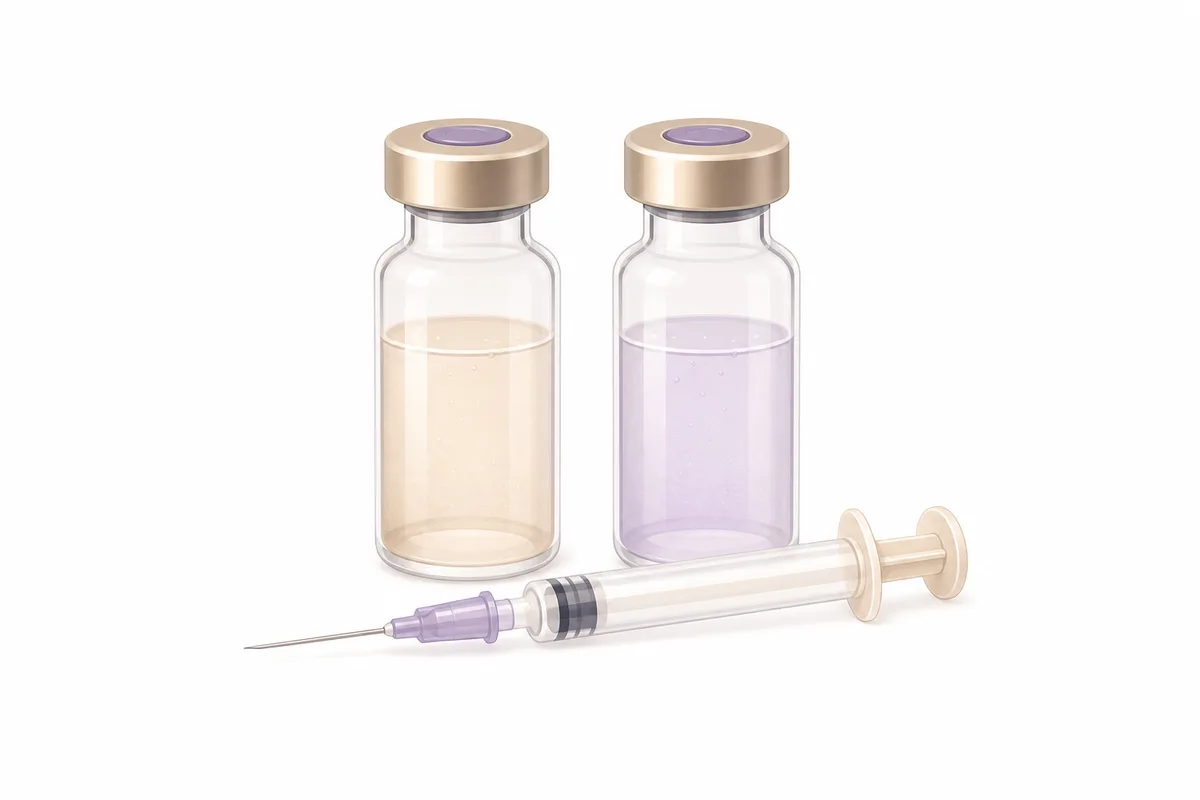
TL;DR: In the literature, a BPC-157 and TB-500 protocol pairs daily BPC-157 (around 250-500 mcg) with twice-weekly TB-500 (around 2-5 mg), often front-loaded in a higher-dose loading phase before a lower maintenance phase. They are usually kept in separate vials but can be drawn together for a single injection.
The BPC-157 + TB-500 combination is easily the most discussed “healing stack” in peptide research circles, and the questions that come up again and again are remarkably consistent: what doses show up in the protocol literature, what people mean by a “loading phase,” and whether the two peptides can be reconstituted or mixed in one vial. This guide walks through each of those, framed strictly around what the research and protocol discussion actually describe. If you want a head-to-head on the two compounds first, our BPC-157 vs TB-500 comparison is the better starting point.
Why researchers combine BPC-157 and TB-500
The rationale for the stack is mechanistic complementarity: the two peptides act on different parts of the repair cascade, so combining them is thought to cover more of the healing process than either alone.
- BPC-157 is a stable gastric pentadecapeptide (sequence GEPPPGKPADDAGLV) that, in animal models, upregulates growth factors and modulates the nitric-oxide system and angiogenesis. In transected rat Achilles tendon it accelerated healing and, in cultured tendon fibroblasts, promoted outgrowth, survival, and migration via the FAK-paxillin pathway (Chang et al., 2011; Staresinic et al., 2003).
- TB-500 is a synthetic fragment of thymosin beta-4, a 43-amino-acid actin-sequestering peptide. Its research signature is promoting cell migration, angiogenesis, and re-epithelialization. In a rat full-thickness wound model, thymosin beta-4 increased re-epithelialization by 42% at day 4 and up to 61% at day 7 versus saline (Malinda et al., 1999).
Rat full-thickness wound model (Malinda et al., 1999)
Put simply, the research framing is that BPC-157 helps build the vascular and structural groundwork while TB-500 mobilizes the migrating repair cells. Neither is a substitute for the other, which is exactly why the BPC-157 and TB-500 protocol persists as a paired approach. For a broader look at how this fits alongside other combinations, see our overview of common peptide stacks.
The doses that appear in the protocol literature
There is no approved human dosing for either compound. What follows is a synthesis of the numbers repeatedly cited in protocol write-ups and research discussion, not a prescription. Doses are typically expressed as micrograms (mcg) for BPC-157 and milligrams (mg) for TB-500.
| Compound | Loading-phase pattern (cited) | Maintenance-phase pattern (cited) | Typical route in discussion |
|---|---|---|---|
| BPC-157 | ~250-500 mcg daily | ~250 mcg daily or every other day | Subcutaneous, often near the target site |
| TB-500 | ~2-5 mg, 2x per week | ~2-2.5 mg, once weekly | Subcutaneous, abdomen |
| Combined cycle | Higher-dose weeks 1-4 | Lower-dose weeks 4-8 | Two injections, same session |
A commonly repeated combined starting pattern is BPC-157 250 mcg once or twice daily plus TB-500 2-2.5 mg twice weekly. Whether BPC-157 works better applied locally versus systemically is its own debate, which we unpack in BPC-157 injection site: local vs systemic. To convert any of these figures into an actual draw volume for a given vial concentration, the peptide reconstitution calculator removes the guesswork.
A 10 mg vial reconstituted with 2 mL bacteriostatic water gives 5 mg/mL, so a 250 mcg dose is 0.05 mL = 50 units on a U-100 syringe.
The loading phase vs maintenance phase concept
The “loading phase” idea is borrowed largely from TB-500 discussion, and it is a protocol convention rather than a validated clinical schedule.
- Loading phase (roughly weeks 1-4 to 6): a higher, more frequent dose intended to reach a working tissue concentration quickly. For TB-500 this is where the twice-weekly, higher-milligram figures show up.
- Maintenance phase (thereafter): a reduced dose and/or frequency intended to sustain the effect once the loading period is over, often halving the weekly TB-500 amount and spacing BPC-157 to every other day.
It is worth being blunt here: the loading/maintenance split reflects thymosin beta-4’s actin-binding, migration-driving biology and how researchers reason about reaching an effective concentration, but the specific week counts and milligram cut-offs come from community protocol convention, not controlled human dose-ranging trials.
- 1
Weeks 1-4 (loading)
Higher, more frequent dosing: BPC-157 ~250-500 mcg daily plus TB-500 ~2-5 mg twice weekly to reach a working tissue concentration.
- 2
Weeks 4-8 (maintenance)
Reduced dose and frequency: BPC-157 spaced to every other day and the weekly TB-500 amount roughly halved to ~2-2.5 mg once weekly.
- 3
After the cycle
Some discussion continues maintenance dosing longer or repeats cycles with breaks. Week counts are convention, not validated clinical dosing.
Can you mix BPC-157 and TB-500 in one vial?
This is the single most-asked practical question, so here is the distinction that matters:
- Reconstituting both in the same vial: generally discouraged in reconstitution guidance. The two peptides can have different handling and storage sensitivities, and combining lyophilized powders into one vial removes your ability to control each concentration independently. Purpose-made pre-blended vials exist precisely because they are formulated and filled together under controlled conditions.
- Drawing both into one syringe for a single injection: widely described as acceptable when each has already been reconstituted separately, since it simply reduces two subcutaneous injections to one.
Standard handling notes apply to both: reconstitute with bacteriostatic water, let the vial reach room temperature first, add the diluent slowly down the vial wall rather than directly onto the powder, swirl gently instead of vortexing (high-shear agitation and foaming promote peptide aggregation), and store reconstituted vials at 2-8 degrees C, where both are generally cited as stable for around 28 days. You can price and source each compound on our reference pages for BPC-157 10mg and TB-500 10mg.
What the research actually shows (and its limits)
Here is the honest evidence picture, because YMYL topics deserve it:
- BPC-157 has extensive animal data for tendon, muscle, ligament, and gastrointestinal healing, largely from the Sikiric group in Zagreb, plus early-stage human safety signals in inflammatory bowel disease research. Robust, independent, large-scale human efficacy trials for musculoskeletal healing are still lacking.
- TB-500 / thymosin beta-4 has strong preclinical wound-healing and angiogenesis data and has been studied in humans for dermal and ophthalmic indications, but again not as an approved musculoskeletal-repair drug.
- The combination itself has essentially no controlled human trial data. Its popularity rests on the individual mechanisms lining up sensibly, not on a study testing the stack head-to-head.
So the fair summary is: promising mechanisms, meaningful animal evidence, limited and early human evidence, and no combination-specific clinical trials. Both remain research-use-only compounds in the EU and are not approved medicines.
Frequently Asked Questions
Can I combine BPC-157 and TB-500 in the same syringe or vial?
Reconstitution guidance generally advises against mixing both peptides in the same vial, since they can differ in handling and you lose independent concentration control. Drawing two already-reconstituted peptides into one syringe for a single injection is commonly described as acceptable, and pre-blended vials are filled under controlled conditions for that purpose.
How does a loading phase differ from a maintenance phase on the healing stack?
A loading phase uses a higher, more frequent dose early on (often weeks 1-4 to 6) to reach a working tissue concentration quickly, mainly reflected in TB-500’s twice-weekly schedule. The maintenance phase then reduces dose or frequency to sustain the effect. These week counts are protocol convention, not validated clinical dosing.
What is discussed for a tendon injury or post-surgery recovery protocol?
Tendon-focused discussion leans on BPC-157’s animal data, where it accelerated transected Achilles tendon healing and drove tendon-fibroblast migration. Protocols typically pair daily BPC-157 near the site with twice-weekly TB-500 across a multi-week cycle. This describes the literature and community framing only, not medical guidance for treating an injury.
How long does a BPC-157 / TB-500 cycle typically run?
Cited cycles most often run about four to eight weeks, structured as a higher-dose loading block followed by a lower-dose maintenance block. Some discussion continues maintenance dosing longer or repeats cycles with breaks. These durations come from protocol convention and animal-study timelines rather than from controlled human dose-ranging research.
References
- Chang CH, Tsai WC, Lin MS, Hsu YH, Pang JH. The promoting effect of pentadecapeptide BPC 157 on tendon healing involves tendon outgrowth, cell survival, and cell migration. Journal of Applied Physiology. 2011;110(3):774-780.
- Staresinic M, Sebecic B, Patrlj L, et al. Gastric pentadecapeptide BPC 157 accelerates healing of transected rat Achilles tendon and in vitro stimulates tendocytes growth. Journal of Orthopaedic Research. 2003;21(6):976-983.
- Malinda KM, Sidhu GS, Mani H, et al. Thymosin beta4 accelerates wound healing. Journal of Investigative Dermatology. 1999;113(3):364-368.
- Goldstein AL, Hannappel E, Sosne G, Kleinman HK. Thymosin beta4: a multi-functional regenerative peptide. Basic properties and clinical applications. Expert Opinion on Biological Therapy. 2012;12(1):37-51.
- Crockford D, Turjman N, Allan C, Angel J. Thymosin beta4: structure, function, and biological properties supporting current and future clinical applications. Annals of the New York Academy of Sciences. 2010;1194:179-189.
- Seiwerth S, Milavic M, Vukojevic J, et al. Stable gastric pentadecapeptide BPC 157 and wound healing. Frontiers in Pharmacology. 2021;12:627533.
- Sikiric P, Seiwerth S, Rucman R, et al. Toxicity by NSAIDs. Counteraction by stable gastric pentadecapeptide BPC 157. Current Pharmaceutical Design. 2013;19(1):76-83.
This article is for educational and research-use-only purposes and is not medical advice or a dosing prescription; BPC-157 and TB-500 are not approved medicines in the EU.