TL;DR: Bacteriostatic water is sterile water with 0.9% benzyl alcohol added as a preservative. That preservative is the whole point — it is what allows a vial to be punctured repeatedly over days or weeks without the contents turning into a culture medium. Sterile water and 0.9% saline contain no preservative and are single-use once opened, which makes them the most common substitution you will run into. A legitimate product is a sealed glass vial with a crimped stopper, a printed benzyl alcohol declaration, a lot number and an expiry date. If the benzyl alcohol is not on the label, it is not bacteriostatic water, whatever the front of the bottle says.
Reconstitution guides tend to jump straight to the arithmetic — how many millilitres into how many milligrams — and skip the diluent itself. That is a gap, because the diluent is where most of the practical failure modes live. In European research circles this is now the single most-asked sourcing question, partly because the supply picture here is genuinely different from the US one, and partly because the market has filled with products that look like bacteriostatic water and are not. This piece covers what the stuff actually is, what a real vial looks like, and what a substandard one looks like.
What bacteriostatic water actually is
Bacteriostatic Water for Injection is a very simple formulation: water for injection, sterilised, with benzyl alcohol added at 0.9% w/v as an antimicrobial preservative. That is the entire recipe. There is no buffer, no salt, no tonicity agent.
Benzyl alcohol is bacteriostatic, not bactericidal — the distinction matters. It does not sterilise anything. It inhibits bacterial growth, which means that if a small number of organisms are introduced during a needle puncture, the preservative suppresses them rather than letting them multiply. That single property is why a bacteriostatic vial tolerates multiple withdrawals over an extended period while an unpreserved one does not.
Bacteriostatic water vs sterile water vs saline
These three get used interchangeably in conversation and they are not interchangeable in practice. This is the most common source of both honest confusion and deliberate mislabelling.
| Product | Composition | Preserved? | In-use behaviour |
|---|---|---|---|
| Bacteriostatic Water for Injection | Sterile water + 0.9% benzyl alcohol | Yes | Multi-puncture; conventionally treated as good for ~28 days after first entry |
| Sterile Water for Injection | Sterile water only | No | Single-use in practice; discard the remainder after opening |
| Sodium Chloride 0.9% (saline) | Sterile water + 0.9% NaCl | No (unless a preserved presentation) | Single-use in practice; the NaCl is a tonicity agent, not a preservative |
Notice the coincidence that trips people up: bacteriostatic water is 0.9% benzyl alcohol and saline is 0.9% sodium chloride. Two completely different substances at the same concentration, doing completely different jobs. Sodium chloride does nothing whatsoever to inhibit microbial growth. A vial of saline that has been punctured is, from a microbiological standpoint, an unpreserved open container.
Saline and sterile water are not bad diluents — some peptides are reconstituted with them by design, and for a vial that will be fully consumed in one sitting the preservative question is moot. The problem is only ever the substitution: buying something labelled or sold as “bacteriostatic” that is actually unpreserved, and then treating it as multi-dose for a month. That is the failure mode worth engineering against.
Where the 28-day convention comes from
Almost every reconstitution guide says the same thing: 28 days from first puncture. It is worth understanding that this is an in-use convention, not a chemical cliff.
The number derives from the standard in-use period assigned to multi-dose preserved injectable presentations. The preservative’s job is to hold microbial growth in check across repeated entries, and 28 days is the window over which that suppression is conventionally relied upon — beyond it, the assumption stops being made, largely because cumulative punctures, coring of the stopper and general handling all accumulate risk. It is a discipline, not a countdown to a chemical failure event.
Two practical consequences follow. First, the 28 days runs from the first puncture, not from purchase — an unopened vial is good until its printed expiry, which is typically a year or more out. Second, the peptide in the vial is often the shorter-lived component anyway. Our peptide storage guide covers how reconstituted peptide stability, not diluent stability, is usually what sets your real working window.
- 1
Unopened — printed expiry governs
A sealed vial is good until the expiry date on the label, typically a year or more out. Room temperature, out of direct light. No refrigeration needed.
- 2
First puncture — the clock starts
Write the date on the vial. This is the moment the 28-day convention begins, not the day you bought it.
- 3
Days 1-28 — multi-puncture window
A fresh needle every entry, stopper wiped each time. The preservative suppresses incidental contamination; it does not undo careless technique.
- 4
Day 28 onward — convention says replace
Not a chemical cliff, but the point at which the preservative is no longer conventionally relied upon. Most researchers open a fresh vial.
Sourcing in Europe
The European picture is not the American one, and importing the American framing causes confusion. In the US, Bacteriostatic Water for Injection is a widely stocked pharmacy and retail item, which is why so much of the online discussion is about which retail listing to trust. In Europe, availability varies substantially by country: in some markets it is a pharmacy item that can be ordered in, in others it is stocked as a hospital or compounding line rather than something on the shelf, and in others it is effectively absent from the retail channel entirely and researchers buy it alongside their peptides from laboratory suppliers.
That fragmentation is precisely why the counterfeit and substandard problem exists here. Where a legitimate channel is inconvenient, an illegitimate one grows to fill the gap, and it is trivially easy to print a label that says “bacteriostatic water” and put tap-adjacent purified water behind it. The defence is not brand loyalty — it is knowing what a real product looks like, which is a short and checkable list.
Independent testing of retail-channel bacteriostatic water has, in a number of instances, turned up products that failed verification on pH or on benzyl alcohol content — meaning the preservative was out of specification or, in some cases, effectively absent. We are not going to quote a headline pass-rate figure at you, because the sampling behind those exercises is not something we can vouch for. The useful takeaway is narrower and more actionable: buy from a channel that documents what it is selling, and inspect the vial yourself. The same documentation logic we apply to peptides in understanding peptide purity and the CoA applies to the diluent — a supplier that cannot tell you the lot number of the water it sold you is telling you something.
How to read the label
A legitimate vial is boring and specific. It says, in printed text:
- “Bacteriostatic Water for Injection” — the full product name, not “bacteriostatic solution” or “sterile bac water” or some marketing coinage.
- Benzyl alcohol 0.9% — an explicit declaration of the preservative and its concentration. This is the load-bearing line.
- Volume — 10 mL and 30 mL are the common presentations.
- A lot or batch number — traceable back to a production run.
- An expiry date — for the unopened vial.
- Manufacturer identity — a real named manufacturer with an address, not just a webshop’s logo.
Physical tells of a substandard or relabelled product
Beyond the label text, the packaging itself does a lot of the work. Legitimate injectable diluent is filled and sealed under conditions that produce a very characteristic object.
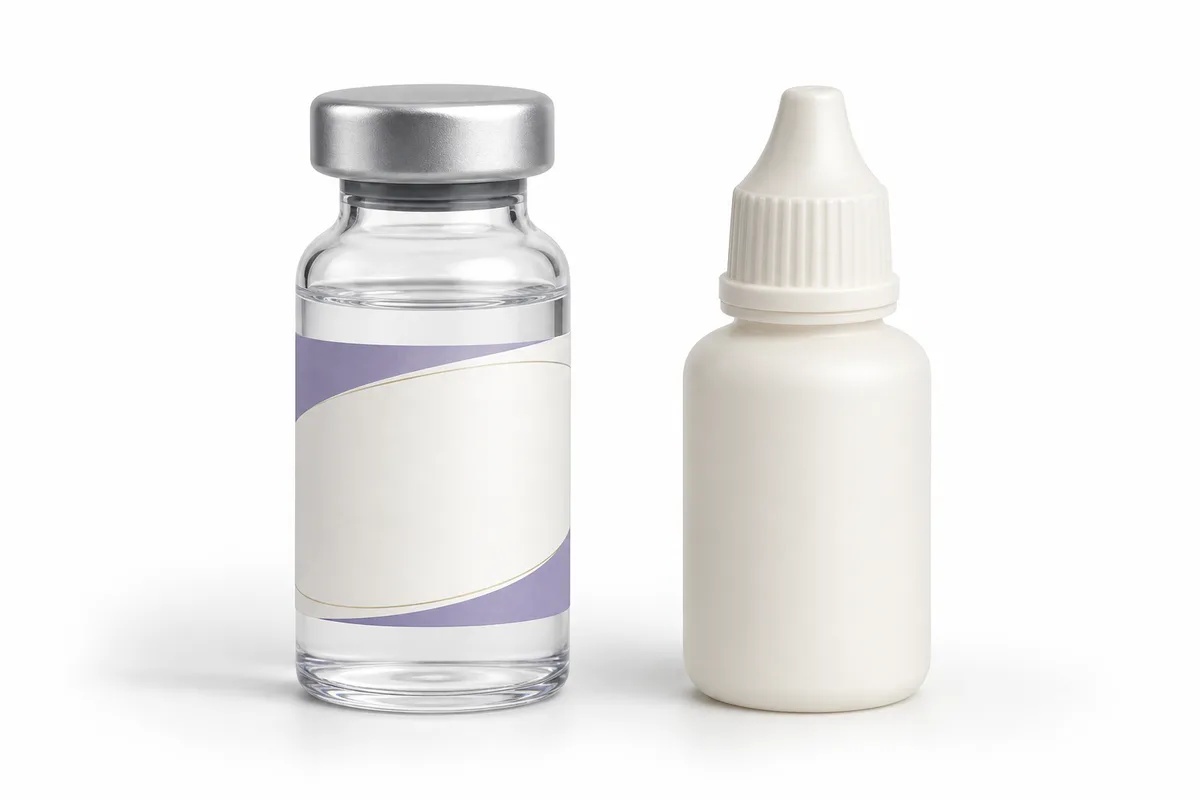
- Sealed glass vial with a crimped aluminium ring and a rubber stopper. This is what multi-dose injectable presentations look like. A plastic squeeze bottle, a screw-cap bottle or a dropper is not a multi-dose injectable presentation and should be treated as a hard stop.
- A flip-off cap that is genuinely intact. If the centre cap is missing or already popped, the vial has been opened.
- Printed, adhered labelling — not a photocopy. Blurry text, obvious pixelation, a label that peels at the corner, or one that is visibly stuck over another label underneath, are all tells that the presentation has been repackaged.
- A lot number and an expiry that are actually there. No lot number is the single most common giveaway. Legitimate injectable manufacturing does not produce untraceable units.
- Clear, particle-free contents. The solution should be water-clear with nothing floating in it. Cloudiness or visible particulates mean it does not get used, full stop.
- Consistency across a batch you order. If two vials from the same order have different label typography or different lot formats, you are looking at a repackager, not a manufacturer.
None of this requires equipment. It requires two minutes of looking at the vial before it goes anywhere near a peptide, which is a lot cheaper than discovering the problem later via a batch of solution that went cloudy in the fridge — a scenario we cover from the other end in reconstitution troubleshooting.
Storage and handling
Bacteriostatic water is stored at controlled room temperature. It does not need refrigeration, and freezing it serves no purpose. Keep it out of direct sunlight and out of the same drawer where things get knocked over.
The handling rules are short:
- Wipe the stopper before every entry. The preservative buys you tolerance for incidental contamination, not for a stopper that has been sitting exposed.
- A fresh needle, every time, into the vial. Reusing a needle into the diluent vial is the fastest way to seed it. Needles are the cheapest thing in the entire workflow.
- Date the vial at first puncture. Written on the vial itself, not remembered.
- Do not decant it. Transferring it into another container defeats the sealed presentation entirely.
How much you actually need
Less than people buy. A 10 mL vial of bacteriostatic water covers a great many peptide vials, because typical reconstitution volumes are 1-3 mL per vial. The arithmetic — how many millilitres to draw for a given target concentration, and how the choice of volume changes what your syringe markings mean — is a topic in its own right, and we have worked it through in peptide reconstitution and BAC water ratios and in the broader peptide reconstitution guide.
The practical point for sourcing is that a single well-documented 10 mL or 30 mL vial from a channel you have vetted goes a long way, so there is no economic reason to buy the cheap unlabelled option. The saving is trivial and the thing you are saving on is the only preservative in the system.
One factual footnote, since it comes up: benzyl alcohol is the reason bacteriostatic water is not used for neonates. Newborns metabolise benzyl alcohol poorly and high cumulative exposure has been associated with gasping syndrome, which is why unpreserved diluents are used in that setting. It is a well-established pharmacological point about a specific population, and it is the reason the preserved and unpreserved presentations both exist on the market.
Frequently asked questions
Can I use saline or sterile water instead of bacteriostatic water?
Chemically, yes — many peptides reconstitute perfectly well in either. The difference is entirely about the in-use window. Saline and sterile water contain no preservative, so once the vial has been punctured there is nothing suppressing microbial growth, and they are treated as single-use in practice. If you intend to draw from a reconstituted vial repeatedly over days or weeks, the preserved diluent is what makes that reasonable. If the vial is being consumed in one go, the distinction largely evaporates.
How do I know if my bacteriostatic water is fake?
Read the label first: it should say “Bacteriostatic Water for Injection”, declare benzyl alcohol at 0.9%, and carry a lot number, an expiry date and a named manufacturer. Then look at the object: a sealed glass vial with a crimped ring and an intact flip-off cap. A plastic squeeze bottle, a missing lot number, a photocopied or over-stuck label, or an absent benzyl alcohol declaration are each sufficient on their own to reject the product.
Does bacteriostatic water need to be refrigerated?
No. It is stored at controlled room temperature, away from direct light, both before and after opening. Refrigeration offers no benefit and freezing offers none either. What does matter is the in-use clock: once the vial has been punctured, the conventional 28-day window begins, regardless of what temperature you keep it at.
Why 28 days after opening?
It is the standard in-use period conventionally applied to preserved multi-dose injectable presentations — the window over which the preservative’s suppression of microbial growth is relied upon across repeated punctures. It is a handling convention rather than a chemical expiry, and it starts at first puncture, not at purchase. An unopened vial remains good until its printed expiry, which is usually a year or more away.
What does the benzyl alcohol actually do?
It inhibits bacterial growth rather than killing bacteria outright — bacteriostatic, not bactericidal. If organisms are introduced during a needle puncture, the preservative suppresses their multiplication instead of allowing the vial to become a growth medium. It does not sterilise the solution and it does not compensate for poor technique. It is what makes repeated withdrawal from a single vial a defensible practice at all, and it is the only functional difference between bacteriostatic water and plain sterile water.
References
- Hospira, Inc. Bacteriostatic Water for Injection, USP — prescribing information. Lake Forest, IL.
- United States Pharmacopeia. Bacteriostatic Water for Injection monograph. USP-NF.
- European Pharmacopoeia. Water for Injections monograph (0169). Council of Europe, Strasbourg.
- Gershanik J, Boecler B, Ensley H, McCloskey S, George W. The gasping syndrome and benzyl alcohol poisoning. New England Journal of Medicine. 1982;307(22):1384-1388.
- Meyer BK, Ni A, Hu B, Shi L. Antimicrobial preservative use in parenteral products: past and present. Journal of Pharmaceutical Sciences. 2007;96(12):3155-3167.
- European Medicines Agency. Guideline on the pharmaceutical quality of inhalation and nasal products / in-use stability testing of human medicinal products. EMA/CHMP.
Research use only. This article describes the composition and handling of a laboratory diluent for educational purposes. It is not medical advice and does not recommend any dose, protocol, or human use. Peptides and diluents discussed here are research materials not intended for self-administration; handle all research materials in accordance with applicable EU regulations and institutional guidance.