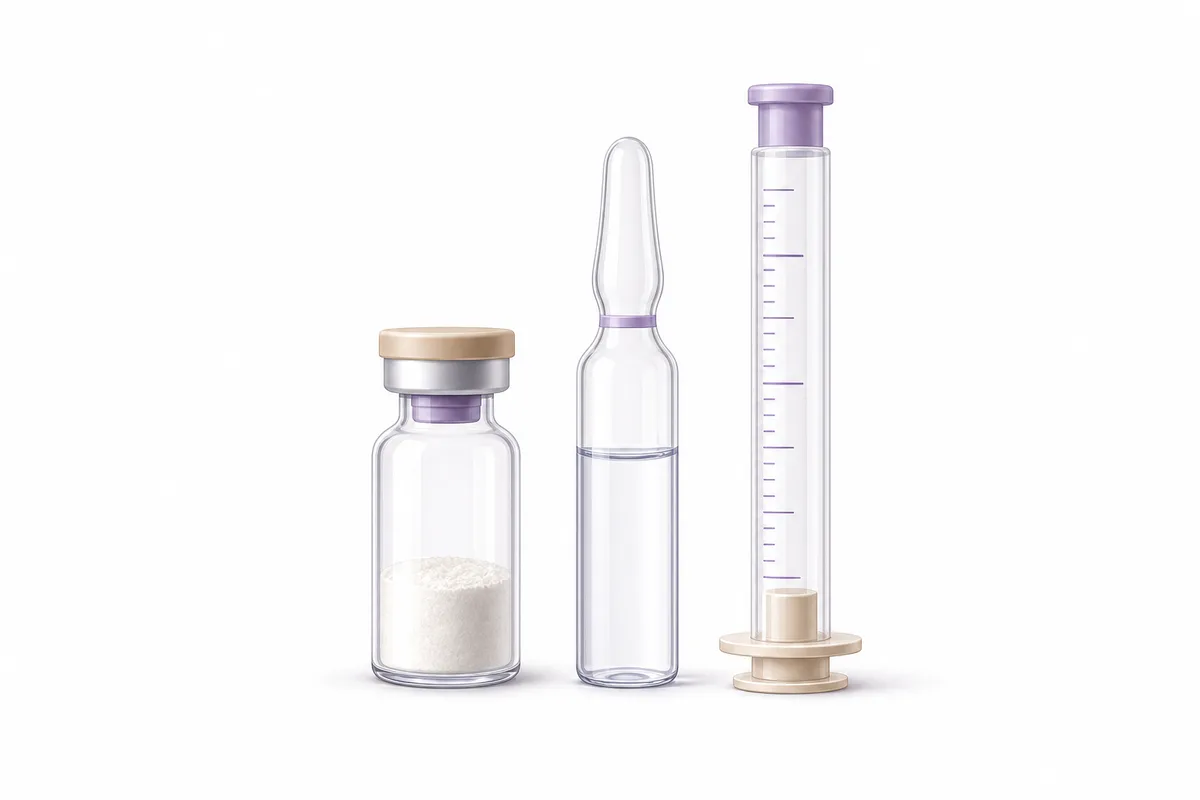
TL;DR: In peptide reconstitution, the BAC-water-to-vial ratio directly sets concentration: peptide mass (mg) divided by water volume (mL) equals mg/mL. Choosing a round ratio, such as 2 mL of bacteriostatic water per 5 mg vial, makes syringe math cleaner and improves measurement precision. Add water down the glass wall, swirl rather than shake, and refrigerate.
Reconstitution is where accurate research begins. The volume of bacteriostatic (BAC) water you add to a lyophilized vial does not change how much peptide is present, but it decides the concentration of every draw that follows, and therefore how precisely a target amount can be measured on a syringe. This article focuses on how to pick a ratio that keeps the math simple, and on the handling errors that quietly ruin otherwise good material. For the foundational technique, see our full peptide reconstitution guide; for the underlying calculations, our reconstitution calculator does the arithmetic for you.
Why the Ratio Matters More Than the Volume
The single equation behind every reconstitution is straightforward:
Concentration (mg/mL) = Peptide mass (mg) ÷ BAC water volume (mL)
A 5 mg vial reconstituted with 1 mL yields 5 mg/mL; the same vial with 2 mL yields 2.5 mg/mL; with 5 mL it yields 1 mg/mL. The total amount of peptide is identical in all three cases, but the measured volume needed to draw any given amount changes dramatically. This is the crux of injection precision: on a standard U-100 insulin syringe, each “unit” mark equals 0.01 mL. A more dilute solution spreads the same amount of peptide across more marks, so small hand errors translate into smaller absolute errors.
There is a trade-off, though. Dilute too far and the required draw becomes an awkwardly large volume; concentrate too far and each mark carries so much peptide that reading between marks becomes imprecise. The goal is a ratio that lands your typical research amount on a whole number of syringe units.
Choosing a Ratio for Easy Math
The most useful ratios are the ones that make the syringe read like a ruler. If a concentration puts your target amount at, say, 12 units instead of 11.7 units, you remove a rounding decision every single time you draw. A widely used convention is to pick a volume so that the concentration is a clean number such as 2.5 mg/mL or 5 mg/mL, then let the syringe units map directly to micrograms.
The table below shows how the same vial behaves across common BAC water volumes. Values assume a U-100 insulin syringe where 100 units = 1 mL.
| Vial size | BAC water | Concentration | Amount per 0.1 mL (10 units) | Notes on precision |
|---|---|---|---|---|
| 5 mg | 1 mL | 5 mg/mL | 500 mcg | Concentrated; tiny draws, less margin |
| 5 mg | 2 mL | 2.5 mg/mL | 250 mcg | Common, clean unit math |
| 5 mg | 2.5 mL | 2 mg/mL | 200 mcg | Round numbers, easy fractions |
| 10 mg | 2 mL | 5 mg/mL | 500 mcg | Concentrated but tidy |
| 10 mg | 4 mL | 2.5 mg/mL | 250 mcg | Larger draws, high precision |
| 10 mg | 5 mL | 2 mg/mL | 200 mcg | Very dilute, big volumes |
More water lowers concentration; the total peptide is unchanged.
Reading the table: the “amount per 0.1 mL” column is the number to anchor on, because it tells you what each visible block of 10 syringe units represents. A researcher working with a 5 mg vial who wants each 10-unit block to equal 250 mcg would choose 2 mL of BAC water. The choice is arithmetic, not chemistry, and both the reconstitution calculator and a printed reconstitution chart can confirm the mapping before you commit a vial.
5 mg vial in 2 mL BAC water = 2.5 mg/mL, so 10 units (0.1 mL) holds 250 mcg.
What the Research Shows
Two evidence threads are relevant here, and it is worth being precise about what each one does and does not establish.
First, on the diluent itself: bacteriostatic water is USP-defined as sterile water containing 0.9% benzyl alcohol as a preservative. The benzyl alcohol is bacteriostatic rather than bactericidal, meaning it inhibits microbial reproduction after the vial is punctured rather than sterilizing the contents. The 28-day in-use limit widely cited for multi-dose vials derives from this preservative system under refrigerated storage, not from peptide-specific data.
Second, and more nuanced: the same benzyl alcohol that protects against microbes can also promote aggregation in some proteins. Controlled formulation studies published in the Journal of Pharmaceutical Sciences have repeatedly shown benzyl alcohol accelerating aggregation in a concentration-dependent way. Thirumangalathu and colleagues (2006) documented this for granulocyte colony-stimulating factor; Zhang and colleagues (2004) and Roy and colleagues (2005) described the mechanism for interleukin-1 receptor antagonist as one of partial unfolding into aggregation-prone species; Bis and colleagues (2015) reported similar partial-unfolding behavior for interferon α-2a; and Hutchings and colleagues (2013) ranked common preservatives, placing benzyl alcohol in the middle of the aggregation-promoting spectrum.
The honest framing: this is preclinical, protein-specific, in vitro formulation science, largely on large recombinant proteins rather than the small research peptides most reconstitution guides discuss. It does not translate to any human or therapeutic claim. What it does establish is a defensible rationale for handling choices — avoiding excess heat, minimizing agitation, and not over-concentrating — because those are exactly the conditions that tip partially unfolded species toward aggregation in the published models.
Common Mistakes That Ruin a Vial
Shaking Instead of Swirling
Vigorous shaking introduces air-liquid interfaces and shear that can drive surface-induced aggregation and produce foam that makes accurate draws impossible. Add the water, then let it dissolve on its own; if a nudge is needed, roll the vial gently between your palms or swirl it. Patience beats agitation every time.
Using the Wrong Diluent
Tap, distilled, or “spring” water is not an acceptable substitute. Tap water carries minerals, chlorine, and microorganisms; distilled water lacks any preservative and offers no protection across repeated draws. For single-use preparations, sterile water for injection is an option, but it must be used quickly because it has no bacteriostatic agent. BAC water remains the default for multi-draw research vials.
Spraying Water Onto the Powder
Directing the stream straight down onto lyophilized cake can shear the material and cause clumping or incomplete dissolution. Aim the needle at the inner glass wall and let the water run down slowly, flooding the powder gently rather than blasting it. This mirrors the technique detailed in our injection and handling best practices.
Wrong Spray Angle and Needle Placement
A related error is puncturing the stopper at a steep angle so the stream jets toward the powder or foams as it enters. Keep the needle bevel toward the glass and the angle shallow. The objective is a quiet, wall-hugging flow, not a fast injection.
Mishandling Storage After Reconstitution
Once dissolved, a peptide is far more vulnerable than it was as a dry cake. Refrigerate at 2-8°C immediately, protect from light, and label the vial with the reconstitution date. Room-temperature storage, repeated warming, and freeze-thaw cycling all accelerate degradation. Lyophilized material tolerates long-term freezer storage; reconstituted solution does not.
Putting It Together for Precision
The workflow that maximizes accuracy is simple: decide the concentration you want by choosing a clean ratio, confirm it against a chart or calculator, add the water gently down the wall, let it dissolve without shaking, and refrigerate promptly. If you routinely work with a specific compound, browse the per-vial reconstitution notes on the individual peptide reference pages — for example, the entry for semaglutide 10 mg — to see how vial size interacts with common ratios before you ever draw water.
Frequently Asked Questions
How much BAC water should I add to a peptide vial?
There is no single correct volume; it depends on the concentration you want. Divide the vial’s peptide mass by your target concentration to get the water volume. A common, math-friendly choice is 2 mL of BAC water per 5 mg vial, giving 2.5 mg/mL. A reconstitution calculator confirms the syringe mapping instantly.
Does adding more BAC water reduce the strength of the peptide?
No. The amount of peptide in the vial is fixed. Adding more water lowers the concentration, so each draw contains the same amount spread across a larger volume. You are changing how the peptide is measured, not how much exists. More water simply means larger measured volumes for the same amount.
Why swirl instead of shake?
Shaking creates air-liquid interfaces and shear forces that, in published formulation studies, promote protein unfolding and aggregation, and it also generates foam that ruins measurement accuracy. Gently swirling or rolling the vial dissolves the powder while minimizing mechanical stress. If dissolution is slow, wait several minutes rather than forcing it with agitation.
Can I use regular or distilled water instead of BAC water?
No. Tap water carries contaminants and microorganisms; distilled water has no antimicrobial preservative. Bacteriostatic water contains 0.9% benzyl alcohol, which inhibits microbial growth across multiple draws. Sterile water for injection can work for single-use only, since it also lacks a preservative and offers no protection after the first puncture.
How long is a reconstituted peptide usable?
The 28-day figure commonly cited comes from the bacteriostatic preservative’s in-use window under refrigeration, not from peptide-specific stability data. Actual stability varies by compound. Store at 2-8°C, protect from light, label with the reconstitution date, and discard any solution that turns cloudy, discolored, or develops particles.
What ratio gives the best injection precision?
A ratio that places your typical research amount on a whole number of syringe units. Slightly more dilute solutions spread the same amount across more marks, reducing absolute error from small hand movements, but overly dilute solutions require awkwardly large draws. Aim for clean concentrations like 2.5 mg/mL and check the mapping on a reconstitution chart.
References
- Zhang Y, Roy S, Jones LS, et al. Mechanism for benzyl alcohol-induced aggregation of recombinant human interleukin-1 receptor antagonist in aqueous solution. Journal of Pharmaceutical Sciences. 2004;93(12):3076-3089.
- Roy S, Jung R, Kerwin BA, Randolph TW, Carpenter JF. Effects of benzyl alcohol on aggregation of recombinant human interleukin-1-receptor antagonist in reconstituted lyophilized formulations. Journal of Pharmaceutical Sciences. 2005;94(2):382-396.
- Thirumangalathu R, Krishnan S, Brems DN, Randolph TW, Carpenter JF. Effects of pH, temperature, and sucrose on benzyl alcohol-induced aggregation of recombinant human granulocyte colony stimulating factor. Journal of Pharmaceutical Sciences. 2006;95(7):1480-1497.
- Hutchings RL, Singh SM, Cabello-Villegas J, Mallela KMG. Effect of antimicrobial preservatives on partial protein unfolding and aggregation. Journal of Pharmaceutical Sciences. 2013;102(2):365-376.
- Bis RL, Singh SM, Cabello-Villegas J, Mallela KMG. Role of benzyl alcohol in the unfolding and aggregation of interferon α-2a. Journal of Pharmaceutical Sciences. 2015;104(2):407-415.
- Manning MC, Chou DK, Murphy BM, Payne RW, Katayama DS. Stability of protein pharmaceuticals: an update. Pharmaceutical Research. 2010;27(4):544-575.
- United States Pharmacopeia. Bacteriostatic Water for Injection, USP monograph. In: United States Pharmacopeia and National Formulary (USP-NF). Rockville, MD: United States Pharmacopeial Convention.
- United States Pharmacopeia. General Chapter ⟨51⟩ Antimicrobial Effectiveness Testing. In: United States Pharmacopeia and National Formulary (USP-NF). Rockville, MD: United States Pharmacopeial Convention.
This article is provided for educational and informational purposes only and describes laboratory research practices. All peptides referenced are intended strictly for in vitro research use only. Nothing here constitutes medical advice, a therapeutic claim, or a recommendation for human or animal administration. Follow all applicable EU and local regulations for handling research chemicals.