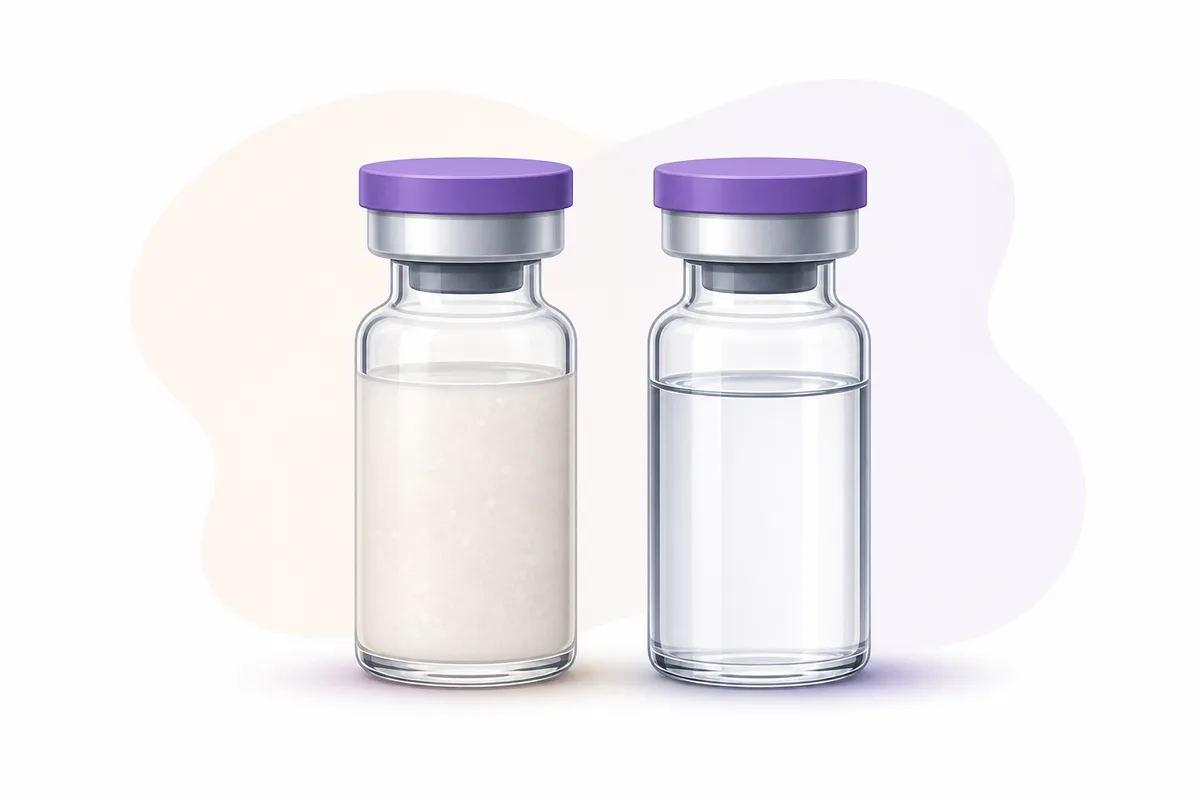
TL;DR: A cloudy peptide vial usually means the powder has not fully dissolved, the concentration exceeds the peptide’s solubility limit, or the solution is contaminated or degraded. Fix it by swirling gently at room temperature, adding more diluent, or discarding a vial that stays turbid, off-colour, or smells wrong.
Reconstitution rarely goes perfectly the first time. Powder sticks to the stopper, the liquid turns hazy, foam sits on top, or flakes drift through the vial hours later. This guide works through each problem in the order researchers actually encounter them, separating cosmetic quirks from genuine spoilage. If you are new to the process, start with our complete beginner’s guide to reconstitution and then use this page when something looks off.
Cloudy or Hazy Solution: Normal vs. Problem
A correctly reconstituted peptide should be clear and colourless. Cloudiness is the single most reported problem, and it has two very different causes.
Transient haze (usually fine). Immediately after adding diluent, many solutions look faintly milky as micro-particles disperse. If this clears within a few minutes of gentle swirling, the peptide has simply not finished dissolving. Peptides dissolve more slowly than table salt, and cold powder straight from the fridge dissolves slower still.
Persistent turbidity (usually a problem). Cloudiness that will not clear, or that develops hours to days later, points to one of three things: the peptide has exceeded its solubility limit and is precipitating out, the solution is contaminated with bacteria, or the peptide has physically aggregated. Aggregation is a well-documented degradation route for peptide therapeutics and is driven by concentration, temperature, pH, and agitation (Zapadka et al., 2017). Persistent haze is a discard signal, not a mixing signal.
The practical test: warm the vial to room temperature and swirl gently for a few minutes. If it clears, dissolution was incomplete. If it stays cloudy, treat the vial as compromised.
Undissolved Powder and Clumping: Swirl, Don’t Shake
Clumps of powder clinging to the glass or floating as gel-like specks mean the diluent has not reached all of the peptide. The fix is patience and the right motion, not force.
- Swirl or roll, never shake. Rolling the vial slowly between your palms or swirling it in small circles moves liquid across the powder without shearing the molecules or whipping in air. Vigorous shaking is one of the most reliable ways to damage a peptide and trigger aggregation.
- Warm to room temperature first. Solubility rises with temperature. A vial taken straight from 2-8°C storage will dissolve sluggishly.
- Give it time. Ten to twenty minutes of intermittent gentle swirling dissolves most standard research peptides. Some hydrophobic sequences take longer.
- Aim the diluent stream at the glass wall, not directly onto the powder cake, so the powder wets gradually rather than clumping into a dense pellet.
Some peptides are simply hard to dissolve because of their amino-acid makeup. Sequences that are more than 50% hydrophobic residues, or that carry very few charged residues, resist water and may need a different approach entirely (GenScript solubility guidelines; Bachem technical notes). For research contexts these peptides sometimes call for a specialised initial solvent, but that is a formulation decision beyond the scope of a home diluent swap.
- 1
Warm first
Bring the vial from 2-8°C storage up to room temperature so solubility rises.
- 2
Aim at the wall
Direct the diluent stream down the glass wall, not onto the powder cake.
- 3
Swirl or roll
Roll the vial slowly between your palms; never shake and shear the molecules.
- 4
Give it 10-20 min
Intermittent gentle swirling dissolves most standard research peptides.
What the Research Shows
Peptide behaviour in solution is governed by well-characterised chemistry, even though almost all of the primary literature concerns pharmaceutical manufacturing and formulation rather than end-user reconstitution. Two points carry over directly.
First, solubility depends on pH relative to the peptide’s isoelectric point (pI). At its pI a peptide carries no net charge, molecules stop repelling each other, and they aggregate and drop out of solution. Moving pH away from the pI restores the net charge and the electrostatic repulsion that keeps molecules dispersed (Sigma-Aldrich and GenScript solubility guidelines). This is why an otherwise fine peptide can go cloudy near neutral pH.
Second, chemical degradation is real and measurable. The dominant pathways are aggregation, deamidation, and oxidation (Cleland, Powell & Shire, 1993; Manning et al., 2010). Asparagine and glutamine deamidate, with Asn-Gly a notorious hot spot; methionine, cysteine, and tryptophan oxidise on exposure to oxygen and metal ions. Degradation accelerates with heat, light, and time, which is exactly why reconstituted vials have a limited window even under refrigeration.
An honest caveat: these findings come from controlled stability studies on manufactured peptide and protein drugs. There is essentially no published human trial data on the shelf-life of researcher-reconstituted vials of the grey-market compounds many people ask about. Treat any specific “weeks of stability” figure as a rule of thumb extrapolated from formulation science, not a validated result for your exact vial.
Foaming, Bubbles, and Precipitation
Foaming is caused by agitation and by the benzyl alcohol in bacteriostatic water, which lowers surface tension. A head of foam makes accurate volume measurement difficult and, more importantly, signals that air has been sheared into the solution, which promotes aggregation at the air-liquid interface. Let a foamy vial rest until the bubbles collapse, and next time swirl instead of shake.
Precipitation is the appearance of visible flakes, strands, or a settled layer after the solution was initially clear. This is a late-stage warning: the peptide is coming out of solution because the concentration was too high, the temperature dropped, or degradation has begun. A precipitated vial should not be “re-dissolved” by shaking and used as normal.
Diluent and Storage Mistakes
The wrong liquid or the wrong storage undoes good technique. The table below maps the common failures.
| Problem | Likely cause | Fix / prevention |
|---|---|---|
| Faint haze right after mixing | Incomplete dissolution | Warm to room temp, swirl gently a few minutes |
| Persistent cloudiness | Over-concentration, aggregation, or contamination | Add more diluent if concentration is the issue; otherwise discard |
| Clumps stuck to glass | Diluent sprayed onto powder; too cold | Aim stream at wall; warm vial; roll gently |
| Thick foam on top | Shaking; benzyl alcohol lowers surface tension | Let rest until bubbles clear; swirl, never shake |
| Flakes or strands appearing later | Precipitation from high concentration or cold | Reconstitute at lower concentration; keep at 2-8°C, not colder |
| Yellow or discoloured solution | Oxidation or degradation | Discard; protect future vials from light and heat |
| Cloudy days after opening | Bacterial contamination | Discard; use bacteriostatic water and sterile technique |
| Powder won’t dissolve at all | Highly hydrophobic sequence | Verify the compound; some peptides need a specialist solvent |
A few diluent and storage rules prevent most of these:
- Use bacteriostatic water for multi-dose vials. Its 0.9% benzyl alcohol suppresses bacterial growth, which is the main defence against the cloudiness that appears days after opening. Plain sterile water has no preservative and is single-use. Tap or distilled water should never be used.
- Do not over-concentrate. Dividing a fixed amount of peptide into too little water pushes it toward its solubility ceiling. Our reconstitution calculator and the printable reconstitution chart help you pick a diluent volume that keeps concentration comfortable and injection volumes workable.
- Store reconstituted vials at 2-8°C, protected from light, and label them with the date. Do not freeze a reconstituted solution unless a specific protocol calls for it; freeze-thaw cycles are a known aggregation trigger. Our peptide storage guide covers this in depth.
Cloudiness can also trace back to the powder itself. A vial that was mishandled in transit or that arrived with poor purity may never dissolve cleanly, no matter how careful your technique. Our guide to understanding peptide purity and COAs explains what a certificate of analysis should show before you ever open the vial, and the wider peptides reference library lists the compounds researchers most often work with. Higher-concentration GLP-1 vials such as semaglutide 10mg are especially worth calculating carefully, since a small diluent error changes concentration sharply.
Frequently Asked Questions
Why is my peptide cloudy after reconstitution?
Most often the powder has not finished dissolving, in which case gentle swirling at room temperature clears it within minutes. If cloudiness persists or appears hours later, the likely causes are over-concentration, aggregation, or bacterial contamination. Persistent turbidity is a signal to discard the vial rather than use it.
Can I still use a peptide if it stays slightly cloudy?
No. A correctly reconstituted research peptide should be clear and colourless. Persistent haze indicates precipitation, aggregation, or contamination, all of which mean the preparation is compromised and unreliable for research use. Discard any vial that will not clear after warming and gentle swirling, and prepare a fresh one.
Should I shake the vial to dissolve stubborn powder?
No. Shaking shears the peptide and whips air into the solution, both of which promote aggregation and foaming. Instead, warm the vial to room temperature and roll or swirl it slowly for ten to twenty minutes. If powder still will not dissolve, the sequence may be highly hydrophobic or the vial may be compromised.
Why did my solution foam up when I added the water?
Foaming comes from agitation combined with the benzyl alcohol in bacteriostatic water, which lowers surface tension. It is mostly cosmetic but makes volume measurement inaccurate and can seed aggregation at the air-liquid interface. Let the vial rest until the bubbles collapse, and add diluent slowly down the glass wall next time.
Does adding more bacteriostatic water fix a cloudy vial?
Only if the cloudiness is caused by over-concentration, where the peptide has exceeded its solubility limit. Adding diluent lowers the concentration and can bring it back into solution. It will not rescue a vial that is cloudy from contamination, oxidation, or advanced degradation, which should simply be discarded.
How long does a reconstituted peptide stay usable?
Under refrigeration at 2-8°C with bacteriostatic water, formulation science suggests a rough window of a few weeks, shorter for peptides rich in oxidation-prone residues like methionine or cysteine. This is an extrapolation from pharmaceutical stability data, not a validated figure for any specific research vial, so always inspect before use and discard anything cloudy or discoloured.
References
- Zapadka KL, Becher FJ, Gomes dos Santos AL, Jackson SE. Factors affecting the physical stability (aggregation) of peptide therapeutics. Interface Focus. 2017;7(6):20170030.
- Manning MC, Chou DK, Murphy BM, Payne RW, Katayama DS. Stability of protein pharmaceuticals: an update. Pharmaceutical Research. 2010;27(4):544-575.
- Cleland JL, Powell MF, Shire SJ. The development of stable protein formulations: a close look at protein aggregation, deamidation, and oxidation. Critical Reviews in Therapeutic Drug Carrier Systems. 1993;10(4):307-377.
- Elsayed A, et al. Regulatory guidelines for the analysis of therapeutic peptides and proteins. Journal of Peptide Science. 2025. (Wiley Online Library, doi 10.1002/psc.70001).
- GenScript. Peptide Solubility Guidelines. Technical resource, GenScript Biotech.
- Bachem. Peptide Solubility. Technical Notes, Knowledge Center, Bachem AG.
- Sigma-Aldrich (Merck). Solubility Guidelines for Peptides. Technical Documents.
Research use only. This article is an educational reference for laboratory research contexts and is not medical advice. It does not describe or endorse human or animal administration, dosing, or therapeutic use. Peptides discussed here are not approved for use as medicines in the EU; always follow applicable regulations and institutional safety requirements.