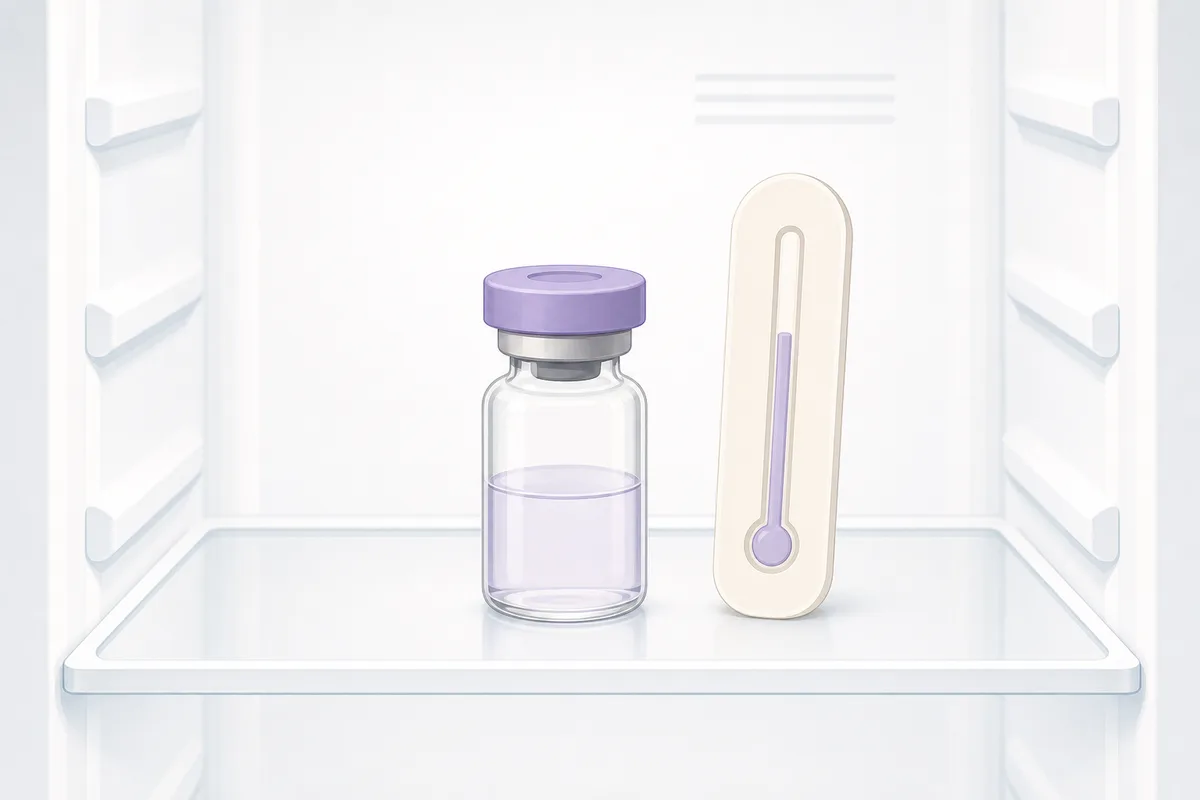
TL;DR: Store lyophilized (powder) peptides sealed at -20°C to -80°C for 2+ years of stability, or 2-8°C for 6-12 months. Once reconstituted with bacteriostatic water, refrigerate at 2-8°C — never freeze — and use within 4-6 weeks, protecting vials from light and always tracking your reconstitution date.
Proper storage is critical for maintaining peptide integrity and ensuring reliable research results. This guide covers everything you need to know about storing peptides in both lyophilized (powder) and reconstituted (liquid) forms.
Why Storage Matters
Peptides are delicate molecules that can degrade when exposed to:
- Heat — Accelerates chemical degradation
- Light — Causes photodegradation
- Moisture — Triggers hydrolysis in powder form
- Oxygen — Leads to oxidation of sensitive residues
- Bacterial contamination — Compromises solution integrity
Proper storage minimizes these risks and preserves peptide potency throughout your research protocol.
Lyophilized (Powder) Storage
Recommended Conditions
| Storage Type | Temperature | Duration | Best For |
|---|---|---|---|
| Long-term | -20°C to -80°C | 2+ years | Stock storage |
| Medium-term | 2-8°C (refrigerator) | 6-12 months | Active inventory |
| Short-term | Room temperature | Days to weeks | Not recommended |
Best Practices for Powder Storage
- Keep sealed — Don’t open vials until ready to reconstitute
- Use desiccant — Store with silica gel packets to absorb moisture
- Protect from light — Keep in original packaging or amber vials
- Minimize freeze-thaw — Avoid temperature fluctuations
- Organize inventory — Label with receipt date and lot numbers
Freezer Storage Tips
- Use a dedicated research freezer if possible
- Avoid door storage (temperature fluctuates)
- Place vials in sealed containers for extra protection
- Consider aliquoting large quantities before freezing
Reconstituted (Liquid) Storage
Once mixed with bacteriostatic water, peptides become more vulnerable to degradation. If you haven’t reconstituted a peptide before, our step-by-step reconstitution guide walks through the process in detail.
Recommended Conditions
| Peptide Type | Temperature | Duration | Notes |
|---|---|---|---|
| Most peptides | 2-8°C | 4-6 weeks | Standard refrigeration |
| Sensitive peptides | 2-8°C | 2-4 weeks | GH secretagogues, some GLP-1s |
| Very stable peptides | 2-8°C | 6-8 weeks | BPC-157, some others |
Critical Rules for Reconstituted Peptides
- Never freeze — Ice crystals damage peptide structure
- Refrigerate immediately — Don’t leave at room temperature
- Protect from light — Wrap vials in foil or use amber vials
- Use sterile technique — Always swab stopper before drawing
- Track reconstitution date — Label vials clearly
Storage by Peptide Category
Reconstituted shelf life varies noticeably by peptide class — the sturdiest last roughly twice as long as the most sensitive.
Upper end of each peptide's recommended use-by window after reconstitution.
GLP-1 Agonists (Semaglutide, Tirzepatide, Retatrutide)
| Form | Storage | Duration |
|---|---|---|
| Lyophilized | -20°C | 2+ years |
| Reconstituted | 2-8°C | 4-6 weeks |
Notes: These peptides are relatively stable. Pharmaceutical versions have similar storage requirements. For dosing and comparison details, see our semaglutide, tirzepatide, and retatrutide comparison guide.
Healing Peptides (BPC-157, TB-500)
| Peptide | Reconstituted Stability | Notes |
|---|---|---|
| BPC-157 | 6-8 weeks | Very stable |
| TB-500 | 4 weeks | More sensitive |
Notes: BPC-157 is notably stable among peptides. TB-500 degrades faster after reconstitution. Learn more about how it’s used in research in our BPC-157 overview.
Growth Hormone Secretagogues (Ipamorelin, GHRP-2, GHRP-6)
| Form | Storage | Duration |
|---|---|---|
| Lyophilized | -20°C | 2+ years |
| Reconstituted | 2-8°C | 3-4 weeks |
Notes: GH secretagogues are generally more sensitive. Use within 3-4 weeks for best results. See our ipamorelin guide for more on this peptide class.
Anti-Aging Peptides (Epithalon, GHK-Cu)
| Peptide | Reconstituted Stability | Notes |
|---|---|---|
| Epithalon | 4-6 weeks | Standard stability |
| GHK-Cu | 4-6 weeks | Solution may have blue tint (normal) |
Signs of Peptide Degradation
Discard peptides if you observe:
- Cloudiness — Clear solutions should remain clear
- Particles — Floating matter indicates contamination or precipitation
- Color change — Most peptides should remain colorless
- Unusual odor — May indicate bacterial growth
- Reduced efficacy — If research results decline
Common Storage Mistakes
Mistake 1: Storing in the Freezer Door
The door experiences the most temperature variation. Store vials in the back of the freezer.
Mistake 2: Freezing Reconstituted Peptides
Never freeze liquid peptide solutions. Ice formation damages molecular structure.
Mistake 3: Leaving Vials at Room Temperature
Even brief periods at room temperature accelerate degradation. Return to refrigerator immediately after drawing.
Mistake 4: Not Tracking Dates
Always label vials with:
- Reconstitution date
- Concentration
- Expiration (4-6 weeks from reconstitution)
Mistake 5: Using Non-Sterile Technique
Contamination drastically reduces peptide stability. Always:
- Swab stoppers with alcohol
- Use new needles
- Work in clean environment
For a full walkthrough of proper technique, see our injection best practices guide.
Temperature Monitoring
For critical research, consider:
- Refrigerator thermometer — Verify 2-8°C range
- Freezer thermometer — Confirm -20°C or lower
- Data logger — Track temperature over time
- Alarm systems — Alert to temperature excursions
Travel and Shipping
When transporting peptides:
Lyophilized
- Can tolerate brief temperature excursions
- Ship with cold packs for multi-day transit
- Avoid extreme heat
Reconstituted
- Must maintain cold chain (2-8°C)
- Use insulated containers with ice packs
- Minimize transit time
- Do not freeze
Storage Checklist
Before Reconstitution:
- Store lyophilized vials at -20°C or colder
- Keep sealed until ready to use
- Protect from light and moisture
- Track lot numbers and receipt dates
After Reconstitution:
- Refrigerate immediately (2-8°C)
- Label with date and concentration
- Wrap in foil or use amber vials
- Set reminder for expiration (4-6 weeks)
- Never freeze
FAQ
How long can lyophilized peptides be stored before use? Properly sealed lyophilized peptides stored at -20°C or colder can remain stable for 2+ years. At refrigerator temperatures (2-8°C), plan on 6-12 months of stability. Always protect vials from light and moisture regardless of temperature, and check the purity documentation before extended storage.
Can reconstituted peptides be frozen to extend shelf life? No — freezing reconstituted peptides is one of the most common storage mistakes. Ice crystal formation physically disrupts the peptide chain, degrading structure and potency. Always keep reconstituted vials refrigerated at 2-8°C and use within the recommended 4-6 week window rather than freezing them for later.
Why does GHK-Cu solution turn slightly blue? The blue tint comes from the copper ion bound to the peptide and is a normal, expected characteristic of GHK-Cu solutions, not a sign of degradation. True degradation typically shows as cloudiness, particulates, or an unusual odor rather than color from the copper complex itself.
What’s the fastest way to check if a peptide has degraded? Visually inspect the vial: clear solutions should stay clear, with no cloudiness, floating particles, or unusual odor. Also compare your reconstitution date against the peptide’s known stability window. If any of these signs appear, or you’re unsure about the purity documentation, discard the vial.
Is it safe to store lyophilized and reconstituted peptides in the same freezer? Lyophilized (powder) peptides tolerate freezer temperatures well, but reconstituted solutions must never be frozen. If sharing freezer space, keep reconstituted vials in the refrigerator (2-8°C) section only, and clearly label lyophilized stock so it isn’t mistaken for liquid inventory ready to freeze.
Summary
| Form | Temperature | Duration | Key Points |
|---|---|---|---|
| Lyophilized | -20°C to -80°C | 2+ years | Keep sealed, protect from moisture |
| Reconstituted | 2-8°C | 4-6 weeks | Never freeze, protect from light |
Proper storage ensures your research peptides maintain their integrity and provide consistent, reliable results throughout your protocol.
Last updated: December 20, 2025
Disclaimer: This information is for educational and research purposes only. Peptides are research chemicals not intended for human consumption.