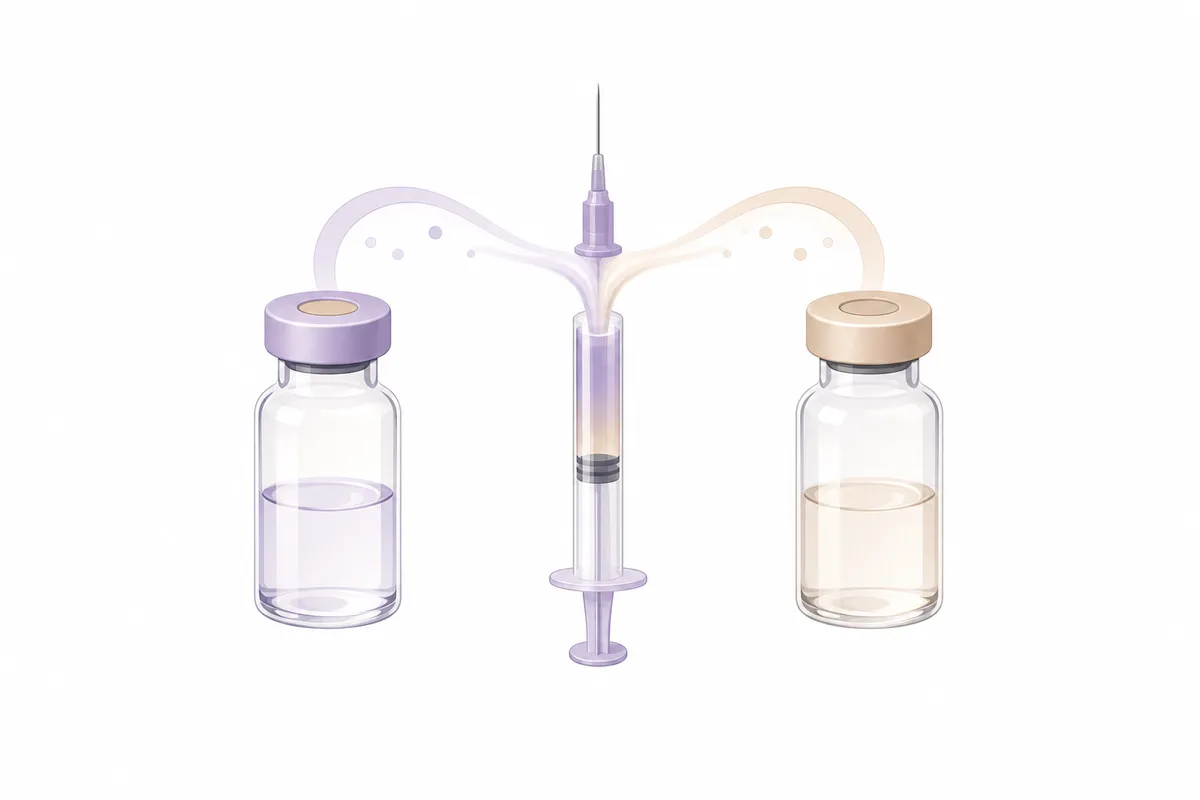
TL;DR: In peptide blend dosing, a “15/15mg” label means 15mg of each of the two compounds in one shared vial, so the total peptide mass is 30mg. Reconstitute both together in a single volume of bacteriostatic water; the mixed concentration and per-compound units follow directly from that ratio.
What “15/15mg” actually means on a blend vial
The slash notation on a two-compound vial is a per-ingredient list, not a total. A 15/15mg blend is 15mg of the first peptide plus 15mg of the second peptide, freeze-dried together in the same vial. That adds up to 30mg of total peptide mass, split 1:1.
This is where the recurring forum question comes from: people see one number style (“30mg blend”) on one brand and a slashed style (“15/15mg”) on another and assume they are different products. They usually are not. A 15/15mg vial and a “30mg total, 1:1” vial describe the same thing. The slash format is simply more honest about how the mass is divided, which matters a great deal once you start doing peptide blend dosing math.
A few label styles you will encounter:
- 15/15mg — 15mg of compound A, 15mg of compound B (30mg total, 1:1 ratio).
- 10/10mg — 10mg each, 20mg total.
- 5/5/5mg — a three-compound blend, 5mg each, 15mg total.
- 2/10mg — an asymmetric blend: 2mg of A and 10mg of B. The ratio is not 1:1, which changes every downstream calculation.
The takeaway: read each number as a separate ingredient. The total is the sum, and the ratio between the numbers is what you actually anchor your dosing to.
The slash lists each compound separately; the total is the sum.
Why the total mass matters less than the ratio
Here is the counterintuitive part. For peptide blend dosing, the “is it 15mg or 30mg” question is mostly about labeling clarity. What governs your actual per-injection amounts is the ratio between the compounds and the total volume you reconstitute in — not the headline total.
Because both peptides dissolve in the same water, they share one concentration figure per milliliter, but each has its own milligram-per-mL value tied to its share of the vial. In a 1:1 blend, when you draw any volume, you are always pulling equal masses of each compound. You physically cannot separate them once mixed. That is the single most important consequence of a shared-vial blend, and it is why the ratio is baked in at the factory rather than chosen at the syringe.
If you want the deeper conceptual background on how single-compound concentration works before layering on a second peptide, our guide to converting mcg to units on an insulin syringe walks through the base arithmetic that every blend calculation is built on.
The core peptide blend dosing math
Every blend calculation rests on the same two formulas you use for a single peptide. The trick is applying them per compound while remembering both share one water volume.
Step 1 — Concentration of each compound:
Concentration of A (mg/mL) = mg of A in vial ÷ mL of bacteriostatic water
Concentration of B (mg/mL) = mg of B in vial ÷ mL of bacteriostatic water
Step 2 — Convert your draw volume to units: On a U-100 insulin syringe, 1 mL = 100 units, so 0.1 mL = 10 units. Units are just a volume scale; they do not “know” about milligrams.
Step 3 — Mass of each compound per draw:
mcg of A per draw = Concentration of A (mg/mL) × draw volume (mL) × 1000
mcg of B per draw = Concentration of B (mg/mL) × draw volume (mL) × 1000
In a 1:1 blend the two concentrations are identical, so any given draw delivers the same mcg of each peptide. In an asymmetric blend they differ, and you anchor the draw to whichever compound is your reference point.
Rather than run this by hand every time, our free peptide reconstitution and dosing calculator handles the per-compound conversion once you enter the vial contents and water volume. It is the fastest way to sanity-check the worked example below.
Worked example: a 15/15mg GHRH + GHRP blend
Let’s use the archetypal pairing — a GHRH analog plus a GHRP-type secretagogue, the same two-pathway logic behind the classic CJC-1295 and ipamorelin blend. Say a research vial is labeled 15/15mg: 15mg CJC-1295 (no DAC / modified GRF 1-29) and 15mg ipamorelin, 30mg total.
Reconstitution: Add 3 mL of bacteriostatic water to the single vial. Both peptides dissolve in that same 3 mL.
Concentration of each compound:
15 mg ÷ 3 mL = 5 mg/mL of CJC-1295
15 mg ÷ 3 mL = 5 mg/mL of ipamorelin
A draw of 20 units (0.2 mL):
5 mg/mL × 0.2 mL × 1000 = 1000 mcg CJC-1295
5 mg/mL × 0.2 mL × 1000 = 1000 mcg ipamorelin
So 20 units delivers 1000mcg (1mg) of each compound — 2mg of total peptide in that draw. Because it is a 1:1 blend, you can describe the draw as “1000/1000mcg.” The whole vial holds 15 such draws before it is empty.
20 units on a U-100 syringe = 0.20 mL, delivering 1000 mcg of each compound.
Here is the same 15/15mg blend reconstituted in 3 mL, shown across common draw volumes:
| Draw (units) | Draw (mL) | CJC-1295 delivered | Ipamorelin delivered | Total peptide in draw |
|---|---|---|---|---|
| 5 units | 0.05 mL | 250 mcg | 250 mcg | 500 mcg |
| 10 units | 0.10 mL | 500 mcg | 500 mcg | 1000 mcg |
| 15 units | 0.15 mL | 750 mcg | 750 mcg | 1500 mcg |
| 20 units | 0.20 mL | 1000 mcg | 1000 mcg | 2000 mcg |
Notice the pattern: in a 1:1 blend, the “per compound” column is always exactly half of the total. Change the water volume and every number scales — reconstitute the same vial in 1.5 mL instead of 3 mL and each draw delivers twice the mcg per unit. If you want to compare pre-mixed research options, product pages such as the CJC-1295 + ipamorelin blend 10mg listing and the single-compound ipamorelin 10mg vial show how ratios and totals are presented in practice.
What the research shows about GHRH + GHRP blends
The reason two peptides get combined into one vial is not marketing — it is a genuine pharmacological rationale documented across decades of endocrinology literature. GHRH analogs and GHRP-type (ghrelin-receptor) secretagogues act on two distinct pituitary pathways, and studied together they raise growth hormone more than either does alone.
The synergy is well established in controlled human work. In a landmark study, Bowers and colleagues showed that GHRP administered with GHRH in normal men produced a GH response significantly greater than the arithmetic sum of each compound given separately — a true synergistic effect, not simple addition (Bowers et al., 1990). Follow-up work confirmed that the GHRP response depends partly on endogenous hypothalamic GHRH, explaining why the two are pharmacologically complementary (Popovic et al., 1995).
On the individual compounds: ipamorelin was characterized as the first selective GH secretagogue — it released GH potently in vitro and in vivo without raising ACTH or cortisol beyond what GHRH itself did, distinguishing it from earlier GHRPs (Raun et al., 1998). CJC-1295 (in its DAC form) was studied in randomized, placebo-controlled trials in healthy adults, producing dose-dependent GH and IGF-I increases over several days (Teichman et al., 2006). A broader review traces the full history and mechanism of this drug class (Ishida et al., 2020).
Be honest about the evidence stage. Much of the synergy data comes from acute-dosing studies and animal models; the specific pre-mixed “blend” products sold for research are not themselves the subject of long-term human efficacy or safety trials. These are laboratory reference compounds. The literature explains why the pairing is interesting mechanistically — it does not constitute a validated human protocol.
Common mistakes in blend dosing math
- Treating the slash as a total. “15/15mg” is 30mg, not 15mg. Halving it in your head undershoots your concentration.
- Forgetting both peptides share one water volume. You do not reconstitute each compound separately; there is one vial, one water addition, one shared mL scale.
- Assuming units equal mcg. Units measure volume on the syringe. The mcg delivered depends on concentration, which depends on your water volume.
- Applying 1:1 logic to an asymmetric blend. A 2/10mg vial delivers five times as much of one compound per draw. Always check the ratio first.
- Anchoring to the wrong compound. In an asymmetric blend, decide which peptide is your reference before you calculate the draw.
Frequently Asked Questions
Is a 15/15mg blend only 15mg total or 30mg total?
It is 30mg total. The slash notation lists each ingredient separately: 15mg of the first peptide plus 15mg of the second, freeze-dried together in one vial. Read each number as its own compound, then add them for the total peptide mass. The ratio here is 1:1.
How do I reconstitute and dose a two-peptide blend thats already in one vial?
Add your chosen volume of bacteriostatic water to the single vial — both peptides dissolve in that same water. There is one concentration scale per milliliter. You cannot separate the compounds after mixing, so the factory ratio between them stays fixed in every draw you take.
How do I work out units for each compound when they are mixed together?
Divide each compound’s milligrams by your water volume to get its mg/mL, then multiply by your draw volume (in mL) and by 1000 for mcg. On a U-100 syringe, 100 units equals 1 mL. In a 1:1 blend both compounds deliver identical mcg per draw.
Why are two peptides combined into one blend vial?
Blends usually pair a GHRH analog with a GHRP-type secretagogue because they act on two separate pituitary pathways. Research shows combined GHRH and GHRP administration raises growth hormone more than the sum of each alone, so co-formulating them in one vial reflects that documented mechanistic synergy and simplifies handling.
References
- Bowers CY, Reynolds GA, Durham D, Barrera CM, Pezzoli SS, Thorner MO. Growth hormone (GH)-releasing peptide stimulates GH release in normal men and acts synergistically with GH-releasing hormone. Journal of Clinical Endocrinology & Metabolism. 1990;70(4):975-982.
- Popovic V, Damjanovic S, Micic D, et al. Blocked growth hormone-releasing peptide (GHRP-6)-induced GH secretion and absence of the synergic action of GHRP-6 plus GH-releasing hormone in patients with hypothalamopituitary disconnection. Journal of Clinical Endocrinology & Metabolism. 1995;80(3):942-947.
- Raun K, Hansen BS, Johansen NL, et al. Ipamorelin, the first selective growth hormone secretagogue. European Journal of Endocrinology. 1998;139(5):552-561.
- Teichman SL, Neale A, Lawrence B, Gagnon C, Castaigne JP, Frohman LA. Prolonged stimulation of growth hormone (GH) and insulin-like growth factor I secretion by CJC-1295, a long-acting analog of GH-releasing hormone, in healthy adults. Journal of Clinical Endocrinology & Metabolism. 2006;91(3):799-805.
- Ishida J, Saitoh M, Ebner N, Springer J, Anker SD, von Haehling S. Growth hormone secretagogues: history, mechanism of action, and clinical development. JCSM Rapid Communications. 2020;3(1):25-37.
All content is for research and educational reference only (research use only); it describes what the literature reports and is not medical advice or a human dosing recommendation.