TL;DR: To work out how many units is your peptide dose on a U-100 insulin syringe, first find concentration (mg per mL) = peptide mass divided by bacteriostatic water added. Then units = (dose in mg / concentration) times 100, because 1 mL equals 100 units. Change the water volume and the units change too.
If you have ever stared at a reconstituted vial and a tiny insulin syringe wondering how many units is my peptide dose, you are asking one of the most common questions in every research forum. The good news: it is pure arithmetic. Once you understand three relationships — mass, volume, and concentration — the conversion from micrograms (mcg) or milligrams (mg) to “units” on a syringe becomes something you can do in your head. This is educational math for handling research materials, not a human dosing prescription.
The three numbers that matter
Every peptide unit conversion sits on three quantities. Get comfortable with these and everything else falls out:
- Mass — how much peptide is in the vial, labelled in mg (milligrams) or mcg (micrograms). Remember 1 mg = 1000 mcg.
- Volume — how much bacteriostatic water (BAC water) you add during reconstitution, measured in mL.
- Concentration — mass divided by volume, expressed as mg/mL or mcg/mL. This is the number that actually controls your units-per-dose.
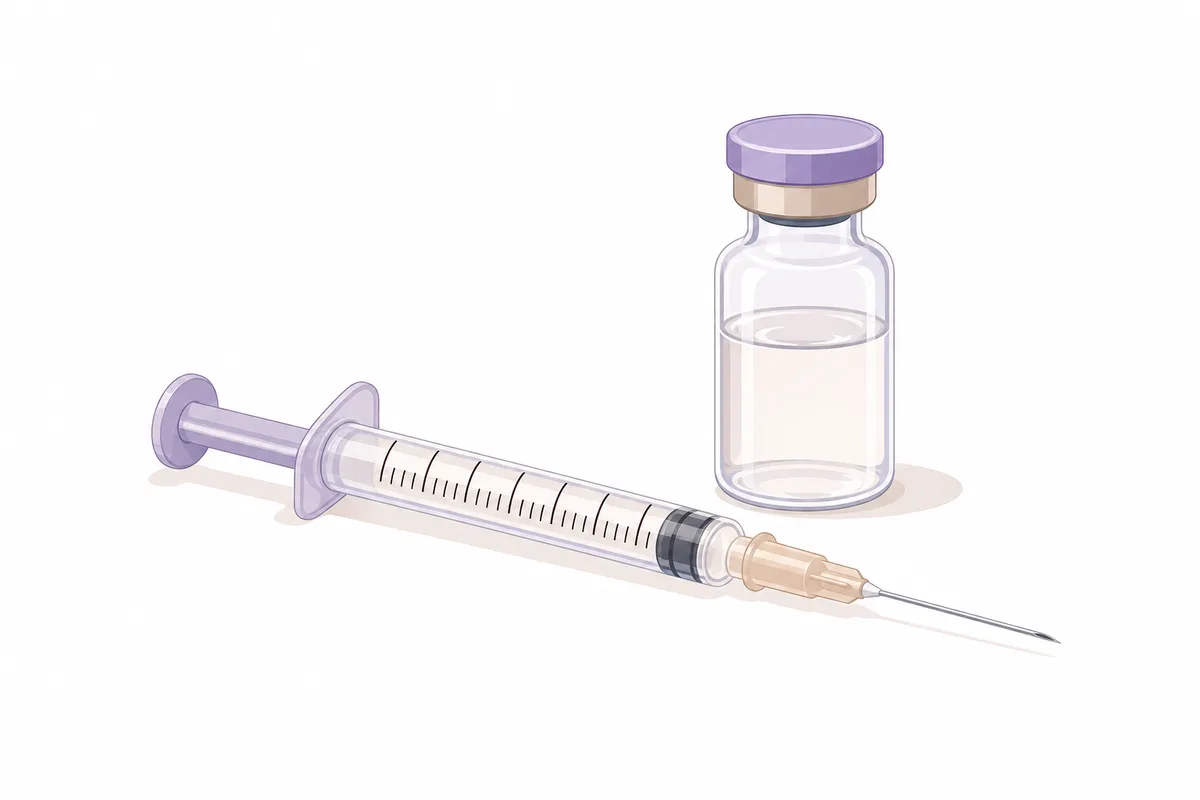
The insulin syringe adds a fourth idea, but it is fixed and universal: a U-100 insulin syringe is calibrated so that 1 mL = 100 units. That is the standard concentration marking for insulin worldwide, recognised in FDA-approved insulin labelling. So 1 unit = 0.01 mL, 10 units = 0.1 mL, and 50 units = 0.5 mL. Nothing you do to the peptide changes the syringe scale — the syringe only ever measures volume.
Step 1: Find your concentration after reconstitution
Concentration is the hinge of the whole calculation:
Concentration (mg/mL) = peptide mass in the vial (mg) ÷ BAC water added (mL)
Say you have a 10 mg vial and you add 2 mL of BAC water. Then:
- Concentration = 10 mg ÷ 2 mL = 5 mg/mL
- In micrograms that is 5 × 1000 = 5000 mcg/mL
If you would rather not do this by hand every time, the PeptiMap peptide reconstitution and dosage calculator runs these numbers for you, and the printable peptide reconstitution chart gives common vial-and-water combinations at a glance. For a deeper walk-through of the mixing step itself, the step-by-step peptide reconstitution guide covers technique.
Step 2: Convert your target dose into mL
Keep your units consistent. If your dose is in mcg and your concentration is in mg/mL, convert one of them first. The cleanest approach is to work everything in mcg/mL:
Volume per dose (mL) = dose (mcg) ÷ concentration (mcg/mL)
Using the 5000 mcg/mL vial above, a 250 mcg dose is:
- 250 mcg ÷ 5000 mcg/mL = 0.05 mL
Step 3: Convert mL into insulin-syringe units
This is the easy part. Because 1 mL = 100 units on a U-100 syringe:
Units = volume (mL) × 100
So 0.05 mL × 100 = 5 units. That is how many units is your peptide dose in this scenario. The full chain, start to finish, looks like this:
Units = (dose in mg ÷ concentration in mg/mL) × 100
Or entirely in micrograms:
Units = dose (mcg) ÷ (concentration in mcg/mL) × 100
- 1
Step 1 — Concentration
Peptide mass ÷ BAC water added. A 10 mg vial in 2 mL = 5 mg/mL (5,000 mcg/mL).
- 2
Step 2 — Volume per dose
Dose ÷ concentration. 250 mcg ÷ 5,000 mcg/mL = 0.05 mL.
- 3
Step 3 — Units
Volume × 100. 0.05 mL × 100 = 5 units on a U-100 syringe.
On a U-100 syringe, 100 units = 1 mL — so 25 units = 0.25 mL. Whatever your dose works out to in mL, multiply by 100 to get units.
Worked examples: mcg/mg to units on an insulin syringe
The table below reconstitutes the same 10 mg vial with different amounts of BAC water, then reads off the units for a fixed 250 mcg research dose. Watch the last column move.
| BAC water added | Concentration | 250 mcg dose = volume | Units on U-100 syringe |
|---|---|---|---|
| 1 mL | 10 mg/mL (10,000 mcg/mL) | 0.025 mL | 2.5 units |
| 2 mL | 5 mg/mL (5,000 mcg/mL) | 0.05 mL | 5 units |
| 3 mL | 3.33 mg/mL (3,333 mcg/mL) | 0.075 mL | 7.5 units |
| 5 mL | 2 mg/mL (2,000 mcg/mL) | 0.125 mL | 12.5 units |
Same vial, same target dose, four different unit readings. That is the single most important takeaway in this entire article, and it is the trap that trips up almost everyone new to peptide math.
More water lowers concentration, so you draw more units for the identical dose.
The BAC water trap: why your units keep changing
Here is the counter-intuitive part. The amount of BAC water you add does not change the actual dose of peptide — 250 mcg is 250 mcg regardless. What it changes is how many units of volume you draw to deliver that dose.
Think of it like squash concentrate. Whether you dilute a fixed amount of syrup in a small glass or a big jug, the amount of syrup is the same; you just sip a different volume to get it. More water means a lower concentration, which means you draw more units to hit the same mcg. Less water means higher concentration and fewer units.
This is why copying someone else’s “I pull it to 10 units” number is meaningless unless you also reconstituted your vial with the exact same peptide mass and the exact same water volume. Two researchers can both target 250 mcg and correctly draw completely different unit marks. The math for multi-peptide vials adds another layer — see the peptide blend dosing math walkthrough for how fixed-ratio blends complicate the per-unit reading. The broader framing lives in peptide dosing 101.
A practical consequence: choose your water volume so common doses land on easy, readable unit marks. Fractions like 2.5 units are hard to draw accurately on a 1 mL syringe; picking a concentration where your dose falls on a whole 5- or 10-unit line reduces measurement error.
What the research shows
It is worth separating the arithmetic (which is settled and universal) from the pharmacology (which is where evidence quality varies). The mcg-to-units conversion is just the definition of a U-100 syringe; there is nothing uncertain about it. The compounds people are measuring, however, sit at very different stages of evidence.
Take the frequently reconstituted pair CJC-1295 and ipamorelin. CJC-1295 is a long-acting analogue of growth-hormone-releasing hormone (GHRH). In a randomised, placebo-controlled human study, Teichman and colleagues reported that a single subcutaneous injection produced dose-dependent increases in mean plasma growth hormone (2- to 10-fold for six days or more) and IGF-I (1.5- to 3-fold for 9 to 11 days), with an estimated half-life of about 5.8 to 8.1 days (Teichman et al., 2006). A companion study confirmed that pulsatile GH secretion persisted during this sustained stimulation (Ionescu and Frohman, 2006).
Ipamorelin is a selective growth-hormone secretagogue — a pentapeptide first described by Raun and colleagues in 1998, notable because it released GH in animal models without the cortisol, prolactin, or ACTH spikes seen with earlier peptides. Human pharmacokinetic modelling later put its terminal half-life at roughly two hours (Gobburu et al., 1999), which is why it is a short-acting compound in the literature.
Two honest caveats. First, much of the mechanistic detail — especially the selectivity story — comes from animal models, and animal-to-human extrapolation is imperfect. Second, while the individual components have human pharmacokinetic data, robust human clinical-trial evidence for the combined CJC-1295 plus ipamorelin blend as marketed is limited. Neither is an approved therapeutic in this context; both remain research compounds. None of this is a recommendation to dose anything — it is background on why the numbers on the vial exist.
A quick reference: mL and units at a glance
| Volume drawn | Units on U-100 syringe |
|---|---|
| 0.01 mL | 1 unit |
| 0.05 mL | 5 units |
| 0.10 mL | 10 units |
| 0.25 mL | 25 units |
| 0.50 mL | 50 units |
| 1.00 mL | 100 units |
Pair this with your own concentration and you can convert any mcg or mg figure in seconds. If you want a concrete product page to see how vial mass is listed before you even reconstitute, the Ipamorelin 10 mg reference page shows a typical starting mass for these calculations.
Frequently Asked Questions
How many units is 250 mcg on my insulin syringe?
It depends entirely on your concentration. At 5 mg/mL (a 10 mg vial in 2 mL BAC water), 250 mcg is 0.05 mL, which reads as 5 units on a U-100 syringe. At 10 mg/mL it would be 2.5 units, and at 2 mg/mL it would be 12.5 units. Always calculate from your own concentration.
Why does my units-per-dose change when I use more or less bac water?
Because units measure volume, not peptide mass. Adding more BAC water lowers the concentration, so you must draw a larger volume — more units — to deliver the same micrograms. Less water raises concentration and needs fewer units. The peptide amount is unchanged; only the volume you pull to reach it shifts.
What’s the difference between units, mL, mg and mcg?
mg and mcg measure the mass of peptide (1 mg = 1000 mcg). mL measures liquid volume. Units are a volume scale on a U-100 insulin syringe where 1 mL = 100 units, so 1 unit = 0.01 mL. Concentration (mg/mL) is the bridge that converts a mass dose into a volume you can draw.
How long will one vial of CJC-1295 + Ipamorelin last at my dose?
Divide the total mass in the vial by your per-dose mass, then account for frequency. A 5 mg (5000 mcg) vial used at a 250 mcg research dose provides 20 doses. At one dose per day that is roughly 20 days; every other day it is about 40. Reconstituted vials also have limited stability, so factor that in.
Does the amount of bac water I add change my actual dose?
No. The BAC water only changes concentration and therefore the volume (units) you draw. Your actual peptide dose in micrograms is fixed by the mass you pull, not by how much water you diluted it in. More water simply means more units for the same dose; less water means fewer.
References
- Teichman SL, Neale A, Lawrence B, Gagnon C, Castaigne JP, Frohman LA. Prolonged stimulation of growth hormone (GH) and insulin-like growth factor I secretion by CJC-1295, a long-acting analog of GH-releasing hormone, in healthy adults. Journal of Clinical Endocrinology and Metabolism. 2006;91(3):799-805. doi:10.1210/jc.2005-1536.
- Ionescu M, Frohman LA. Pulsatile secretion of growth hormone (GH) persists during continuous stimulation by CJC-1295, a long-acting GH-releasing hormone analog. Journal of Clinical Endocrinology and Metabolism. 2006;91(12):4792-4797. doi:10.1210/jc.2006-1702.
- Raun K, Hansen BS, Johansen NL, Thøgersen H, Madsen K, Ankersen M, Andersen PH. Ipamorelin, the first selective growth hormone secretagogue. European Journal of Endocrinology. 1998;139(5):552-561. doi:10.1530/eje.0.1390552.
- Gobburu JV, Agersø H, Jusko WJ, Ynddal L. Pharmacokinetic-pharmacodynamic modeling of ipamorelin, a growth hormone releasing peptide, in human volunteers. Pharmaceutical Research. 1999;16(9):1412-1416. doi:10.1023/A:1018955126402.
- Agersø H, Larsen LS, Riis A, Lövgren U, Karlsson MO, Senderovitz T. Pharmacokinetics and pharmacodynamics of ipamorelin, a novel growth hormone secretagogue, in healthy subjects. European Journal of Pharmaceutical Sciences. 2004;21(2-3):349-357. doi:10.1016/j.ejps.2003.10.026.
- U.S. Food and Drug Administration. Humulin R U-100 (insulin human injection, USP) prescribing information: 100 units per mL standard. FDA-approved labelling, 2011.
This article is educational and provided strictly for research-use-only contexts; it is not medical advice or a human dosing prescription.