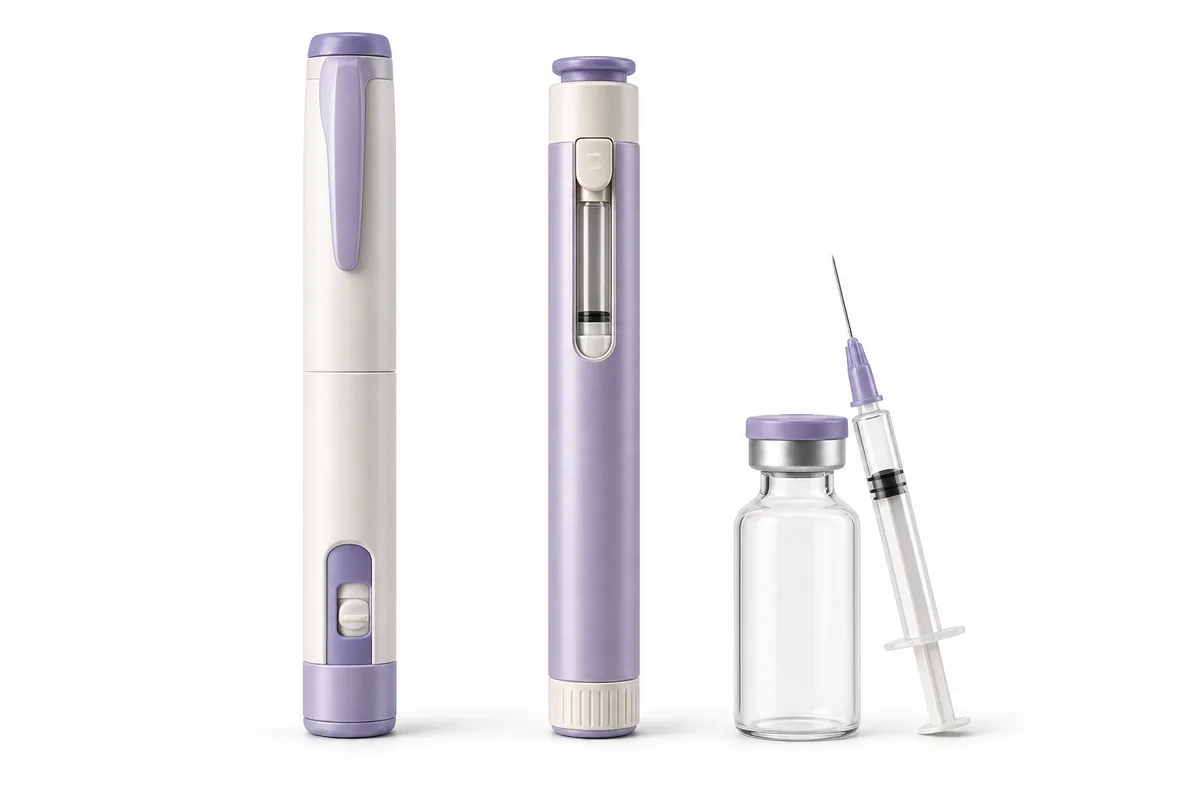
TL;DR: A peptide injector pen is either a prefilled disposable (fixed-dose or dial-a-dose, made for one branded drug at one concentration) or a reusable pen that takes a swappable cartridge. Both dose in the drug’s own units, not insulin units, which is the single most common point of confusion. A vial and insulin syringe trade that convenience for full control over concentration and dose — which is why it’s still the default workflow for research use.
Search interest in “peptide pen” has climbed alongside the branded GLP-1 boom — Ozempic, Wegovy, Mounjaro, and Zepbound all ship in pen form, and most people’s first hands-on experience with an injectable peptide is now a pen rather than a vial. If you’ve spent time with the vial-and-syringe workflow this site normally covers, a pen looks similar but runs on different logic entirely. This is a device-mechanics explainer, not a dosing guide — it’s here to make the pen make sense, and to be honest about why the vial workflow still dominates research use.
The three formats, side by side
Every injectable peptide delivery system on the market falls into one of three buckets. They differ less in “what’s inside” and more in who controls the concentration and the dose.
| Prefilled disposable pen | Reusable pen + cartridge | Vial + insulin syringe | |
|---|---|---|---|
| Flexibility | Locked to one drug, one concentration | Locked to the cartridge’s concentration | Any concentration you reconstitute |
| Dose control | Fixed step or dial in the drug’s own units | Dial in the drug’s own units | Any volume, read directly in mL/units |
| Cost per use | Higher — device discarded with the drug | Moderate — pen reused, cartridges bought | Lowest — syringes are inexpensive |
| Learning curve | Very low — click and go | Low — load cartridge, dial, inject | Higher — draw, measure, calculate |
Prefilled disposable pens
This is the format nearly everyone associates with GLP-1 therapy. A prefilled pen arrives loaded with a fixed volume of one specific drug at one specific concentration, and it’s built for exactly one use case: get that drug into you without any measuring.
There are two sub-styles, and the distinction matters:
- Fixed-dose pens deliver a single, unchangeable dose per click. There’s no dial, sometimes no visible needle, and the pen is a single-use, single-dose device — you use it once and it’s done.
- Dial-a-dose pens hold enough drug for several doses. Before each injection you rotate a dial to select the dose you’re taking that time, click the trigger, and the pen delivers exactly that amount. The same pen gets reused across several weeks until it’s empty, then it’s discarded regardless of the drug’s actual shelf stability, because the device itself isn’t designed to be refilled.
In both cases, the manufacturer has already decided the concentration. You never touch bacteriostatic water, you never draw anything, and you never see a “mg per mL” figure — the pen abstracts all of that away in exchange for locking you into whatever the manufacturer built.
Reusable pens and cartridges
The second format is a durable pen body — dial, trigger, housing — that you keep, paired with a replaceable drug cartridge you swap in when one runs empty. This is the model classic insulin pens popularized, and it shows up in some non-GLP-1 injectable workflows too.
The mechanics mirror a dial-a-dose disposable: load the cartridge, screw on a fresh pen needle, dial the dose, inject. The only difference is that the outer pen survives between cartridges instead of being thrown away with the drug. It splits the difference on cost — pay once for the pen body, then repeatedly for cartridges — without ever handing you control over what’s inside the cartridge.
How the dose dial actually works
A dial-a-dose pen doesn’t measure volume the way a syringe does. Instead, the pen’s internal mechanism is calibrated to a single known concentration — the one specific to that cartridge or prefilled reservoir — and the dial is marked directly in the drug’s dosing units for that product. Turn the dial to “0.5,” click, and the pen’s internal plunger travels exactly far enough to deliver 0.5 of whatever unit that pen uses, at whatever concentration it was filled with.
This is the exact inverse of how the vial workflow works. On a vial, you pick the concentration yourself by choosing how much BAC water to add, then you calculate the volume that delivers your target dose and read it off the syringe barrel in mL or insulin units. On a pen, the manufacturer already fixed the concentration at the factory, so the dial can afford to just show you the drug amount directly — there’s nothing left for you to calculate because there’s nothing left for you to control. Our mcg to insulin-syringe units guide walks through that vial-side math in detail if you want to see the calculation the pen is hiding from you.
The vial and syringe workflow, for comparison
The vial-and-syringe approach that most peptide research protocols use looks primitive next to a pen, but the apparent simplicity of a pen is really just someone else making the concentration decision for you in advance.
On a U-100 insulin syringe, 35 units = 0.35 mL — a volume you calculate yourself from your own reconstitution, not a number a manufacturer preset.
With a vial, the chain is: reconstitute at a concentration you choose, calculate the volume for your target dose, draw that volume on an insulin syringe, inject. Every step is visible and adjustable. Our step-by-step reconstitution guide and peptide dosing 101 cover those first two steps in full, and injection best practices covers the technique once the dose is drawn.
Why the vial route still dominates in research
The honest trade is flexibility versus convenience, and it cuts cleanly:
A pen buys speed and zero arithmetic, at the cost of being locked to one concentration and one manufacturer’s fixed dose increments — if your target dose doesn’t line up with the dial, you’re stuck rounding to the nearest click. A vial buys the ability to set any concentration by choosing your own BAC water volume, then draw any dose that concentration supports, read straight off a syringe barrel. That flexibility is what most research protocols need, since research compounds rarely arrive pre-matched to a commercial pen’s fixed concentration the way a handful of blockbuster GLP-1 drugs do.
Neither format is “better” in the abstract — a pen suits a fixed drug, concentration, and schedule; a vial suits needing to set any of those three yourself.
Needles, priming, and storage
Pen needles are a separate, single-use component that screws onto the tip of the pen before each injection and gets removed and discarded afterward — they are not reused across injections. Common pen-needle lengths run roughly from 4 mm up to 8 mm, with gauges typically in the 29-32G range; finer gauges feel more comfortable but can be slower to inject through. Choosing the right length is a function of the injection site’s tissue depth, similar to the angle guidance in injection best practices.
Before the first use of a new pen or a fresh cartridge, most devices call for a small “priming” or “air shot” — dialing a small test amount and expelling it into the air (not into skin) to clear any air from the needle and cartridge, and to confirm the pen is delivering a visible stream. Skipping this step on a brand-new device risks an incomplete first dose.
Storage instructions vary by product, so this is one area where the manufacturer’s own insert is the authority rather than a general rule: most prefilled and reusable pens need refrigeration before their first use, then shift to a defined room-temperature window once they’re in active use, with the exact number of days differing between products. Treat the specific pen’s packaging as the source of truth rather than assuming one product’s window applies to another.
Related reading
If a site or storage reaction comes up regardless of which delivery method you use, injection site reactions and PIP covers what’s normal and what’s worth a closer look.
Frequently asked questions
Is a peptide injector pen the same as an insulin pen?
Mechanically, yes — both use a dial or fixed mechanism to deliver a preset volume of a liquid drug through a screw-on needle. The difference is only what’s inside: an insulin pen is calibrated to an insulin concentration, while a GLP-1 or peptide pen is calibrated to that specific drug’s own concentration. The dial numbers are not interchangeable between them.
Can I draw from a pen cartridge with a syringe instead?
Pen cartridges are designed to be used through the pen’s own mechanism, not accessed directly with a separate syringe, and doing so bypasses the calibration the pen relies on. If you want syringe-based control over concentration and dose, the vial-and-syringe workflow this site covers is built for exactly that, starting with peptide dosing 101.
Why doesn’t my pen’s dose match the syringe units I’m used to?
Because they’re different measurement systems entirely. A syringe reads volume directly off a barrel calibrated to a fixed scale (like U-100), while a pen’s dial is calibrated to the specific concentration inside that pen and displays the drug’s own dosing units. See our mcg to units conversion guide for how the syringe side of that math works.
Do I need a new needle for every pen injection?
Yes. Pen needles are single-use components — a fresh, sterile needle should be attached before each injection and removed immediately after, the same single-use principle covered for syringe needles in injection best practices. Reusing a pen needle dulls the tip and increases the odds of a rougher injection.
Why do prefilled pens get discarded even if there’s drug left inside?
Prefilled pens are built as sealed, single-purpose devices rather than refillable containers, so once the device’s usable life or dose count ends, the whole unit is discarded together. This is part of the convenience trade — you gain a zero-calculation device at the cost of losing the ability to use every last bit of drug the way a vial lets you.
Which format should a researcher choose?
It comes down to whether the concentration and dose you need are already fixed for you. If you’re working with a compound that matches a commercial pen’s exact concentration and dose steps, the pen is faster and simpler. If your protocol needs a specific concentration or dose that doesn’t line up with a preset pen, the vial-and-syringe workflow gives you that control, at the cost of doing the reconstitution math yourself.
This article explains how injector-pen and vial devices work; it is not a dosing recommendation. Consult the specific product’s manufacturer instructions for device details, and a qualified professional for any medical decision.