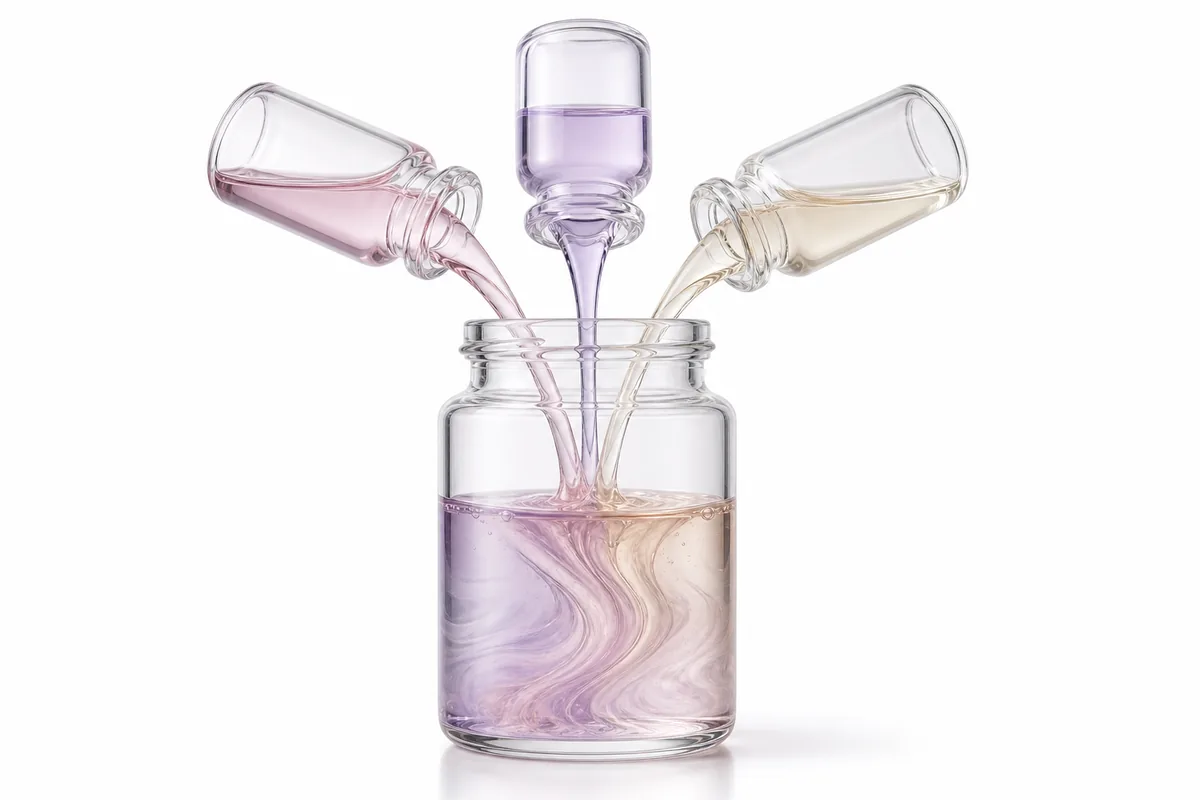
TL;DR: The GLOW peptide blend is GHK-Cu, BPC-157 and TB-500 combined in one vial; KLOW is the same three plus KPV. Both are vendor-marketing constructs, not standardized formulations, so the ratio of each compound varies by supplier and there is no single “correct” recipe. No trial has ever studied the combined blend — every safety and efficacy signal comes from the individual peptides. The part that actually trips people up is the math: because a blend vial states a total ratio, drawing a set number of units delivers a different mg amount of each compound, and that number changes every time you change the reconstitution water or the ratio itself.
What GLOW and KLOW actually are
GLOW stands for a three-peptide mix: GHK-Cu, BPC-157, and TB-500 (the “L” and “OW” come from how the acronym was branded, not from the compound names). KLOW is the same three peptides with KPV added as a fourth.
- GHK-Cu — a naturally occurring copper-binding tripeptide studied for skin and connective-tissue signaling, most associated with the decades of work by Loren Pickart. See our GHK-Cu explainer for the mechanism.
- BPC-157 — a synthetic peptide derived from a gastric protective protein, studied in animal models for gut and tendon repair. Our BPC-157 guide covers what the preclinical literature shows.
- TB-500 — a synthetic fragment related to thymosin beta-4, studied for cell migration and angiogenesis. See our TB-500 explainer.
- KPV — a tripeptide fragment of alpha-MSH studied in vitro and in animal models for anti-inflammatory signaling. Our KPV guide has the detail.
Here is the part worth saying plainly: GLOW and KLOW are not clinical or pharmacopeial names. They are labels a vendor invented to sell a pre-mixed vial, the same way “GHRH + GHRP blend” describes a category rather than one fixed product. Nobody standardized the ratio, nobody ran the combination through a trial, and different suppliers advertise different splits under the identical acronym. If you have seen one GLOW vial, you have seen one vendor’s GLOW vial — not “the” formula.
There is no standard ratio
The most commonly advertised split is 70 mg GHK-Cu / 10 mg BPC-157 / 10 mg TB-500 — 90 mg total, so GHK-Cu makes up roughly four-fifths of the vial by mass. But that is one vendor’s choice, not a settled recipe. Forum discussion around these blends regularly surfaces people self-mixing a completely different split — 50 mg GHK-Cu / 20 mg BPC-157 / 30 mg TB-500 comes up often, which shifts the balance from copper-dominant to a much more even three-way mix.
Both ratios are internally consistent — they just describe different products. This is exactly why reading the label on your specific vial matters more than memorizing any single number from a forum post or a vendor page. The moment you swap suppliers, the ratio can move, and every downstream mg-per-unit figure moves with it.
The dosing math: what a unit actually delivers
This is the genuinely useful part, and it is the same underlying method our peptide blend dosing math guide walks through for two-compound blends — just extended to three or four ingredients sharing one vial.
A blend vial lists milligrams per compound, not per unit and not per mL. Once you reconstitute it, all the compounds share the same bacteriostatic water, so they share one volume — but each compound keeps its own share of the total mass. That means every unit you draw contains a fixed, calculable amount of each peptide, and that amount depends entirely on the total mg of that compound divided by however much water you added.
Worked example. Take the common 70/10/10 GLOW vial — 70 mg GHK-Cu, 10 mg BPC-157, 10 mg TB-500, 90 mg total — and reconstitute it with 2 mL of bacteriostatic water.
Step 1 — concentration of each compound:
GHK-Cu:   70 mg ÷ 2 mL = 35 mg/mL
BPC-157:  10 mg ÷ 2 mL = 5 mg/mL
TB-500:   10 mg ÷ 2 mL = 5 mg/mL
Step 2 — convert to a per-unit amount. On a U-100 insulin syringe, 100 units equals 1 mL, so 1 unit = 0.01 mL:
GHK-Cu per unit:  35 mg/mL × 0.01 mL = 0.35 mg
BPC-157 per unit:  5 mg/mL × 0.01 mL = 0.05 mg
TB-500 per unit:   5 mg/mL × 0.01 mL = 0.05 mg
So a single unit of this specific vial delivers 0.35 mg GHK-Cu, 0.05 mg BPC-157, and 0.05 mg TB-500 — a fixed ratio you cannot separate once mixed. Scale that to a 20-unit draw (0.20 mL) and every figure multiplies by 20:
GHK-Cu:   0.35 mg × 20 = 7 mg
BPC-157:  0.05 mg × 20 = 1 mg
TB-500:   0.05 mg × 20 = 1 mg
Total: 9 mg20 units = 0.20 mL, delivering 7 mg GHK-Cu, 1 mg BPC-157 and 1 mg TB-500 at this reconstitution.
70/10/10 GLOW vial reconstituted with 2 mL BAC water.
The whole 2 mL vial holds 200 units total (100 units per mL × 2 mL), so that same vial is 10 full draws at 20 units each, or 20 draws at 10 units each — and every draw, whatever size, keeps the same 35:5:5 mg/mL split baked in.
The same method extends cleanly to KLOW. Say a supplier lists a KLOW vial as 50 mg GHK-Cu / 10 mg BPC-157 / 10 mg TB-500 / 10 mg KPV — 80 mg total — reconstituted in the same 2 mL. Each compound gets its own line in step 1 (25, 5, 5, and 5 mg/mL respectively), and step 2 applies identically: multiply each concentration by your draw volume. Adding a fourth ingredient does not change the arithmetic, it just adds a fourth row to the table.
If reconstitution mechanics themselves are still fuzzy — how much BAC water to add, how to read a vial label, how long a reconstituted vial keeps — our peptide reconstitution guide covers that groundwork.
What the research actually supports — and doesn’t
That distinction matters more than it sounds. Combining ingredients that each look promising alone does not automatically mean the combination behaves the same way, at the same doses, with the same tolerability — it is an assumption, not a documented finding. The individual research bodies are real and worth reading; the leap to “so the blend does all of this at once” is the part vendors make and the literature does not.
What users actually report
Because there’s no trial data on the blend itself, the closest thing to real-world signal is what people report after using it — and it is worth reading as exactly that: user reports, not controlled evidence.
A recurring theme in community discussion of GLOW is fatigue. One person described it this way after starting a 70/10/10 vial: they were excited for the protocol, but every dose left them “insanely tired/lethargic to the point I can barely work,” and they guessed it was the TB-500 specifically, since they had tolerated GHK-Cu and BPC-157 fine on their own before combining them. That is a single account, not a pattern confirmed by any study, but the fatigue cluster shows up often enough in blend discussions that it is worth flagging as a self-reported, unverified signal rather than dismissing it outright.
The other recurring theme is injection-site discomfort tied to GHK-Cu. It has a reputation for stinging more than BPC-157 or TB-500, and that carries into blends. In one dosage discussion, a user started conservatively at 6 units to gauge tolerance and moved up to 11 once comfortable. Someone else in the same thread asked how much bacteriostatic water they’d need for 50 mg of GHK-Cu specifically because they were “afraid of the pain people often say is associated with it.” Diluting further (more water, same mg) lowers the concentration per unit and is the standard way people soften that sting, at the cost of a larger draw volume for the same dose.
None of this is trial data. It is what shows up repeatedly when real users compare notes, and it is useful precisely because the clinical literature is silent on the combined product.
Is KLOW worth it over GLOW?
The honest answer: it depends what you’re trying to isolate, and neither product has been tested well enough to answer definitively. KPV’s research base is smaller and more preclinical than the other three — mostly in vitro and animal work on inflammatory signaling, summarized in our KPV guide. Adding it means adding a fourth variable to a mixture that already had zero combined-product research behind it, not layering a validated addition onto a validated base.
It also does what adding any ingredient does to the math: it takes a share of the same total mg pool, so unless the vendor raises the total mg or the water volume to compensate, the other three compounds each land at a slightly lower mg-per-unit than an equivalent three-ingredient GLOW vial. Whether that trade is “worth it” comes down to whether you specifically want KPV’s mechanism in the mix — not whether KLOW is the more advanced or better-vetted product, because vetting-wise, it isn’t.
For a wider view of how these healing peptides get combined outside of pre-mixed vials — including two-compound stacks people build themselves — our guide to common peptide stacks is a useful next stop.
Frequently asked questions
What is in the GLOW peptide blend?
GLOW combines GHK-Cu, BPC-157, and TB-500 in one reconstituted vial. A commonly advertised split is 70 mg GHK-Cu, 10 mg BPC-157, and 10 mg TB-500 (90 mg total), but this ratio is not standardized — different vendors and self-mixers use different proportions, so always check the specific label on your vial.
What does KLOW add to the GLOW blend?
KLOW is GLOW plus KPV, a tripeptide studied in vitro and in animal models for anti-inflammatory signaling. It does not replace or increase the other three compounds; it adds a fourth ingredient to the same total mg pool, which changes the per-unit math for every compound in the vial.
How do I calculate how much of each peptide is in one unit?
Divide each compound’s total milligrams by your bacteriostatic water volume to get its mg/mL, then multiply by your draw volume in mL. On a U-100 syringe, 1 unit equals 0.01 mL. For a 70/10/10 GLOW vial in 2 mL of water, that works out to 0.35 mg GHK-Cu, 0.05 mg BPC-157, and 0.05 mg TB-500 per unit.
Has GLOW or KLOW been studied in a clinical trial?
No. Every research citation associated with these blends comes from studies of the individual compounds alone — GHK-Cu, BPC-157, TB-4/TB-500, and KPV were each studied independently, mostly in animal or in vitro models. No trial has evaluated the combined multi-peptide blend, at any ratio, in humans.
Why do some people report fatigue on GLOW?
Fatigue and lethargy come up repeatedly in community discussions of GLOW, with some users pointing to the TB-500 component specifically after tolerating GHK-Cu and BPC-157 individually. This is a self-reported pattern from forum discussion, not a finding from any controlled study, so treat it as anecdotal signal rather than an established side-effect profile.
Is GLOW supposed to sting more than other peptides at the injection site?
GHK-Cu carries a reputation for injection-site stinging more than BPC-157 or TB-500, and that carries into blends where GHK-Cu is often the dominant ingredient by mass. Users commonly manage this by reconstituting with more bacteriostatic water, which lowers the mg-per-unit concentration at the cost of a larger draw volume for the same dose.
All content is for research and educational reference only (research use only); it describes what the literature and community discussion report and is not medical advice or a human dosing recommendation.