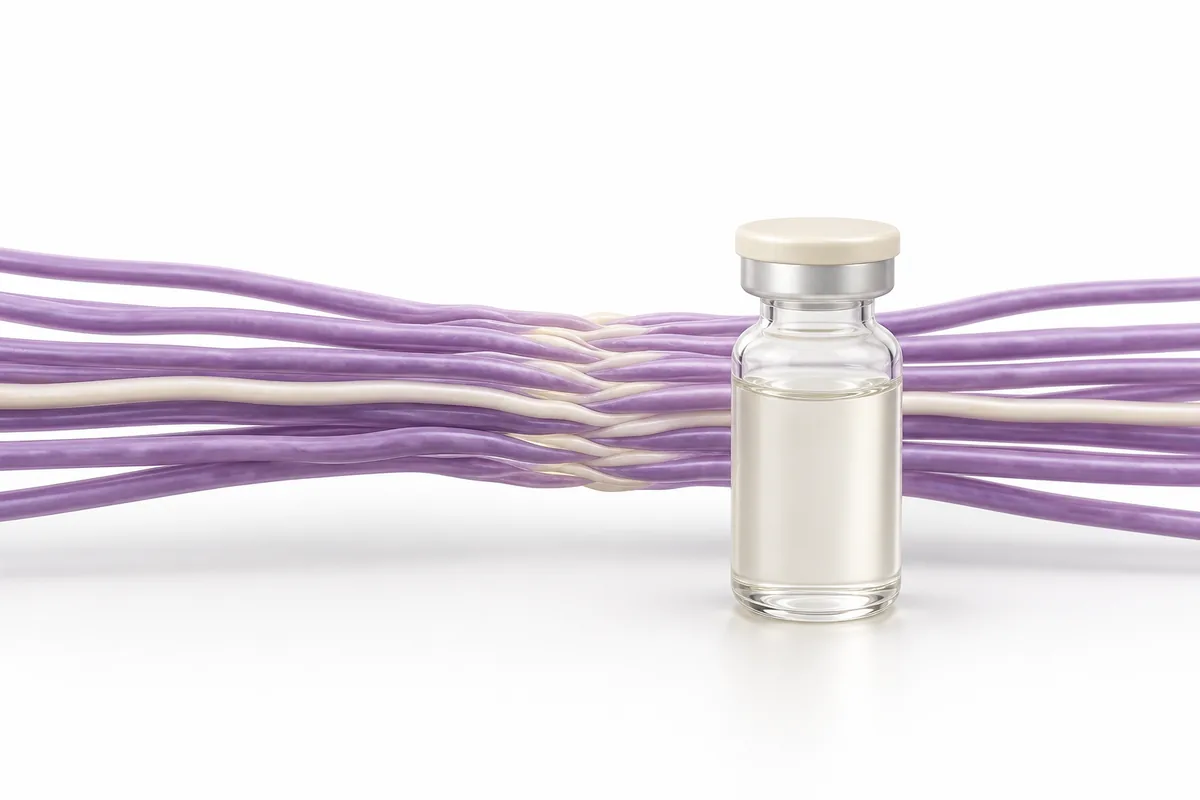
TL;DR: TB-500 is a synthetic fragment of Thymosin Beta-4, a naturally occurring actin-regulating protein, studied in preclinical research for its potential role in cell migration, tissue repair, and wound healing. Its proposed action is systemic rather than site-specific, and current evidence is limited to animal and in-vitro studies — not proven human outcomes.
TB-500 is one of the most frequently referenced peptides in tissue-repair and recovery research. It is a synthetic peptide related to a naturally occurring protein, and much of the interest around it comes from a body of preclinical (animal and in-vitro) work exploring cell migration, wound healing, and tissue flexibility. This guide summarizes what TB-500 is, how it is thought to act, and what the research literature does and does not show — strictly for research and educational purposes.
What is TB-500?
TB-500 is a synthetic peptide corresponding to the active region of Thymosin Beta-4 (Tβ4), a 43-amino-acid protein that occurs naturally in nearly all cell types in the body. Rather than reproducing the full Tβ4 protein, TB-500 is generally described as a fragment focused on the segment thought to be responsible for much of Tβ4’s biological activity, including its actin-binding and cell-migration properties.
Natural Thymosin Beta-4 is notable because it is:
- Present in essentially all tissues and cell types
- Found at its highest concentrations in wound fluid
- Involved in cell migration and proliferation
- A recurring subject in tissue-repair research
Because TB-500 is studied as a research peptide rather than an approved therapeutic, all discussion below reflects laboratory and animal findings, not established human outcomes. Researchers who are new to this space may find it useful to start with our beginner’s guide to peptide research for foundational context before working through the mechanism details below.
Mechanism of Action
The proposed mechanisms of TB-500 are drawn largely from research on Thymosin Beta-4. Three themes appear consistently in the preclinical literature.
Actin regulation
TB-500’s best-characterized activity involves actin, a cytoskeletal protein central to cell structure and movement. Tβ4 acts as an actin-sequestering peptide, binding G-actin monomers and helping regulate the assembly and disassembly of the cytoskeleton. This actin regulation is relevant to:
- Cell structure and shape
- Cell movement and migration
- Cytoskeletal reorganization during repair
- Cell division
Cell migration
By influencing actin dynamics, TB-500 has been studied for its potential to promote the migration of cells toward areas of injury in experimental models. Cell types examined in this context include:
- Endothelial cells
- Keratinocytes
- Progenitor and stem cells recruited to injury sites
Angiogenesis and inflammation modulation
Preclinical studies have also examined Tβ4/TB-500 in relation to angiogenesis (the formation of new blood vessels), which supports nutrient delivery in regenerating tissue, and to modulation of inflammatory signaling. Reported observations in animal and cell models include changes in inflammatory cytokine activity and reduced markers of inflammation. These remain research observations rather than demonstrated clinical effects.
Research Background & Key Findings
Interest in TB-500 stems from decades of work on Thymosin Beta-4. Reviews such as Goldstein, Hannappel, and Kleinman (2005) describe how an actin-sequestering protein appears to “moonlight” in tissue repair, a framing that helped drive subsequent investigation. Across the preclinical literature, recurring areas of study include:
- Musculoskeletal tissue — tendon, ligament, and muscle repair models
- Cardiac tissue — animal studies of heart-muscle injury and repair
- Dermal wounds — skin wound-healing experiments
- Ocular surface — corneal injury and healing research
- Flexibility and mobility — soft-tissue mobility endpoints in animal models
A frequently cited feature in this research is that TB-500’s activity appears systemic rather than localized: because it is thought to travel through circulation and act on cell migration broadly, experimental models have examined it without requiring administration directly at an injury site. This distinguishes it from compounds studied primarily for local action and is one reason it is often described as a “systemic” repair peptide in the research context.
An important caveat: the evidence base is predominantly preclinical. Large, well-controlled human clinical trials establishing efficacy and long-term safety are lacking. Findings from animal and in-vitro studies do not automatically translate to humans, and TB-500 should be understood as an investigational research compound rather than a proven treatment. Enthusiastic claims that outpace the underlying data are common in informal sources, so careful reading of the primary literature is warranted.
TB-500 and BPC-157
TB-500 is frequently studied alongside BPC-157, another peptide popular in healing research. The two are often discussed together because they are thought to act through different primary pathways — TB-500 via actin regulation and cell migration, and BPC-157 via growth-factor and nitric-oxide-related mechanisms — leading researchers to explore whether they are complementary.
| Factor | TB-500 | BPC-157 |
|---|---|---|
| Origin | Thymosin Beta-4 fragment | Gastric protein fragment |
| Size | 43 amino acids | 15 amino acids |
| Primary mechanism | Actin regulation, cell migration | Growth factors, NO system |
| Typical research dose | mg range | mcg range |
| Frequency | ~2x weekly | Daily |
Because they are so often paired, a combined BPC-157 / TB-500 blend exists for research convenience. For a detailed side-by-side, see our BPC-157 vs TB-500 comparison. Standalone research material is also available in BPC-157 5mg format. For background on the companion peptide itself, see our what is BPC-157 overview, and researchers designing recovery-focused protocols may also want to review our common peptide stacks article. Higher-yield research material is available in TB-500 10mg format for larger-scale study designs.
Reconstitution & Handling Overview
TB-500 is supplied as a lyophilized (freeze-dried) powder that must be reconstituted with bacteriostatic water before use in a research setting. As a general reference, a 5mg vial reconstituted with 2mL of bacteriostatic water yields a concentration of 2.5mg/mL:
| Desired amount | Draw volume |
|---|---|
| 2mg | 0.80mL / 80 units |
| 2.5mg | 1.00mL / 100 units |
| 5mg | 2.00mL / full vial |
From a 5mg vial at 2.5mg/mL, a 2mg amount is 80 units on a U-100 syringe = 0.80 mL.
Handling should follow careful, sterile technique. For step-by-step methodology, see the peptide reconstitution guide and the injection best practices overview. Product-specific details are outlined on the TB-500 2mg and TB-500 5mg pages.
Research Dosing Considerations
The figures below reflect ranges commonly cited in the research context and are provided for general informational purposes only. They are not human medical instructions or a protocol for personal use.
Loading phase (weeks 1–4)
| Frequency | Amount |
|---|---|
| 2x weekly | 2–2.5mg per administration |
| Weekly total | 4–5mg |
Maintenance phase (weeks 5+)
| Frequency | Amount |
|---|---|
| 1–2x weekly | 2–2.5mg per administration |
| Weekly total | 2–5mg |
A two-phase pattern — a higher-frequency initial period followed by reduced-frequency maintenance — is commonly described in TB-500 research discussions, reflecting the peptide’s systemic distribution rather than site-specific action.
- 1
Weeks 1-4 (loading)
2x weekly at 2-2.5mg per administration (4-5mg weekly total).
- 2
Weeks 5+ (maintenance)
1-2x weekly at 2-2.5mg per administration (2-5mg weekly total).
Storage & Stability
Proper storage supports peptide integrity:
- Lyophilized powder: stored at around -20°C, generally regarded as stable for extended periods (2+ years)
- Reconstituted solution: kept at 2–8°C and typically used within 3–4 weeks
- General note: TB-500 is reasonably stable but benefits from consistent cold storage; avoid repeated temperature cycling and protect from light
For a broader overview of cold-chain handling across peptide types, see the peptide storage guide.
Safety, Legality & Research Disclaimers
TB-500 is a research peptide, not an approved medicine. It has not been authorized as a therapeutic for human use in major regulatory jurisdictions, and comprehensive human safety data is limited. Reported observations in research settings suggest a generally minimal side-effect profile, with occasional mentions of transient flu-like sensations, but long-term human data remains scarce.
Anyone handling TB-500 should treat it strictly as a laboratory research chemical, comply with all applicable local laws and institutional guidelines, and never use it for self-administration or human consumption. Nothing here is medical advice.
Sourcing & Quality Verification for Research
For research integrity, material quality matters as much as any protocol. When evaluating a research peptide source, generic quality indicators to look for include:
- Third-party testing by an independent laboratory
- A Certificate of Analysis (COA) documenting identity and purity (often via HPLC and mass spectrometry)
- Batch traceability, so a specific vial can be linked to its testing data
- Transparent handling and storage information
These are general due-diligence principles rather than an endorsement of any particular supplier. Verifying purity and identity helps ensure that research observations reflect the peptide itself rather than contaminants or mislabeling. For a deeper walkthrough of reading these documents, see understanding peptide purity and COAs.
Frequently Asked Questions
Is TB-500 the same as Thymosin Beta-4? Not exactly. Thymosin Beta-4 is the full 43-amino-acid natural protein. TB-500 is a synthetic peptide corresponding to its active region, studied because that segment appears responsible for much of Tβ4’s actin-binding and cell-migration activity.
Is TB-500 proven to work in humans? No. The evidence base is largely preclinical — animal and in-vitro studies. Large, controlled human trials establishing efficacy and long-term safety are lacking, so human outcomes should not be assumed.
Why is TB-500 often paired with BPC-157? They are thought to act through different primary pathways, so researchers frequently study them together to explore potentially complementary effects. A combined blend exists for research convenience.
How is TB-500 typically administered in research? It is reconstituted from lyophilized powder with bacteriostatic water and, in research contexts, most often described as a subcutaneous administration. Because its activity is systemic, the site is generally not considered critical.
How should TB-500 be stored? Lyophilized powder is typically kept near -20°C, and reconstituted solution at 2–8°C with use within a few weeks. Avoid repeated freeze-thaw cycles.
Is TB-500 legal? It is generally handled as a research chemical, not an approved medicine. Legal status varies by jurisdiction, and it is not authorized for human use. Always follow local laws and institutional policy.
References
- Goldstein AL, Hannappel E, Kleinman HK. “Thymosin beta4: actin-sequestering protein moonlights to repair injured tissues.” Trends in Molecular Medicine. 2005.
- Preclinical research on Thymosin Beta-4 / TB-500 and tissue repair, angiogenesis, and cell migration.
Last updated: July 4, 2026
Disclaimer: This information is for educational and research purposes only. TB-500 is a research peptide, not an approved medicine, and is not intended for human consumption. This is not medical advice.