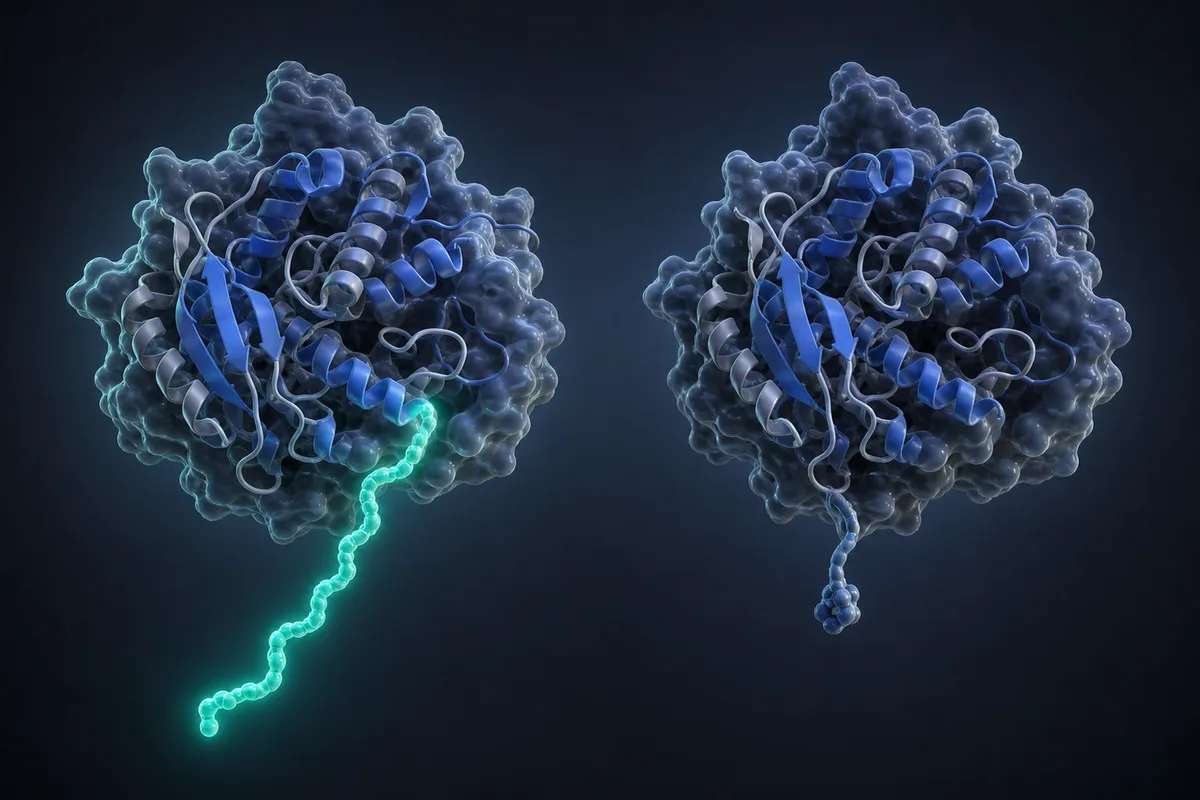
TL;DR: Follistatin-344 (FST-344) and follistatin-315 (FST-315) are two splice variants of the same follistatin gene, both marketed as “myostatin inhibitor” research peptides. FST-344 is the full-length precursor; after its signal peptide is clipped, it matures into the circulating FST-315 form. The real functional split in follistatin biology is between the freely-circulating long isoform and the tissue-anchored short isoform, and it comes down to how tightly each binds heparin. Both variants antagonize myostatin and activin with similar affinity, so the difference is distribution, not potency. Human muscle-growth data is still thin and mostly flows through gene-therapy and bodybuilding channels — worth understanding before you assume “follistatin for muscle” is settled science.
What Follistatin Actually Does
Follistatin is a secreted glycoprotein that acts as a high-affinity trap for members of the TGF-beta superfamily. Its headline job in the muscle world is antagonizing myostatin (GDF-8), the endogenous brake on skeletal-muscle growth. Myostatin normally signals muscle to stop enlarging; follistatin binds and neutralizes it, releasing that brake. It also sequesters activin A, activin B, and GDF-11 at nanomolar-to-picomolar affinities.
That mechanism — a natural myostatin inhibitor (Spanish: inhibidor de miostatina; German: Myostatin-Hemmer) — is why follistatin became a fixation for the anabolics and physique-research crowd. If you can block myostatin, the theory goes, you tilt the balance toward hypertrophy. For the deeper mechanism, see our what is Follistatin-344 guide.
The Structural Difference: A Tail and a Heparin Switch
The follistatin isoforms differ only at the C-terminus. FST-344 is the primary translation product — 344 amino acids including a 29-residue signal peptide. Once that signal peptide is cleaved during secretion, what remains is the mature FST-315, the longest circulating form. In other words, FST-344 is essentially the cDNA/precursor label and FST-315 is the processed product. This is exactly why vendors conflate them: chemically, one becomes the other.
The longer isoforms carry a 27-residue acidic C-terminal tail. That tail folds back over follistatin’s heparin-binding site and partially masks it. The shortest isoform (FST-288) lacks the tail entirely, leaving its heparin-binding surface fully exposed — which is why FST-288 clamps onto heparan-sulfate proteoglycans on cell surfaces and stays put in tissue. FST-315, with its tail intact, binds heparin more weakly and circulates freely.
Directional comparison; the exposed heparin site on the tail-less short isoform drives cell-surface anchoring.
The practical takeaway: FST-315 behaves like an endocrine signal that travels through the bloodstream, while the tail-less short form behaves in an autocrine/paracrine way, acting locally where it’s anchored. When myostatin actually binds follistatin, it creates a continuous electropositive surface that boosts heparin affinity and speeds myostatin clearance regardless of isoform — so both still get the job done at the target.
FST-344 vs FST-315: Do They Differ in Practice?
For a research peptide sold in a lyophilized vial, the honest answer is: less than the marketing implies. Both isoforms neutralize myostatin with comparable binding kinetics, so per-molecule potency isn’t the differentiator. What differs is where the molecule ends up — freely circulating (favoring the tailed FST-315/FST-344 lineage) versus tissue-sequestered (favoring the tail-less short form).
Most importantly, the strongest muscle-growth evidence in primates used the 344 construct. In a landmark study, an AAV1 vector expressing human follistatin-344 (AAV1-FS344) injected into monkey quadriceps produced pronounced, durable gains in muscle size and strength. That’s a gene-therapy delivery, not an injected peptide — a distinction the “FST-344 for muscle” pitch tends to skip.
The Muscle-Growth Rationale — and the Honest Caveat
The research logic is clean: myostatin limits muscle mass, follistatin blocks myostatin, therefore follistatin should expand muscle. Animal work supports the mechanism convincingly — transgenic and gene-delivery models show real hypertrophy, and follistatin gene transfer has been trialed in muscular-dystrophy populations.
Where it gets thin is injected follistatin peptide in healthy humans for physique goals. That use case rides almost entirely on the bodybuilding/anabolics niche and preclinical extrapolation, not controlled human hypertrophy trials. The compelling primate data used viral gene delivery producing sustained local expression — a very different pharmacokinetic reality than a subcutaneous peptide with a short half-life. Keep that gap in mind when you read bold “follistatin for muscle” claims.
If you’re modeling reconstitution or research dosing for a 1mg vial, our peptide calculator handles the concentration math, and the Follistatin-344 1mg product page lists the specific presentation most vendors stock.
Frequently Asked Questions
Is FST-344 the same as FST-315?
Nearly. FST-344 is the 344-amino-acid precursor that includes a signal peptide. Once secreted and processed, it becomes the mature 315-amino-acid FST-315, the main circulating follistatin form. They sit on the same processing pathway rather than being two unrelated molecules.
Which follistatin variant is “stronger” for myostatin inhibition?
Neither has a clear per-molecule advantage — both bind myostatin and activin with similar high affinity. The meaningful difference across follistatin isoforms is distribution: circulating versus tissue-anchored, driven by heparin-binding strength, not raw potency.
Why do the isoforms bind heparin differently?
The acidic C-terminal tail on the longer forms folds over and masks the heparin-binding site, so FST-315 circulates. The short FST-288 form lacks that tail, exposes the site fully, and sticks to cell-surface heparan sulfate — making it act locally.
Is there human evidence that follistatin builds muscle?
The strongest data is preclinical and gene-therapy based, including durable strength gains in monkeys given AAV1-FS344 and dystrophy gene-transfer trials. Robust controlled trials of injected follistatin peptide for hypertrophy in healthy people are lacking.
How does follistatin compare to other muscle-focused peptides?
Follistatin works upstream by neutralizing myostatin, unlike growth-hormone secretagogues such as ipamorelin that act through the GH/IGF-1 axis. The mechanisms are complementary on paper, which is why research audiences discuss them together.
References
- Sidis Y, Mukherjee A, Keutmann H, et al. Biological activity of follistatin isoforms and follistatin-like-3 is dependent on differential cell surface binding and specificity for activin, myostatin, and bone morphogenetic proteins. Endocrinology. 2006;147(7):3586–3597.
- Cash JN, Rejon CA, McPherron AC, Bernard DJ, Thompson TB. The structure of myostatin:follistatin 288: insights into receptor utilization and heparin binding. EMBO Journal. 2009;28(17):2662–2676.
- Kota J, Handy CR, Haidet AM, et al. Follistatin gene delivery enhances muscle growth and strength in nonhuman primates. Science Translational Medicine. 2009;1(6):6ra15.
- Lee SJ, McPherron AC. Regulation of myostatin activity and muscle growth. Proceedings of the National Academy of Sciences USA. 2001;98(16):9306–9311.
- Schneyer AL, Wang Q, Sidis Y, Sluss PM. Differential distribution and function of follistatin isoforms: application of a new FS315 ELISA. Molecular and Cellular Endocrinology. 2004;225(1-2):25–28.
This article is for research and educational reference only. Follistatin-344 and FST-315 are not approved medicines, this is not medical advice, and these materials are not for human consumption.