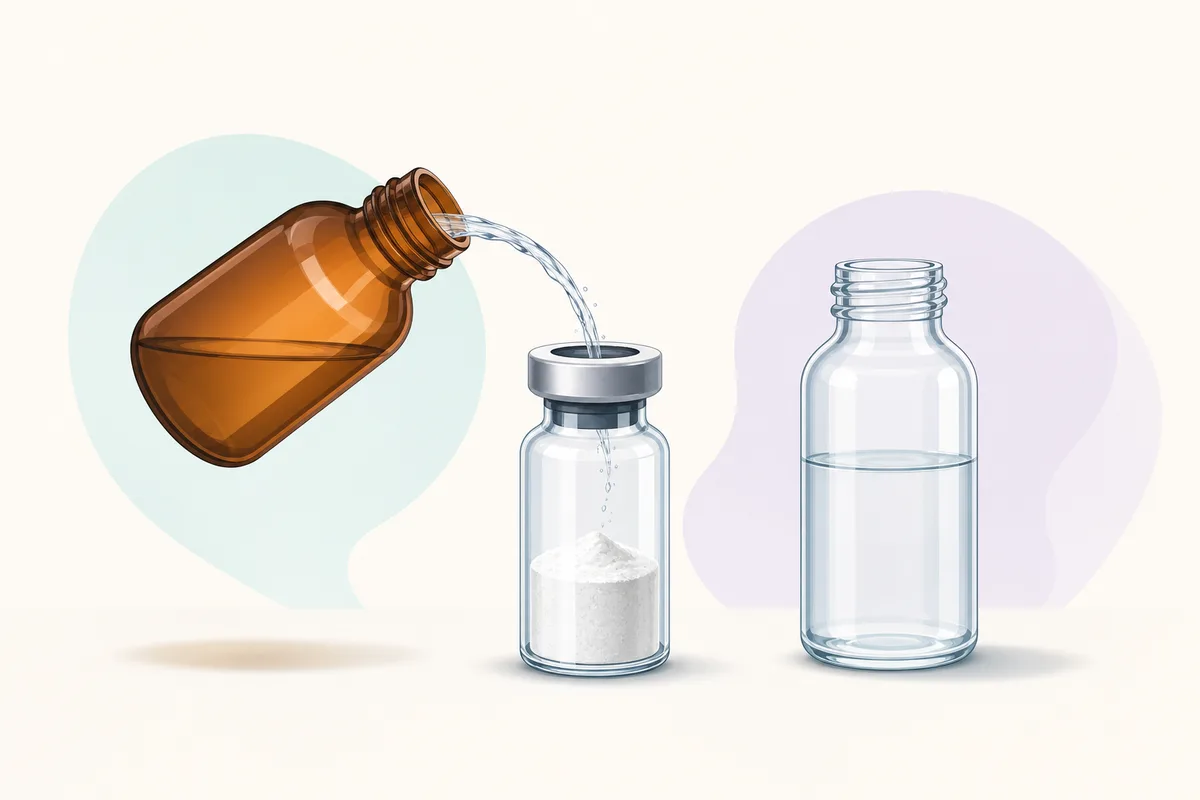
TL;DR: Dihexa is not a water-soluble peptide. It is a lipophilic capped dipeptide analog of about 505 Da, and supplier data sheets list it as insoluble in water while dissolving readily in DMSO — one vendor lot reports 100 mg/mL in DMSO. So the site-wide “add BAC water and swirl” default silently fails here. The working practice is a two-stage co-solvent: DMSO first to make a clear stock, then bacteriostatic water to dilute. The dihexa calculator handles the concentration and unit conversions; this guide walks the reasoning so the numbers make sense.
Why the BAC-water default fails on dihexa
Most of the compounds on this site are short, charged peptides. They carry ionisable side chains, they hydrogen-bond happily with water, and bacteriostatic water dissolves them in seconds. Dihexa (PNB-0408, N-hexanoic-Tyr-Ile-(6)-aminohexanoic amide, CAS 1401708-83-5, C27H44N4O5, MW 504.66) is a different animal. It was deliberately engineered for lipophilicity so it would survive the gut and cross the blood-brain barrier — the hexanoic cap on one end and the aminohexanoic amide tail on the other are fat-friendly by design.
That design choice has a direct bench consequence: supplier characterisation sheets list dihexa as insoluble in water and insoluble in ethanol, with DMSO as the practical solvent. Selleck’s data for one lot puts DMSO solubility at 100 mg/mL (about 198 mM). So when you push 2 mL of BAC water into a 5 mg dihexa vial, nothing much happens. You get a cloudy suspension, a floating cake, or particles that look dissolved until they settle out an hour later. Nothing is wrong with the vial. The solvent is simply wrong for the molecule.
The solvent decision: DMSO first, water second
There are three approaches you will see across RUO suppliers, and they are not equivalent.
Pure DMSO. Dissolve the whole vial in DMSO and use it as-is. This works chemically — it is exactly how cell-culture stocks are made. It also gives you a very small, very concentrated volume that is awkward to measure on an insulin syringe.
Pure BAC water. This is the site default and the one that does not apply. Skip it for dihexa.
DMSO then BAC water (co-solvent). Dissolve in DMSO to get a clear stock, then dilute stepwise with bacteriostatic water. This is what the dihexa 5mg and dihexa 10mg reference pages use, and it is the approach most vendor protocols describe. Note the direction of travel: vendor in vivo formulation notes for dihexa start from a concentrated DMSO stock and add the aqueous phase afterwards, never the reverse. Adding DMSO into a vial of water gives you a diluted solvent that can no longer pick the powder up.
Two practical notes. DMSO is hygroscopic — a bottle that has been open for months has already pulled water out of the air, and a wet bottle dissolves less. And add the water slowly, in stages, swirling between additions. Dumping 1.5 mL of BAC into a concentrated DMSO stock in one shot is the classic way to crash the compound straight back out. If that happens, the mechanism is the same one described in why peptides gel or refuse to dissolve.
Dihexa 5mg: the concentration and unit math
Take the standard two-stage recipe for a 5 mg vial — the one most searches for reconstitución de Dihexa end up landing on.
Step 1 — the DMSO stock.
- 5 mg ÷ 0.5 mL DMSO = 10 mg/mL clear stock
Step 2 — dilute with BAC water.
- Add 1.5 mL BAC water slowly → total volume 2 mL
- 5 mg ÷ 2 mL = 2.5 mg/mL
- DMSO fraction: 0.5 ÷ 2 = 25% DMSO by volume
Step 3 — convert to syringe units. On a U-100 insulin syringe, 1 mL = 100 units, so:
mcg per unit = (mg/mL × 1000) ÷ 100
- 2.5 mg/mL = 2500 mcg/mL
- 2500 ÷ 100 = 25 mcg per unit
From there every draw is one division:
- 100 mcg → 100 ÷ 25 = 4 units
- 250 mcg → 250 ÷ 25 = 10 units
- 500 mcg → 500 ÷ 25 = 20 units
10 units on a U-100 barrel = 0.10 mL of a 2.5 mg/mL dihexa solution.
The whole 2 mL vial is 200 units of barrel. At 10 units per draw that is 20 draws — which matters, because a reconstituted co-solvent mix is not a two-year proposition. The reference pages put reconstituted storage at 2-8 °C for roughly 2-4 weeks, so match your dilution to how much you will actually use in that window.
Dihexa 10mg: same logic, twice the scale
The 10 mg vial is the more common research size, and the trick is that you can make it read identically to the 5 mg vial on the syringe by scaling both solvents:
- 10 mg ÷ 1 mL DMSO = 10 mg/mL stock (same as before)
- Add 3 mL BAC water → total 4 mL
- 10 mg ÷ 4 mL = 2.5 mg/mL → 25 mcg per unit
- DMSO fraction: 1 ÷ 4 = 25%
Same concentration, same units-per-draw, twice the number of draws (400 units of barrel, 40 draws at 250 mcg). If you have been running the 5 mg vial and switch to 10 mg, this keeps your arithmetic unchanged — which is the single best reason to pick it.
If you want a denser solution instead, 1 mL DMSO plus 1 mL BAC gives 2 mL at 5 mg/mL, i.e. 50 mcg per unit. A 250 mcg draw then lands on 5 units. That is a lot of resolution to give up on a barrel marked in whole units, and it leaves you at 50% DMSO by volume, which is a much harsher mix. Whichever language you searched it in — Dihexa Rekonstitution, ricostituzione Dihexa — the answer is usually “more water, not less,” right up to the point where the compound stops staying in solution.
Picking a ratio: DMSO fraction versus syringe resolution
Here is the trade-off in one picture. Every recipe below starts from the same 10 mg/mL DMSO stock and differs only in how much bacteriostatic water follows.
All four start from a 10 mg/mL DMSO stock. More BAC water means finer resolution on the barrel and a lower DMSO fraction.
Read it as a ruler problem — the dilution du Dihexa question is really a question about measurement, not about strength. Adding more water does not change how much compound you own — it changes how finely you can measure it. The 5 mL recipe (1 mg/mL, 10 mcg per unit) puts a 250 mcg draw at 25 units, which is beautifully readable and only 10% DMSO. The 2 mL dense recipe puts the same draw at 5 units, where a half-unit misread is a 10% dosing error.
The counterweight is solubility. There is no published solubility curve for dihexa in DMSO/water mixtures, so the point at which a given dilution crashes is something you find empirically, not something you can look up. That is an honest gap in the data. Start at 25% DMSO, which is the ratio the reference pages use and which holds in practice, and only push toward 10% if your mix stays visibly clear on standing.
When the mix goes cloudy
Cloudiness after adding water means the compound has come back out of solution. The usual causes, in order of frequency:
- Water added too fast. Local water concentration spikes at the point of entry and the compound precipitates there. Add in 3-4 portions, swirling between.
- Wet or old DMSO. The stock never fully cleared to begin with, so you were diluting a suspension.
- Too much water for the load. You have passed the mixture’s carrying capacity. Back off the target concentration.
- Cold. A mix pulled straight from 2-8 °C can look hazy and clear again at room temperature. Let it warm before judging it.
If the DMSO stock itself will not clear, that is a different failure and worth checking against the general reconstitution troubleshooting guide — a stock that stays gritty in neat DMSO usually points at the powder, not the method.
What the evidence actually supports
Worth being plain about this, because dihexa’s reputation runs well ahead of its evidence base. The compound came out of Joseph Harding’s group at Washington State University as an angiotensin IV analog proposed to potentiate hepatocyte growth factor at the c-Met receptor. All of the primary data is preclinical — rodent and cell culture. There is no human pharmacokinetic dataset for dihexa itself, which is precisely why nobody can hand you a validated concentration target.
The literature also carries a real integrity problem. The 2012 Kawas paper and the 2014 Benoist paper — the two studies that established the HGF/c-Met mechanism — were both formally retracted in 2025 following a Washington State University investigation that found falsified image data; the 2013 McCoy oral-dosing study carries a 2021 expression of concern and has not been retracted. Separately, fosgonimeton (ATH-1017), a prodrug in the same programme, missed its primary endpoint in the Phase 2/3 LIFT-AD trial in September 2024.
None of that changes the reconstitution chemistry, which is a straightforward solubility question. It does mean that anyone quoting a confident “optimal dose” for dihexa is extrapolating from rodent milligram-per-kilogram figures in papers whose status is contested. The math in this guide tells you exactly what is in your syringe; it cannot tell you what number belongs there.
Frequently Asked Questions
Can you reconstitute dihexa with bacteriostatic water only?
No. Supplier characterisation lists dihexa as insoluble in water, so BAC water alone leaves a cloudy suspension or an undissolved cake regardless of how long you swirl. The standard approach is DMSO first to make a clear stock, then bacteriostatic water added slowly to dilute it to a workable concentration.
How much DMSO do you use for a 5mg dihexa vial?
0.5 mL of DMSO gives a 10 mg/mL clear stock, which is the concentration most reference protocols start from. Adding 1.5 mL of bacteriostatic water afterwards brings you to 2 mL total, 2.5 mg/mL, and roughly 25% DMSO by volume — the ratio used on the 5mg reference page.
How many units is a dihexa dose on an insulin syringe?
It depends entirely on concentration. At 2.5 mg/mL you have 25 mcg per unit, so 250 mcg is 10 units and 500 mcg is 20 units. Change the water volume and every unit count changes proportionally. The dihexa calculator does the conversion exactly.
Why did my dihexa turn cloudy after adding water?
Almost always because the water went in too fast, which spikes local water concentration and crashes the compound out. Add bacteriostatic water in three or four portions with swirling between each. Old, water-laden DMSO and over-dilution past the mixture’s carrying capacity are the other two common causes.
Does the 10mg vial need different math from the 5mg vial?
The formula is identical. Scale both solvents together — 1 mL DMSO plus 3 mL BAC water on a 10 mg vial — and you land on the same 2.5 mg/mL and the same 25 mcg per unit as the 5 mg recipe. Same readings, twice the draws per vial.
Is there a published solubility limit for dihexa in DMSO and water mixtures?
Not one you can look up. Vendors publish neat-DMSO figures (around 100 mg/mL for one reported lot) and list water as insoluble, but no solubility curve exists for the intermediate mixtures. The 25% DMSO working point is practice-derived, not literature-derived, and worth treating as such.
References
- Selleck Chemicals. “Dihexa (PNB-0408) product data sheet” — CAS 1401708-83-5, C27H44N4O5, MW 504.66; solubility: DMSO 100 mg/mL (198.15 mM), water insoluble, ethanol insoluble.
- Cayman Chemical. “Dihexa product information insert,” item 14126 — solubility and storage characterisation.
- McCoy AT, Benoist CC, Wright JW, et al. “Evaluation of metabolically stabilized angiotensin IV analogs as procognitive/antidementia agents.” Journal of Pharmacology and Experimental Therapeutics, 2013;344(1):141-154. doi:10.1124/jpet.112.199497. (Carries a 2021 editorial Notice of Concern.)
- “Retraction notice to ‘The Procognitive and Synaptogenic Effects of Angiotensin IV-Derived Peptides Are Dependent on Activation of the Hepatocyte Growth Factor/c-Met System’ [J Pharmacol Exp Ther 351 (2014) 390-402].” Journal of Pharmacology and Experimental Therapeutics, 2025;392(4):103567. doi:10.1016/j.jpet.2025.103567.
- Retraction Watch. “Four papers by Athira CEO earn expressions of concern,” 24 September 2021.
- Athira Pharma. “Athira Pharma Announces Topline Results from Phase 2/3 LIFT-AD Clinical Trial of Fosgonimeton for Mild-to-Moderate Alzheimer’s Disease,” press release, 3 September 2024.
- Alzforum. “Fosgonimeton” therapeutics entry — trial history and outcomes for the dihexa-derived prodrug.
This article is a research and educational reference only; dihexa is not an approved medicine, this is not medical advice, and it is not for human consumption.