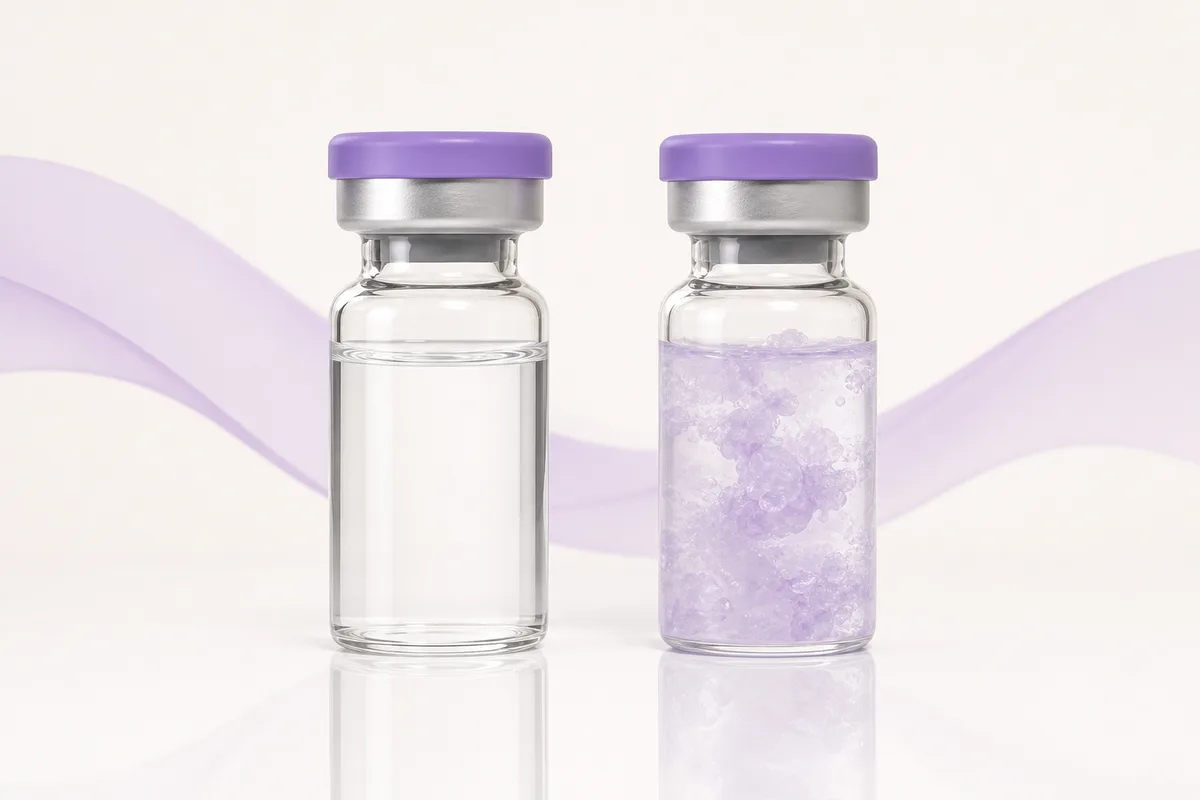
You add bacteriostatic water to the vial, swirl it, and the powder does not disappear. It clumps against the glass. It forms a translucent blob that slides around when you tilt the vial. Twenty minutes later it is still there. Most peptides dissolve on contact and this one is behaving like it has other plans.
This is not necessarily a bad vial, and it is almost never bad water. It is chemistry, and specifically it is pH. Some sequences simply will not dissolve in a neutral vehicle, and no amount of patience or shaking changes that — you need a different solvent, not more effort.
Which peptides do this
The repeat offenders are consistent enough that you can predict trouble before you open the vial:
- IGF-1 LR3 — the classic. Reconstituting it in plain bacteriostatic water is the single most common cause of the “my peptide turned to jelly” post.
- AOD-9604 — frequently clumps, often dissolves eventually with time and gentle handling, sometimes does not.
- HGH Fragment 176-191 — same family, same behaviour, same reason.
- Highly hydrophobic or strongly basic sequences more generally — the ones with a lot of nonpolar residues, or an amino acid composition that puts their neutral point right where your water sits.
Notice what these have in common: they are the peptides most often sold with a note about acidic reconstitution that people skim past.
Why: the isoelectric point
Every peptide is a chain of amino acids carrying charged groups — some acidic, some basic. The isoelectric point (pI) is the pH at which those charges exactly cancel and the molecule carries zero net charge.
A peptide with net charge is soluble, because charged molecules attract water and repel each other. Strip the charge away and both effects vanish at once: water stops holding the molecule in solution, and neighbouring molecules stop pushing each other apart. They start associating instead. That is your clump.
A peptide is at its least soluble at its own pI. This is not a quirk of particular compounds; it is universal protein chemistry, and it is the entire explanation for what is sitting in your vial.
Bacteriostatic water sits near neutral. For most peptides that is comfortably away from their pI and everything dissolves without drama. For a peptide whose pI happens to land near neutral, plain BAC water is the worst possible solvent — you have accidentally chosen the exact pH at which the molecule least wants to be dissolved.
Try the boring things first
Before reaching for anything acidic, exhaust the free options. A surprising share of “it won’t dissolve” resolves itself.
- 1
Aim the stream at the glass
Let the water run down the vial wall rather than blasting the cake directly. A jet on the powder can pack it into a dense clump that then dissolves from the outside in.
- 2
Swirl, never shake
Slow rotation for 30-60 seconds. Shaking introduces foam and shear, both of which encourage aggregation — the opposite of what you want.
- 3
Wait
Put it in the fridge and leave it 15-30 minutes, or longer. Many stubborn cakes dissolve on their own timeline. This step alone fixes a large share of AOD-9604 complaints.
- 4
Warm gently in the hand
Room temperature dissolves better than fridge temperature. Body warmth in a closed fist for a minute or two is enough — nothing hotter.
- 5
Re-swirl and reassess
If it is visibly smaller than it was, it is dissolving and just needs more time. If it is unchanged, time is not the missing ingredient and pH probably is.
That ladder is deliberately unhurried. Most of the damage done to difficult peptides is done by people trying to force them.
When you need a lower-pH vehicle
If time and gentle handling have not moved it, the vehicle is wrong.
The standard approach is dilute acetic acid — 0.6% is the figure most commonly cited for IGF-1 LR3, and it is what most reference material for the compound specifies. The acid lowers the pH, restores net positive charge on the peptide, and the cake dissolves, often within seconds of contact.
A gentler variant works for the borderline cases: add a small amount of sterile water first to wet and partially dissolve the cake, swirl, and only add the bulk of your vehicle once it has broken up. This gives the powder a chance to disperse before it can consolidate into a single dense mass, and it sometimes gets a marginal peptide over the line without any acid at all.
Once dissolved in an acidic vehicle, further dilution with bacteriostatic water is generally tolerated — the peptide is already in solution and a modest pH shift will not necessarily drop it back out. Generally. This is where the trade-offs start.
Be honest about the trade-offs
An acidic vehicle is not a free win, and articles that present it as one are skipping the interesting part.
Injection site comfort. A solution well below physiological pH stings. This is not subtle and it is not something technique fixes. It is the direct, predictable cost of the thing that made the peptide dissolve.
Solution longevity. Acidic conditions change how the peptide degrades over time. A vehicle that solves your solubility problem today is not automatically the vehicle that keeps the solution intact for eight weeks — different peptides have different pH stability optima, and the pH that dissolves best is not always the pH that stores best.
Concentration limits. Acetic acid does not make a peptide infinitely soluble. It moves the ceiling; it does not remove it. Push the concentration far enough and it will come out of solution regardless of pH.
So: use the lowest-intervention vehicle that actually works. If gentle swirling and half an hour of patience dissolve it, that is the better answer, and it is free.
Not dissolved yet vs. ruined
This is the distinction that matters most, because it decides whether you wait or discard.
Not dissolved yet looks like: a cake that is visibly shrinking, clumps that break up when swirled, cloudiness that clears as you watch, solution that goes clear when warmed to room temperature. This is a kinetics problem. Give it time and the right vehicle.
Aggregated or denatured looks like:
- Cloudy that will not clear. Not haze that settles or resolves — persistent turbidity that survives warming and time.
- Visible strands or fibrils. Wisps, threads, anything with structure suspended in the liquid. This is peptide that has come out of solution as an ordered aggregate, and it does not go back.
- A gel that will not break up. Not a clump that fragments under swirling — a coherent mass that deforms and reforms.
Shaking is the usual cause of the second category, which is why every reconstitution guide says swirl. Shear and air-liquid interfaces are what unfold peptides; unfolded peptides find each other; and that is aggregation. The instruction is not superstition.
Frequently Asked Questions
Why won’t my peptide dissolve in bacteriostatic water?
Most likely because its isoelectric point sits near neutral, and bacteriostatic water sits near neutral too. At its pI a peptide carries zero net charge, which is precisely where it is least soluble — so plain BAC water is the worst available solvent for that particular sequence. A lower-pH vehicle restores net charge and it dissolves.
Which peptides commonly gel or clump?
IGF-1 LR3 is the most reliable offender, with AOD-9604 and HGH Fragment 176-191 close behind. More broadly, highly hydrophobic or strongly basic sequences are the ones to expect trouble from. These are usually the compounds sold with an acidic reconstitution note attached.
What concentration of acetic acid is used for IGF-1 LR3?
0.6% is the figure most commonly cited in reference material for the compound. The acid lowers the pH away from the peptide’s isoelectric point, restoring net positive charge so the molecule goes into solution — often within seconds of contact.
Can I just shake the vial harder to dissolve it?
No, and it makes things worse. Shaking creates shear forces and air-liquid interfaces, both of which unfold peptides. Unfolded peptides aggregate. You can convert a slow-dissolving vial into a permanently ruined one this way. Swirl gently and give it time instead.
How do I know if my peptide is ruined rather than just slow?
Slow looks like a shrinking cake, clumps that break up when swirled, or cloudiness that clears with time and warmth. Ruined looks like persistent turbidity that will not clear, visible strands or fibrils, or a gel that will not break up under gentle swirling. Aggregation does not reverse — if you see those signs, the vial is finished.
Related reading
- Peptide Reconstitution Guide — the full procedure, start to finish
- Peptide Reconstitution Troubleshooting — the other things that go wrong in the vial
- BAC Water Ratios for Reconstitution — choosing how much vehicle to add
- Peptide Storage Guide — keeping the solution intact once it dissolves