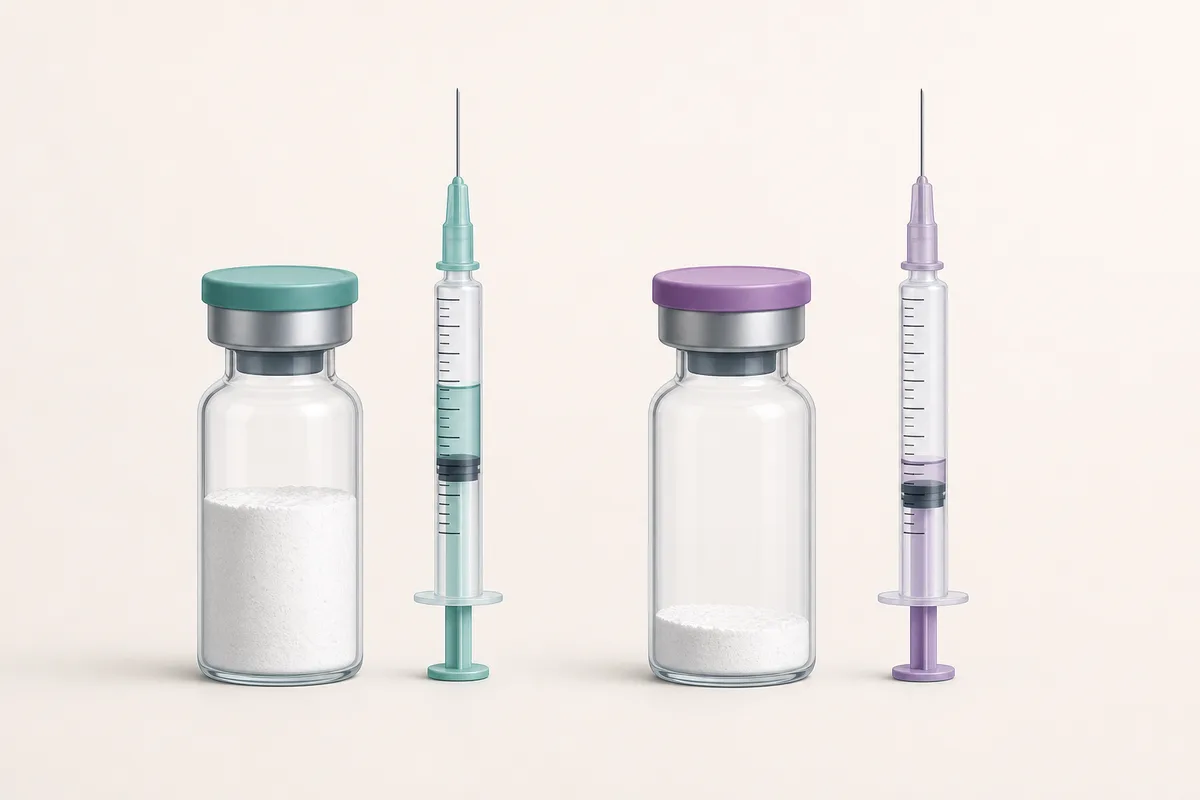
TL;DR: P21 (also written P021, research code GLXC-21260) ships as a lyophilized powder in 5mg and 10mg vials, and the vial size on the label tells you nothing on its own — the concentration comes from how much bacteriostatic water you add. Reconstitute both with 2 mL and you get 2.5 mg/mL versus 5 mg/mL, meaning 25 mcg per unit versus 50 mcg per unit. The same 500 mcg target therefore lands on 20 units from the 5mg vial and 10 units from the 10mg vial. The P21 calculator does the conversion instantly; this page shows the arithmetic behind it.
What P21 is, briefly
P21 is a small synthetic peptide — structure Ac-DGGL(A)G-NH2, molecular weight roughly 578.7 — that came out of epitope-mapping the biologically active region of human ciliary neurotrophic factor (CNTF) down to a four-residue core. The C-terminal glycine carries an adamantyl group, which raises lipophilicity, slows exopeptidase degradation, and improves blood-brain barrier passage. The compound originated in Khalid Iqbal’s laboratory at the New York State Institute for Basic Research in Developmental Disabilities.
Mechanistically, the published work describes two threads: inhibition of leukemia inhibitory factor (LIF) signalling, and increased BDNF expression, which in the mouse studies fed forward into TrkB-PI3K-Akt signalling and reduced GSK-3β activity. In 3xTg-AD mice, chronic treatment increased dentate gyrus neurogenesis, reduced tau hyperphosphorylation, and improved cognitive measures (Kazim et al., 2014; Baazaoui and Iqbal, 2017).
Worth stating plainly: all of that is preclinical. The efficacy data are rodent, the studies dosed P021 orally through the feed at 60 nmol/g diet, and there is no published human trial establishing a dose, a route, or a schedule. Developer Phanes Biotech has publicly described an IND and Phase 1 plans, but no human dosing data exists in the literature to anchor a number to. Anything you see quoted as a “standard” P21 dose is convention, not evidence — so the honest version of this article is the arithmetic, not a protocol.
The two numbers that actually matter
Forget the vial label for a second. Two values determine everything:
1. Concentration: mg/mL = vial strength (mg) ÷ BAC water added (mL)
2. Resolution: mcg per unit = (mg/mL × 1000) ÷ 100
That second line is just the U-100 syringe definition: 1 mL = 100 units, so one unit is 0.01 mL. Multiply concentration by 1000 to get mcg/mL, divide by 100 to get mcg per unit. Once you have mcg per unit, every dose is a single division:
units to draw = target dose (mcg) ÷ mcg per unit
That is the entire model. Everything else in this article is substitution. If you want the general version applied across compounds, mcg to units on an insulin syringe walks the same conversion from scratch.
The 5mg vial
At the common 2 mL reference volume, the P21 5mg vial gives:
- Concentration: 5 ÷ 2 = 2.5 mg/mL = 2500 mcg/mL
- Per unit: 2500 ÷ 100 = 25 mcg per unit
So the draws work out as:
- 250 mcg → 250 ÷ 25 = 10 units
- 500 mcg → 500 ÷ 25 = 20 units
- 1 mg (1000 mcg) → 1000 ÷ 25 = 40 units
At 2.5 mg/mL the barrel reads 25 mcg per unit, so a 500 mcg draw stops at the 20-unit mark — 0.20 mL.
Twenty units is a comfortable place to be. It is far enough up the barrel that a half-unit misread costs you about 2.5% of the dose rather than 20%, which is the practical reason people asking about dosis de P21 keep landing on the smaller vial for pilot work.
The 10mg vial: same dose, half the units
Same 2 mL of BAC water, double the powder, so the P21 10mg vial is exactly twice as strong:
-
Concentration: 10 ÷ 2 = 5 mg/mL = 5000 mcg/mL
-
Per unit: 5000 ÷ 100 = 50 mcg per unit
-
250 mcg → 250 ÷ 50 = 5 units
-
500 mcg → 500 ÷ 50 = 10 units
-
1 mg → 1000 ÷ 50 = 20 units
Notice the trap in the 250 mcg row. Five units on a U-100 barrel is a cramped, low-resolution draw — the tick spacing near the bottom of the plunger travel is where reading error is proportionally worst, and anything under 5 units is essentially estimation. If your target is small, the 10mg vial at 2 mL is the wrong ruler for it.
The fix: change the water, not the vial
Here is the point the vial-size question usually hides. The 10mg vial can produce any concentration you want:
- 10mg + 2 mL = 5 mg/mL = 50 mcg/unit
- 10mg + 4 mL = 2.5 mg/mL = 25 mcg/unit — identical resolution to the 5mg vial at 2 mL
- 10mg + 5 mL = 2 mg/mL = 20 mcg/unit, so 500 mcg = 25 units
And in reverse, a 5mg vial reconstituted with 1 mL gives 5 mg/mL — the same 50 mcg/unit as the 10mg vial at 2 mL. The mg on the label sets how much total compound you have; the mL you add sets where doses land. Those are separate decisions, and conflating them is the single most common error in the P21 Dosierung threads.
Doses per vial and the shelf-life ceiling
The other axis is how long the reconstituted vial lasts. Divide, then check it against the calendar:
- 5mg ÷ 500 mcg = 10 doses
- 10mg ÷ 500 mcg = 20 doses
- 10mg ÷ 250 mcg = 40 doses
Reconstituted P21 is typically held at 2-8°C with a working window of roughly 2-3 weeks. On a daily schedule the 10mg vial at 500 mcg gives you 20 days of draws — right at the edge of that window, and the 40-dose scenario blows straight past it. Lyophilized powder stored at -20°C keeps for years, so the sensible pattern is to buy the larger vial for cost per mg but reconstitute in a way that matches your actual run length, or to split the powder before adding water.
This is why the dosaggio P21 question rarely has one answer: 10mg is cheaper per milligram, but if half of it degrades in the fridge it was the more expensive vial. Cadence first, then vial, then BAC volume.
Rounding, dead space, and honest precision
Two small things that eat a percentage or two:
Rounding. If a target lands between marks — say 600 mcg at 50 mcg/unit = 12 units, fine, but 600 mcg at 45 mcg/unit = 13.33 units — do not eyeball a third of a unit. Change the reconstitution volume so the number comes out clean. The math is identical either way; you are just choosing a friendlier ruler.
Dead space. A U-100 syringe with a fixed needle retains a small residual volume in the hub. Over 20 draws from a 10mg vial that quietly costs you a fraction of a dose each time, which is one reason the real number of usable doses per vial usually comes in slightly under the arithmetic. It is not a rounding error worth panicking over, but it is why 20 draws sometimes turns into 19.
If you are placing P21 next to the other cognitive-category peptides, Selank vs Semax covers the two most-compared entries in that shelf — different mechanisms entirely, but the same unit-conversion arithmetic applies to all of them.
Frequently Asked Questions
How many units is 500mcg of P21?
It depends on concentration, not vial size. A 5mg vial in 2 mL is 25 mcg per unit, so 500 mcg is 20 units. A 10mg vial in 2 mL is 50 mcg per unit, so the same 500 mcg is 10 units. Same dose, different mark, because the water volume changed the ruler.
Should I buy the 5mg or 10mg P21 vial?
Cost per milligram favours 10mg, but reconstituted peptide has a 2-3 week refrigerated window. If your run is short or your target dose is small, the 5mg vial finishes inside that window and gives finer syringe resolution at 2 mL. Longer sequences justify 10mg, ideally with more BAC water.
How much bacteriostatic water for a 10mg P21 vial?
Two millilitres is the common reference and gives 5 mg/mL. Four millilitres gives 2.5 mg/mL and doubles your unit count per dose, which helps if your target is 250-500 mcg and you want readable marks. There is no single correct volume — pick the one that puts draws in the 15-50 unit band.
Is there an established human dose for P21?
No. Every published efficacy study is preclinical, mostly in transgenic mouse models, and used oral administration at 60 nmol/g of feed rather than injection. Developer Phanes Biotech has described IND approval and Phase 1 plans, but no human dosing schedule has been published to convert from.
What is P21 derived from?
Ciliary neurotrophic factor. P21 is a four-residue core mapped from the active region of human CNTF, capped with an adamantylated glycine for stability and brain penetration. It is frequently and incorrectly described as Cerebrolysin-derived; Cerebrolysin is a porcine brain-derived peptide mixture, while P21 is a single defined molecule.
Does the mcg-per-unit formula work for other peptides?
Yes — it is syringe geometry, not chemistry. Any U-100 barrel is 100 units per mL, so mcg per unit is always (mg/mL × 1000) ÷ 100. The same arithmetic in this article applies unchanged to Semax, Selank, or anything else you reconstitute.
References
- Li B, Wanka L, Blanchard J, et al. “Neurotrophic peptides incorporating adamantane improve learning and memory, promote neurogenesis and synaptic plasticity in mice.” FEBS Letters, 2010;584(15):3359-3365. doi:10.1016/j.febslet.2010.06.025.
- Kazim SF, Blanchard J, Dai CL, Tung YC, LaFerla FM, Grundke-Iqbal I, Iqbal K. “Disease modifying effect of chronic oral treatment with a neurotrophic peptidergic compound in a triple transgenic mouse model of Alzheimer’s disease.” Neurobiology of Disease, 2014;71:110-130. doi:10.1016/j.nbd.2014.07.001.
- Bolognin S, Buffelli M, Puoliväli J, Iqbal K. “Rescue of cognitive-aging by administration of a neurogenic and/or neurotrophic compound.” Neurobiology of Aging, 2014;35(9):2134-2146. doi:10.1016/j.neurobiolaging.2014.02.017.
- Baazaoui N, Iqbal K. “Prevention of dendritic and synaptic deficits and cognitive impairment with a neurotrophic compound.” Alzheimer’s Research & Therapy, 2017;9:45. doi:10.1186/s13195-017-0273-7.
- Khatoon S, Chalbot S, Bolognin S, Puoliväli J, Iqbal K. “Elevated Tau Level in Aged Rat Cerebrospinal Fluid Reduced by Treatment with a Neurotrophic Compound.” Journal of Alzheimer’s Disease, 2015;47(3):557-564. doi:10.3233/JAD-142799.
- Kazim SF, Iqbal K. “Neurotrophic factor small-molecule mimetics mediated neuroregeneration and synaptic repair: emerging therapeutic modality for Alzheimer’s disease.” Molecular Neurodegeneration, 2016;11:50. doi:10.1186/s13024-016-0119-y.
- Alzheimer’s Drug Discovery Foundation, Cognitive Vitality. “P021” research report, updated May 2025.
This article is a research and educational reference only; P21 is not an approved medicine, this is not medical advice, and it is not for human consumption.