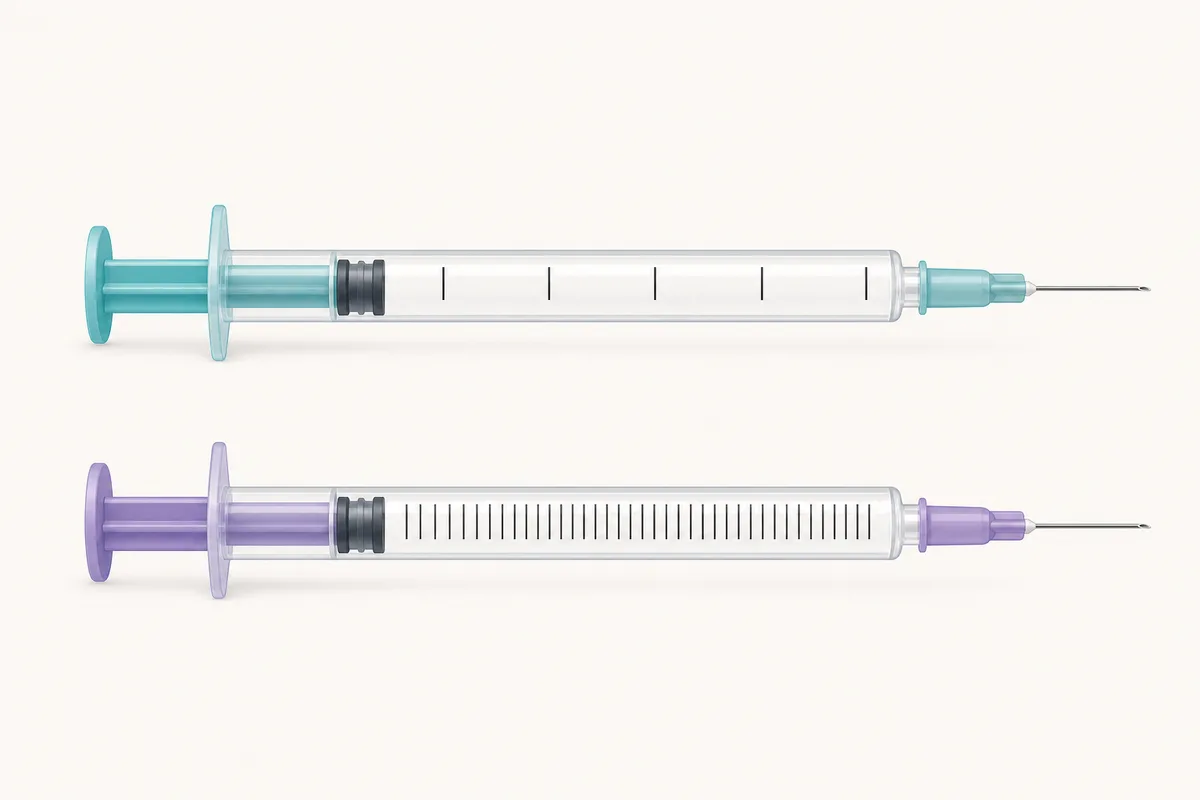
TL;DR: A U-100 barrel and a U-40 barrel are the same 1mL tube with two different rulers printed on them. On U-100, 1 unit = 0.01 mL. On U-40, 1 unit = 0.025 mL. So a unit number worked out for U-100 and then drawn on a U-40 barrel pulls 2.5x the volume — and 2.5x the peptide. Go the other way and you get 40% of what you meant. Every unit figure on PeptiMap is U-100 unless it says otherwise, and the reconstitution calculator now has a syringe-scale selector so you can set it to whichever barrel is actually in your hand.
The barrel is the same; only the ruler changes
An insulin syringe measures volume and nothing else. It does not know what is in it, and it certainly does not know it is holding a reconstituted research peptide rather than insulin. The “U” number on the packet is not a property of the syringe at all — it is the insulin concentration the ruler was printed for.
- U-100 means the scale assumes insulin at 100 international units per mL. One printed unit therefore marks off one hundredth of a millilitre: 0.01 mL.
- U-40 means the scale assumes insulin at 40 IU per mL. One printed unit marks off one fortieth: 0.025 mL.
Both barrels commonly hold 1 mL. The U-100 barrel numbers that millilitre from 0 to 100. The U-40 barrel numbers the identical millilitre from 0 to 40. Nothing about the glass, the plunger or the needle differs in a way that matters here — the ink does.
Why U-40 is still a live question in Europe
Most peptide writing treats U-100 as simply “the syringe”, which works fine right up until it doesn’t. In Europe, U-40 barrels have never gone away, because European veterinary insulin is commonly formulated at 40 IU/mL and ships alongside matching U-40 syringes. Those barrels circulate through ordinary veterinary and pharmacy supply, they are cheap, and they look almost exactly like the U-100 ones sitting next to them.
Human insulin in Europe is a different story — the U-100 standard dominates, and where it doesn’t, the alternative goes the other way entirely (insulin glargine 300 units/mL is dispensed in a pen precisely so nobody has to draw it). The upshot is that if a U-40 barrel turns up in a European kit, it almost certainly arrived through the veterinary channel rather than by mistake.
The two rulers, mark for mark
This is the whole article in one table. Read across: the same printed numeral, two different volumes.
| Mark on the barrel | Volume on U-100 | Volume on U-40 |
|---|---|---|
| 1 unit | 0.01 mL | 0.025 mL |
| 2 units | 0.02 mL | 0.05 mL |
| 4 units | 0.04 mL | 0.10 mL |
| 5 units | 0.05 mL | 0.125 mL |
| 10 units | 0.10 mL | 0.25 mL |
| 20 units | 0.20 mL | 0.50 mL |
| 40 units | 0.40 mL | 1.00 mL (barrel full) |
| 50 units | 0.50 mL | past the end of a 1mL U-40 barrel |
| 100 units | 1.00 mL (barrel full) | not present on the scale |
The ratio never changes: 0.025 ÷ 0.01 = 2.5. Whatever the numeral, a U-40 mark is worth two and a half U-100 marks. That single constant is the entire conversion. Read the same numeral on U-40 and the volume is 2.5x larger; to convert a U-100 unit count into the U-40 count for the identical volume, divide by 2.5.
Worked examples on real vials
Concentration first, always. The chain is unchanged from the mcg-to-units guide, which covers U-100 in depth; this article just adds the second ruler on the end.
Concentration (mg/mL) = vial strength (mg) ÷ BAC water added (mL)
Volume (mL) = dose (mg) ÷ concentration (mg/mL)
Units = volume (mL) × 100 on U-100, or × 40 on U-40
Worked in full, a 5mg BPC-157 vial in 2 mL of bacteriostatic water:
- Concentration: 5 ÷ 2 = 2.5 mg/mL = 2500 mcg/mL
- A 250 mcg dose: 250 ÷ 2500 = 0.10 mL
- On U-100: 0.10 × 100 = 10 units
- On U-40: 0.10 × 40 = 4 units
Same vial, same water, same 250 mcg of peptide, same 0.10 mL in the barrel. Ten on one ruler, four on the other. Here is the same arithmetic across a spread of common vials:
| Vial and BAC water | Concentration | Target dose | Volume | U-100 units | U-40 units |
|---|---|---|---|---|---|
| BPC-157 5mg in 2 mL | 2.5 mg/mL | 250 mcg | 0.10 mL | 10 | 4 |
| BPC-157 5mg in 2 mL | 2.5 mg/mL | 500 mcg | 0.20 mL | 20 | 8 |
| GHRP-6 5mg in 2 mL | 2.5 mg/mL | 100 mcg | 0.04 mL | 4 | 1.6 |
| Ipamorelin 10mg in 2 mL | 5 mg/mL | 200 mcg | 0.04 mL | 4 | 1.6 |
| Ipamorelin 10mg in 2 mL | 5 mg/mL | 300 mcg | 0.06 mL | 6 | 2.4 |
| Semaglutide 5mg in 1 mL | 5 mg/mL | 1 mg | 0.20 mL | 20 | 8 |
| TB-500 5mg in 2.5 mL | 2 mg/mL | 2 mg | 1.00 mL | 100 | 40 (barrel full) |
The last row is the tidiest illustration in the table. A full millilitre is a full barrel either way — 100 on U-100, 40 on U-40, identical volume, identical mass. The rulers only disagree in the middle. Catalogue references for those vials: BPC-157 5mg, GHRP-6 5mg, Ipamorelin 10mg, Semaglutide 5mg and TB-500 5mg.
20 units on a U-100 barrel is 0.20 mL. At 5 mg/mL that is 1 mg of peptide — the figure the calculator returns with the scale set to U-100.
What the 2.5x actually delivers
Take that 1 mg draw. At 5 mg/mL it is 0.20 mL, which the U-100 ruler calls 20 units. Now pick up a U-40 barrel and pull to the numeral 20 anyway. You have drawn 20 × 0.025 = 0.50 mL, which at 5 mg/mL is 2.5 mg — half the barrel, and two and a half times the intended mass.
The ticks above are the U-100 ruler, shown so you can see where mark 20 on a U-40 barrel physically sits. The barrel is the same 1mL tube; the ink puts the number in a different place.
Across a few concentrations, the miss looks like this:
| Concentration | Intended dose | Correct U-100 mark | Same mark on U-40 | Volume delivered | Mass delivered |
|---|---|---|---|---|---|
| 2.5 mg/mL | 250 mcg | 10 | 10 | 0.25 mL | 625 mcg |
| 2.5 mg/mL | 500 mcg | 20 | 20 | 0.50 mL | 1.25 mg |
| 5 mg/mL | 300 mcg | 6 | 6 | 0.15 mL | 750 mcg |
| 5 mg/mL | 1 mg | 20 | 20 | 0.50 mL | 2.5 mg |
| 2 mg/mL | 2 mg | 100 | does not exist | — | a 1mL U-40 barrel stops at 40 |
That bottom row is the one piece of good news in the table: large U-100 numbers cannot be reproduced on a U-40 barrel at all, because the scale runs out at 40. Anything above 40 units fails loudly rather than quietly. It is the readings under 40 — which is to say almost every peptide draw — that transfer silently and wrongly.
The error runs in both directions, and the reverse is the less obvious one. A figure worked out for U-40 and drawn on U-100 gives 40 ÷ 100 = 0.4x. Our 500 mcg BPC-157 draw is 8 units on U-40; pull 8 units on a U-100 barrel and you get 0.08 mL, which at 2.5 mg/mL is 200 mcg. Not a disaster, just quietly 60% short of what you were aiming for, and impossible to spot from the plunger.
A 5mg BPC-157 vial in 2mL of BAC water sits at 2.5 mg/mL. The correct draw is 10 units on U-100 or 4 units on U-40. Keep the number and swap the ruler and you land on 2.5x or 0.4x instead.
The resolution problem, and how to fix it with water
There is a second, quieter consequence of the U-40 ruler: it is 2.5x coarser. Forty marks across a millilitre instead of a hundred means small peptide draws land between the lines. Look back at the GHRP-6 row — a 100 mcg dose at 2.5 mg/mL is 1.6 units on U-40. That is a perfectly correct number and a completely unreadable plunger position.
The fix is the one that always works in this arithmetic: change the water, not the dose. Adding more bacteriostatic water lowers the concentration, which raises the unit count for the identical mass of peptide, which pushes the reading back onto a mark you can actually see.
| Vial | BAC water | Concentration | Dose | U-40 units | U-100 units |
|---|---|---|---|---|---|
| GHRP-6 5mg | 2 mL | 2.5 mg/mL | 100 mcg | 1.6 | 4 |
| GHRP-6 5mg | 5 mL | 1 mg/mL | 100 mcg | 4 | 10 |
| Ipamorelin 10mg | 2 mL | 5 mg/mL | 300 mcg | 2.4 | 6 |
| Ipamorelin 10mg | 5 mL | 2 mg/mL | 300 mcg | 6 | 15 |
Same peptide, same dose, readable mark. This is exactly the trade the general reconstitution chart is built around, and it matters more on U-40 than on U-100 simply because you have fewer marks to land on. If you are working from U-40 barrels as a matter of course, reconstituting a little more generously than the standard reference volumes is the cheapest accuracy you will ever buy.
Set the scale before you read the number
The reconstitution calculator carries a syringe-scale selector: U-100, U-40, or plain mL if you would rather skip units entirely and read volume directly. It defaults to U-100, because that is what most people have — but the default is a default, not a fact about your kit.
The habit worth building is a two-second one. Pick up the barrel, read the printed scale on it, set the calculator to match, then read the answer. If the barrel says 40 at the far end, it is U-40. If it says 100, it is U-100. Cap colours follow rough conventions in the trade, but the conventions vary by supplier and the printed ruler never does — so read the ruler.
If you would rather sidestep the question completely, set the selector to mL and work in volume. Millilitres mean the same thing on every barrel ever made, and a 0.20 mL draw is a 0.20 mL draw whether the ink around it counts to 40 or to 100. That is also the honest answer when you cannot identify a barrel: measure volume, ignore units.
For the two dose-chart articles that state U-100 explicitly and then move on, the conversion above is all you need to carry their numbers over — divide by 2.5. The Ipamorelin 10mg vial dose chart and the sermorelin dosing math walkthrough both flag the assumption in their opening paragraphs; now you have the arithmetic to translate them.
What we cannot tell you
Two honest gaps. First, our dataset records vial strengths and catalogue sizes, not what syringe barrel ships in any given box — so we cannot tell you which ruler you have. Nothing on a peptide vial’s label implies one scale or the other, and no supplier field in our data encodes it. Second, U-40 and U-100 are the two scales in ordinary European circulation, but they are not the only ones that have ever been printed. If a barrel’s end mark is neither 40 nor 100, none of the numbers here apply to it and the mL selector is the only reliable way to read it.
Frequently Asked Questions
What is the difference between a U-40 and a U-100 syringe?
Only the printed scale. Both are typically 1 mL barrels. A U-100 barrel divides that millilitre into 100 marks, so one unit is 0.01 mL. A U-40 barrel divides the same millilitre into 40 marks, so one unit is 0.025 mL. The volume capacity is identical; the numbering is not.
How do I convert U-100 units to U-40 units?
Divide by 2.5. A 20 unit U-100 draw is 0.20 mL, which is 8 units on U-40. Going the other way, multiply by 2.5: 8 units on U-40 is 20 units on U-100. The cleanest route is always through millilitres, because volume is the thing both barrels actually measure.
What happens if I use a U-100 number on a U-40 syringe?
You draw 2.5 times the intended volume, and therefore 2.5 times the peptide. A 250 mcg dose worked out as 10 units on U-100 becomes 0.25 mL on a U-40 barrel, which at 2.5 mg/mL is 625 mcg. The reverse mistake gives you 40% of the intended dose.
Which syringe does PeptiMap assume?
U-100, stated once and applied everywhere unless an article says otherwise. The calculator now lets you switch that assumption to U-40 or to straight millilitres, and it reports units to one decimal place so small draws are not rounded into a wrong whole number.
Why do U-40 syringes still exist in Europe?
Because European veterinary insulin is commonly formulated at 40 IU/mL, and U-40 barrels are supplied to match it. They stay in ordinary circulation through veterinary and pharmacy channels, which is why a European kit can end up with both rulers in the same drawer.
Can I just read millilitres instead of units?
Yes, and it is the most robust option if you are unsure what you are holding. Set the calculator’s scale selector to mL and it returns the draw volume directly. Millilitres are ruler-independent — a 0.10 mL draw is 0.10 mL on any barrel, whatever numeral happens to sit next to it.
Does the U number change the peptide dose?
No. The peptide dose is fixed by concentration and volume: mass drawn equals mg/mL times mL. The syringe scale only decides which numeral corresponds to that volume. Change the barrel and the number moves; change the water and the concentration moves; the peptide itself never cares.
References
- International Organization for Standardization. ISO 8537:2016 — Sterile single-use syringes, with or without needle, for insulin. Specifies barrels graduated for insulin at both 100 IU/mL and 40 IU/mL.
- Summary of Product Characteristics for porcine insulin zinc suspension (Caninsulin), 40 IU/mL — the European veterinary presentation supplied for use with U-40 graduated syringes.
- European Medicines Agency. Product information for insulin glargine 300 units/mL (Toujeo) — an EU example of a non-U-100 insulin concentration delivered by pen rather than by drawn syringe.
- PeptiMap. Reconstitution and dosing calculator — syringe-scale selector (U-100 / U-40 / mL) with unit output to one decimal place, build of 22 July 2026.
- PeptiMap. Peptide reconstitution chart — reference concentrations and draw volumes for common vial strengths and BAC water volumes.
This article is a research and educational reference only; it covers syringe-scale arithmetic rather than medical advice, and nothing described here is for human consumption.