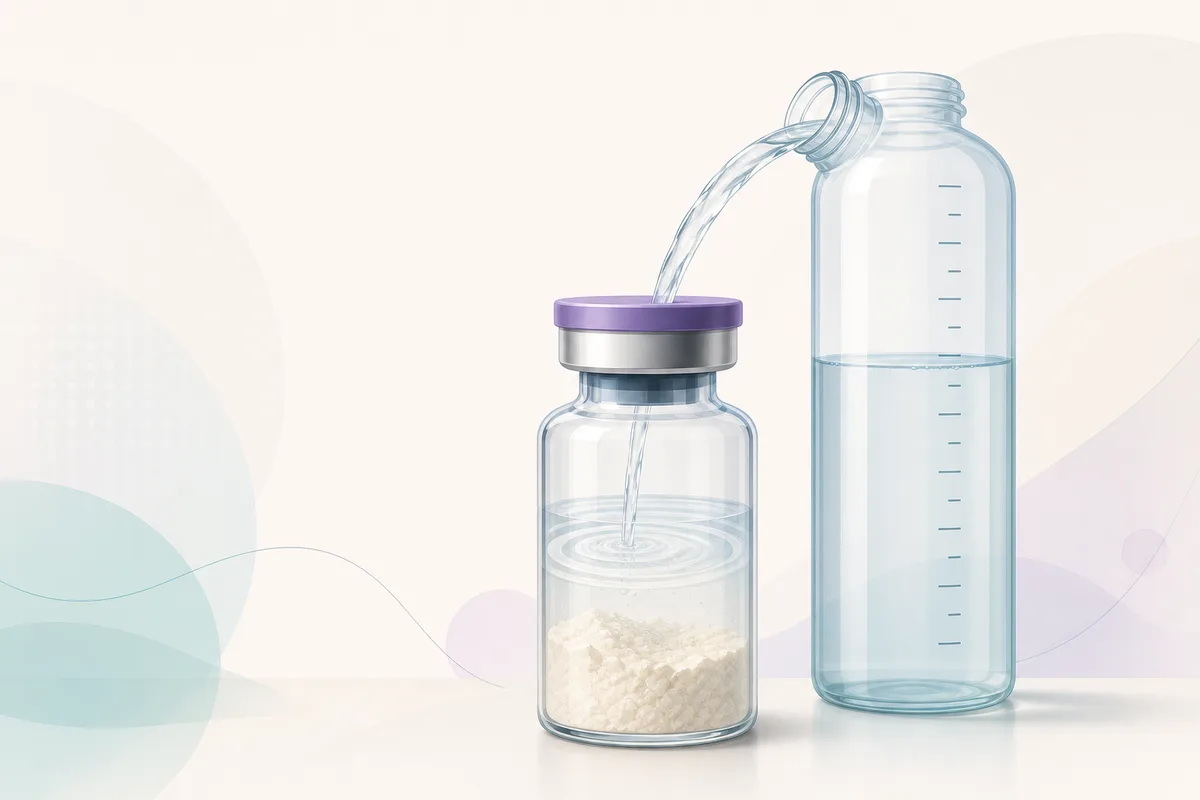
TL;DR: The high-strength tesamorelin vials are where reconstitution arithmetic stops being forgiving. A 20mg vial in 2mL of bacteriostatic water sits at 10 mg/mL, so a 1mg dose is only 0.10 mL — 10 units on a U-100 syringe, and one unit either side of the mark moves the dose by a full 10%. The same 1mg from a 10mg vial in 5mL is 50 units, where a unit is worth 2%. Below: the complete grid at 2mL, 3mL and 5mL for both vials, plus what the price index says the ladder actually saves. The tesamorelin calculator reproduces any row.
Why the big vials are a different problem
Our tesamorelin dosing protocol piece scopes itself, in its own description, to the 2mg and 5mg presentations — deliberately. At those strengths the standard 2mg daily figure lands on comfortable, large draws: a 2mg vial in 1mL is a full 100-unit barrel, and a 5mg vial in 2.5mL matches it exactly. You cannot misread a 100-unit draw by much.
The 10mg and 20mg vials invert that. Fill them the way most people fill everything — 2mL, the volume printed on the vial page — and the concentration doubles, then doubles again. Every draw gets shorter, every tick on the barrel carries more peptide, and the margin for a sloppy plunger read collapses.
That U-100 assumption holds for every number below and is stated once here: one unit is 0.01 mL, one hundred units is one millilitre. On a U-40 barrel none of these unit counts transfer.
The two lines of arithmetic
Everything in the tables is these two formulas, applied repeatedly.
mg/mL = vial strength (mg) ÷ BAC water added (mL)
mcg per unit = (mg/mL × 1000) ÷ 100
Worked example, the 20mg vial in 2mL:
- Concentration: 20 ÷ 2 = 10 mg/mL = 10000 mcg/mL
- Per unit: 10000 ÷ 100 = 100 mcg per unit
- A 1mg (1000 mcg) dose: 1000 ÷ 100 = 10 units = 0.10 mL
- The reference 2mg dose: 2000 ÷ 100 = 20 units = 0.20 mL
Worked example, the 10mg vial in 5mL:
- Concentration: 10 ÷ 5 = 2 mg/mL = 2000 mcg/mL
- Per unit: 2000 ÷ 100 = 20 mcg per unit
- The same 1mg dose: 1000 ÷ 20 = 50 units = 0.50 mL
- The same 2mg dose: 2000 ÷ 20 = 100 units = 1.00 mL
Identical peptide, identical dose, five times the syringe travel. Nothing about the compound changed — you chose a different ruler.
10 units on a U-100 syringe = 0.10 mL = 1mg when a 20mg vial is reconstituted with 2mL. Most 1mL barrels are marked every 2 units, so this dose spans five printed ticks.
The full reconstitution grid
Six configurations, two vials, three fill volumes each.
| Vial | BAC water | Concentration | mcg per unit | 1mg draw | 2mg draw |
|---|---|---|---|---|---|
| 10mg | 2 mL | 5 mg/mL | 50 mcg | 20 units (0.20 mL) | 40 units (0.40 mL) |
| 10mg | 3 mL | 3.33 mg/mL | 33.3 mcg | 30 units (0.30 mL) | 60 units (0.60 mL) |
| 10mg | 5 mL | 2 mg/mL | 20 mcg | 50 units (0.50 mL) | 100 units (1.00 mL) |
| 20mg | 2 mL | 10 mg/mL | 100 mcg | 10 units (0.10 mL) | 20 units (0.20 mL) |
| 20mg | 3 mL | 6.67 mg/mL | 66.7 mcg | 15 units (0.15 mL) | 30 units (0.30 mL) |
| 20mg | 5 mL | 4 mg/mL | 40 mcg | 25 units (0.25 mL) | 50 units (0.50 mL) |
A single 1mg dose spans 10 to 50 units depending purely on how much water went in. That is the point of the grid: the vial label tells you nothing about your syringe reading until the fill volume is fixed.
10mg vial: every common dose
Doses-per-vial assumes full recovery and no waste. It is identical across fill volumes — water changes the reading, never the milligrams.
| Target dose | 2mL (5 mg/mL) | 3mL (3.33 mg/mL) | 5mL (2 mg/mL) | Doses per vial |
|---|---|---|---|---|
| 0.5 mg | 10 units / 0.10 mL | 15 units / 0.15 mL | 25 units / 0.25 mL | 20 |
| 1 mg | 20 units / 0.20 mL | 30 units / 0.30 mL | 50 units / 0.50 mL | 10 |
| 1.4 mg | 28 units / 0.28 mL | 42 units / 0.42 mL | 70 units / 0.70 mL | 7.1 |
| 2 mg | 40 units / 0.40 mL | 60 units / 0.60 mL | 100 units / 1.00 mL | 5 |
| 3 mg | 60 units / 0.60 mL | 90 units / 0.90 mL | 150 units / 1.50 mL | 3.3 |
Only one cell breaks: 3mg from a 10mg vial in 5mL needs 150 units, more than one U-100 barrel holds, so it becomes two draws. Everything else lands inside a single barrel on a whole unit.
20mg vial: every common dose
| Target dose | 2mL (10 mg/mL) | 3mL (6.67 mg/mL) | 5mL (4 mg/mL) | Doses per vial |
|---|---|---|---|---|
| 0.5 mg | 5 units / 0.05 mL | 7.5 units / 0.075 mL | 12.5 units / 0.125 mL | 40 |
| 1 mg | 10 units / 0.10 mL | 15 units / 0.15 mL | 25 units / 0.25 mL | 20 |
| 1.4 mg | 14 units / 0.14 mL | 21 units / 0.21 mL | 35 units / 0.35 mL | 14.3 |
| 2 mg | 20 units / 0.20 mL | 30 units / 0.30 mL | 50 units / 0.50 mL | 10 |
| 3 mg | 30 units / 0.30 mL | 45 units / 0.45 mL | 75 units / 0.75 mL | 6.7 |
The 0.5mg line is the one to watch: 3mL gives 7.5 units, 5mL gives 12.5, both half-unit draws. Most 1mL U-100 barrels print a tick every two units, so 7.5 units is an estimate rather than a reading. For sub-milligram work pair the 5mL fill with a 0.5mL syringe, which marks single units, and skip 3mL entirely. Both the 20mg page and the 10mg page list 2mL as the reference fill, which is why the two vials read so differently out of the box.
Where a one-unit misread actually costs you
Resolution is the real difference between these six configurations. One unit carries a fixed number of micrograms — that number is your error granularity.
Higher bars mean coarser resolution: each unit on the barrel carries more peptide, so a one-unit misread costs more. Computed as (mg/mL x 1000) / 100.
As a percentage of a 1mg dose, one unit is worth 10.0% at 20mg in 2mL, 5.0% at 10mg in 2mL, and 2.0% at 10mg in 5mL. That is a five-fold difference in precision from the same two vials, decided entirely at reconstitution. On a 2mg target every figure halves — which is why the high-strength vials suit the reference 2mg dose far better than sub-milligram work.
Doses per vial against the reconstituted window
Reconstituted tesamorelin holds roughly 3 to 4 weeks refrigerated at 2 to 8 °C, the figure carried on both size pages. Past a point that window, not the vial, is the binding constraint — the argument against buying the biggest vial by reflex.
| Vial | 0.5 mg daily | 1 mg daily | 1.4 mg daily | 2 mg daily |
|---|---|---|---|---|
| 10mg | 20 days | 10 days | 7 days | 5 days |
| 20mg | 40 days | 20 days | 14 days | 10 days |
A 20mg vial at 1mg daily lasts 20 days, comfortably inside the window. At 0.5mg daily it runs 40 days, spending its last twelve days beyond the four-week end of that window — two 10mg vials in sequence cover the same ground with neither sitting open beyond three weeks. At the reference 2mg daily figure the arithmetic flatters the large vial: 10 days from a 20mg, 5 from a 10mg.
What our price index has, and what it does not
Three tesamorelin rows sit in our EU price-index snapshot, and the ladder behaves as vial ladders usually do:
- 5mg at €35.00 = €7.00 per mg
- 10mg at €49.00 = €4.90 per mg — a 30.0% drop on that doubling
- 20mg at €85.00 = €4.25 per mg — a further 13.3% drop
That is -39.3% per mg across the full ladder, with most of it banked on the first doubling. Twenty milligrams bought as two 10mg vials costs €98.00 against €85.00 for the single 20mg — a €13.00 saving on identical peptide, real but modest next to the 30% already collected at 5mg to 10mg.
Per dose, a 20mg vial is €8.50 at the reference 2mg daily figure (10 doses) and €4.25 at 1mg daily (20 doses). The 10mg vial is €9.80 and €4.90 on the same two rungs.
The full table lives in the price index, and the cost calculator turns any price into cost per mg, cost per dose and doses per vial.
Related reading
For the 2mg and 5mg presentations, the tesamorelin dosing protocol covers those sizes, the once-daily timing convention and how a GHRH analogue differs from the ghrelin-mimetic secretagogues. If your vial is a pre-mixed 15mg tesamorelin and ipamorelin blend, the arithmetic changes shape entirely — blend dosing math works through the fixed 2:1 ratio, where every draw carries both components.
The site-wide reconstitution chart covers any strength against any fill volume, and the tesamorelin calculator or general reconstitution calculator returns mg/mL, mcg per unit and the syringe mark for anything not tabled here.
Frequently Asked Questions
How much BAC water do I add to a 20mg tesamorelin vial?
The reference fill on our 20mg page is 2mL, giving 10mg/mL and 100 mcg per unit — a 2mg dose is 20 units, a 1mg dose 10 units. For larger, easier-to-read draws, 5mL gives 4mg/mL and puts that 2mg dose at 50 units; 4mL gives 5mg/mL, reading exactly like a 10mg vial in 2mL.
How many units is 1mg of tesamorelin?
It depends entirely on concentration, never on the vial label. At 10mg/mL (20mg in 2mL) a 1mg dose is 10 units. At 5mg/mL (10mg in 2mL, or 20mg in 4mL) it is 20 units. At 2mg/mL (10mg in 5mL) it is 50 units. All three deliver the same milligram.
Is a 20mg tesamorelin vial cheaper per mg than a 10mg?
Yes, by 13.3%. Our price index lists 10mg at €49.00 (€4.90/mg) and 20mg at €85.00 (€4.25/mg), so twenty milligrams bought as one vial costs €85.00 against €98.00 as two — a €13.00 saving. The bigger jump is earlier: 5mg at €35.00 is €7.00/mg, so the 5mg to 10mg step alone cuts 30%.
How long does a reconstituted 20mg tesamorelin vial last?
Storage guidance on the size pages is 3 to 4 weeks refrigerated at 2 to 8 °C. At 2mg daily a 20mg vial runs 10 days, at 1mg daily 20 days — both inside the window. At 0.5mg daily it runs 40 days, past it, which is the case for two 10mg vials in sequence instead.
Why does my 1mg draw look so small on the syringe?
Because the vial is concentrated. A 20mg vial in 2mL is 10mg/mL, so 1mg occupies just 0.10 mL — ten units, roughly five printed ticks on a 1mL barrel. Adding more water spreads the same milligram over more units without changing the dose.
Which fill volume gives the best precision?
More water, always. One unit carries 100 mcg at 10mg/mL and only 20 mcg at 2mg/mL, so a one-unit misread costs 10% of a 1mg dose in the first case and 2% in the second. The trade is headroom: at 2mg/mL a 2mg dose fills the entire barrel.
References
- EGRIFTA SV (tesamorelin for injection) prescribing information, Theratechnologies Inc. — DailyMed. (1.4mg daily subcutaneous dose; mean elimination half-life ~8 minutes in healthy subjects; absolute subcutaneous bioavailability under 4%.)
- Falutz J, Allas S, Blot K, et al. “Metabolic effects of a growth hormone-releasing factor in patients with HIV.” New England Journal of Medicine, 2007;357(23):2359-2370.
- Falutz J, Mamputu JC, Potvin D, et al. “Effects of tesamorelin (TH9507), a growth hormone-releasing factor analogue, in human immunodeficiency virus-infected patients with excess abdominal fat: a pooled analysis of two multicenter, double-blind placebo-controlled phase 3 trials with safety extension data.” Journal of Clinical Endocrinology and Metabolism, 2010;95(9):4291-4304.
- Stanley TL, Feldpausch MN, Oh J, et al. “Effect of tesamorelin on visceral fat and liver fat in HIV-infected patients with abdominal fat accumulation: a randomized clinical trial.” JAMA, 2014;312(4):380-389.
- PeptiMap. “EU Peptide Price Index” — build-time snapshot of listed European research-supply pricing. The tesamorelin 5mg, 10mg and 20mg figures in this article come from that dataset; no 2mg row exists in it.
This article is a research and educational reference only; tesamorelin sold as a research peptide is not an approved medicine, this is not medical advice, and it is not for human consumption.