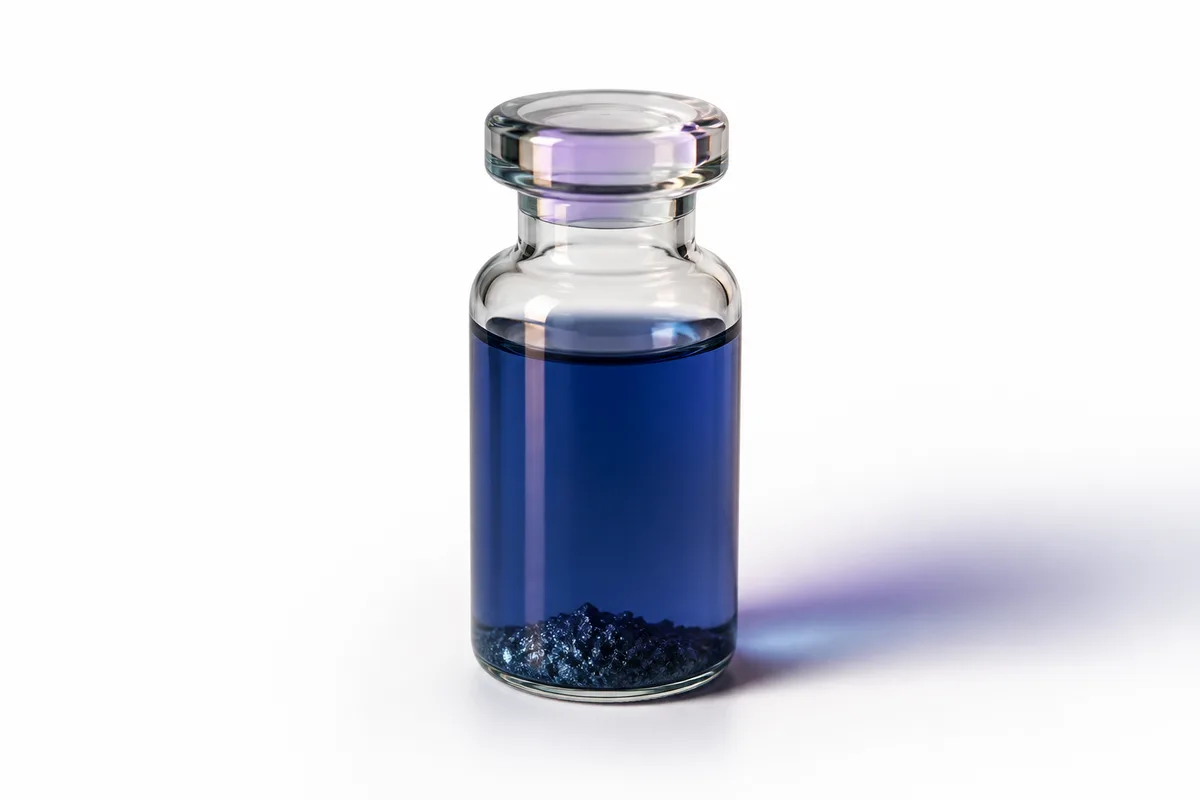
TL;DR: Almost every strange thing GHK-Cu does traces back to one fact — it is a copper(II) complex, not a plain peptide. The blue colour is correct and expected. Slow dissolution and stubborn residue are copper-complex behaviour, not automatically spoilage. Welts and itching at an injection site are the single most-reported GHK-Cu quirk and usually respond to more diluent, smaller volumes, and site rotation. And because a reactive metal complex sitting next to other peptides for days is a genuinely bad idea, GHK-Cu is the clearest case in the fridge for “gets its own vial.”
Most peptide troubleshooting advice is generic, and generic advice mostly works — until you get to GHK-Cu. Our reconstitution troubleshooting guide says a correctly reconstituted peptide should be clear and colourless, and for the vast majority of compounds in a research fridge that is exactly right. GHK-Cu breaks that rule on purpose, along with several others, and people reasonably panic about a vial that is behaving completely normally.
The organising idea for everything below: GHK-Cu is the copper(II) complex of the tripeptide glycyl-L-histidyl-L-lysine. Three amino acids form a binding pocket around a single Cu²⁺ ion. The copper is not a contaminant or an additive — it is the active part of the story, and it is also the source of nearly every practical oddity people hit. Once you hold that in your head, the failure modes stop looking random.
”My GHK-Cu is blue” — that is correct, not a fault
This is the most common GHK-Cu question and it has the most reassuring answer: blue is what it is supposed to look like.
The colour comes from d-d electronic transitions in the coordinated copper(II) ion — the same reason copper sulphate solutions are blue and the same reason a copper roof is not silver. A GHK-Cu solution typically reads somewhere between a clear sky blue and a deeper blue-violet. That is the complex doing exactly what a copper complex does.
The inversion is the useful part. For a normal peptide, colour is the alarm. For GHK-Cu, the absence of colour is the thing worth questioning. A GHK-Cu vial that reconstitutes to a water-clear, colourless solution is not obviously a “clean” vial — it is a vial that raises a question about whether the copper complex is actually there at the expected concentration.
The corollary is that you cannot compare your vial’s colour to a photograph on a forum and conclude anything. You do not know their concentration. Colour intensity is only informative against itself — how does this vial look now compared with how it looked the day you mixed it?
Residue at the bottom of the vial
The second most common report: powder or particulate that will not go away, sitting at the bottom or clinging to the glass. Before treating that as a dead vial, separate two very different situations — undissolved but recoverable versus genuinely degraded.
Undissolved but recoverable looks like discrete powder or fine granules that were there from the moment you added diluent and are slowly shrinking. Copper complexes can simply be slower to go fully into solution than an ordinary short peptide, and cold powder straight out of the fridge is slower still. The plausible causes, roughly in order of likelihood:
- Incomplete dissolution. The most common one, and the most boring. Warm the vial to room temperature, swirl gently, and give it time — well past the point where you would have expected a plain peptide to clear. Patience is doing real work here.
- Concentration too high for the diluent volume. A 100 mg vial squeezed into 1 mL is a much harder ask than the same vial into 3 mL. If the solution is saturated, more diluent is the answer, not more agitation.
- Cold-induced precipitation. Solubility falls with temperature. Material that dropped out in the fridge overnight will often go back into solution as the vial warms and is gently rotated. This is why a vial that looked perfect at mixing can look wrong the next morning and then look fine again by afternoon.
- pH effects. Solubility depends on the solution’s pH relative to the peptide’s charge state, and the coordination chemistry of the copper complex is itself pH-dependent. This is real, but it is not something you can meaningfully diagnose or “fix” with a home diluent — it is a reason a particular batch or diluent can behave differently, not a knob to turn.
Genuinely degraded looks different: the solution itself has gone hazy or murky rather than being clear liquid with distinct particles in it; the colour has faded, shifted brown, or gone off; there are flocculent strands or a settled layer that appeared days after the vial was already clear. That combination — a change in the bulk solution rather than leftover solids from day one — is a discard signal, and no amount of swirling reverses it.
Swirl, don’t shake — and mean it here
The universal peptide rule applies with extra force. Vigorous shaking shears peptide molecules and whips air into the solution, and the air-liquid interface is a well-documented seeding ground for aggregation. Foam also makes accurate volume measurement genuinely difficult.
For GHK-Cu specifically, agitation is a tempting mistake precisely because dissolution is slow. The residue is still there after five minutes, so the instinct is to shake harder. That instinct is exactly backwards: the thing that dissolves it is time and gentle rotation, and the thing that damages it is force.
The technique that works:
- Aim the diluent stream down the glass wall, not straight onto the powder cake, so the powder wets gradually instead of packing into a dense pellet.
- Roll the vial slowly between your palms or swirl it in small circles. Set it down. Come back.
- Let it reach room temperature before judging whether anything is wrong.
- Expect it to take longer than you think — and treat “it is still going in” as a normal state rather than a failure.
Welts, itching, and redness at the injection site
This is the characteristic GHK-Cu report, and it comes up often enough that it should be described plainly rather than treated as alarming. Localised welts, itching, redness, or a raised bump at the injection site are a well-recognised local reaction to GHK-Cu specifically — more so than with most non-metal-binding peptides.
The plausible mechanisms, none of which are exotic:
- A local histamine-type response in the tissue at the site, which is what a raised, itchy welt physically is.
- The copper complex itself being locally irritating to tissue at the point of delivery. Copper species are simply less inert than a plain peptide backbone.
- Concentration too high — the same total amount of compound delivered in a smaller, more concentrated volume puts more mg into a smaller patch of tissue.
- Injecting too shallow, placing the material intradermally rather than into subcutaneous tissue, where the reaction tends to be more visible and more irritating.
- Too large a volume in one site, which distends the tissue and concentrates whatever local reaction occurs into a single point.
The mitigations follow directly from the mechanisms, and they are all things you control at the vial:
| What you are seeing | The lever to pull |
|---|---|
| Welts or strong local redness | Reconstitute with more diluent — same amount of compound, lower concentration |
| Itching and a raised bump | Smaller volume per site, split across more sites if needed |
| The same spot reacting repeatedly | Rotate sites properly rather than favouring one area |
| A shallow, blotchy surface reaction | Confirm subcutaneous depth rather than intradermal placement |
Notice that “more diluent” is the answer to a striking number of GHK-Cu problems — it is the same lever that fixes over-concentration residue. That is not a coincidence; it is what a saturated, reactive metal complex tends to respond to. Our injection site reactions and PIP article covers the general mechanics of local reactions in more depth, and injection best practices covers depth and rotation technique.
Why GHK-Cu should not share a vial
Of all the peptides that get casually co-mixed into a single vial or a single pen cartridge, GHK-Cu is the clearest case for don’t.
The reasoning is straightforward chemistry rather than superstition. GHK-Cu carries a coordinated transition metal, and transition metals are catalytically active — copper in particular is well known to participate in redox chemistry and to catalyse oxidation of susceptible amino-acid residues. Methionine, cysteine, tryptophan, and histidine are the usual targets. Put a copper complex into prolonged, intimate contact with another peptide in the same solution, at fridge temperature, for days or weeks, and you have constructed a small, slow, uncontrolled experiment in metal-catalysed oxidation.
There is a second, quieter problem: copper coordination is an equilibrium, not a permanent weld. Another molecule in the same vial with good metal-binding character can, in principle, compete for the copper. That does not just risk degrading the companion peptide — it risks changing the thing that makes GHK-Cu what it is.
Storage: light, cold, and the copper complex
The copper is once again the reason the rules tighten slightly relative to a plain peptide.
- Light. Copper complexes are photosensitive, and light exposure is a plausible route to both colour loss and degradation. Amber vials, or simply keeping the vial in its box, are standard practice and cost nothing.
- Lyophilised powder. Unopened and freeze-dried, GHK-Cu is the stable form. Kept frozen, sealed, dry, and dark, the powder is where the compound is happiest — which is a good argument for not reconstituting more than you will actually work through.
- Reconstituted solution. Refrigerated at 2-8°C, protected from light, dated on the label. Reconstitution starts a clock on any peptide, and a copper complex in aqueous solution has more chemistry available to it than an inert peptide does.
- Freeze-thaw cycles. Avoid them. Repeated freezing and thawing is a known aggregation trigger, and it is an unnecessary stressor on a solution that already has a metal centre to worry about.
Be sceptical of anyone quoting you a precise number of weeks. Those figures are extrapolated from pharmaceutical formulation science, not validated for whichever specific vial is in front of you. Our peptide storage guide covers the general principles; the GHK-Cu-specific addition is simply “and protect it from light, because copper.”
Topical sidesteps most of this
Worth stating once, because it reframes the whole troubleshooting exercise: the injection-site problems above do not exist topically. No welts, no site rotation, no depth question, no volume-per-site issue. They are all artefacts of putting a copper complex into subcutaneous tissue.
That is not an argument for one route over the other, but it is a notable asymmetry — particularly because the bulk of the peer-reviewed GHK-Cu literature (the collagen, GAG, and antioxidant work) is topical or in vitro, not injectable. Our GHK-Cu topical vs injectable article works through the evidence base and the route comparison properly, and there is no point re-litigating it here.
Reading a GHK-Cu certificate of analysis
A COA for GHK-Cu is not quite the same document as a COA for a plain peptide, because you are verifying a complex rather than a sequence. Things worth actually looking at:
- Is it GHK-Cu, or is it GHK? The uncomplexed tripeptide is a different compound with a different molecular weight and no copper. Check that the identity line says what you think it says.
- Mass spectrometry against the complex, not just the peptide. The expected mass differs depending on whether the copper is coordinated. An MS trace that matches bare GHK is telling you something.
- HPLC purity, read as usual — but remember purity tells you what fraction of the material is the target compound, not whether the copper stoichiometry is right.
- Copper content, if reported. Not every COA includes it. Where it appears, it is one of the more genuinely useful lines on the page for this compound specifically.
- Appearance. Many COAs describe the powder. For GHK-Cu, a description consistent with the blue copper complex is a small, free confirmation that you have the complex and not the bare peptide.
Everything you would normally check on a peptide COA still applies; the lines above are simply the copper-specific additions. Once the vial checks out, our reconstitution guide covers the diluent maths you will need before anything goes into solution.
The short version
Nearly all of GHK-Cu’s odd behaviour is one fact expressed five different ways. The blue is the copper. The slow dissolution is the copper. The injection-site reactivity is the copper. The co-mixing problem is the copper. The light sensitivity is the copper. It is a remarkably coherent compound once you stop expecting it to behave like the plain peptides around it in the fridge — and the practical toolkit is small: more diluent, gentler mixing, more patience, its own vial, and a dark shelf. For the compound background itself, see what GHK-Cu is.
Frequently asked questions
Why is my GHK-Cu blue, and is that a problem?
It is not a problem — it is the expected appearance. The blue to blue-violet colour comes from the coordinated copper(II) ion at the centre of the complex, and its intensity scales with concentration, so a vial reconstituted with less water will look deeper than the same vial reconstituted with more. The result actually worth questioning is a GHK-Cu solution that comes out colourless, or one that has visibly faded, browned, or gone murky compared with how it looked when you first mixed it.
There is powder left at the bottom of my GHK-Cu vial. Is the vial ruined?
Usually not. Copper complexes can take noticeably longer to dissolve than plain peptides, especially straight from cold storage, so discrete powder that has been there since mixing and is slowly shrinking is most likely just incomplete dissolution. Warm the vial to room temperature, swirl gently, and be patient. If the concentration is high, adding more diluent often finishes the job. What is not recoverable is a solution where the liquid itself has gone hazy or off-colour, or where flakes and strands appeared days after the vial was already clear.
Why does GHK-Cu cause welts and itching at the injection site?
It is a well-recognised local reaction with this compound, more common than with most non-metal-binding peptides. The likely contributors are a local histamine-type response, the copper complex being somewhat irritating to tissue at the point of delivery, a concentration that is too high for the volume being placed, injection that is too shallow, or too much volume going into a single site. The practical levers are all under your control: reconstitute with more diluent, use smaller volumes per site, rotate sites properly, and confirm subcutaneous rather than intradermal depth.
Can I mix GHK-Cu with other peptides in the same vial?
This is the one compound where the answer is a firm no. Copper is a catalytically active transition metal that is well known to drive oxidation of susceptible amino-acid residues such as methionine, cysteine, tryptophan, and histidine. Leaving a copper complex in prolonged contact with other peptides in a shared vial or pen cartridge sets up exactly the conditions for metal-catalysed degradation, and it also risks disturbing the copper coordination that makes GHK-Cu what it is. Give it its own vial.
How should GHK-Cu be stored differently from other peptides?
The main addition is light protection, because copper complexes are photosensitive. Beyond that, the usual rules apply with a bit more conviction: keep the lyophilised powder frozen, sealed, and dry; refrigerate the reconstituted solution at 2-8°C, protected from light and dated; and avoid freeze-thaw cycles, which stress the solution unnecessarily. Treat any specific “lasts X weeks reconstituted” figure as a rough extrapolation rather than a validated result for your particular vial.
References
- Pickart, L., & Margolina, A. (2018). Regenerative and Protective Actions of the GHK-Cu Peptide in the Light of the New Gene Data. International Journal of Molecular Sciences, 19(7), 1987.
- Pickart, L., Vasquez-Soltero, J. M., & Margolina, A. (2015). GHK Peptide as a Natural Modulator of Multiple Cellular Pathways in Skin Regeneration. BioMed Research International, 2015, 648108.
- Zapadka, K. L., Becher, F. J., Gomes dos Santos, A. L., & Jackson, S. E. (2017). Factors affecting the physical stability (aggregation) of peptide therapeutics. Interface Focus, 7(6), 20170030.
- Manning, M. C., Chou, D. K., Murphy, B. M., Payne, R. W., & Katayama, D. S. (2010). Stability of protein pharmaceuticals: an update. Pharmaceutical Research, 27(4), 544-575.
- Adnan, S. B., Maarof, M., Fauzi, M. B., & Md Fadilah, N. I. (2025). Exploring the Role of Tripeptides in Wound Healing and Skin Regeneration: A Comprehensive Review. International Journal of Medical Sciences, 22(16), 4175-4200.
Disclaimer: This information is for educational and research purposes only. Peptides are research chemicals not intended for human consumption.