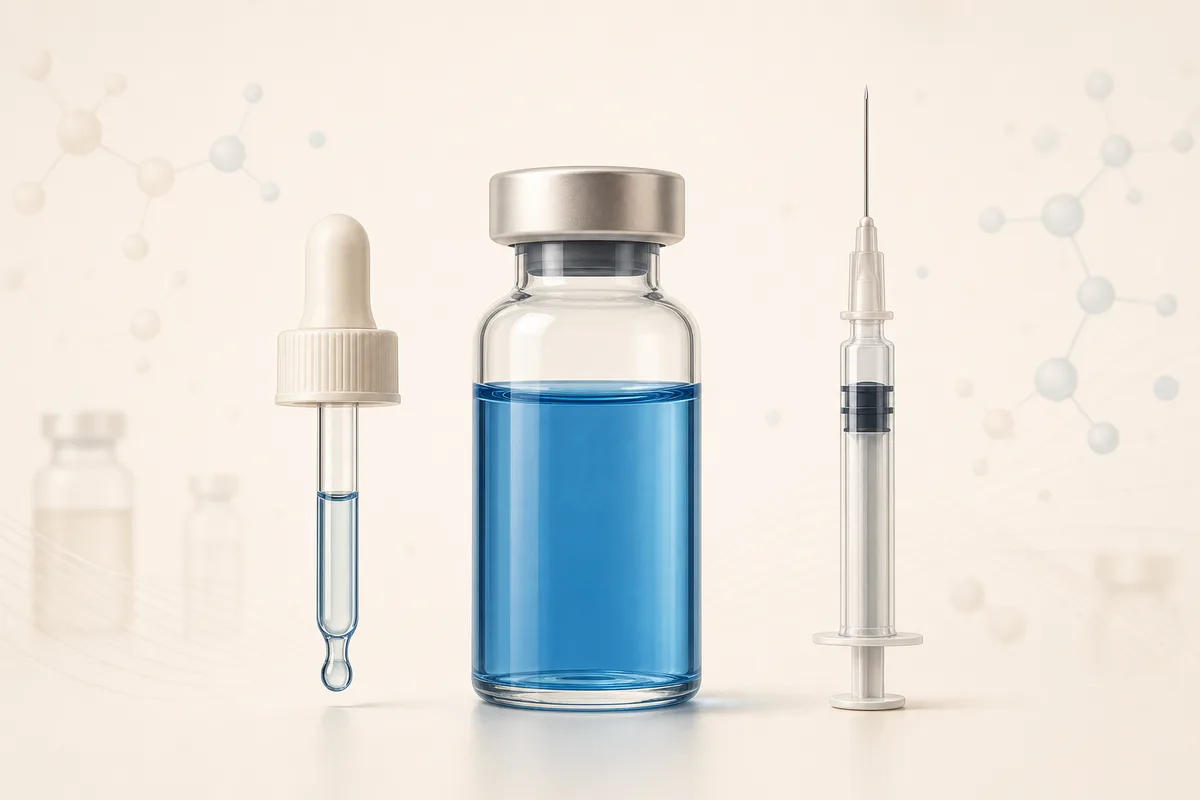
TL;DR: GHK-Cu (copper tripeptide) is studied through two very different routes — topical application for skin and hair research, and subcutaneous reconstitution for systemic work. The dosing logic differs completely between them. This guide covers the research ranges commonly reported for each, the concentration maths for reconstituting a vial, and why the reconstituted solution is deep blue by design.
GHK-Cu is one of the most-referenced peptides outside the GLP-1 space, and its dosing is frequently misunderstood because the same compound is used two entirely different ways. This guide separates the routes cleanly and gives the concentration maths for the research vial. For the underlying biology, see our what is GHK-Cu overview; for the route decision itself, see GHK-Cu topical vs injectable.
What is GHK-Cu?
GHK-Cu is the tripeptide glycyl-L-histidyl-L-lysine bound to a copper(II) ion. The copper is not an impurity — it is integral to the molecule and its biological activity, and it is the reason a correctly reconstituted solution takes on a distinct blue colour. A clear or colourless GHK-Cu solution is the anomaly, not the blue one.
GHK-Cu research vials are commonly supplied in 50mg, 100mg, and 200mg presentations.
The Two Routes Have Different Dosing Logic
The single most important dosing distinction is the route, because the two are not interchangeable numbers.
- 1
Topical
Applied to skin/scalp as a low-percentage solution; dosing is expressed as concentration, not injected mass.
- 2
Subcutaneous
Reconstituted lyophilised powder injected as a defined mcg/mg mass, like other research peptides.
- 3
Not interchangeable
A topical percentage and a subcutaneous mass are different quantities and cannot be converted 1:1.
Topical route
For skin and hair research, GHK-Cu is typically formulated as a low-percentage solution or serum, and the “dose” is expressed as a concentration rather than an injected mass. Research and cosmetic literature commonly reference concentrations in the region of a fraction of a percent up to a few percent by weight. Because absorption depends heavily on the formulation vehicle, topical figures do not translate into an equivalent injected amount.
Subcutaneous route
For systemic research, the lyophilised powder is reconstituted with bacteriostatic water and administered subcutaneously as a defined mass, exactly like other research peptides. The figures below reflect general ranges reported in the research literature and are provided for educational context only. They are not medical instructions and are not intended for human use.
| Protocol | Dose | Frequency |
|---|---|---|
| Low | 1mg | Once daily |
| Standard | 1-2mg | Once daily |
| Divided | 1mg | Split across the day |
Qualitative bands from the research literature; not a recommendation. Topical dosing is expressed differently (concentration, not mass).
Reconstitution & Concentration Maths
Because GHK-Cu vials are large (50-200mg) relative to a typical per-injection research dose (~1-2mg), the reconstitution volume determines how small and precise each draw is. A worked example for a 50mg vial:
| Peptide | BAC Water | Concentration | 1mg dose = |
|---|---|---|---|
| 50mg | 5mL | 10mg/mL | 0.10mL (10 units) |
| 50mg | 2.5mL | 20mg/mL | 0.05mL (5 units) |
| 100mg | 5mL | 20mg/mL | 0.05mL (5 units) |
Higher concentrations keep the injection volume small but make each unit on the syringe worth more, so precision matters. For the general procedure, see our peptide reconstitution guide, and to check any vial and dose combination, use the reconstitution calculator.
Why the Solution is Blue
A correctly reconstituted GHK-Cu solution is visibly blue because of the bound copper ion. This is expected and is not a sign of contamination. Points frequently noted in the handling literature:
- The blue colour confirms the copper complex is intact
- A colourless solution may indicate a product that is not true GHK-Cu, or a labelling issue
- As with all reconstituted peptides, the solution should still be clear (transparent), not cloudy — blue-and-clear is correct; cloudy is not
Storage & Stability
- Lyophilised powder: store at -20°C for long-term stability
- Reconstituted solution: store at 2-8°C (refrigerated), protected from light
- Avoid repeated freeze-thaw cycles of the reconstituted solution
For general storage principles across research peptides, see our peptide storage guide. Route-specific handling issues are covered in GHK-Cu troubleshooting.
Safety, Legality & Research Disclaimers
GHK-Cu is a research peptide. It is not an approved medicine and has not been authorised for therapeutic use in humans. It should be treated strictly as a laboratory research chemical, handled by qualified individuals, and used only for legitimate research purposes. Regulatory status varies by jurisdiction, and researchers are responsible for confirming compliance with all applicable local laws and institutional requirements. Nothing here is medical advice.
FAQ
Is GHK-Cu dosed the same topically and subcutaneously?
No. Topical GHK-Cu is expressed as a concentration (a percentage of a solution or serum), while subcutaneous GHK-Cu is a defined injected mass in milligrams. The two are different quantities and cannot be converted one-to-one, because topical absorption depends on the formulation.
Why is my GHK-Cu solution blue?
Because GHK-Cu contains a bound copper ion, and the copper complex is blue. A correctly reconstituted GHK-Cu solution is blue and clear. A colourless solution is the unexpected result and may point to a product that is not true GHK-Cu.
How much bacteriostatic water should I use for a GHK-Cu vial?
It depends on how precise you need each draw to be. For a 50mg vial, 5mL of bacteriostatic water gives 10mg/mL, so a 1mg research dose is 0.10mL (10 units on a U-100 syringe). Use the reconstitution calculator to model other vial and dose combinations.
Can GHK-Cu be used in humans?
No. It is a research peptide, not an approved medicine, intended for laboratory research purposes only.
References
- Pickart L, Margolina A. “Regenerative and Protective Actions of the GHK-Cu Peptide.” Research literature on the copper tripeptide.
- Research literature on GHK-Cu topical formulation concentrations in skin and hair studies.
Last updated: July 8, 2026
Disclaimer: This information is for educational and research purposes only. Peptides are research chemicals not intended for human consumption. For vial-specific reconstitution, see our GHK-Cu research page.