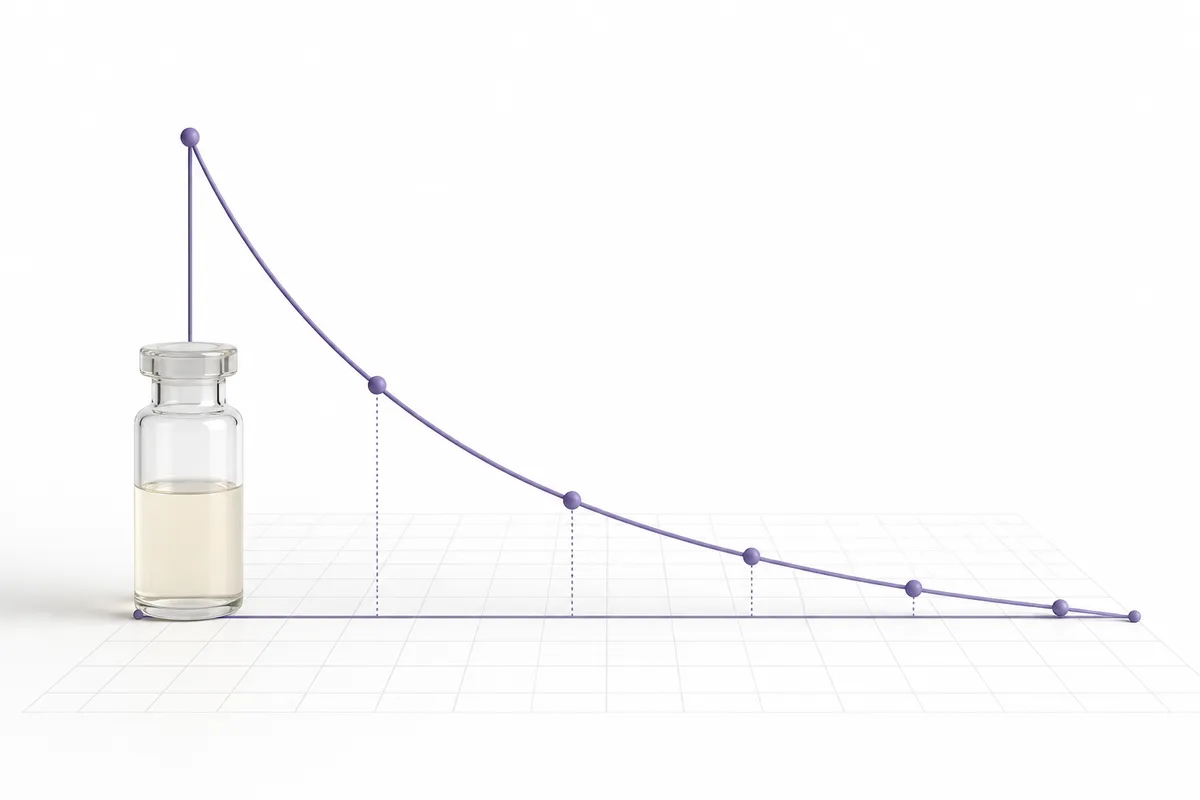
TL;DR: Elimination half-life (t½) is the time it takes for plasma concentration to fall by half. It is the single number that most reliably predicts how often a compound is administered — short half-life means frequent pulses, long half-life means weekly or monthly. But half-life is not the same as duration of effect, and for several peptides the biological effect substantially outlasts the plasma curve. Understand the mechanism and you stop needing to memorise numbers.
If you only learn one piece of pharmacokinetics, make it this one. Half-life explains why Mod GRF 1-29 is dosed several times a day and semaglutide once a week. It explains why a GLP-1 titration schedule takes over a month to arrive anywhere. It explains why someone says “it finally kicked in around week five” and is describing a graph, not a feeling. And it explains why “longer-acting” is not automatically “better.”
What half-life actually measures
Elimination half-life is a property of the decay curve, not of the compound’s usefulness. After administration, plasma concentration rises to a peak and then falls. The time it takes to fall from any point to half that point is t½ — and the defining feature of first-order elimination is that this interval is constant. It takes as long to go from 100 units to 50 as it does to go from 50 to 25.
That constancy is what makes the number so portable. You do not need to know the starting concentration to reason about the curve; you only need t½ and a bit of arithmetic.
Log-scale magnitudes shown for comparison only. Figures are approximate and derived from human pharmacokinetic literature.
The spread here is roughly four orders of magnitude — from minutes to a week — and every practical difference in how these compounds are administered falls out of that spread.
Half-life is not duration of effect
This is the nuance that trips up almost everyone, and it is worth getting straight before anything else.
Half-life describes how long the molecule stays in plasma. It says nothing directly about how long the biological consequence of that molecule persists. The two can diverge enormously, in either direction:
- Effect outlasts plasma presence. A peptide can bind its receptor, trigger a signalling cascade, and be cleared from circulation long before the downstream consequences finish playing out. GHK-Cu is the textbook case — it is studied for effects on gene expression, collagen synthesis and tissue remodelling, processes that unfold over days and weeks regardless of how quickly the tripeptide itself disappears. The same logic applies broadly to the healing peptides: they are not thought to work by maintaining a plasma level, they are thought to initiate a repair program.
- Effect is shorter than plasma presence. Conversely, a compound can still be measurably circulating at a concentration too low to occupy enough receptors to do anything. Detectable is not the same as active.
The 4-5 half-lives rule (both directions)
Two rules of thumb do most of the practical work, and they are the same rule seen from two ends.
Washout. After stopping, roughly 4-5 half-lives are needed for a compound to be substantially cleared. Each half-life halves what remains: 50%, 25%, 12.5%, 6.25%, 3.1%. By the fifth, you are down to a few percent of where you started — close enough to zero for most purposes. Multiply t½ by five and you have your washout estimate.
Steady state. On repeated dosing at a fixed interval, concentration does not stay flat — it climbs, because the next dose lands before the previous one has fully cleared. It keeps climbing until the amount eliminated per interval equals the amount administered per interval. That plateau is steady state, and it takes roughly the same 4-5 half-lives to reach. Accumulation is not a side story; it is the whole reason long-acting compounds behave the way they do.
Run semaglutide through it. A ~7-day half-life means roughly 28-35 days — four to five weeks — before plasma levels plateau at any given dose. That is not a rounding detail. It is precisely why GLP-1 titration schedules step upward slowly: escalating faster than the previous step has stabilised means stacking a new dose on top of a level that is still rising. The slow ladder in our GLP-1 microdosing guide is a direct consequence of the half-life, not a cautious convention.
It also explains one of the most common observations in any research log: “it started working in week five.” Week five is often just when the curve finished climbing.
Why half-life drives dosing frequency
Once you accept that a signalling compound has to be present to signal, the frequency question answers itself.
| Half-life | Dosing pattern that follows | Examples |
|---|---|---|
| Minutes | Multiple times daily, pulse-like | Sermorelin, Mod GRF 1-29 |
| Hours | Once or several times daily | Ipamorelin, GHRPs |
| Days | Weekly | Semaglutide, tirzepatide, CJC-1295 with DAC |
| Weeks | Monthly or less | Long-acting depot formulations |
The rule is simple: dosing interval tracks half-life. If you dose a 30-minute compound once a week, you have administered a brief spike and then nothing for 167 hours. If you dose a 7-day compound daily, you are accumulating toward a plateau you never intended to reach. Neither is a matter of preference; both are arithmetic. The dose-and-interval maths behind this is covered in peptide dosing 101.
Short is not a defect: the pulsatile argument
Here is where “longer is better” falls apart completely.
Growth hormone is secreted in discrete pulses, not continuously — that rhythm is how the somatotropic axis signals. A GH secretagogue with a very short half-life (Mod GRF 1-29 at ~30 minutes, sermorelin at ~10-20 minutes) produces a sharp rise and a fast fall: a clean, discrete pulse that mimics the physiology. The short half-life is the point. It is what lets the signal switch off, which is what makes the next pulse meaningful.
Attach a Drug Affinity Complex to the same peptide backbone and you get CJC-1295 with DAC, half-life ~6-8 days. Now the receptor sits under continuous, low-grade stimulation — a sustained “bleed” rather than a pulse. The total exposure is far higher; the physiological fidelity is far lower, and the sustained pressure is exactly the condition under which receptor response tends to blunt. The trade-off is laid out in full in CJC-1295 DAC vs no-DAC, and it is the same reasoning that drives the on/off logic in peptide cycling and tolerance.
What engineers change to move the number
Peptides are, by default, short-lived. They are cleared fast by peptidases and, if small enough, filtered straight out by the kidney. Extending half-life means fighting one of those routes:
- Albumin binding. Attach a group that reversibly binds circulating albumin and the peptide effectively hitches a ride on a long-lived carrier protein. This is what the DAC in CJC-1295 does, and it is the difference between ~30 minutes and ~6-8 days.
- Fatty-acid acylation. Semaglutide carries a C18 diacid chain that drives strong, reversible albumin binding — the main reason it reaches ~7 days.
- Enzymatic resistance. Native GLP-1 is destroyed by DPP-4 in a couple of minutes. A single amino-acid substitution at the cleavage site removes the enzyme’s grip. This is a prerequisite for everything else — no point protecting a molecule from the kidney if an enzyme eats it first.
- PEGylation. Bolting on a polyethylene glycol chain increases the effective molecular size, slowing renal filtration.
- Size and renal clearance. Below roughly the glomerular filtration threshold, small peptides are cleared rapidly by the kidney whatever else you do to them. Increasing hydrodynamic size is one of the few ways around it.
Every one of these is a deliberate engineering decision, and every one trades a pulse for a plateau.
Route changes what you observe
The half-life quoted in a paper is usually derived from intravenous administration, where the entire dose enters circulation at once. That is rarely how peptides are actually given.
Subcutaneous injection creates a depot: the compound is absorbed gradually from the tissue, so the apparent duration is governed by how fast it leaves the depot, not by how fast the body eliminates it. When absorption is slower than elimination, the observed profile is flatter and longer than the true elimination half-life would suggest. This is why an “effective duration” and a “half-life” can be quoted for the same compound and disagree without either being wrong.
Oral delivery is a different problem entirely — the limiting factor there is bioavailability (how much survives the gut at all), not clearance. A compound with excellent oral stability and 1% absorption is not a long-acting compound; it is a mostly-wasted one. The oral-versus-injectable trade-off is covered in BPC-157 oral vs injectable.
Be sceptical of most quoted peptide half-lives
This is the part most sites will not tell you.
For the pharmaceutical GLP-1s and the well-characterised GH secretagogues, human pharmacokinetic data exists, was measured properly, and is published. Those numbers are trustworthy.
For most of the research-only compounds — BPC-157, TB-500, epithalon, MOTS-c — human PK data is thin or simply absent. Yet precise-looking figures circulate freely on vendor pages and forums, often to the minute. Trace them back and they frequently lead to another vendor page, a forum post, an animal study extrapolated without adjustment, or nothing at all.
We would rather tell you a number is unknown than invent one. Where the data is qualitative, reason qualitatively.
What this means in practice
Three practical consequences fall directly out of everything above.
Washout before switching. If you want a clean baseline before starting a different compound, multiply the old compound’s half-life by roughly five. For a short-acting secretagogue that is a matter of hours. For semaglutide it is over a month — and blends complicate this further, since the components clear on different schedules, as our peptide blend dosing math piece explains.
Missed doses hurt asymmetrically. On a short half-life compound, a missed dose is a missed pulse — the gap is real and immediate. On a long half-life compound sitting at steady state, a single missed dose barely dents the plateau, because most of what is circulating came from earlier doses. Same mistake, completely different consequence.
Onset is often just accumulation. Before concluding that a long-acting compound “did nothing,” check whether it had reached steady state at all. Four to five half-lives is the honest yardstick — and for the compounds in the weekly tier, that means well over a month.
Half-life is not trivia. It is the shape of the curve, and the curve is what you are actually working with. Keep your compounds stored properly so that curve means something (peptide storage guide), and reason from the number rather than memorising it.
Frequently asked questions
What does elimination half-life mean for a peptide?
It is the time required for the plasma concentration of the peptide to fall by half. Because elimination is typically first-order, that interval stays constant — the drop from 100 to 50 takes as long as the drop from 50 to 25. This makes half-life a portable way to describe an entire decay curve with a single number, and it is the primary determinant of how frequently a compound is administered.
How long does it take for a peptide to leave the system?
Roughly four to five half-lives gets you to substantial washout, at which point only a few percent of the original amount remains. For a ~30-minute compound like Mod GRF 1-29, that is a couple of hours. For semaglutide at a ~7-day half-life, it is around five weeks. Multiplying the half-life by five is the standard shortcut for estimating a washout window.
Why does semaglutide take weeks to reach full effect?
Because of accumulation. With a ~7-day half-life, each weekly dose lands before the previous one has cleared, so plasma levels climb toward a plateau rather than resetting. Reaching that plateau — steady state — takes roughly four to five half-lives, which works out to four or five weeks at any given dose. This is also why titration schedules step upward slowly rather than jumping to a maintenance dose.
Is a longer half-life always better for a peptide?
No, and growth hormone secretagogues are the clearest counterexample. GH is secreted in pulses, and a short-acting secretagogue produces a discrete pulse that mirrors that physiology. A long-acting version such as CJC-1295 with DAC (~6-8 days) produces sustained, low-grade stimulation instead — more total exposure, but a flattened signal and greater potential for blunted receptor response. Longer buys convenience; it costs pulsatility.
Can I trust half-life numbers quoted for BPC-157 or TB-500?
Treat them with caution. Human pharmacokinetic data for most research-only peptides is thin or absent, yet precise-sounding figures circulate widely on vendor sites and forums, frequently without a traceable primary source. If a number is quoted to the minute but no human PK study exists, the precision is decorative. For these compounds, a qualitative description — short, intermediate, long — is usually the most honest available answer.
Research use only. This article explains pharmacokinetic concepts for laboratory and educational contexts. It is not medical advice and does not recommend any dose, protocol, or human use. Peptides discussed here are research chemicals not intended for self-administration.