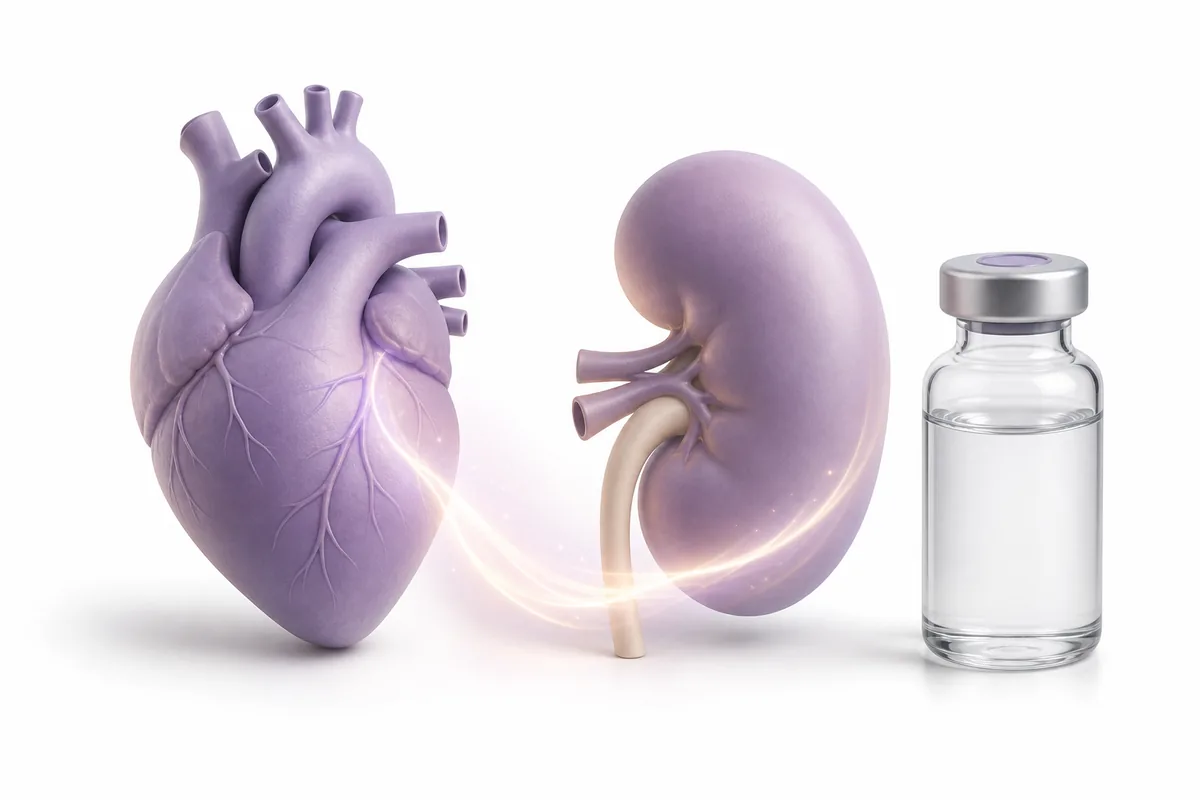
TL;DR: Two phase 3 outcome trials moved semaglutide well past a weight-loss story. SELECT enrolled 17,604 adults with overweight or obesity and existing heart disease, but no diabetes, and found a 20% relative risk reduction in heart attack, stroke, and cardiovascular death, leading to an FDA label expansion in 2024. FLOW enrolled 3,533 adults with type 2 diabetes and chronic kidney disease and found a 24% relative risk reduction in a composite kidney and cardiovascular outcome, a result strong enough to stop the trial early. Both are large, randomized, placebo-controlled trials that changed what semaglutide is approved to do. A 20% relative risk reduction is not a 20-point drop on a page, and the honest reading of SELECT is that the heart benefit doesn’t track cleanly with how much weight someone lost.
Two organs, two trials, one drug
GLP-1 receptor agonists spent their first decade being studied mostly for blood sugar, then for body weight. SELECT and FLOW asked a different, harder question: does semaglutide actually prevent the things that kill or disable people with metabolic disease, not just move a number on a scale or a lab panel. Both trials were designed from the start around hard clinical endpoints rather than surrogate markers, and both were large enough and long enough to answer that question with real statistical weight.
SELECT (Semaglutide Effects on Heart Disease and Stroke in Patients with Overweight or Obesity) tested semaglutide 2.4 mg, the dose sold as Wegovy, in people who already had cardiovascular disease but not diabetes. FLOW (Evaluate Renal Function with Semaglutide Once Weekly) tested semaglutide 1.0 mg, the dose sold as Ozempic, in people with type 2 diabetes who already had chronic kidney disease. Different populations, different doses, same underlying molecule, and both trials answered yes.
What MACE means, and why “20%” is not 20 points
Before the numbers, two terms are worth defining plainly, because most coverage of these trials blurs them.
MACE stands for major adverse cardiovascular events, and in both trials it’s a composite of cardiovascular death, non-fatal heart attack, and non-fatal stroke. A trial counts how many people in each group experienced any one of those three things, then compares the rates.
Relative risk reduction (RRR) describes the drop compared to the placebo group’s own rate, not a flat drop in percentage points. If 8 people out of 100 on placebo have an event, and a 20% RRR applies, the treated group’s rate falls to about 6.4 out of 100 — a drop of 1.6 percentage points, not 20. The relative number is the one that gets repeated in headlines because it sounds bigger, and it is a legitimate way to describe a treatment effect, but it’s a different quantity from the absolute risk reduction (ARR), which is the actual percentage-point gap between the two groups. Both numbers are real. Only one of them tells you how many events were actually prevented per 100 people treated.
SELECT: heart outcomes without diabetes in the picture
SELECT enrolled people at least 45 years old with a BMI of 27 or higher and an established history of cardiovascular disease — prior heart attack, stroke, or peripheral artery disease — who did not have diabetes. That last detail matters: it isolated the cardiovascular effect of semaglutide from any confound of improving blood sugar, since these participants didn’t have elevated blood sugar to improve in the first place. Across 41 countries and more than 800 sites, participants were randomized 1:1 to once-weekly semaglutide 2.4 mg or placebo, on top of their existing cardiovascular care.
The primary outcome — time to first MACE event — occurred in 6.5% of the semaglutide group versus 8.0% of the placebo group, a hazard ratio of 0.80. That’s the 20% relative risk reduction, over a mean follow-up of about 40 months. In March 2024, the FDA expanded Wegovy’s label based on this result, making it the first weight-management medication also approved to reduce the risk of cardiovascular death, heart attack, and stroke in adults with established cardiovascular disease and overweight or obesity.
FLOW: kidney outcomes on top of existing diabetes care
FLOW enrolled a different population entirely: 3,533 adults who already had both type 2 diabetes and chronic kidney disease, defined by reduced kidney filtration or significant protein in the urine. Participants were randomized to semaglutide 1.0 mg weekly or placebo, added to standard diabetes and kidney care.
The primary outcome was a composite of kidney failure, a sustained 50% or greater drop in kidney filtration rate, kidney-related death, or cardiovascular death. It occurred in 18.7% of the semaglutide group versus 23.2% of the placebo group — a 24% relative risk reduction. The result was strong enough that an independent monitoring committee stopped the trial early, at a median follow-up of 3.4 years, because the efficacy threshold had already been met. Secondary analyses reported an 18% reduction in cardiovascular events and a 20% reduction in all-cause mortality alongside the kidney benefit. In January 2025, the FDA approved a new indication for Ozempic based on FLOW, making semaglutide the only GLP-1 medicine approved specifically to reduce the risk of worsening kidney disease and cardiovascular death in adults with type 2 diabetes and chronic kidney disease.
SELECT: MACE (CV death, non-fatal MI, non-fatal stroke) in adults with CVD, no diabetes. FLOW: composite kidney/CV outcome in adults with type 2 diabetes and CKD.
Is it just the weight loss?
This is the honest, still-partly-open question, and it’s worth resisting the urge to give it a tidy answer. Semaglutide lowers weight, blood pressure, and inflammatory markers all at once, and any of those could plausibly explain fewer heart attacks or slower kidney decline on their own. The straightforward story is that less weight means less strain on the heart and less pressure on the kidneys’ filtering units, and the benefit is really just weight loss wearing a different hat.
A prespecified analysis of SELECT complicates that story. Researchers looked at whether the size of a participant’s cardiovascular benefit tracked with how much weight they had lost, and it largely didn’t — people who lost relatively little weight still saw a meaningful drop in cardiovascular events, and the benefit showed up early, often before most of the weight loss had even occurred. That pattern points toward something happening at the vessel wall or in systemic inflammation that isn’t fully explained by the number on the scale — a direct vascular or anti-inflammatory effect running in parallel with, not purely downstream of, weight change.
FLOW doesn’t settle this any more cleanly. Semaglutide’s kidney benefit likely reflects some mix of better glycemic control, lower blood pressure, reduced weight, and a plausible direct effect on the kidney’s own filtering structures, and the trial wasn’t built to cleanly separate those threads from each other. The fair summary for both trials: weight loss, glycemic improvement, and blood pressure changes clearly contribute, but neither trial supports the claim that they’re the whole story, and neither rules out a genuine direct effect.
Where this leaves the two organs
Put together, SELECT and FLOW mean semaglutide now carries outcome data — not just symptom or biomarker data — on three fronts: weight, heart, and kidney. That’s a different category of evidence than most metabolic drugs ever accumulate, and it’s part of why regulators moved on the label twice in under a year of each other’s readouts. If you’re new to what semaglutide actually is and how it works at the receptor level, the what is semaglutide explainer is the right starting point before these outcome trials make much sense. If you’re already on a semaglutide protocol and titrating toward a therapeutic dose, the semaglutide dosing and titration guide covers the standard schedule, and the GLP-1 side effect management guide covers the nausea and GI symptoms that show up during that climb, which were also the most common adverse events reported in both SELECT and FLOW.
Two more pieces round out the picture. If your weight loss has flattened out, that’s expected physiology, not a sign the cardiovascular or kidney benefit has stopped — see the GLP-1 weight-loss plateau piece for why stalls happen and what to do about them. And if you’re weighing semaglutide against the newer dual- and triple-agonist molecules, the semaglutide vs. tirzepatide vs. retatrutide comparison lays out how they stack up, though it’s worth noting that as of today, semaglutide is the GLP-1 molecule with the deepest outcome-trial record on heart and kidney endpoints specifically.
Frequently asked questions
What is the difference between SELECT and FLOW?
SELECT tested semaglutide 2.4 mg in 17,604 adults with existing cardiovascular disease and overweight or obesity, but no diabetes, measuring heart attack, stroke, and cardiovascular death. FLOW tested semaglutide 1.0 mg in 3,533 adults who already had both type 2 diabetes and chronic kidney disease, measuring a composite of kidney failure, kidney function decline, and death. They studied different populations and different doses of the same drug, but both used hard clinical endpoints rather than surrogate lab markers.
Does semaglutide reduce the risk of heart attack and stroke?
In SELECT, semaglutide 2.4 mg reduced the combined rate of cardiovascular death, non-fatal heart attack, and non-fatal stroke by 20% relative to placebo, with event rates of 6.5% versus 8.0% over about 40 months. That result led the FDA to expand Wegovy’s label in March 2024 specifically for cardiovascular risk reduction in adults with established heart disease and overweight or obesity.
Was semaglutide’s cardiovascular benefit in SELECT just from weight loss?
Not entirely, and this is genuinely still being worked out. A prespecified analysis found that the size of a participant’s cardiovascular benefit didn’t track closely with how much weight they lost, and benefits appeared earlier than most of the weight loss did. That suggests a direct vascular or anti-inflammatory effect running alongside the weight-loss effect, though the trial wasn’t designed to fully separate the two.
What did the FLOW trial find about semaglutide and kidney disease?
FLOW found a 24% relative risk reduction in a composite outcome of kidney failure, a sustained major drop in kidney function, kidney-related death, or cardiovascular death, in adults with type 2 diabetes and chronic kidney disease. The result — 18.7% of the semaglutide group versus 23.2% of placebo — was strong enough that the trial was stopped early for efficacy at a median follow-up of 3.4 years, and it led to an FDA-approved kidney indication for Ozempic in January 2025.
What does a “20% relative risk reduction” actually mean?
It means the treated group’s event rate is 20% lower than the placebo group’s own rate, not that risk dropped by 20 percentage points. In SELECT, that 20% relative reduction corresponded to an absolute drop from 8.0% to 6.5% — a 1.5-percentage-point difference over roughly 40 months. Both the relative and absolute numbers are accurate; they just answer different questions about the same result.
Are SELECT and FLOW considered strong evidence?
Yes. Both are large, randomized, double-blind, placebo-controlled phase 3 trials with independent event adjudication, run specifically to test hard clinical outcomes rather than surrogate markers. That’s the same evidentiary tier that supports most approved cardiovascular and kidney therapies, and both trials led directly to expanded FDA-approved indications for semaglutide.