TL;DR: A “copper peptide” is a short peptide bound to a copper ion — and in practice the term almost always means GHK-Cu, the copper tripeptide that leads the category in both skincare and tissue-repair research. There is a small family (AHK-Cu for hair, others), but GHK-Cu is the flagship. This guide explains what copper peptides are, why GHK-Cu dominates the “copper peptide” search term, and where the rest of the family fits.
“Copper peptide” is one of the most-searched terms in the peptide space — far more than the chemical name GHK-Cu it usually refers to. That gap matters: people looking for “copper peptide serums” or “copper peptides for skin” are, in almost every case, looking for GHK-Cu. This guide maps the family behind the search term.
What Is a Copper Peptide?
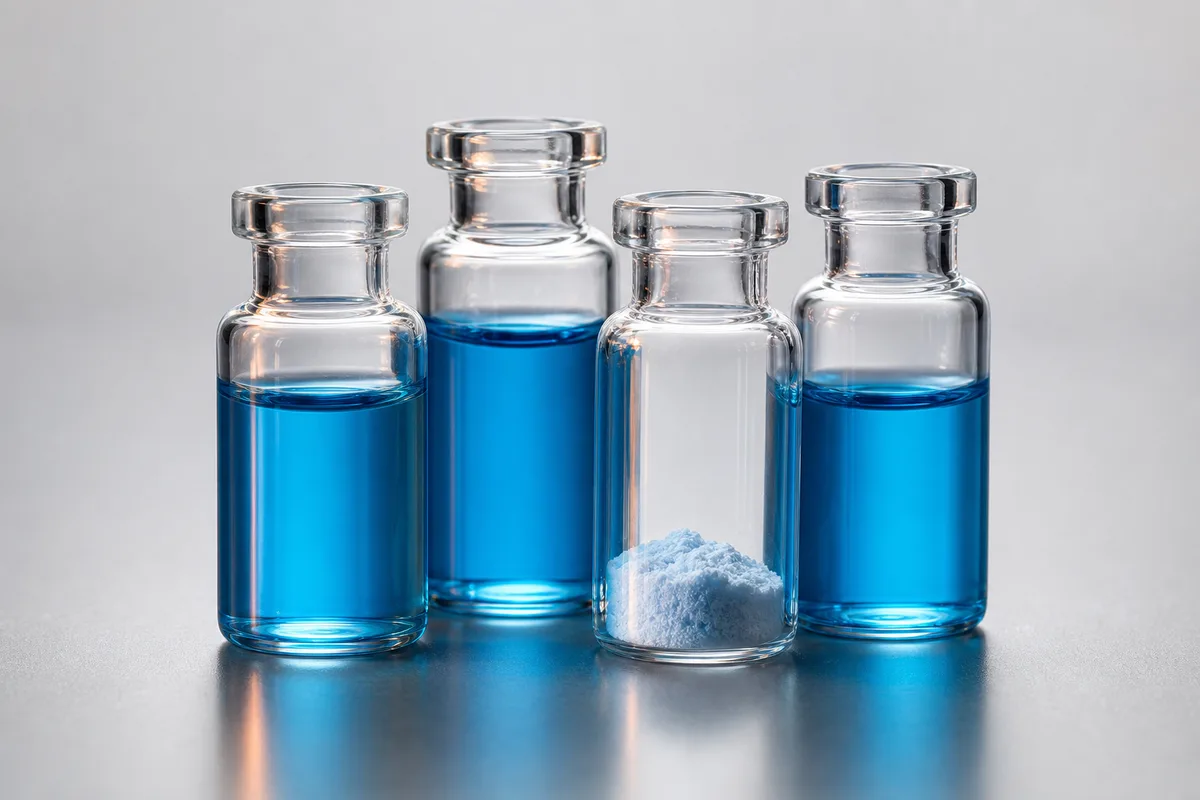
A copper peptide is a short peptide complexed with a copper(II) ion. The copper is integral, not an impurity — it is central to the molecule’s activity and is why a correctly reconstituted copper-peptide solution is distinctly blue. The best-known by a wide margin is GHK-Cu (the copper tripeptide, glycyl-L-histidyl-L-lysine bound to copper).
Copper peptides are studied along two very different lines: topical use for skin and hair, and systemic (subcutaneous) use in tissue-repair and anti-aging research. Our what is GHK-Cu overview covers the biology, and GHK-Cu dosing covers the numbers for each route.
Why “Copper Peptide” Almost Always Means GHK-Cu
- 1
Term searched
People search "copper peptide" / "copper peptide serum" far more than "GHK-Cu".
- 2
What they mean
In almost all cases, the compound they are describing is GHK-Cu.
- 3
The family
Other copper peptides (AHK-Cu, etc.) exist but are niche by comparison.
GHK-Cu carries the category because it has the broadest research base — skin remodelling, wound-healing, hair, and antioxidant work — and because it crossed into mainstream skincare, where “copper peptide serum” became a recognisable product category in 2026. GHK-Cu research vials are available in 50mg, 100mg, and 200mg presentations.
The Copper-Peptide Family
| Copper peptide | Associated use | Form |
|---|---|---|
| GHK-Cu | Skin, hair, tissue repair | Topical + injectable |
| AHK-Cu | Hair growth | Mainly topical |
| Others (research) | Various | Mostly topical |
Qualitative — GHK-Cu dominates the category by a wide margin.
AHK-Cu is the copper peptide most often mentioned alongside GHK-Cu, usually in the context of hair. It is largely a topical ingredient rather than a reconstituted injectable, so it sits outside the research-vial format that GHK-Cu occupies. The remaining copper peptides are niche and mostly topical.
Topical vs Injectable
The single most important practical distinction for GHK-Cu — and copper peptides generally — is the route, because the two are dosed completely differently:
- Topical: expressed as a concentration in a serum, for skin and hair. Absorption depends on the formulation.
- Injectable (subcutaneous): reconstituted lyophilised powder, dosed as a defined mass, for systemic tissue-repair research.
These do not convert one-to-one. Our GHK-Cu topical vs injectable guide covers the decision, and GHK-Cu troubleshooting covers the handling quirks (including the blue colour).
Safety, Legality & Research Disclaimers
Copper peptides, GHK-Cu included, are handled here as research compounds (or, topically, as cosmetic ingredients). Injectable GHK-Cu is not an approved medicine. Treat research-grade material as a laboratory chemical for qualified individuals and legitimate research purposes only. Regulatory status varies by jurisdiction; researchers are responsible for compliance with applicable local laws and institutional requirements. Nothing here is medical advice.
FAQ
Is “copper peptide” the same as GHK-Cu?
In practice, almost always yes. “Copper peptide” is the popular term, and the compound it usually refers to is GHK-Cu — the copper tripeptide that leads the category. There are other copper peptides (such as AHK-Cu for hair), but GHK-Cu is what most “copper peptide” searches are actually about.
Why are copper peptide solutions blue?
Because the copper ion bound to the peptide is blue. A correctly reconstituted GHK-Cu (or other copper-peptide) solution is a clear blue. A colourless solution is the unexpected result and can indicate a product that is not a true copper peptide.
What is the difference between GHK-Cu and AHK-Cu?
Both are copper peptides. GHK-Cu is the broadly-studied flagship used for skin, hair, and tissue repair, available in both topical and injectable research forms. AHK-Cu is a narrower, mainly topical copper peptide associated specifically with hair. GHK-Cu is by far the more researched and searched of the two.
Can copper peptides be used in humans?
Topical copper peptides appear in cosmetic products. Injectable/research-grade copper peptides such as reconstituted GHK-Cu are research compounds, not approved medicines, and are intended for laboratory research purposes only.
References
- Pickart L, Margolina A. “Regenerative and Protective Actions of the GHK-Cu Peptide.” Research literature on the copper tripeptide.
- Research literature on copper-peptide topical formulations in skin and hair applications.
Last updated: July 12, 2026
Disclaimer: This information is for educational and research purposes only. Peptides are research chemicals not intended for human consumption. See the GHK-Cu research page for reconstitution detail.