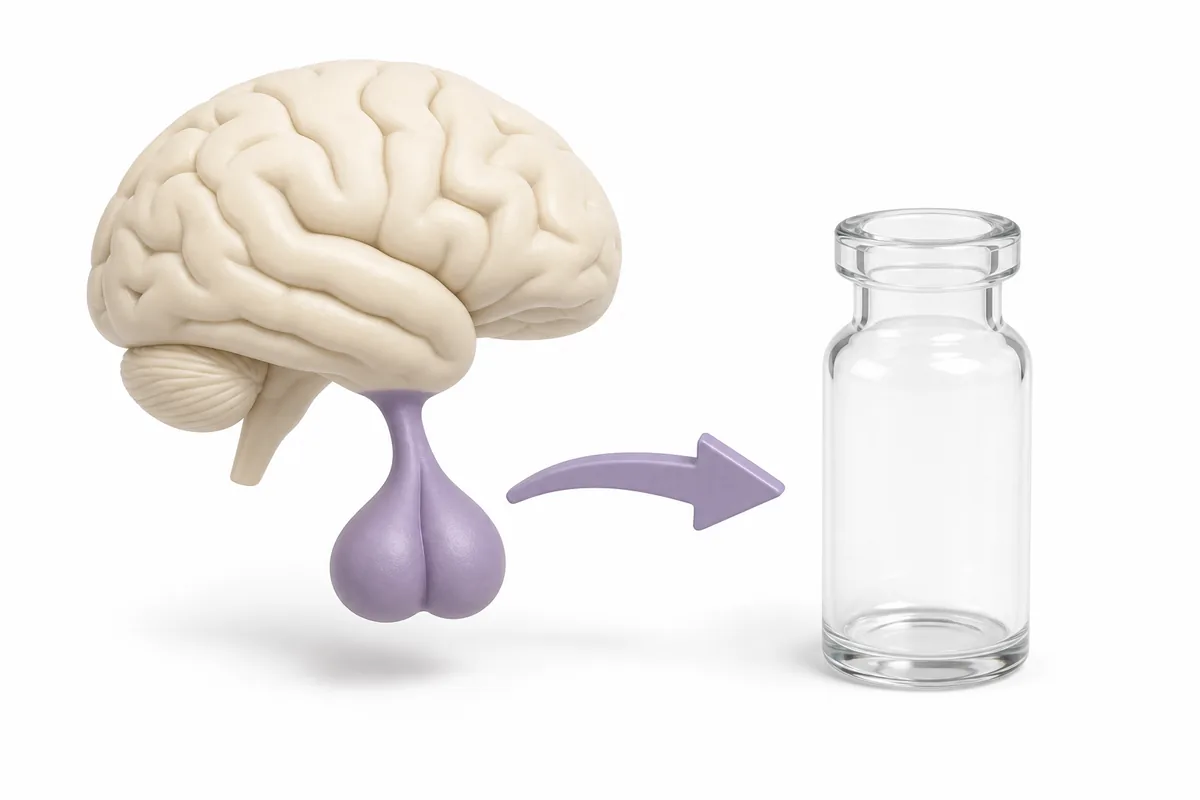
TL;DR: Sermorelin is a 29-amino-acid GHRH analog that prompts the pituitary to release the body’s own growth hormone in natural pulses, rather than replacing GH directly. Unlike synthetic HGH, it preserves feedback control via IGF-1 and somatostatin, making it a key reference compound in GH-axis research.
Sermorelin represents a more physiological approach to growth hormone research compared to direct GH administration. By stimulating the body’s own GH production, it maintains natural feedback mechanisms. This guide explains what sermorelin is, how it works at the receptor level, how it compares with related peptides, and the handling considerations that matter in a laboratory research context. All information here is provided strictly for research and educational purposes only. For a broader orientation to the field, see our beginner’s guide to peptide research.
What is Sermorelin?
Sermorelin (also known as GRF 1-29 NH2) is a synthetic peptide consisting of the first 29 amino acids of human growth hormone releasing hormone (GHRH). These 29 amino acids represent the biologically active portion of the full 44-amino acid GHRH molecule. Because the N-terminal fragment retains the receptor-binding and signalling activity of the parent hormone, sermorelin is classified as a GHRH analog rather than a growth hormone itself.
The distinction matters. Native GHRH is produced in the hypothalamus and travels to the anterior pituitary, where it prompts specialised cells to synthesise and release growth hormone (GH). Sermorelin mimics this upstream signal. Rather than supplying GH directly, it engages the same regulatory pathway the body already uses, which is why researchers describe it as a “secretagogue” acting on the GHRH axis.
How Sermorelin Differs from HGH
| Factor | Sermorelin | HGH |
|---|---|---|
| Type | GHRH analog | Direct hormone |
| Action | Stimulates GH release | Replaces GH |
| Feedback | Preserves natural | Suppresses natural |
| Pulsatility | Natural pulses | Constant levels |
| IGF-1 | Physiological | Supraphysiological |
The core research interest in sermorelin stems from this contrast. Direct GH administration overrides the hypothalamic-pituitary axis and can produce sustained, non-physiological hormone levels. Sermorelin instead works within existing regulatory limits, which is a central reason it is studied as a model for physiologic GH stimulation.
Mechanism of Action
Sermorelin works through a specific pathway:
- Binds to GHRH receptors on pituitary somatotrophs
- Triggers the cAMP cascade inside pituitary cells
- Stimulates GH synthesis and release in a pulsatile manner
- Released GH enters circulation and acts on peripheral tissues
- Negative feedback via somatostatin and IGF-1 prevents excessive release
The GHRH receptor is a G-protein-coupled receptor. When sermorelin binds, it activates adenylate cyclase, raising intracellular cyclic AMP (cAMP), which in turn drives the transcription and secretion of stored GH. Crucially, this signal is still subject to the body’s braking systems: rising IGF-1 and hypothalamic somatostatin dampen further GH output. That preserved feedback is what allows sermorelin to maintain physiologic GH pulsatility rather than flooding the circulation with a flat, continuous level of hormone.
Pulsatility is not a minor technical detail. The pattern and amplitude of GH pulses are thought to influence downstream signalling, and research literature on GHRH analogs frequently highlights the preservation of this rhythm as a defining feature.
Research Background and Key Findings
Sermorelin has a long history in the scientific literature as a tool for probing GH secretory capacity. Foundational research by Walker and colleagues examined GHRH 1-29 and its ability to stimulate endogenous growth hormone release, and subsequent studies used it as a diagnostic and investigational probe of pituitary function. Because sermorelin acts through the native GHRH receptor, an observable GH response is often interpreted as evidence of a functioning somatotroph population.
A recurring theme in the literature is the contrast between GHRH analogs and growth hormone secretagogues (GHS) such as ipamorelin. GHRH analogs signal through the GHRH receptor, whereas GHS peptides act through the ghrelin/GHS receptor. These two pathways are complementary, and research protocols frequently pair them because co-stimulation tends to produce a larger, cleaner GH release than either class alone. This complementary pharmacology is a large part of why sermorelin remains a reference compound in GH research.
Sermorelin vs Related Peptides
Sermorelin sits within a broader family of compounds that modulate the GH axis, and understanding the categories helps clarify how they are studied together.
- GHRH analogs — Sermorelin, CJC-1295, and tesamorelin all engage the GHRH receptor. They differ mainly in half-life and stability. Sermorelin is short-acting, closely tracking a natural pulse, whereas modified analogs such as CJC-1295 DAC are engineered for extended activity.
- GHRPs / GH secretagogues — Ipamorelin and related peptides such as hexarelin and GHRP-2 act on the separate ghrelin receptor pathway. They are commonly researched alongside GHRH analogs rather than as substitutes.
Because the two classes act on different receptors, they are frequently combined in research settings. The pairing of a GHRH analog with a GHRP is one of the most studied combinations in the GH-axis literature. For a broader look at how these are grouped, see our overview of common peptide stacks.
Reconstitution and Handling Overview
Sermorelin is supplied as a lyophilised (freeze-dried) powder that must be reconstituted with bacteriostatic water before use in research. Accurate reconstitution is essential for consistent, reproducible concentrations across an experiment. The specific volume chosen determines the final concentration and therefore the draw volume for a given target amount.
For a worked example using a 5mg vial reconstituted with 2.5mL of bacteriostatic water (2mg/mL):
| Target Amount | Draw Volume |
|---|---|
| 200mcg | 0.10mL / 10 units |
| 300mcg | 0.15mL / 15 units |
| 500mcg | 0.25mL / 25 units |
At a 2mg/mL concentration, a 500mcg target = 0.25mL = 25 units on a U-100 insulin syringe.
Smaller 2mg vials follow the same arithmetic with proportionally less diluent. For a full step-by-step walkthrough of technique, sterile handling, and concentration math, see our dedicated peptide reconstitution guide.
Research Dosing Considerations
The figures below describe general ranges reported in the research literature. They are provided for informational and educational context only and are not human medical instructions or a protocol for use in people.
| Context | Reported Range | Notes |
|---|---|---|
| Baseline studies | 100-300mcg | Single evening equivalent |
| Co-stimulation studies | 100-200mcg + GHRP | Paired with a secretagogue |
Two variables dominate the literature. First, timing relative to the natural nocturnal GH surge, since GHRH signalling is often studied in alignment with the body’s own rhythm. Second, the nutritional state, because elevated insulin and circulating nutrients are known to blunt GH responses in experimental models. These are documented experimental variables, not usage advice.
Storage and Stability
Sermorelin is comparatively delicate among research peptides, so storage conditions have a direct effect on data quality.
- Lyophilised powder: stored frozen at approximately -20°C, stable for extended periods (often cited at 2+ years)
- Reconstituted solution: refrigerated at 2-8°C, typically used within 3-4 weeks
- Light sensitivity: protect from light; store vials in a dark environment
- Handling: avoid repeated freeze-thaw cycles and vigorous agitation, which can degrade the peptide
Degradation is not always visible, so tracking reconstitution dates and storage temperatures is good laboratory practice for reproducibility. For a broader reference on cold-chain handling across compounds, see our peptide storage guide.
Safety, Legality and Research Disclaimers
Sermorelin is handled in this context as a research peptide and is not presented as an approved medicine here. Regulatory status varies by jurisdiction, and it is the responsibility of the researcher to understand and comply with the laws that apply to acquisition, possession, and handling in their location.
Nothing in this article is medical advice, and none of it describes a protocol for human or animal administration. All materials should be labelled “for research purposes only” and handled by qualified individuals in an appropriate laboratory setting. Long-term human safety data for many research peptides remains limited, which is itself a reason the research context matters.
Sourcing and Quality Verification for Research
Data quality depends heavily on material quality. When evaluating any research peptide, generic verification principles apply regardless of supplier:
- Third-party testing — independent laboratory analysis confirming identity and purity
- Certificate of Analysis (COA) — documentation of purity (commonly assessed by HPLC), identity (often by mass spectrometry), and results specific to the material
- Batch traceability — a lot or batch number linking the physical vial to its testing records
- Purity thresholds — clearly stated purity figures rather than vague marketing claims
- Consistent lyophilisation — a uniform, intact powder cake as a basic quality signal
These are general due-diligence criteria for research materials and are deliberately supplier-agnostic. The goal is traceable, verifiable material, not a particular brand. For a deeper walkthrough of reading a Certificate of Analysis, see understanding peptide purity and COAs.
Frequently Asked Questions
Is sermorelin the same as HGH?
No. Sermorelin is a GHRH analog that stimulates the pituitary to release the body’s own growth hormone, whereas HGH is the hormone itself administered directly. Sermorelin preserves natural feedback and pulsatility; direct GH does not.
Why is sermorelin often paired with a GHRP in research?
GHRH analogs and GH secretagogues act on two different receptors. Co-stimulation of both pathways tends to produce a larger and more physiologic GH release in experimental models, which is why the pairing is so commonly studied.
What makes sermorelin’s pulsatile release significant?
Because sermorelin works through the native GHRH receptor and leaves feedback intact, released GH still follows a pulsatile pattern rather than a flat, continuous level. Preserving this rhythm is a defining feature of GHRH-analog research.
How is sermorelin stored?
As a lyophilised powder it is kept frozen near -20°C. Once reconstituted it is refrigerated at 2-8°C, protected from light, and typically used within a few weeks. Avoiding freeze-thaw cycles helps preserve integrity.
How does sermorelin compare to CJC-1295 or tesamorelin?
All three are GHRH analogs acting on the same receptor. The main practical difference is duration: sermorelin is short-acting and closely mimics a single natural pulse, while other analogs are modified for longer activity.
What purity indicators should researchers look for?
Look for a Certificate of Analysis with HPLC purity and mass-spectrometry identity data, a batch number for traceability, and independent third-party testing. These are generic quality signals rather than brand markers.
Conclusion
Sermorelin offers a more physiological approach to GH research by working with the body’s natural mechanisms rather than replacing them. Its action through the GHRH receptor, its preservation of feedback and pulsatility, and its long history as a reference probe of pituitary function make it a foundational compound in the study of the growth hormone axis. Handled carefully and sourced with proper verification, it remains a widely referenced tool in peptide research.
References
- Walker RF, et al. Research on sermorelin (GHRH 1-29) and growth hormone secretion.
- Literature on GHRH analogs and physiologic growth-hormone release.
Last updated: July 4, 2026
Disclaimer: This information is for educational and research purposes only. Peptides are research chemicals not intended for human consumption. For detailed handling references, see our Sermorelin dosage overview.