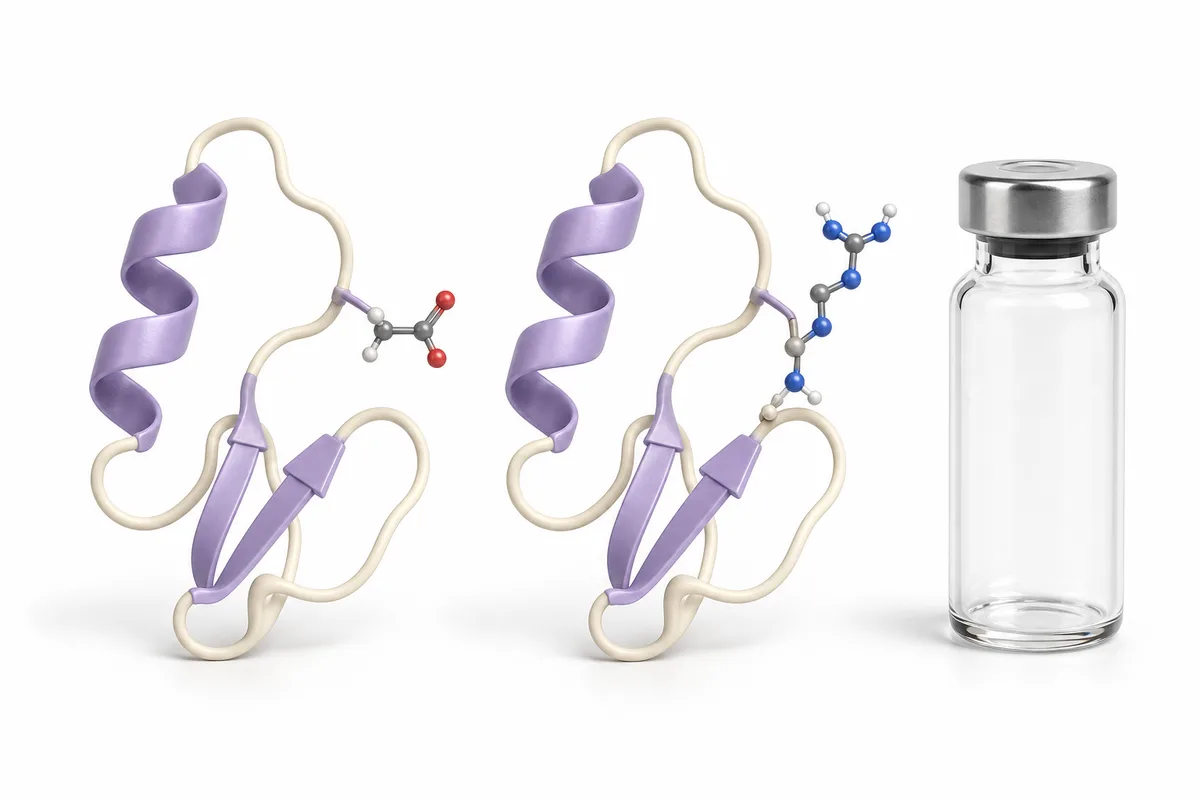
TL;DR: Pentadeca Arginate (PDA) is not a new peptide. It is the exact same 15-amino-acid pentadecapeptide sequence as BPC-157, just paired with an arginate counter-ion instead of the usual acetate salt. A salt form changes solubility and shelf stability, not the active molecule or its mechanism. Vendors position PDA as a “next-generation” upgrade, but there is no robust head-to-head evidence that the arginate salt outperforms acetate in research. Treat PDA as BPC-157 in a different wrapper, and everything below describes research context, not usage guidance.
“Is Pentadeca Arginate a different peptide than BPC-157, or just a rebrand?” has quietly become the most-asked healing-peptide question of 2026. The short answer is the one most vendor pages bury: same sequence, different salt. That single fact settles most of the confusion, but it is worth unpacking properly, because the naming makes PDA sound like a novel compound when the chemistry says otherwise.
The core fact: same peptide, different salt
BPC-157 is a pentadecapeptide — fifteen amino acids — derived from a protective protein found in gastric juice. “Pentadeca” literally means fifteen. When someone writes “Pentadeca Arginate,” they are describing that same fifteen-residue chain, supplied as an arginate salt.
Most BPC-157 on the research market is an acetate salt: the peptide is manufactured and lyophilized with acetate as the counter-ion left over from purification. PDA swaps that counter-ion for arginate. The peptide backbone — the sequence that actually does the biology — is identical in both.
This is a routine distinction in peptide chemistry. The same active molecule is regularly sold as an acetate, a hydrochloride, a trifluoroacetate, or another salt depending on how it was purified and what a manufacturer wants to emphasize. The salt is a formulation detail. PDA is BPC-157 formulated as an arginate salt, in the same way that two versions of a compound can differ on the label while sharing the molecule that matters.
For the full picture of what the underlying peptide is and where it comes from, our what is BPC-157 overview covers the sequence, the gastric-juice origin, and the repair research in detail. Everything in that article applies to PDA, because it is the same molecule.
Why the term exploded in 2026
If PDA is just BPC-157 with a different counter-ion, why did it suddenly become everywhere? The answer is naming, not new science.
Over the past couple of years the compounding and research-supply landscape reshuffled, and a number of vendors looked for ways to differentiate a crowded BPC-157 market. “Pentadeca Arginate” is an appealing rebrand: it sounds technical and distinct, it maps to a genuine chemical difference (the salt is real), and it lets a product be marketed as a fresh, “next-generation” evolution of BPC-157 rather than yet another listing of the same peptide.
So the explosion of the term is mostly a positioning phenomenon. The arginate salt exists and is a legitimate formulation choice; the framing of it as a categorically better or newer compound is where marketing runs ahead of the chemistry.
Mechanism: identical to BPC-157
Because the sequence is the same, there is nothing mechanistically separate to explain for PDA. The pentadecapeptide is studied for tissue-repair processes — angiogenesis (new blood-vessel formation), effects on tendon, ligament, and muscle healing, and gut and mucosal repair, the latter fitting its gastric-juice origin. Whatever the research literature attributes to BPC-157 is what would apply to PDA, because they are the same active molecule in the vial once reconstituted.
Rather than re-explain that biology here, it lives in our existing coverage:
- What is BPC-157 — the mechanism, origin, and repair research.
- BPC-157 vs TB-500 — how the pentadecapeptide compares to the other main repair peptide.
- BPC-157 timeline and side effects — how the research response tends to build over weeks.
If you understand BPC-157, you already understand PDA’s mechanism. There is no additional receptor, pathway, or target that the arginate salt introduces.
The stability argument, kept proportionate
The main claim made for PDA is stability: that the arginate salt is more stable, has a longer shelf life, and — in some versions of the pitch — better tolerance to gastric acid. It is worth separating what is plausible from what is proven.
What an arginate salt could plausibly do:
- Solubility and buffering. Arginine is a basic amino acid, so an arginate counter-ion can shift the local pH environment of the reconstituted solution and may influence how readily and how cleanly the powder dissolves. Different salts genuinely do have different solubility and hygroscopic behavior.
- Shelf stability. A counter-ion can affect how a lyophilized powder holds up against moisture and degradation over time. It is chemically reasonable that one salt sits more happily in the vial than another.
What that plausibility does not establish:
- That PDA is more effective in any research readout. “More stable in the vial” is a property of the powder, not of the biology. A peptide that degrades slightly slower on the shelf still delivers the same molecule to the same targets once it is intact and reconstituted.
- That gastric-acid tolerance translates into a meaningful oral advantage. BPC-157 is already noted for relative robustness given its gastric origin, and the oral-versus-injectable question is genuinely unsettled — our BPC-157 oral vs injectable piece walks through why. An arginate salt does not resolve that debate.
Evidence honesty
This is where PDA marketing tends to overreach, and where being straight about the evidence is the whole point.
Start with the parent compound. BPC-157 itself has no published human clinical trials. Its evidence base is preclinical — animal models, mostly rodents — plus in-vitro work. Even its pharmacokinetics are animal-only; the figure most often cited is a short plasma half-life on the order of roughly 15 minutes after intravenous administration in rats. That is a rat number, not a human one, and it is about all the dedicated PK there is.
Now layer PDA on top. As a newer, rebranded salt form, it has even less dedicated data than BPC-157. There is no body of head-to-head research comparing arginate against acetate for the pentadecapeptide, no human PDA trials, and no robust demonstration that the salt swap changes any biological endpoint. When a vendor claims PDA is superior, that claim is running on inference and positioning, not on comparative evidence.
Practical handling
Because PDA is the same peptide, the practical mechanics are handled exactly like BPC-157. Reconstitution and storage do not change in any special way for the arginate salt:
- Reconstitution follows the same bacteriostatic-water logic as any lyophilized peptide — see our peptide reconstitution guide for the arithmetic and technique.
- Storage follows the same cold-chain and light-protection principles as BPC-157 — covered in the peptide storage guide.
If the arginate stability advantage is real, the place it would show up is here: potentially a bit more forgiving on shelf life or reconstituted stability. That is a logistics benefit, not a performance one. Nothing about dosing arithmetic or the underlying research protocol changes because the salt changed — the same considerations from our BPC-157 and TB-500 dosing protocol reference apply unchanged.
The honest verdict
Pentadeca Arginate is BPC-157 in a different salt. That is the beginning and the end of the chemistry. The arginate counter-ion is a legitimate formulation choice that may plausibly give the powder somewhat better solubility or shelf behavior. It does not make PDA a different peptide, a different mechanism, or an evidence-superior compound.
So the practical framing is: PDA is interesting, plausibly a touch more stable, and functionally interchangeable with BPC-157 in terms of what it is and what it does. A research or purchasing decision should not assume PDA is dramatically better, because nothing in the available evidence supports that. If a listing prices PDA at a large premium purely on “next-generation” language, you are mostly paying for the name and, at most, a modest stability edge — not for a better molecule.
Frequently asked questions
Is Pentadeca Arginate the same thing as BPC-157?
Effectively yes. PDA is the identical 15-amino-acid pentadecapeptide sequence as BPC-157, supplied as an arginate salt rather than the more common acetate salt. The active molecule and its mechanism are the same. The only genuine difference is the counter-ion, which affects solubility and shelf stability rather than the biology, so PDA is best understood as a salt-form variant of BPC-157, not a distinct peptide.
What does “arginate salt” mean compared to “acetate salt”?
Peptides ship paired with a counter-ion that balances their charge, left over from manufacturing and purification. Acetate is the usual counter-ion for BPC-157; arginate uses arginine-derived ions instead. Swapping the salt can change how the powder dissolves, its local pH when reconstituted, and how it holds up on the shelf. It does not change the amino-acid sequence, so the peptide that does the work is the same in both forms.
Is PDA more effective than BPC-157?
There is no robust evidence that it is. Claims of superiority rest on the arginate salt’s plausible stability advantages, but “more stable in the vial” is a property of the powder, not of the research outcome. No head-to-head studies compare arginate against acetate for this peptide, and PDA has even less dedicated data than BPC-157, which itself has no human trials. The superiority framing is a vendor position, not a demonstrated finding.
Why did Pentadeca Arginate become so popular in 2026?
Mostly rebranding. After the research-supply landscape reshuffled, vendors looked to differentiate a crowded BPC-157 market, and “Pentadeca Arginate” is a technical-sounding name that maps to a real chemical difference — the salt — while implying a next-generation upgrade. The salt is genuine; the framing of PDA as a categorically newer or better compound is where the marketing runs ahead of the chemistry.
Do you reconstitute and store PDA differently than BPC-157?
No. Because PDA is the same peptide, reconstitution and storage follow the same principles as any lyophilized pentadecapeptide — bacteriostatic water for reconstitution, cold and light-protected storage afterward. If the arginate salt’s stability claim holds, it would mostly mean slightly more forgiving shelf life, not a different procedure. Our reconstitution and storage guides apply to PDA exactly as they do to BPC-157.
References
- Sikiric P, Seiwerth S, Rucman R, et al. Brain-gut axis and pentadecapeptide BPC 157: theoretical and practical implications. Current Neuropharmacology. 2016;14(8):857-865.
- Gwyer D, Wragg NM, Wilson SL. Gastric pentadecapeptide body protection compound BPC 157 and its role in accelerating musculoskeletal soft tissue healing. Cell and Tissue Research. 2019;377(2):153-159.
- Seiwerth S, Rucman R, Turkovic B, et al. BPC 157 and standard angiogenic growth factors. Gastrointestinal tract healing, lessons from tendon, ligament, muscle and bone healing. Current Pharmaceutical Design. 2018;24(18):1972-1989.
- Vukojevic J, Milavic M, Perovic D, et al. Pentadecapeptide BPC 157 and the central nervous system. Neural Regeneration Research. 2022;17(3):482-487.
Research use only. This article explains the chemistry and evidence context of Pentadeca Arginate for laboratory and educational purposes. It is not medical advice and does not recommend any dose, protocol, or human use. Peptides discussed here are research chemicals not intended for self-administration; handle all research materials in accordance with applicable EU regulations and institutional guidance.