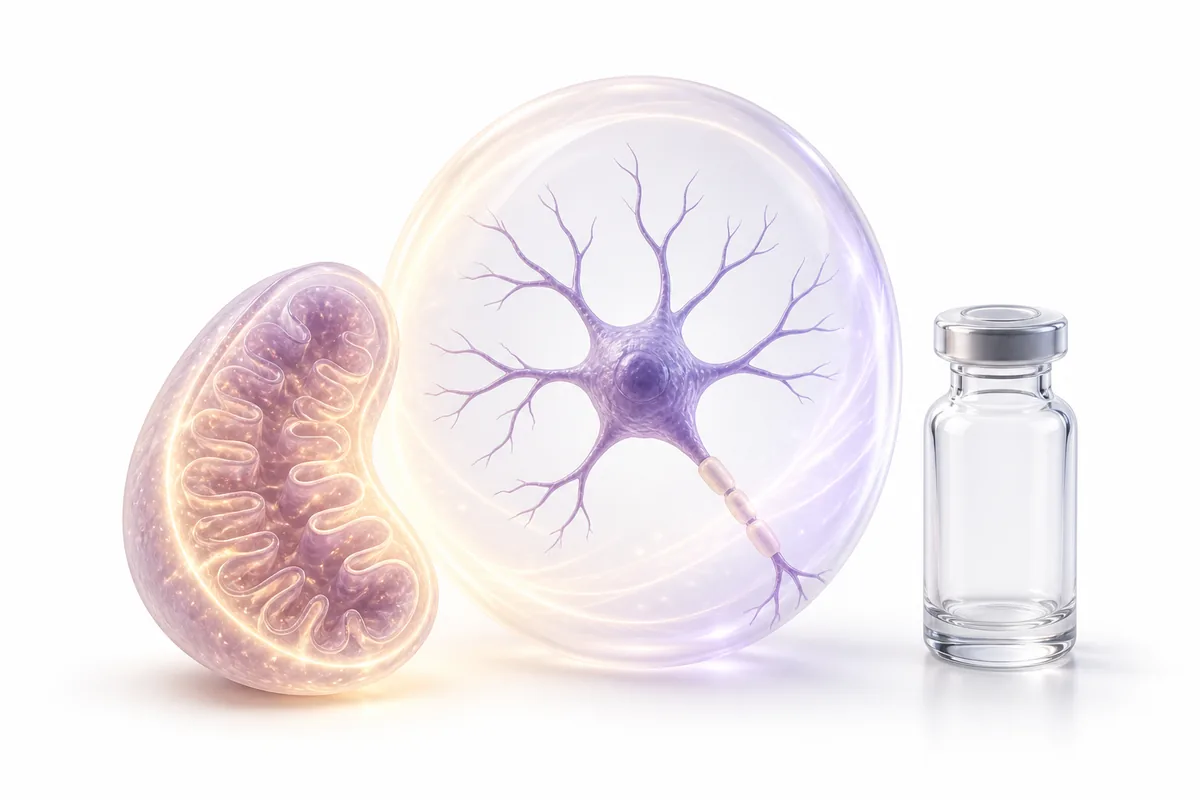
TL;DR: Humanin is a 24-amino-acid peptide encoded inside the mitochondrial genome, discovered in 2001 in neurons that survived an Alzheimer’s insult. Circulating levels fall with age, and the offspring of centenarians carry higher levels than age-matched controls, which is part of why longevity researchers pay attention to it. The catch: essentially all of that human data is observational. Lifespan extension has been shown in C. elegans and metabolic benefits in mice, but there is no completed, published human interventional trial of humanin or its analogs.
A peptide found by accident, in a dying neuron
Humanin’s discovery story is unusual even by peptide-research standards. In 2001, Hashimoto and colleagues at Keio University School of Medicine were studying neurons taken from the occipital lobe of an Alzheimer’s disease patient, hunting for genes that let some neurons survive familial Alzheimer’s mutations that should have killed them. Cloned from surviving cells, one sequence turned out to encode a short, 24-amino-acid peptide that blocked neuronal death triggered by mutant APP, presenilin-1, and presenilin-2, as well as by amyloid-beta itself.
The bigger surprise came when researchers traced the gene. It wasn’t nuclear DNA at all. The sequence sits inside the mitochondrial 16S ribosomal RNA gene, formally called MT-RNR2, one of the small handful of known open reading frames tucked inside mitochondrial DNA that actually gets translated into a functional peptide. That made humanin the first confirmed mitochondrial-derived peptide (MDP), years before MOTS-c was characterized in the same category. If you’ve read our piece on what MOTS-c is, you already know the broader concept: mitochondria are not just power plants, they’re also quietly encoding signaling molecules.
How humanin actually works
Humanin’s mechanism is genuinely distinct from most peptides discussed on this site, and it operates on two fronts at once.
Inside the cell, humanin binds directly to pro-apoptotic proteins, most notably BAX, and to IGFBP-3 (insulin-like growth factor binding protein 3). By intercepting BAX before it can trigger the mitochondrial pathway to cell death, humanin behaves as a cytoprotective brake, stopping the self-destruct sequence rather than repairing damage after the fact.
Outside the cell, secreted humanin acts as a signaling molecule with its own receptor logic. It engages a trimeric cell-surface receptor complex built from CNTFR (ciliary neurotrophic factor receptor), WSX-1, and gp130, which relays signal through JAK2/STAT3. Humanin also binds formyl peptide receptor-like 1 (FPRL1), a separate receptor that signals through the ERK1/2 cascade. Downstream of these receptors, humanin has been reported to activate AMPK, dampen mTOR and NF-kB signaling, and modulate insulin/IGF-1 pathway activity, an overlapping toolkit with several other longevity-associated interventions. It’s this receptor-level signaling, not just intracellular anti-apoptotic binding, that positions humanin as a genuine hormone-like messenger rather than a purely local protective factor.
The centenarian connection, precisely stated
This is the finding that put humanin on longevity researchers’ radar, and it deserves to be stated exactly as the data shows it, no more and no less.
Circulating humanin declines with age. That pattern has been observed across species: roughly a 40% drop over the first 18 months of life in mice, and a comparable age-related decline documented in rhesus macaques between 19 and 25 years old.
The centenarian-adjacent finding is specifically about offspring of centenarians, not centenarians themselves. In a study comparing a small cohort of centenarians’ children (n=18) against age-matched controls (n=19), the offspring group showed significantly higher circulating humanin levels. This matters because children of centenarians are themselves a well-studied “enriched for healthy aging” cohort in longevity research, independent of humanin, they tend to show lower rates of age-related disease and a documented survival advantage over the general population. Higher humanin sitting alongside that phenotype is a correlation worth taking seriously, but it is a correlation in a fairly small sample, not proof that humanin causes the longevity advantage.
A second comparative-biology clue comes from the naked mole-rat, a rodent famous for barely aging at all by normal mammalian standards. Naked mole-rats show baseline humanin levels roughly four-fold higher than young mice, and unlike mice, their levels stay comparatively stable across the animal’s lifespan rather than declining sharply. That is the kind of cross-species pattern, high and flat in the exceptionally long-lived species, that keeps humanin in the conversation.
- 1
2001
Hashimoto and colleagues discover humanin in surviving Alzheimer's-patient neurons; it blocks amyloid-beta and mutant-APP/presenilin toxicity in cell culture.
- 2
Mid-2000s
Mechanistic work identifies BAX and IGFBP-3 binding, and the potent synthetic analog HNG (S14G-humanin) is developed for research use.
- 3
Late 2000s
Receptor biology mapped: the CNTFR/WSX-1/gp130 trimer and FPRL1, linking humanin to STAT3 and ERK1/2 signaling.
- 4
2010s
Comparative and cohort studies report the centenarian-offspring association and the naked mole-rat's elevated, stable humanin levels.
- 5
Present
Human data remains observational; C. elegans and mouse studies continue to probe lifespan and metabolic effects, with no completed human interventional trial to date.
What HNG and animal-model data show
Because native humanin has a short half-life, most functional lifespan and healthspan work has used HNG (S14G-humanin), an engineered analog with a single amino-acid substitution that dramatically increases potency in cell and animal assays.
In C. elegans, overexpressing humanin extended average lifespan, from roughly 17.7 days in controls to about 19.0 days in the humanin-overexpressing strain, a real but modest effect, and one generated through genetic overexpression rather than peptide dosing.
In middle-aged mice, HNG treatment improved several metabolic markers: reduced visceral fat, increased lean mass, and decreased IGF-1. It did not extend overall lifespan across a 14-month observation window in that same study. That’s the nuance easy to lose when a molecule gets nicknamed after Lazarus: metabolic benefits, yes; a survival benefit, not in this trial.
Humanin vs. MOTS-c vs. SS-31
All three of these are grouped together as “mitochondrial peptides” in research writing, and the grouping is reasonable, but the mechanisms genuinely diverge. Humanin and MOTS-c are both mitochondrial-derived peptides encoded directly in mtDNA, while SS-31 (elamipretide) is a fully synthetic peptide designed to target mitochondria rather than originate from them. Even between the two true MDPs, the genes and pathways don’t overlap: MOTS-c comes from MT-RNR1 (the 12S rRNA gene) and works through AMPK activation via the folate-methionine cycle, while humanin comes from MT-RNR2 (the 16S rRNA gene) and works through BAX/IGFBP-3 binding plus CNTFR/WSX-1/gp130 and FPRL1 receptor signaling. Our mitochondrial peptides overview covers all three side by side if you want the fuller comparison.
Scale is illustrative: 1 = observational-only human data, 3 = completed human interventional trials.
| Feature | Humanin | MOTS-c | SS-31 (elamipretide) |
|---|---|---|---|
| Length | 24 amino acids | 16 amino acids | 4 amino acids (synthetic) |
| Gene / origin | MT-RNR2 (16S rRNA), mtDNA-encoded | MT-RNR1 (12S rRNA), mtDNA-encoded | Not mtDNA-encoded; fully synthetic |
| Primary pathway | BAX / IGFBP-3 binding; CNTFR-WSX-1-gp130 to STAT3; FPRL1 to ERK1/2 | AICAR accumulation activating AMPK | Cardiolipin binding, inner-membrane stabilization |
| Key association | Centenarian-offspring cohorts; naked mole-rat comparative biology | Declines with age; rises with acute exercise | N/A (mechanistic target, not an age biomarker) |
| Human trial status | No completed interventional trials | No completed interventional trials of native peptide | Multiple Phase 2/3 human trials completed |
Read that table for what it is: humanin and MOTS-c sit in the same evidence tier as each other, both compelling in mice and cells, both thin in humans, while SS-31 has genuinely outpaced them on the clinical-development axis. Our SS-31 overview goes deeper on that comparison if the clinical trial angle interests you.
The honest bottom line on human evidence
This is worth stating plainly rather than tucking into a footnote: there is no completed, published human interventional trial of humanin or any humanin analog. Every human data point above, the age-related decline, the centenarian-offspring association, is observational: researchers measured levels in existing cohorts rather than administering the peptide and tracking outcomes. The lifespan-extension evidence is C. elegans. The metabolic-improvement evidence is mice. Humans have, so far, only been watched, not dosed, in the published record.
That doesn’t make the biology less interesting. A peptide encoded in mitochondrial DNA, degraded by age, elevated in centenarians’ children, and flat-lined at a high level in an animal that barely ages, is a legitimately unusual set of dots to connect. It just means the connecting has been done with correlation and animal models, not human trials.
Longevity researchers exploring this cluster typically look at humanin alongside the folate-methionine and NAD+ axis covered in our NAD+ overview, and alongside telomerase-focused peptides like the one described in our epithalon guide. None of these compounds share a mechanism, which is precisely why researchers studying cellular aging tend to read across the whole cluster rather than picking one peptide in isolation.
Frequently asked questions
What is humanin peptide?
Humanin is a 24-amino-acid peptide encoded within the mitochondrial 16S rRNA gene (MT-RNR2), discovered in 2001 in neurons that survived an Alzheimer’s disease-related insult. It works both inside cells, by binding BAX and IGFBP-3 to block apoptosis, and outside cells, by signaling through the CNTFR-WSX-1-gp130 receptor complex and FPRL1.
What is the evidence for humanin and longevity?
The evidence is a mix of animal data and human observation. In C. elegans, overexpressing humanin extended average lifespan from about 17.7 to 19.0 days. In humans, circulating humanin declines with age, and centenarians’ offspring show significantly higher levels than age-matched controls. There is no completed human interventional trial connecting humanin to a lifespan outcome.
Is humanin the same as MOTS-c?
No. Both are mitochondrial-derived peptides, but they’re encoded in different mitochondrial genes and act through different pathways. Humanin comes from MT-RNR2 (the 16S rRNA gene) and works through BAX/IGFBP-3 binding and receptor signaling via CNTFR-WSX-1-gp130 and FPRL1. MOTS-c comes from MT-RNR1 (the 12S rRNA gene) and works primarily through AMPK activation. They’re complementary research subjects, not interchangeable ones.
Are there human trials of humanin?
No completed, published human interventional trials exist for humanin or its analogs, including HNG (S14G-humanin). All human data so far come from observational cohort studies measuring circulating humanin levels, such as the centenarian-offspring comparison, not from studies where the peptide was administered and outcomes tracked.
Do centenarians themselves have higher humanin levels?
The published finding is specifically about centenarians’ offspring, not centenarians themselves. A study comparing 18 children of centenarians against 19 age-matched controls found significantly higher circulating humanin in the centenarian-offspring group. That’s a distinct claim from “centenarians have more humanin,” and it’s worth keeping the two separate when reading about this research.
What is HNG and how is it different from native humanin?
HNG (S14G-humanin) is a synthetic analog of humanin carrying a single amino-acid substitution that makes it substantially more potent in cell and animal assays than the native peptide. Most of the functional animal research, including the mouse metabolic studies and C. elegans lifespan work, has used humanin overexpression or HNG rather than dosing with unmodified native humanin.
References
- Hashimoto Y, Niikura T, Tajima H, et al. A rescue factor abolishing neuronal cell death by a wide spectrum of familial Alzheimer’s disease genes and Abeta. Proceedings of the National Academy of Sciences. 2001;98(11):6336-6341.
- Lee C, Yen K, Cohen P. Humanin: a harbinger of mitochondrial-derived peptides? Trends in Endocrinology and Metabolism. 2013;24(5):222-228.
- Yen K, Wan J, Mehta HH, et al. The mitochondrial-derived peptide humanin is a regulator of lifespan and healthspan. Aging (Albany NY). 2020;12(11):11185-11199.
- Hoang PT, Park P, Cobb LJ, et al. The neurosurvival factor humanin inhibits beta-cell apoptosis via signal transducer and activator of transcription 3 activation and delays and ameliorates diabetes in NOD mice. Metabolism. 2010;59(3):343-349.
- Muzumdar RH, Huffman DM, Atzmon G, et al. Humanin: a novel central regulator of peripheral insulin action. PLoS One. 2009;4(7):e6334.
- Klein LE, Cui L, Gong Z, et al. A humanin analog decreases oxidative stress and preserves mitochondrial integrity in cardiac myoblasts. Biochemical and Biophysical Research Communications. 2013;440(2):197-203.