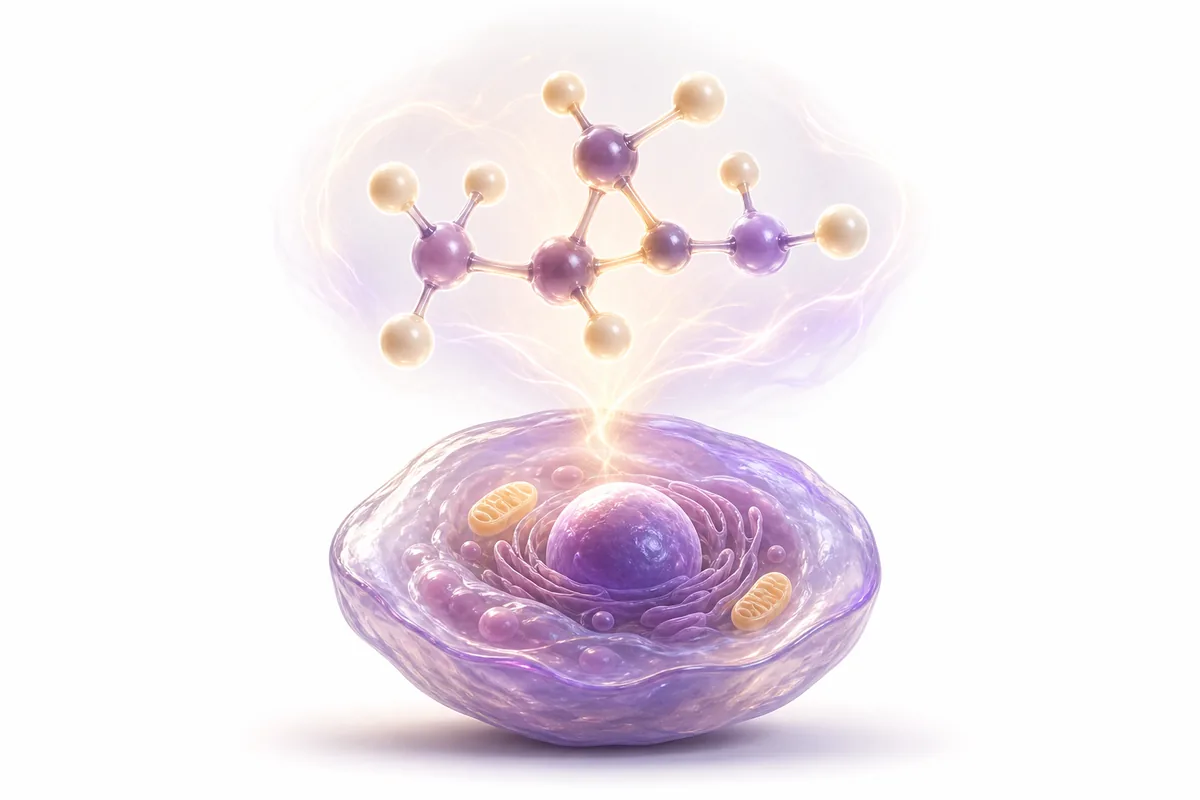
NAD+ (nicotinamide adenine dinucleotide) is one of the most widely discussed molecules in aging biology, yet it is frequently mislabeled. Unlike BPC-157, TB-500, or GHK-Cu, NAD+ is not a peptide — it has no amino acid backbone at all. It is a small nucleotide-based coenzyme that every living cell requires for redox chemistry, energy metabolism, and DNA repair signaling. This article explains what NAD+ actually is, how it functions at the biochemical level, what current research does and does not support, and how it is typically handled as a research compound. It is written strictly for research and educational purposes and is not medical advice.
What Is NAD+?
NAD+ (nicotinamide adenine dinucleotide) is a coenzyme found in every living cell, first characterized over a century ago by biochemists studying fermentation. Structurally, it consists of two nucleotides — one built from nicotinamide (a form of vitamin B3) and one from adenine — joined through their ribose sugars by a shared pair of phosphate groups. That “dinucleotide” architecture is precisely what distinguishes it from a peptide: peptides are chains of amino acids linked by peptide bonds, while NAD+ has no amino acid backbone whatsoever. It belongs to the same broad category of small-molecule cofactors as ATP and FAD, not to the peptide hormone or peptide-bioregulator families more commonly discussed on this site.
Key facts about the molecule:
- Structure: A dinucleotide cofactor, not a peptide or protein
- Function class: Redox coenzyme and enzyme co-substrate
- Distribution: Present in essentially all cells, across all domains of life
- Age association: Tissue and circulating NAD+ levels are widely reported to decline with age, a pattern linked in reviews to reduced mitochondrial efficiency and altered cellular signaling
- Precursors: Can be regenerated from dietary or supplemental precursors including nicotinamide riboside (NR), nicotinamide mononucleotide (NMN), nicotinic acid (NA), and tryptophan
- Regulatory status: Not approved as a drug in the EU; distributed in the research-chemical supply chain as a lyophilized powder for laboratory use only
Because of its central metabolic role, NAD+ has become one of the most heavily studied molecules in aging and mitochondrial research — but, as detailed below, “heavily studied” does not yet translate into settled clinical answers about longevity benefits in humans.
Mechanism of Action
NAD+ operates through two distinct but related biochemical roles: as a redox carrier and as a consumed signaling substrate.
Redox carrier: the NAD+/NADH cycle
In its oxidized form (NAD+), the molecule accepts electrons during metabolic reactions — most notably glycolysis, the citric acid (TCA) cycle, and fatty acid oxidation — becoming NADH, its reduced form. NADH then donates those electrons to the mitochondrial electron transport chain, where the energy released drives ATP synthesis and NADH is converted back to NAD+. This continuous cycling is fundamental to how cells extract usable energy from food, and a cell’s NAD+/NADH ratio is a widely used marker of its overall metabolic and redox state.
Sirtuin substrate
Sirtuins (SIRT1 through SIRT7) are a family of NAD+-dependent deacetylase enzymes that remove acetyl groups from target proteins, altering their activity. SIRT1 is closely tied to metabolic gene regulation via the PGC-1α pathway (a key driver of mitochondrial biogenesis), while SIRT3 acts inside mitochondria to activate enzymes involved in fatty acid oxidation and the TCA cycle. Because sirtuins require NAD+ as a co-substrate — consuming it in the process, not merely using it catalytically — their activity is directly constrained by how much NAD+ a cell has available.
PARP substrate and DNA repair
Poly(ADP-ribose) polymerases (PARPs), especially PARP-1, use NAD+ as a substrate to help detect and repair DNA damage. Under conditions of significant genotoxic stress, PARP-1 can consume very large amounts of cellular NAD+, and this competition for a shared, limited NAD+ pool is one proposed mechanism by which chronic DNA damage may contribute to age-related NAD+ depletion and reduced sirtuin activity.
CD38 and immune-linked NAD+ consumption
CD38, a cell-surface enzyme most active in certain immune cells, also degrades NAD+ as part of its normal function. CD38 expression and activity have been reported to increase with age and with chronic low-grade inflammation, and several research groups have proposed this as an additional contributor to age-related NAD+ decline — though the relative contribution of CD38 versus other consumers remains an active area of investigation.
Taken together, these overlapping demands on a single, shared NAD+ pool are the biochemical basis for why NAD+ status is so tightly linked to mitochondrial function, DNA repair capacity, and cellular aging research more broadly.
Research Background & Key Findings
The NAD+ research base spans decades of mechanistic biochemistry plus a growing, but still limited, set of human intervention trials. A foundational mechanistic review by Cantó, Menzies, and Auwerx (Cell Metabolism, 2015) laid out the framework summarized above — NAD+ as a hub connecting mitochondrial energy metabolism to nuclear signaling via sirtuins — and remains a widely cited reference point for how researchers think about NAD+ biology.
More recent human studies have focused less on NAD+ itself (which has poor oral bioavailability) and more on its precursors and delivery routes:
- Head-to-head precursor comparison. Cuenoud and colleagues (Nature Metabolism, 2025) directly compared nicotinamide riboside (NR), nicotinamide mononucleotide (NMN), and nicotinamide (Nam) in a randomized trial, reporting that both NR and NMN roughly doubled circulating NAD+ after 14 days of daily supplementation, while nicotinamide alone did not produce a sustained increase. The study also proposed that gut bacteria play a role in converting some of these precursors into nicotinic acid en route to raising blood NAD+.
- Combined precursor supplementation. Xue and colleagues (Nutrients, 2022) ran a randomized, triple-blind, placebo-controlled crossover pilot trial of a nicotinamide-plus-D-ribose combination (RiaGev) in healthy middle-aged adults, reporting increases in NAD+ metabolome markers (including NADP+) alongside favorable safety and tolerability over a short supplementation period.
- Direct NAD+ infusion tolerability. Reyna and colleagues (Frontiers in Aging, 2026) conducted a retrospective pilot study comparing intravenous NAD+ infusion against intravenous nicotinamide riboside in a real-world clinical setting, focusing specifically on tolerability rather than longevity outcomes — one of the few published looks at direct NAD+ administration rather than an oral precursor.
- Systematic review of the whole field. A 2026 PRISMA-guided systematic review by Gallagher and Emmanuel (Ageing Research Reviews) screened studies from 2010–2025 and identified 33 human intervention trials alongside roughly 80 rodent studies. Its conclusion is an important caution for anyone evaluating NAD+ research: augmentation strategies reliably raise measurable NAD+ in blood and tissue, but clinical evidence for anti-aging or general “wellness” outcomes in humans remains inconclusive — and notably, the review found no eligible outcome trials specifically testing intravenous or intramuscular NAD+ for anti-aging endpoints, even though injectable/infusion delivery is one of the most commercially discussed routes.
Approximate fold-change vs. baseline (Cuenoud et al., Nature Metabolism, 2025). NR and NMN roughly doubled blood NAD+; nicotinamide alone produced no sustained increase.
The overall picture: the mechanistic case for NAD+‘s centrality to mitochondrial and cellular aging biology is strong and well-established at the biochemistry level. Human evidence that raising NAD+ — whether via oral precursors or direct infusion — produces measurable anti-aging or longevity benefits is still preliminary, uneven across delivery routes, and, for the injectable route specifically, largely limited to tolerability rather than efficacy data. Preclinical and rodent findings should not be assumed to translate directly to humans.
Forms, Reconstitution & Handling
In the research supply chain, NAD+ is typically distributed as a lyophilized (freeze-dried) powder in sealed, light-protected vials — see the NAD+ 100mg and NAD+ 500mg reference pages for vial-specific reconstitution figures. As with peptide research compounds, the powder is generally reconstituted with bacteriostatic water using standard sterile technique before any laboratory use.
General handling notes relevant to NAD+ specifically:
- NAD+ is notably light-sensitive; vials and reconstituted solution are commonly kept in amber glass or wrapped to exclude light at every stage
- Bring vials to room temperature before reconstituting to reduce condensation
- Add diluent slowly down the interior wall of the vial rather than directly onto the powder, and swirl gently rather than shaking
- Confirm the resulting solution is clear and free of visible particulates before any further laboratory use
Research Considerations
Laboratory work involving NAD+ commonly touches on several general considerations, discussed here for informational purposes only rather than as instructions:
- Delivery route differences. The evidence base looks quite different depending on whether a protocol uses oral precursors (NMN, NR) versus direct NAD+ administration — the literature on direct infusion tolerability is newer and considerably thinner than the oral precursor literature.
- Combination research with mitochondrial peptides. NAD+ status is mechanistically linked to mitochondrial energy metabolism, which is also the focus of peptide-based research compounds; see our overview of mitochondrial peptides MOTS-c and SS-31 for a related but mechanistically distinct research area.
- Purity verification. Given variability in the research-chemical supply chain, verifying identity and purity via third-party Certificate of Analysis (COA) testing (e.g., HPLC) is a general due-diligence practice for any research use, not an endorsement of a specific supplier.
- Infusion-related sensations. Tolerability studies of direct NAD+ infusion have noted transient discomfort (such as flushing or chest tightness) associated with rapid administration rates in some protocols — a general observation from the published pilot literature, not a recommendation regarding rate or route.
Storage & Stability
NAD+ is chemically less stable than many synthetic peptides, and is particularly sensitive to heat, moisture, and light:
- Lyophilized powder: generally stored at approximately -20°C, protected from light, where it is considered stable for extended periods when kept sealed and dry
- Reconstituted solution: kept refrigerated at 2–8°C, protected from light, and typically used within a comparatively short window; many suppliers recommend use within roughly one to two weeks given NAD+‘s degradation sensitivity
- General handling: avoid repeated freeze-thaw cycling, minimize exposure to ambient light at every stage, and discard any solution that develops discoloration or cloudiness
Safety, Legality & Research Disclaimers
NAD+ is distributed and handled as a research chemical, not an approved pharmaceutical or dietary supplement in the EU, United States, or comparable jurisdictions when supplied for laboratory use. As the 2026 systematic review by Gallagher and Emmanuel highlights, the injectable/infusion route in particular has not been evaluated in controlled outcome trials for anti-aging or wellness claims — the available human data on direct NAD+ administration is limited mainly to tolerability observations rather than efficacy.
Comprehensive long-term human safety data for NAD+ supplementation across all delivery routes remains incomplete. Anyone engaging with NAD+ in a research setting should treat it strictly as a laboratory compound: comply with all applicable local and EU regulations, use it only within appropriate research or institutional settings, and never as a substitute for medical care. Nothing in this article constitutes medical advice, and no information here is intended as instructions for human use.
Frequently Asked Questions
Is NAD+ a peptide? No. NAD+ is a dinucleotide coenzyme built from nicotinamide and adenine nucleotides joined by phosphate groups. It has no amino acid chain and is chemically unrelated to peptides such as BPC-157 or TB-500, even though it is often discussed alongside them in longevity research contexts.
What is the difference between NAD+, NMN, and NR? NAD+ is the active coenzyme itself. Nicotinamide mononucleotide (NMN) and nicotinamide riboside (NR) are smaller precursor molecules that cells can convert into NAD+ through metabolic salvage pathways. Research trials have generally studied precursors more than direct NAD+ administration because of NAD+‘s limited oral bioavailability.
Does NAD+ really decline with age? A decline in tissue and circulating NAD+ with age is a consistent observation across the reviewed literature and is one of the central reasons NAD+ attracted aging-research interest. The functional consequences of this decline, and how much restoring NAD+ levels can reverse them in humans, remain active research questions.
Is there strong clinical evidence that NAD+ supplementation slows aging in humans? Not yet. Human trials consistently show that NAD+ precursors and direct infusion can raise measurable NAD+ levels, but a 2026 systematic review found clinical evidence for anti-aging or wellness outcomes to be inconclusive, with no eligible outcome trials specifically for intravenous or intramuscular NAD+.
How is NAD+ typically supplied for research? As a lyophilized, light-protected powder in sealed vials (commonly 100mg or 500mg), reconstituted with bacteriostatic water using standard sterile laboratory technique before any experimental use.
Is NAD+ legal to purchase? It is generally sold and handled as a research chemical rather than an approved medicine or supplement, and is not authorized for human consumption in the EU or most other jurisdictions. Legal status can vary by country, so always confirm current local and institutional regulations.
References
- Cantó C, Menzies KJ, Auwerx J. “NAD+ Metabolism and the Control of Energy Homeostasis: A Balancing Act between Mitochondria and the Nucleus.” Cell Metabolism. 2015;22(1):31-53.
- Cuenoud B, et al. “The differential impact of three different NAD+ boosters on circulatory NAD and microbial metabolism in humans.” Nature Metabolism. 2025.
- Xue Y, Shamp T, Nagana Gowda GA, Crabtree M, Bagchi D, Raftery D. “A Combination of Nicotinamide and D-Ribose (RiaGev) Is Safe and Effective to Increase NAD+ Metabolome in Healthy Middle-Aged Adults: A Randomized, Triple-Blind, Placebo-Controlled, Cross-Over Pilot Clinical Trial.” Nutrients. 2022;14(11):2219.
- Reyna K, Heinzen G, Patel N, Ritter M, Siojo A, Legere H, Pojednic R. “Intravenous infusion of nicotinamide adenine dinucleotide (NAD+) versus nicotinamide riboside (NR): a retrospective tolerability pilot study in a real-world setting.” Frontiers in Aging. 2026.
- Gallagher C, Emmanuel OO. “NAD+ supplementation for anti-aging and wellness: A PRISMA-guided systematic review of preclinical and clinical evidence.” Ageing Research Reviews. 2026.
Last updated: July 4, 2026
Disclaimer: This information is for educational and research purposes only. NAD+ is a research chemical, not an approved medicine or supplement, and is not intended for human consumption. This is not medical advice.