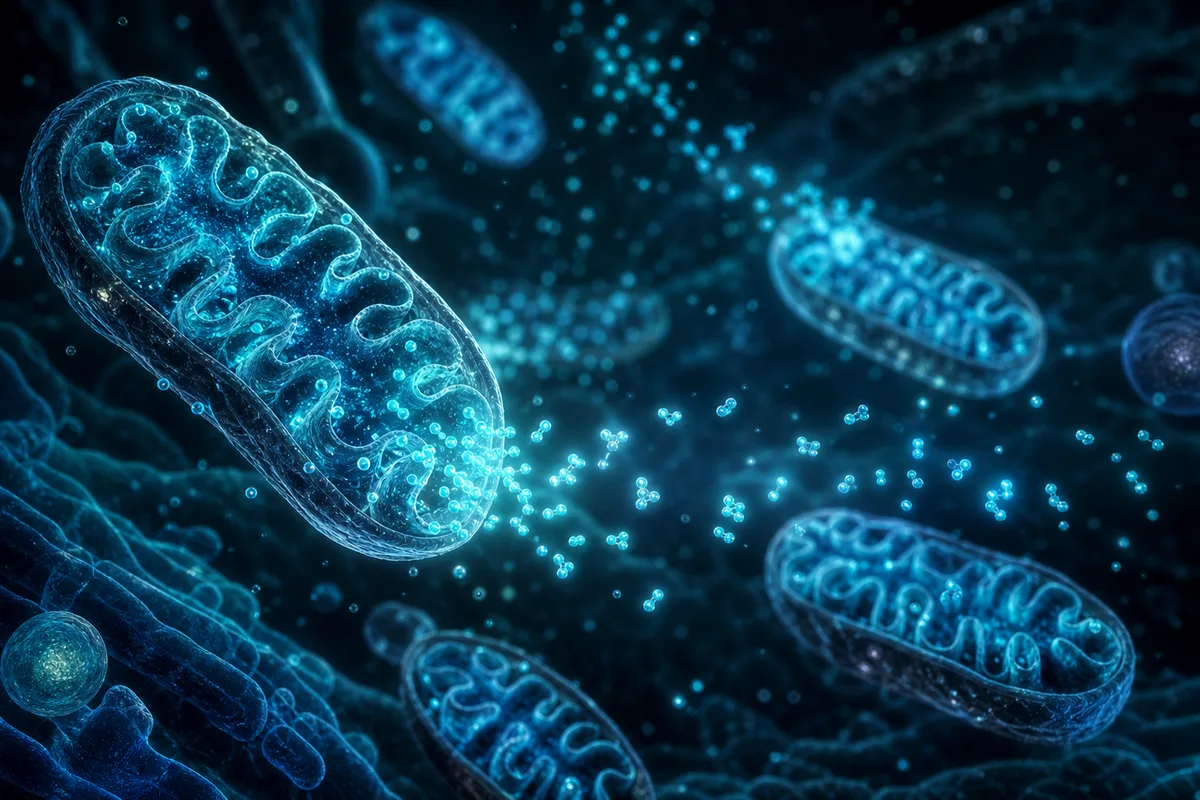
TL;DR: Humanin, MOTS-c, and Epitalon are three research peptides that keep showing up together in longevity discussions. Humanin and MOTS-c are true mitochondrial-derived peptides (MDPs) — tiny proteins encoded inside mitochondrial DNA — while Epitalon is a synthetic pineal tetrapeptide studied for telomerase and circadian signaling. The “stack” rationale is that each targets a different axis of aging: Humanin as the cytoprotective “survival peptide,” MOTS-c as the metabolic “exercise mimetic,” and Epitalon as the pineal/telomere angle. The catch: nearly all evidence is preclinical, and human interventional data is basically absent.
What are mitochondrial-derived peptides (MDPs)?
For decades mitochondria were seen as just the cell’s power plants. Then researchers found that short open reading frames hidden inside mitochondrial DNA (and the 12S/16S rRNA regions) actually code for functional peptides. These are the mitochondrial-derived peptides, or MDPs — and they act like hormones, sending signals from the mitochondria out to the rest of the body.
Humanin, discovered in 2001, was the first MDP identified. MOTS-c followed in 2015. Both belong to a small, fast-growing class that also includes the SHLP (small humanin-like peptide) family. What makes them interesting to the longevity crowd is timing: circulating levels of both Humanin and MOTS-c tend to decline with age, which fuels the “restore what you lose” framing that runs through most MDP research.
Humanin: the “survival peptide” (and why HNG matters)
Humanin (sometimes searched as “Humanina” in Spanish) earned the nickname survival peptide because its core research theme is cytoprotection — keeping cells alive under stress. In preclinical work it antagonizes the pro-apoptotic protein BAX, signals through the CNTFR/WSX-1/gp130 receptor complex to activate JAK2/STAT3, and modulates IGFBP-3. Translated: it pushes cells away from programmed death and toward survival.
The wild-type peptide is fragile, so most research uses a synthetic analog. S14G-Humanin — a single glycine swap at position 14, widely called HNG or Humanin-G — is reported to be roughly 1,000-fold more potent than native Humanin. If you see “HNG” or “S14G-Humanin” in a study, that is the workhorse molecule.
Reported preclinical directions include neuroprotection against amyloid-beta toxicity, cardioprotection in ischemia-reperfusion models, insulin sensitization via central STAT3, and reduced age-related myocardial fibrosis. For a deeper single-compound breakdown, see what is Humanin and the Humanin research page.
MOTS-c: the metabolic “exercise mimetic”
If Humanin is the survival peptide, MOTS-c is the metabolic one. It is a 16-amino-acid MDP encoded in the mitochondrial 12S rRNA region, and it acts largely through the folate–AICAR–AMPK pathway. AMPK is the cell’s master energy sensor, so MOTS-c gets described as an exercise mimetic — it engages some of the same metabolic programming as physical activity without depleting cellular energy.
In animal studies, exogenous MOTS-c has been reported to improve insulin sensitivity, promote mitochondrial biogenesis, and restore exercise tolerance in aged mice. Like Humanin, circulating MOTS-c is lower in older adults than in the young, which is why it gets grouped with NAD+ pathway compounds as a geroscience target.
Illustrative mapping of primary research axes — not comparative efficacy.
The MOTS-c side of the picture is covered in depth in our mitochondrial peptides 2026 guide, and reconstitution basics live on the MOTS-c research page.
Epitalon: the pineal and telomere angle
Epitalon (Epithalon, Ala-Glu-Asp-Gly) is not an MDP — it is a synthetic tetrapeptide modeled on the pineal extract epithalamin, developed within the Russian bioregulator tradition associated with Khavinson and Anisimov. Its research themes are distinct from the mitochondrial peptides: it is studied for stimulating telomerase activity, normalizing melatonin rhythms, and, in some rodent work, extending lifespan and reducing spontaneous tumor incidence.
That is precisely why it is bundled into the stack — it addresses a different aging axis (pineal signaling, circadian regulation, telomere maintenance) rather than duplicating the mitochondrial mechanisms. Background reading: what is Epitalon and the Epitalon research page.
Why researchers frame these three as a “stack”
The longevity stack logic is complementary coverage, not synergy that anyone has proven in humans:
- Humanin (HNG / S14G): cell survival and stress resistance.
- MOTS-c: metabolic flexibility, AMPK, mitochondrial biogenesis.
- Epitalon: circadian and telomere-associated signaling.
Three different levers, minimal mechanistic overlap. On paper that is elegant. In practice it remains a hypothesis assembled from separate animal literatures.
Anyone modeling research quantities or reconstitution math for these vials should use the peptide calculator rather than eyeballing it, and can review general method in the peptide reconstitution guide.
Frequently Asked Questions
What is the difference between Humanin and HNG (S14G-Humanin)?
Humanin is the native 24-amino-acid mitochondrial-derived peptide. HNG, also written S14G-Humanin or Humanin-G, is a synthetic analog with a single glycine substitution at position 14 that is reported to be roughly 1,000 times more potent in preclinical assays. Most published research uses HNG for that reason.
Are Humanin and MOTS-c really made inside mitochondria?
Yes — both are mitochondrial-derived peptides (MDPs), encoded by short open reading frames within mitochondrial DNA rather than the cell nucleus. Humanin comes from the 16S rRNA region and MOTS-c from the 12S rRNA region. This is what distinguishes them as a peptide class.
Why is Epitalon grouped with mitochondrial peptides if it is not an MDP?
Because the stack is organized by aging axis, not by molecular origin. Epitalon covers pineal/circadian and telomerase-associated signaling — a mechanism the two mitochondrial peptides do not address — so it is included to broaden coverage rather than to duplicate their effects.
Is there human evidence for a Humanin, MOTS-c, and Epitalon longevity stack?
No controlled human trials have tested this combination. The individual peptides rest mostly on cell and rodent studies, and there is no established human dosing, pharmacokinetics, or safety data for the stack. It is a research hypothesis, not a validated protocol.
What does “survival peptide” mean for Humanin?
It refers to Humanin’s cytoprotective, anti-apoptotic behavior in laboratory models — antagonizing BAX and activating STAT3 survival signaling to keep cells alive under metabolic, oxidative, or amyloid stress. It is a description of observed cellular activity, not a claim of life extension in people.
References
- Hashimoto Y, et al. “A rescue factor abolishing neuronal cell death by a wide spectrum of familial Alzheimer’s disease genes and Abeta.” Proceedings of the National Academy of Sciences (PNAS), 2001. (Discovery of Humanin and the S14G analog.)
- Guo B, et al. “Humanin peptide suppresses apoptosis by interfering with Bax activation.” Nature, 2003.
- Lee C, et al. “The mitochondrial-derived peptide MOTS-c promotes metabolic homeostasis and reduces obesity and insulin resistance.” Cell Metabolism, 2015. (MOTS-c discovery.)
- Reynolds JC, et al. “MOTS-c is an exercise-induced mitochondrial-encoded regulator of age-dependent physical decline and muscle homeostasis.” Nature Communications, 2021.
- Yen K, et al. “The mitochondrial derived peptide humanin is a regulator of lifespan and healthspan.” Aging (Albany NY), 2020.
- Khavinson VK, et al. “Peptide promotes overcoming of the division limit in human somatic cell.” Bulletin of Experimental Biology and Medicine — Epitalon/telomerase research, early 2000s.
- Anisimov VN, et al. “Effect of Epitalon on biomarkers of aging, life span and spontaneous tumor incidence in rodents.” Biogerontology / Mechanisms of Ageing and Development, 2000s.
- Miller B, et al. “Mitochondrial-derived peptides in aging and healthspan.” Review, Journal of Clinical Investigation / Frontiers in Endocrinology, 2020s.
This article is provided as a research and educational reference only; these peptides are not approved medicines, nothing here is medical advice, and none of it is intended for human consumption.