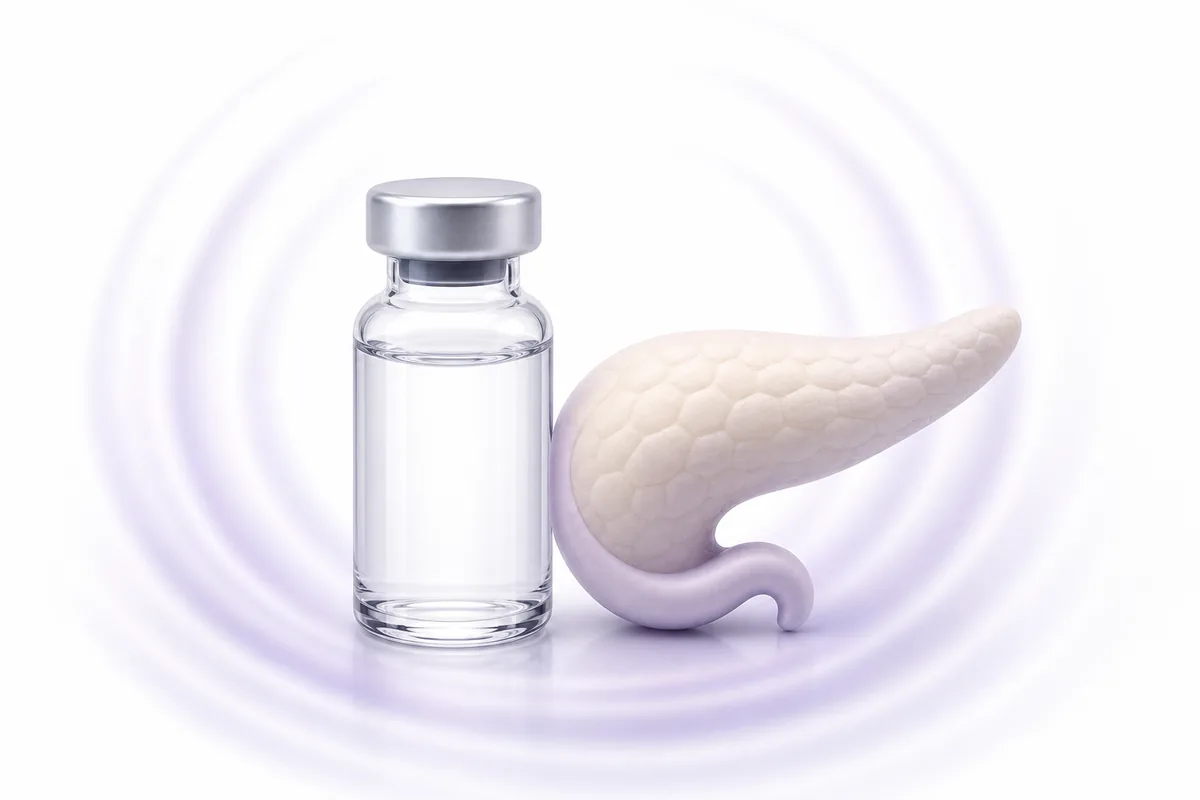
TL;DR: Petrelintide is a long-acting amylin analog from Zealand Pharma, partnered with Roche, that acts on a different receptor system than GLP-1 drugs. In the Phase 2 ZUPREME-1 trial, it produced up to 10.7% mean body-weight reduction at week 42 versus 1.7% on placebo, with tolerability the companies describe as placebo-like. Zealand and Roche announced on April 29, 2026 that petrelintide monotherapy will advance to Phase 3, with initiation planned for the second half of 2026 — there is no Phase 3 data yet, and no approval anywhere.
What is petrelintide?
Petrelintide (also known by its development code ZP8396) is a synthetic, long-acting analog of human amylin, engineered by Zealand Pharma and now co-developed with Roche under a collaboration and licensing agreement worth up to $5.3 billion, signed in 2025. It is a 36-amino-acid, fatty-acid-acylated peptide, built using the same broad engineering logic that turned native GLP-1 into once-weekly semaglutide: chemical modification that extends a naturally short-lived hormone’s time in circulation without wrecking its receptor activity.
Petrelintide is being studied as a treatment for chronic weight management, both as a standalone (monotherapy) injection and in combination with Roche’s own GLP-1/GIP dual agonist, enicepatide (also known as CT-388). It is one of several long-acting amylin analogs currently in development, alongside Novo Nordisk’s cagrilintide — see our cagrilintide guide for the other major molecule in this class — and it sits within a broader wave of candidates covered in our next-gen weight-loss peptides overview.
How amylin analogs work — a different pathway from GLP-1
Amylin is a peptide hormone co-secreted with insulin by the beta cells of the pancreas every time you eat. Unlike GLP-1, which is produced in the gut, amylin’s job starts in the pancreas and radiates outward: it acts on amylin and calcitonin receptors concentrated in the area postrema, a region of the brainstem that sits outside the blood-brain barrier, and on related satiety circuits in the hypothalamus. The downstream effects are a slowing of gastric emptying and a reduction in the drive to eat — appetite regulation through a receptor system entirely separate from the incretin pathway that semaglutide, tirzepatide, and retatrutide all engage.
That separation is the reason “placebo-like tolerability” is the headline claim around petrelintide rather than a marketing flourish. GLP-1 agonists produce nausea and vomiting largely because they slow gut motility while also acting directly on GI-adjacent brainstem circuitry that governs the vomiting reflex. Amylin agonism slows gastric emptying too, but historically has produced comparatively less of that GI intolerance in clinical experience — a pattern researchers attribute to differences in how the two receptor systems engage the area postrema and nucleus tractus solitarius. Petrelintide’s Phase 2 data is the newest test of that theory at scale.
None of this is new biology. Pramlintide, an amylin analog derived from rat amylin, has been used clinically alongside insulin for years — but it is short-acting and requires injections up to three times a day around meals, which makes it impractical as a weekly weight-management drug. The entire petrelintide program exists because Zealand Pharma’s engineering — fatty-acid acylation for albumin binding, the same trick used to extend GLP-1 drugs — pushed the terminal half-life from pramlintide’s few hours out to roughly 10 days in Phase 1 human studies, enough for once-weekly dosing with a monthly step-up schedule.
Petrelintide vs cagrilintide
Petrelintide and cagrilintide are the two amylin analogs furthest along in weight-management development, and they are more alike than different at the mechanism level: both are long-acting, both are dual amylin/calcitonin receptor agonists, and both were engineered for once-weekly dosing via fatty-acid acylation. Where they diverge is company, combination partner, and trial stage.
Cagrilintide comes from Novo Nordisk and is best known as the amylin half of CagriSema, paired with Novo’s own semaglutide — read our CagriSema breakdown for how that combination performed in REDEFINE. Petrelintide comes from Zealand Pharma, licensed to Roche, and is being paired with Roche’s own GLP-1/GIP dual agonist enicepatide (CT-388) — a Phase 2 combination trial was slated to begin in Q2 2026. Both programs follow an identical playbook: pair an in-house amylin analog with an in-house incretin agonist so the weight-loss and tolerability benefits of amylin biology stack onto a company’s own GLP-1 franchise instead of a competitor’s.
On the numbers, cagrilintide’s foundational monotherapy dataset (Lau et al., 2021) tested doses from 0.3 to 4.5 mg over 26 weeks; petrelintide’s ZUPREME-1 dose-escalated across five arms up to 9.0 mg over 42 weeks. The trials are not directly comparable — different populations, different dose ranges, different durations — but both point in the same direction: amylin monotherapy alone can deliver double-digit percentage weight loss without behaving like a GLP-1 drug in the gut. For a wider view of how amylin-pathway candidates stack up against incretin agonists generally, see our GLP-1 comparison of semaglutide, tirzepatide, and retatrutide.
Inside the ZUPREME-1 Phase 2 results
ZUPREME-1 enrolled 493 people with overweight or obesity (mean baseline BMI approximately 37 kg/m², 53% female, mean age 47), randomized across five once-weekly petrelintide dose arms with escalation every fourth week, against placebo. The trial met its primary endpoint — statistically significant, dose-dependent weight reduction from baseline at week 28 — in every treatment arm, and the effect continued through week 42.
Efficacy estimand; up to 10.7% mean weight loss on petrelintide vs 1.7% on placebo, p<0.001. Source: Zealand Pharma / Roche topline, March 5, 2026.
Secondary endpoints moved in the same direction: waist circumference fell 7.9 to 10.8 cm on petrelintide versus 4.3 cm on placebo, high-sensitivity C-reactive protein dropped 17 to 41% versus 6%, and triglycerides fell 12 to 21% versus 9% — a metabolic-marker profile consistent with genuine adiposity loss rather than water weight.
The tolerability data is what made this readout notable rather than routine. In the highest-dose arm, treatment discontinuation ran 4.8% versus 4.9% on placebo — essentially identical — and overall trial withdrawal for any reason was lower on petrelintide (8.4%) than on placebo (13.6%). Nausea was more common on drug (19.6% versus 6.2% on placebo), which is still a real GI signal, but vomiting was reported in 3.0% of petrelintide participants versus 6.2% on placebo, and injection site reactions tracked closely with placebo. More than three-quarters of GI adverse events were mild, and discontinuations specifically attributable to GI adverse events were just 1.5%. A separate finding worth flagging honestly: women lost considerably more weight than men in the trial, a sex-based response gap that has also shown up in earlier amylin-analog data and is not yet fully explained.
From Phase 1 to Phase 3: the development timeline
- 1
Preclinical engineering
Zealand Pharma develops petrelintide (ZP8396) as a 36-amino-acid acylated human amylin analog, balancing potency at AMY3R and CTR with a half-life long enough for weekly dosing.
- 2
2024 — Phase 1b MAD trials
Multiple ascending-dose studies show dose-dependent weight loss (up to 8.6% over 16 weeks at 4.8 mg) and confirm a roughly 10-day human half-life.
- 3
2025 — Zealand/Roche collaboration
Zealand Pharma and Roche sign a collaboration and licensing agreement worth up to $5.3 billion to co-develop and co-commercialize petrelintide.
- 4
April 2025 — ZUPREME-2 initiated
A second Phase 2 trial begins in people with overweight or obesity and type 2 diabetes.
- 5
March 5, 2026 — ZUPREME-1 topline
Phase 2 monotherapy trial reports up to 10.7% mean weight loss vs 1.7% placebo at week 42, with placebo-like tolerability.
- 6
April 29, 2026 — Phase 3 decision
Zealand and Roche announce petrelintide monotherapy will advance to Phase 3 for chronic weight management, with initiation planned for the second half of 2026.
- 7
2H 2026 — next milestones
ZUPREME-2 topline data expected; Phase 3 program initiation planned.
What comes next: ZUPREME-2 and the Phase 3 program
Two things are still open. ZUPREME-2, which enrolls people with overweight or obesity and type 2 diabetes, is expected to report topline results in the second half of 2026 — a materially different population from ZUPREME-1, since glycemic control changes both the metabolic backdrop and the safety monitoring involved. And the Phase 3 program itself, confirmed on April 29, 2026, has not yet started; Zealand and Roche have only committed to initiating it in the second half of 2026, which puts a Phase 3 readout years, not months, away. A parallel Phase 2 trial combining petrelintide with Roche’s enicepatide was planned to begin in Q2 2026, testing whether stacking two of Roche’s own mechanisms outperforms either alone — the same logic Novo Nordisk is testing with CagriSema.
Frequently asked questions
What is petrelintide?
Petrelintide is a long-acting, synthetic analog of human amylin, developed by Zealand Pharma and co-developed with Roche for chronic weight management. It acts on amylin and calcitonin receptors rather than the GLP-1 receptor, and is dosed once weekly with a step-up schedule.
How much weight did petrelintide help people lose in ZUPREME-1?
In the Phase 2 ZUPREME-1 trial, participants in the highest-dose arm lost up to 10.7% of body weight on average by week 42, compared with 1.7% on placebo, using the efficacy estimand. The trial enrolled 493 people with overweight or obesity and met its primary endpoint across all five dose arms.
Is petrelintide the same as cagrilintide?
No, but they are close mechanistic cousins. Both are long-acting, once-weekly amylin/calcitonin receptor agonists engineered with fatty-acid acylation, but cagrilintide is Novo Nordisk’s molecule (paired with semaglutide as CagriSema) while petrelintide is Zealand Pharma and Roche’s molecule (paired with enicepatide). See the cagrilintide guide for the fuller comparison.
Has petrelintide been approved by the FDA or any regulator?
No. Petrelintide has completed Phase 2 monotherapy testing and Zealand and Roche announced on April 29, 2026 that it will advance to Phase 3, with initiation planned for the second half of 2026. It has not completed Phase 3 trials and is not approved for any use in any jurisdiction.
Why is amylin agonism better tolerated than GLP-1 agonism?
Amylin and GLP-1 both slow gastric emptying, but they engage different brainstem and hypothalamic circuits to do it. Amylin receptors are concentrated in the area postrema without the same direct linkage to GLP-1-driven nausea and vomiting pathways, which is the biological reason amylin analogs like petrelintide have historically shown less GI intolerance — a pattern ZUPREME-1’s placebo-matched discontinuation rate reinforces.
When will more petrelintide data be available?
ZUPREME-2, in people with overweight or obesity and type 2 diabetes, has topline results expected in the second half of 2026. Phase 3 trials for chronic weight management are planned to begin in the same window, meaning a Phase 3 readout is still years away. Our next-gen weight-loss peptides overview tracks how petrelintide’s timeline compares with other candidates in development, and our semaglutide guide covers the incretin mechanism it is most often measured against.
References
- Zealand Pharma. “Zealand Pharma announces positive Phase 2 results for petrelintide, an amylin analog.” GlobeNewswire. March 5, 2026.
- Genentech/Roche. “Genentech Announces Positive Phase II Results for Petrelintide, an Amylin Analog Developed for People Living With Overweight and Obesity.” March 5, 2026.
- Zealand Pharma and Roche. “Zealand Pharma and Roche to advance petrelintide, an amylin analog, to Phase 3 trials for chronic weight management.” GlobeNewswire. April 29, 2026.
- Zealand Pharma. “New data from Phase 2 ZUPREME-1 trial at the American Diabetes Association 2026 Scientific Sessions.” GlobeNewswire. June 5, 2026.
- Brændholt Olsen, et al. “Safety, Tolerability, Pharmacokinetics, and Pharmacodynamics of Petrelintide for Weight Management: Two Randomized, Controlled Phase 1 Trials.” Diabetes, Obesity and Metabolism. 2026.
- “Development of Petrelintide: a Potent, Stable, Long-Acting Human Amylin Analogue.” Journal of Medicinal Chemistry. 2026.
- Lau DCW, Erichsen L, Francisco AM, et al. “Once-weekly cagrilintide for weight management in people with overweight and obesity.” The Lancet. 2021;398(10317):2160-2172.
Last updated: July 10, 2026