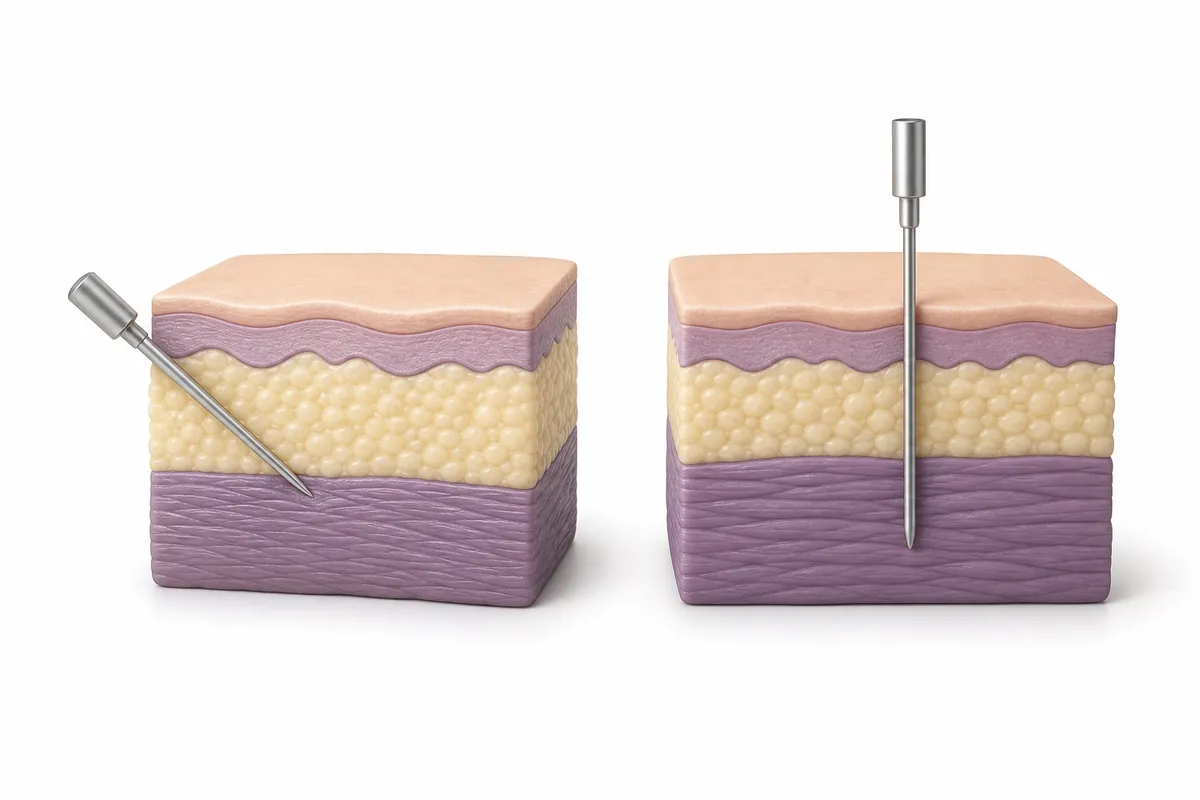
TL;DR: Subcutaneous (subQ) and intramuscular (IM) are two different delivery routes with different pharmacokinetics. IM puts a compound into well-perfused muscle, giving a higher, faster peak — research contexts often see a peak roughly 30-40% higher and earlier than the same dose subQ. SubQ deposits into the fat layer, where absorption is slower and levels hold longer, often across 18-24 hours. For most research peptides — and effectively all GH secretagogues and GLP-1 analogs — subQ is the default. IM is chosen occasionally when a faster onset or a localized, site-specific effect is the point.
Almost every injection guide teaches technique for one route and stops there. The question they skip is which route in the first place — and why. Subcutaneous versus intramuscular is not a stylistic preference; the two routes hand a compound to the bloodstream through different tissue, at different speeds, with different consequences for how a level rises and falls. This article lays out that decision in a research context. It explains how the routes differ and where each is used, without recommending doses, protocols, or human administration.
Two routes, two tissue destinations
The whole difference starts with where the needle stops.
- Subcutaneous (subQ) deposits the solution into the layer of fat between the skin and the muscle. Fat is comparatively sparse in blood supply, so the compound has to diffuse toward capillaries before it reaches circulation. That diffusion step is the reason subQ absorption is slower and steadier.
- Intramuscular (IM) places the solution into the muscle belly itself. Muscle is densely vascularized, so a compound deposited there meets a far larger network of blood vessels and moves into circulation more quickly.
Neither is inherently “better.” They are tools with different absorption profiles, and the right one depends on what a given research context is trying to observe.
The pharmacokinetic difference: peak height and duration
The clearest way to picture the two routes is a concentration-over-time curve.
IM gives a higher, faster peak. Because muscle is well-perfused, a dose delivered IM tends to reach circulation quickly and crest sooner. In research pharmacokinetic comparisons, the IM one-hour concentration frequently runs on the order of 30-40% higher than the same dose given subQ, and the time-to-peak arrives earlier. The curve is taller and narrower — up fast, and coming down sooner.
SubQ gives a lower, slower, longer peak. The fat-layer diffusion step flattens the curve. The peak is more modest, it arrives later, and — importantly — the tail is longer. Many compounds delivered subQ hold measurable levels across an 18-24 hour window, sometimes longer for deliberately long-acting molecules. The curve is shorter and wider — a plateau rather than a spike.
These figures are research-context ranges, not fixed constants. How much higher an IM peak runs, and how long a subQ tail lasts, depends heavily on the specific molecule, its size and formulation, injection volume, and the individual tissue it lands in. Treat the numbers as the shape of the difference, not a promise for any one compound.
Side-by-side comparison
| Factor | Subcutaneous (subQ) | Intramuscular (IM) |
|---|---|---|
| Target tissue | Fat layer under the skin | Muscle belly |
| Blood supply of tissue | Sparse | Dense |
| Absorption speed | Slower, steadier | Faster |
| Peak level | Lower, later | Higher, earlier (~30-40% higher 1-h peak in research contexts) |
| Duration of measurable levels | Longer (often 18-24 h) | Shorter |
| Curve shape | Wide plateau | Tall, narrow spike |
| Typical needle length | Short, 4-8 mm | Longer, ~16-38 mm |
| Typical gauge | Fine, 29-31G | Wider, ~22-25G |
| Insertion angle | 45° (lean) to 90° into a pinched fold | 90° into the muscle |
| Common research use | Default for most peptides, GH secretagogues, GLP-1s | Occasional: faster onset or localized effect |
| Ease of self-handling | High | Lower |
When each route is used
SubQ is the default
For the large majority of research peptides, subQ is the standard route, and for two whole classes it is effectively universal:
- GH secretagogues — the growth-hormone-releasing compounds such as CJC-1295, ipamorelin, and similar GHRH analogs and ghrelin mimetics. These are studied as subQ injections, where the slow, steady release complements the pulsatile way growth hormone is naturally secreted.
- GLP-1 analogs — semaglutide, tirzepatide, and related incretin compounds. Their design goal is a smooth, long-held level with a slow rise, which is exactly what subQ delivery into the fat layer provides. A sharp IM spike would work against that profile.
The through-line is that most peptide research wants a steady, sustained exposure rather than a brief high concentration, and subQ is the route that delivers it. It is also gentler on tissue, easier to perform, and the natural fit for fine insulin syringes. Our subcutaneous injection best-practices guide covers that technique in depth.
IM is the occasional, purposeful choice
IM shows up in narrower situations where its faster, higher peak is the actual objective:
- Faster onset. When a research context calls for a compound to reach circulation quickly, the dense muscle vasculature delivers a steeper early rise than subQ can.
- Localized, site-specific work. Some research on tissue-repair peptides looks at effects near the injection site — for example, depositing a compound in the region of a specific muscle rather than aiming purely for a systemic level. Here the route is chosen for where the compound acts, not just how fast it circulates.
- Volume or formulation factors. Muscle can sometimes accommodate delivery characteristics that the thin fat layer handles less comfortably.
Practical mechanics: needles, sites, angles
The two routes need different hardware and different technique, because they are aiming at different depths.
Needle length and gauge
- SubQ uses short, fine needles — typically 4-8 mm long at 29-31G. The goal is to reach the fat layer and stop, which is why insulin syringes are the standard tool. If you are converting a dose to draw on one of these, see how many units your peptide dose is on a U-100 insulin syringe.
- IM uses longer, wider needles — commonly in the 16-38 mm range at roughly 22-25G — long enough to pass through skin and fat and reach muscle, and wide enough to deliver through that depth. The exact length depends on the site and the overlying tissue thickness.
Injection sites
- SubQ sites are the areas with a reliable pinchable fat layer: the abdomen (avoiding the immediate area around the navel), the outer thigh, the back of the upper arm, and the flank. These give plenty of room to rotate.
- IM sites are the muscle bellies large enough to accept an injection safely — the deltoid (upper arm), the vastus lateralis (outer thigh), and the ventrogluteal region (hip). The muscle has to be large enough and the technique precise enough to stay in the muscle belly.
Angle
- SubQ: pinch up a fold of skin and fat, and insert at 45° if you are lean or 90° if you carry more body fat — either way landing in the fat, not the muscle beneath it.
- IM: insert at 90°, straight into the muscle belly, without a pinch. The perpendicular entry with a longer needle is what carries the tip through the fat and into muscle.
Rotation
Both routes benefit from rotating sites, but for slightly different reasons. SubQ rotation mainly guards against lipohypertrophy — fatty lumps and scarring that build up in repeatedly used fat sites and make absorption erratic. IM rotation guards against muscle soreness, scar tissue, and localized irritation. Either way, a fixed rotation map beats injecting the same spot twice in a row. For what a normal reaction looks like at either kind of site, see our guide on injection-site reactions and PIP.
What the research shows (and its limits)
A few honest framing points:
- The route-based pharmacokinetic pattern is well established. That IM produces a higher, earlier peak and subQ a lower, longer one is a general property of the two routes, seen across many injectable compounds — it follows directly from tissue perfusion. The specific “~30-40% higher one-hour peak” and “18-24 hour” figures are representative research-context ranges, not universal constants; the real numbers shift with the molecule and formulation.
- The class conventions are strong. GLP-1 analogs and GH secretagogues being studied subQ is consistent and well-documented, because their intended profile is a slow, sustained level.
- Much peptide-specific route data is thin. For many research peptides, head-to-head subQ-versus-IM pharmacokinetic studies simply have not been run at the depth the popular compounds have. A lot of what circulates about exact peaks and durations for niche peptides is extrapolated or community-reported rather than trial-grade. Treat it as directional.
The dosing math is separate from the route question — for that groundwork, peptide dosing 101 covers concentration, volume, and units.
Frequently Asked Questions
Is subQ or IM better for peptides?
Neither is universally better; they suit different goals. SubQ is the default for most research peptides because it gives a slower, steadier, longer-held level, which fits GH secretagogues and GLP-1 analogs well. IM is chosen occasionally when a faster onset or a localized, site-specific effect is the objective. The “better” route is whichever matches the pharmacokinetic curve a given context wants.
Why does IM absorb faster than subQ?
Because of the tissue. IM deposits the compound into muscle, which is densely supplied with blood vessels, so it moves into circulation quickly and peaks high and early. SubQ deposits into the fat layer, which is sparsely perfused, so the compound diffuses slowly toward capillaries. That diffusion step is what flattens and lengthens the subQ curve.
How much higher is an IM peak compared with subQ?
In research pharmacokinetic comparisons, the IM one-hour concentration often runs roughly 30-40% higher than the same dose subQ, and it arrives earlier. This is a representative range, not a fixed number — the actual difference depends on the specific molecule, its formulation, the injection volume, and individual tissue. The reliable part is the pattern: IM peaks taller and sooner.
What needle length is used for subQ versus IM?
SubQ uses short, fine needles, typically 4-8 mm long at 29-31G, because it only needs to reach the fat layer — insulin syringes are the standard tool. IM uses longer, wider needles, commonly around 16-38 mm at 22-25G, long enough to pass through skin and fat into the muscle belly. The correct IM length depends on the site and overlying tissue thickness.
Are GLP-1s and GH peptides injected subQ or IM?
Both classes are studied subQ. GLP-1 analogs such as semaglutide and tirzepatide are designed for a smooth, long-held level with a slow rise, which subQ delivery provides. GH secretagogues like CJC-1295 and ipamorelin are also given subQ, where steady release complements the body’s natural pulsatile growth-hormone secretion. A sharp IM spike would work against those intended profiles.
What injection angle should I use for each route?
For subQ, pinch a fold of skin and fat and insert at 45° if you are lean or 90° if you carry more body fat, landing in the fat layer without reaching muscle. For IM, insert at 90° straight into the muscle belly, without pinching — the perpendicular entry with a longer needle carries the tip through the fat and into the muscle.
Related reading
- Peptide injection best practices
- Injection-site reactions and PIP
- mcg/mg to insulin-syringe units
- Peptide dosing 101
For research and educational use only. This article summarises how injection routes differ in a research context and is not medical advice, a dosing protocol, or a recommendation for human administration.