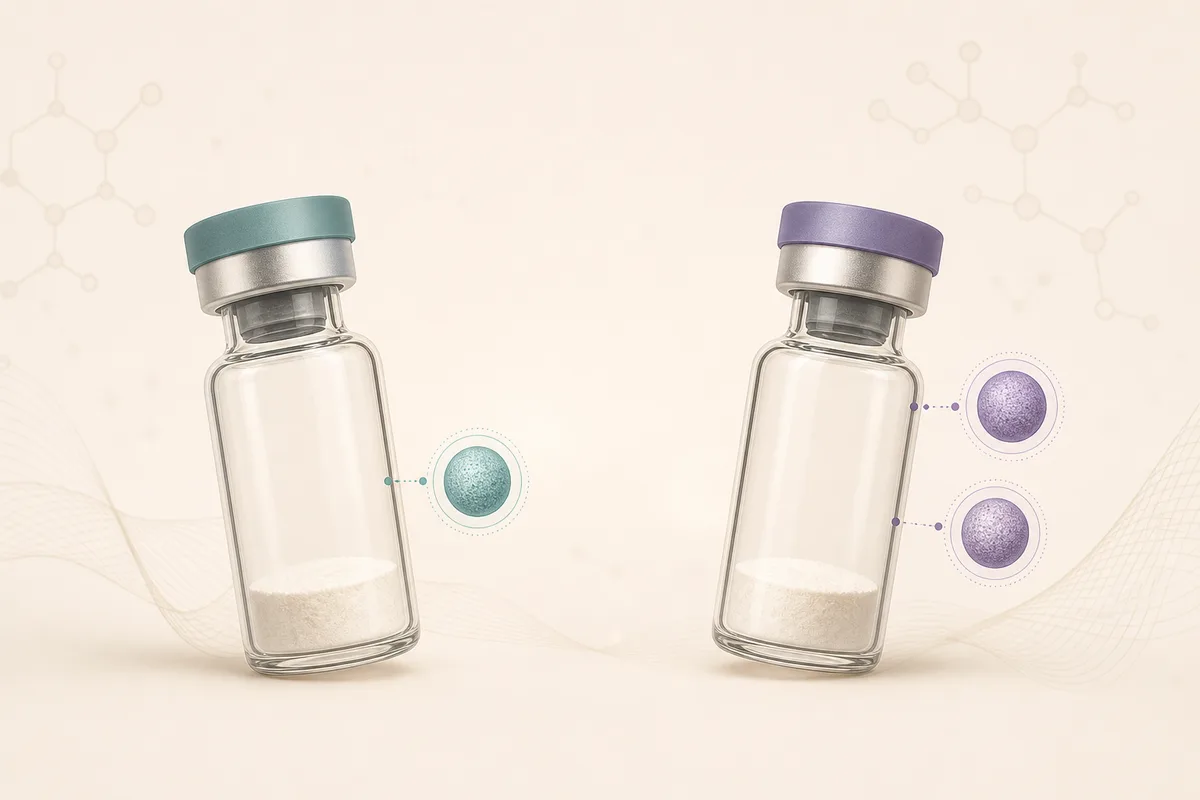
TL;DR: Semaglutide (branded Ozempic/Wegovy, the original “skinny jab”) is a single GLP-1 receptor agonist. Tirzepatide (Mounjaro/Zepbound, nicknamed the “King Kong jab”) is a dual agonist that hits GIP and GLP-1. That extra receptor is why tirzepatide produces greater average weight loss in the trials — roughly 20-22% vs semaglutide’s ~15% at top doses, confirmed when the two were compared head-to-head. The trade-off is a different dosing ladder and side-effect timing.
Semaglutide and tirzepatide are the two most-searched incretin peptides, and the question is always the same: which one takes off more weight? The answer comes down to one mechanistic difference — how many receptors each one activates. This guide compares them on mechanism, data, and dosing.
One Receptor vs Two
Both peptides work through the incretin system, but they cover different amounts of it:
- Semaglutide is a GLP-1 receptor agonist — it activates a single incretin receptor, suppressing appetite, slowing gastric emptying, and improving glucose-dependent insulin release.
- Tirzepatide is a dual GIP/GLP-1 receptor agonist — it does everything semaglutide does and adds GIP-receptor activity, which appears to enhance the metabolic and weight effects.
- 1
Semaglutide → GLP-1
Single incretin receptor: strong appetite and glucose effects.
- 2
Tirzepatide → GIP + GLP-1
Adds the GIP receptor, which amplifies the metabolic and weight response.
- 3
Result
Greater average weight loss for tirzepatide in the trials.
Head-to-Head Comparison
| Feature | Semaglutide | Tirzepatide |
|---|---|---|
| Class | GLP-1 agonist | GIP/GLP-1 dual agonist |
| Brands | Ozempic, Wegovy, Rybelsus | Mounjaro, Zepbound |
| Nicknames | ”skinny jab" | "King Kong jab”, “fat jab” |
| Top-dose weight loss* | ~15% | ~20-22% |
| Dosing | weekly, 0.25→2.4mg ladder | weekly, 2.5→15mg ladder |
| Oral form | yes (Rybelsus) | no |
*Based on trial data at maximum studied doses.
Approximate figures from the clinical trial programs; individual response varies widely.
When the two were compared directly in a head-to-head trial, tirzepatide produced significantly greater weight loss than semaglutide — consistent with the dual-receptor mechanism. For where the triple agonist retatrutide fits above both, see our GLP-1 comparison: semaglutide vs tirzepatide vs retatrutide.
Dosing Ladders
Both are titrated slowly upward to manage gastrointestinal side effects — the escalation is the point, not a formality.
- Semaglutide: 0.25mg → 0.5 → 1.0 → 1.7 → 2.4mg weekly, typically 4 weeks per step. See our semaglutide dosing and titration guide.
- Tirzepatide: 2.5mg → 5 → 7.5 → 10 → 12.5 → 15mg weekly. See tirzepatide dosing and titration.
Research vials are available for semaglutide and tirzepatide; model any vial and dose in the reconstitution calculator. If moving between them, the doses are not equivalent — see switching semaglutide to tirzepatide.
Side Effects
Both share the GLP-1 side-effect profile — nausea, and the constellation the media has nicknamed after Ozempic:
- Both: nausea, constipation or diarrhoea, reduced appetite; the “Ozempic face” and similar effects from rapid fat loss apply to tirzepatide users too. Our GLP-1 side-effects management guide covers mitigation.
- Timing: both are dose-dependent, which is exactly why the slow titration ladders exist.
Safety, Legality & Research Disclaimers
Semaglutide and tirzepatide are approved medicines in many jurisdictions but are handled here as research peptides. Neither should be self-administered outside appropriate medical or research oversight. They are to be treated as laboratory research chemicals, handled by qualified individuals for legitimate research purposes. Regulatory status varies by jurisdiction, and researchers are responsible for confirming compliance with applicable local laws and institutional requirements. Nothing here is medical advice.
FAQ
Does tirzepatide cause more weight loss than semaglutide?
Yes, on average. In the clinical trial programs tirzepatide produced roughly 20-22% weight loss at top dose versus semaglutide’s ~15%, and a head-to-head trial confirmed tirzepatide’s advantage. The reason is mechanistic: tirzepatide is a dual GIP/GLP-1 agonist, while semaglutide activates the GLP-1 receptor alone.
What is the difference between the “skinny jab” and the “King Kong jab”?
“Skinny jab” is the popular nickname for semaglutide (Ozempic/Wegovy); “King Kong jab” is a tabloid nickname for tirzepatide (Mounjaro), reflecting its stronger weight-loss effect. Both are weekly injectable incretin peptides; tirzepatide adds the GIP receptor to semaglutide’s GLP-1 mechanism.
Is semaglutide or tirzepatide better?
For weight loss, the data favours tirzepatide on average, thanks to its dual-receptor mechanism. But semaglutide has a longer track record, an oral form (Rybelsus), and its own strong effect. “Better” depends on the goal and the individual response, which varies widely.
Can you switch between semaglutide and tirzepatide?
The doses are not equivalent, so a switch is not a like-for-like swap — tirzepatide is dosed on a different milligram ladder. See our switching guide for how the two dosing scales relate.
References
- Research literature on semaglutide (GLP-1 agonist) weight-loss trials (STEP program).
- Research literature on tirzepatide (GIP/GLP-1 dual agonist) weight-loss trials (SURMOUNT program) and the head-to-head comparison with semaglutide.
Last updated: July 14, 2026
Disclaimer: This information is for educational and research purposes only. Peptides are research chemicals not intended for human consumption. See the semaglutide and tirzepatide research pages for reconstitution detail.