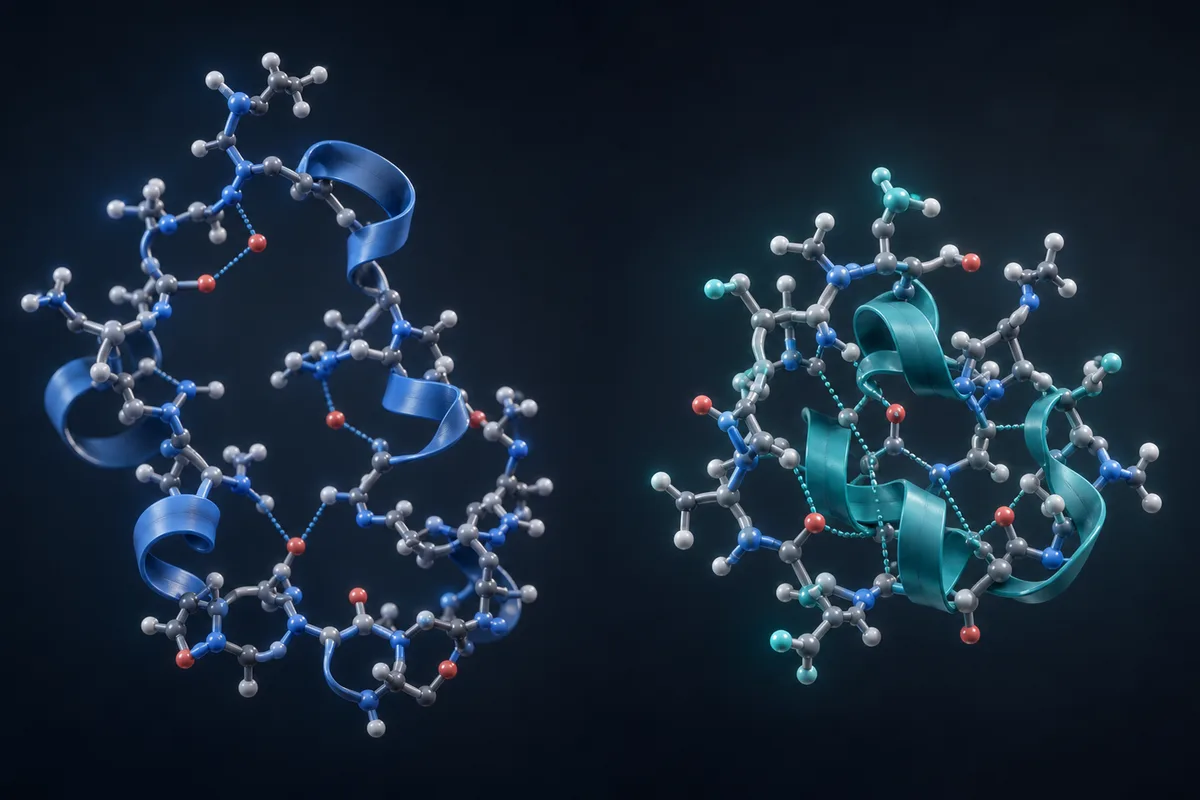
TL;DR: HGH Fragment 176-191 and AOD-9604 are cousins from the same neighborhood of the growth hormone molecule — the C-terminal tail that carries GH’s fat-splitting signal. HGH Frag is the raw 16-amino-acid fragment; AOD-9604 is that same fragment with a tyrosine cap bolted onto the front to make it more stable. AOD-9604 is the one that actually reached human obesity trials (and came up short at the doses tested), while HGH Frag mostly rides on AOD’s data. Both aim at lipolysis without the IGF-1 side of GH — and both are firmly in the rearview mirror of GLP-1 drugs for real-world fat-loss demand. This is the “Frag vs AOD” breakdown, research-context only.
Same Origin Story
Growth hormone is a 191-amino-acid protein, and researchers discovered decades ago that its metabolic jobs aren’t spread evenly across the molecule. The fat-mobilizing (lipolytic) activity concentrates near the C-terminal region — roughly residues 176 to 191. That single insight spawned both peptides on this page.
HGH Fragment 176-191 is literally that stretch of the sequence, synthesized on its own. Take GH, snip out the last 16 residues, and you have the “frag.”
AOD-9604 (“Anti-Obesity Drug 9604”) is the engineered version. Metabolic Pharmaceuticals took the same 176-191 fragment and added an N-terminal tyrosine, producing a hexadecapeptide that folds and holds up better than the naked fragment. Think of AOD-9604 as HGH Frag 176-191 wearing a helmet.
Structure and Stability
The whole reason AOD-9604 exists is stability. A short, unmodified peptide like the raw fragment is a soft target for enzymes — it can degrade quickly and fold inconsistently. The tyrosine addition on AOD-9604 was designed to lock the molecule into a more consistent conformation and improve resistance to breakdown, which in theory supports steadier, more reproducible dosing in a research setting.
In practice, a lot of vials sold as “HGH Frag 176-191” and “AOD-9604” are talked about interchangeably, but they are not the same molecule. AOD-9604 has a defined, patented structure and a documented human paper trail. HGH Frag is the more generic entity, and much of what gets attributed to it is extrapolated from AOD-9604 studies rather than measured on the fragment itself.
Lipolysis Rationale
Both peptides are studied for the same reason: mimicking GH’s fat-releasing signal without dragging along GH’s growth and IGF-1 effects. The proposed mechanisms overlap heavily — stimulating lipolysis (breakdown of stored triglycerides), inhibiting lipogenesis (new fat storage), and interacting with beta-3 adrenergic signaling in fat tissue. Crucially, in the published work AOD-9604 did not raise IGF-1 or disturb glucose, which was the original selling point: fat-loss signal, minus the metabolic baggage of full growth hormone.
That “lipolytic fragment, no IGF-1” story is why both compounds keep circulating in body-composition research chatter, often paired in stacks with GH secretagogues like ipamorelin or a CJC-1295 / ipamorelin blend.
Research History: Where They Diverge
Here’s the honest split. AOD-9604 has a real clinical history; HGH Frag basically doesn’t.
AOD-9604 went through the full early-pharma gauntlet. An initial Phase 2 study in obese adults reported modest fat-mass-favoring weight loss over 12 weeks at the higher doses versus placebo. Momentum built — until the pivotal, larger Phase 2b trial failed to separate from placebo on its primary weight-loss endpoint at the doses tested. Development for the obesity indication was shelved around 2007. Safety, notably, kept looking clean throughout: no IGF-1 elevation, no glucose signal, good tolerability, which later supported a self-affirmed GRAS pathway for other uses.
HGH Fragment 176-191, by contrast, has essentially no standalone human efficacy data. It’s the raw material AOD-9604 was built from, and its reputation is largely borrowed.
Illustrative comparison of documented human research depth, not a potency ranking.
Where Each Fits — and the GLP-1 Reality
If you’re mapping a fat-loss research context: AOD-9604 is the better-characterized, more stable, more studied of the two, with an actual (if underwhelming) clinical record. HGH Frag 176-191 is the cheaper, rawer precursor that mostly leans on AOD’s story.
But the bigger picture matters more than the Frag-vs-AOD nuance. Neither is an approved weight-loss drug, and neither produced GLP-1-scale results. The demand and the data now live overwhelmingly with incretin-class compounds like retatrutide, which post double-digit body-weight reductions in trials — a different league entirely. The lipolytic fragments are a niche, historically interesting corner of the field, not the main event.
For deeper single-compound background, see What is HGH Fragment 176-191? and What is AOD-9604?. If you’re modeling reconstitution and dosing math for either fragment, the peptide calculator handles the mcg-per-unit conversions.
Frequently Asked Questions
Are HGH Frag 176-191 and AOD-9604 the same thing?
No. They come from the same C-terminal region of growth hormone (residues 176-191), but AOD-9604 is a modified analog — the fragment plus an N-terminal tyrosine that improves stability. HGH Frag is the unmodified fragment. They’re often discussed interchangeably, which causes a lot of confusion.
Which one has actual human research behind it?
AOD-9604. It went through roughly six human clinical trials involving over 900 subjects, including obesity Phase 2 and Phase 2b studies. HGH Fragment 176-191 has almost no standalone human efficacy data and mostly borrows AOD-9604’s findings.
Did AOD-9604 work for weight loss?
In the largest pivotal trial it failed to beat placebo on its primary weight-loss endpoint, and obesity development was discontinued around 2007. Earlier smaller studies showed modest, fat-favoring changes. Safety looked reassuring throughout, but efficacy wasn’t strong enough for approval.
Why do people compare these to GLP-1 peptides?
Because both are pitched around fat loss — but the comparison is lopsided. GLP-1 and dual/triple agonists like retatrutide produce far larger, better-documented weight reductions. The lipolytic fragments are eclipsed by GLP-1s for both real-world demand and clinical results.
How is dosing typically expressed in the literature?
Both are dosed in micrograms and reconstituted from lyophilized powder, so unit math matters. A reconstitution calculator converts your vial size and bacteriostatic water volume into consistent per-unit measurements for research recordkeeping.
References
- Heffernan MA, Thorburn AW, Fam B, et al. “Increase of fat oxidation and weight loss in obese mice caused by chronic treatment with human growth hormone or a modified C-terminal fragment (AOD9604).” International Journal of Obesity. 2001;25(10):1442-1449.
- Ng FM, Sun J, Sharma L, et al. “Metabolic studies of a synthetic lipolytic domain (AOD9604) of human growth hormone.” Hormone Research. 2000;53(6):274-278.
- Stier H, Vos E, Kenley D. “Safety and Tolerability of the Hexadecapeptide AOD9604 in Humans.” Journal of Endocrinology, Diabetes & Obesity. 2013;1(1):1006.
- Heffernan M, Summers RJ, Thorburn A, et al. “The effects of human GH and its lipolytic fragment (AOD9604) on lipid metabolism following chronic treatment in obese mice and beta3-adrenoceptor knockout mice.” Endocrinology. 2001;142(12):5182-5189.
- Metabolic Pharmaceuticals Ltd. Phase 2b obesity trial program summaries and company disclosures on AOD-9604 clinical development (mid-2000s); described generically as sponsor-reported outcomes rather than a single peer-reviewed endpoint publication.
This article is provided as a research and educational reference only. The compounds discussed are not approved medicines, this is not medical advice, and nothing here is intended for human consumption.