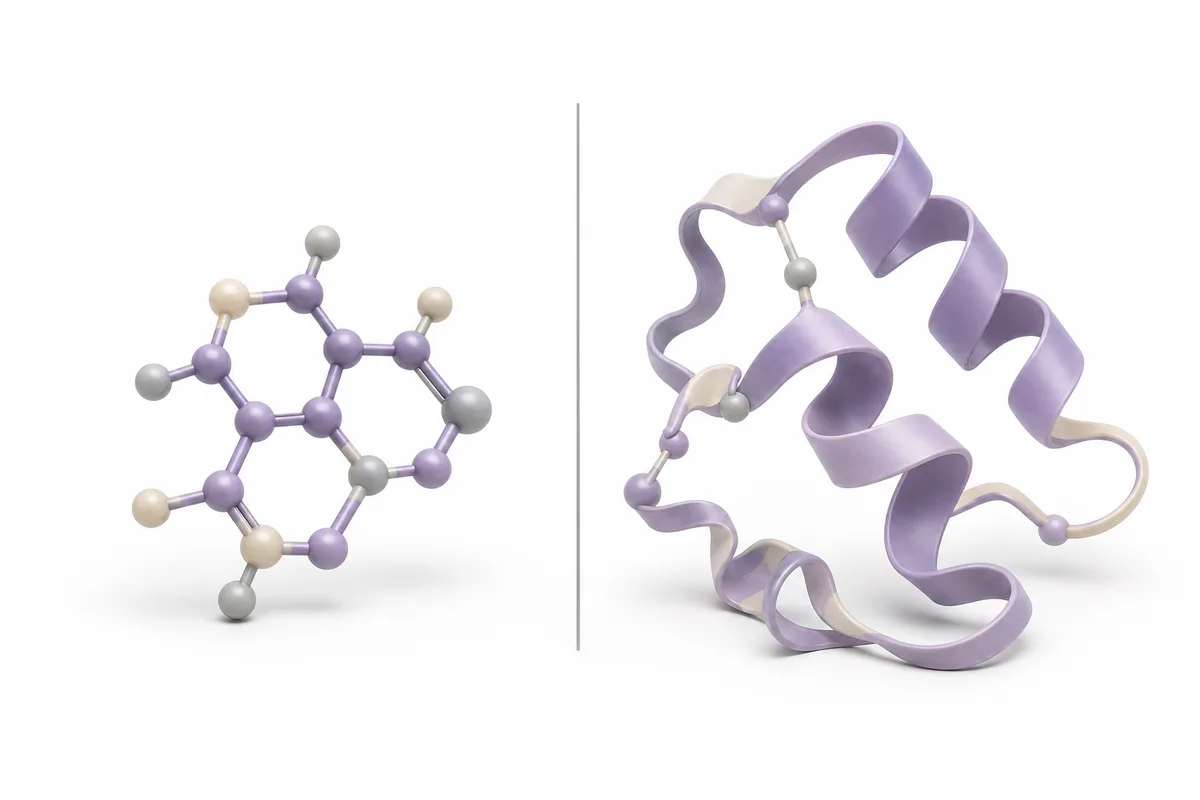
TL;DR: MK-677 (ibutamoren) is not a peptide. It is an orally active non-peptide small molecule — a spiropiperidine — that agonises the same ghrelin receptor (GHS-R1a) as ipamorelin and the GHRPs. Mechanistically it belongs to the ghrelin-mimetic family, but its roughly 24-hour action means it produces a sustained elevation of GH and IGF-1 rather than the discrete pulses that short-acting injectable secretagogues evoke. It also has more human clinical trial data behind it than almost any injectable in this category. Everything below describes research context, not usage guidance.
Anyone who spends a week reading about “GH peptides” eventually runs into MK-677, usually presented on a product page sitting between ipamorelin and CJC-1295 as though it were the same kind of thing. It is not, and the difference is not pedantry — it is the single fact that predicts how MK-677 behaves compared with everything around it. So let’s get the taxonomy right first, then do the comparison that people actually came for.
MK-677 is not a peptide, and that matters
A peptide is a short chain of amino acids. Ipamorelin is five residues. GHRP-6 is six. Sermorelin is 29. MK-677 is none of these — it is a synthetic spiropiperidine, a small organic molecule with no amino-acid backbone, developed in the 1990s at Merck as part of a deliberate programme to find a non-peptide growth hormone secretagogue that survived the gut.
That was the whole point of the molecule. Peptides are chewed up by proteases and absorb poorly across the intestinal wall, which is why every injectable on this list is injectable. Building a non-peptide agonist for the same receptor was the workaround, and it succeeded: MK-677 is orally bioavailable. Its entire practical appeal — the reason it keeps appearing next to peptides it has no chemical relationship with — is that you can swallow it.
The two families of GH secretagogue
Almost all of the confusion in this space dissolves once you see that “GH secretagogue” covers two mechanistically distinct groups that act on the pituitary from different directions.
GHS-R1a agonists (ghrelin mimetics) bind the growth hormone secretagogue receptor. They evoke a GH release event and simultaneously suppress somatostatin, the brake on GH output. Ipamorelin, GHRP-2, GHRP-6 and hexarelin sit here — and so does MK-677.
GHRH analogues bind the GHRH receptor, mimicking the hypothalamic signal that tells somatotrophs to release. They amplify the pulse the body is already trying to make. Sermorelin, Mod GRF 1-29 / CJC-1295 and tesamorelin sit here. Our CJC-1295 with DAC vs without DAC piece covers how much the half-life of a GHRH analogue changes its character; the same logic is about to become the crux of this article.
The two families are complementary rather than redundant, which is why they get combined — a ghrelin mimetic plus a GHRH analogue produces a larger release than either alone. That synergy is the entire reason the CJC-1295 and ipamorelin blend became the default pairing in this space.
MK-677 sits squarely in the first family. But it does not behave like its family members, and the reason is time.
Pulsatility is the crux
Growth hormone is not secreted continuously. It comes in discrete bursts, with the largest tied to the first hours of slow-wave sleep, and that rhythm is not decorative — the pulsatile pattern is how the somatotropic axis signals. Downstream tissues read the peaks and the troughs.
Short-acting injectable secretagogues respect that. Ipamorelin, GHRP-2 and Mod GRF 1-29 clear in a matter of minutes to a couple of hours; each administration drives a fresh release event and then gets out of the way, leaving a trough behind. The pulse shape is largely preserved.
MK-677 does something different. With a duration of action in the region of 24 hours, once-daily administration holds the receptor under near-continuous pressure. The result, seen consistently in the human trials, is a sustained elevation of GH and IGF-1 rather than a clean stack of separate pulses. The 24-hour GH profile does not disappear — it rises and broadens.
Order-of-magnitude comparison; values vary by source and formulation.
Whether that flattening is a problem depends entirely on what you are looking at. Continuous agonist pressure on a receptor is the classic setup for desensitisation and down-regulation — the reason GH secretagogue protocols are the most explicitly cycled compounds in the category, as our peptide cycling and tolerance piece lays out. That is the honest concern with a long-acting agonist.
But a sustained IGF-1 elevation is not always the failure mode. It is precisely what the clinical programme wanted: MK-677 was investigated as a therapy for sarcopenia, frailty and GH deficiency, contexts where the endpoint is anabolic tone over months, not the fidelity of a nightly pulse. And notably, the long-term trial data did not show the effect collapsing — IGF-1 stayed elevated across two years. Pulsatility purism is a legitimate mechanistic position; it is not a settled verdict.
Selectivity, appetite and water
The GHS-R1a is the ghrelin receptor, and ghrelin is a hunger hormone. Agonise it and you get hunger — how much depends on the molecule.
- Ipamorelin is the outlier in a good way. It was characterised as the first selective GH secretagogue, releasing GH with minimal effect on cortisol, ACTH or prolactin, and with far weaker appetite stimulation than its siblings. That selectivity is essentially its entire reputation, and it is why it dominates modern protocols. See what is ipamorelin for the background.
- GHRP-6 is the opposite pole — famous, almost notorious, for intense hunger. Some researchers treat this as a feature, most as a nuisance. Our GHRP-2 vs GHRP-6 comparison covers where GHRP-2 lands in between.
- MK-677 drives appetite strongly and persistently. Increased appetite is one of the most consistently reported findings across its human trials, and it is not a transient early effect — it is a direct consequence of holding the ghrelin receptor occupied around the clock.
Water retention is the other recurring theme. Increased extracellular fluid is a known consequence of raising GH and IGF-1 through any route, and it shows up with MK-677 (reported as oedema in trials) as well as with GHRH-analogue blends — the mechanism is covered in CJC-1295 and ipamorelin water retention. The difference is duration: a continuous GH elevation gives the effect nowhere to recede to between doses.
The evidence base — and this is where MK-677 wins
Here is the thing most comparisons bury. MK-677 has more human clinical trial data than essentially any injectable research peptide in this category. It went through a real pharmaceutical development programme at Merck, which means real randomised trials with real endpoints, published in real journals.
The best-known is Nass et al. (2008, Annals of Internal Medicine): a two-year, randomised, double-blind, placebo-controlled trial of oral MK-677 in healthy older adults. It reported sustained increases in GH and IGF-1 — restoring IGF-1 toward levels typical of young adults — and an increase in fat-free mass relative to placebo. The gains in fat-free mass did not translate into improved strength or function in that population.
The same trial reported, plainly and without drama, the findings that define the compound’s profile: increased appetite, fluid retention, and an increase in fasting blood glucose with a reduction in insulin sensitivity. These are documented trial outcomes, and they are the reason the compound’s metabolic profile gets discussed at all. Stated once, factually: sustained GHS-R1a agonism raises IGF-1 and nudges glucose handling in the other direction.
Compare that to ipamorelin, whose foundational literature is largely preclinical (Raun et al., 1998) plus small human GH-release studies, or to CJC-1295, whose human data is thin. Tesamorelin is the exception on the injectable side — it actually cleared approval for HIV-associated lipodystrophy, which is why what is tesamorelin reads differently from the rest. Sermorelin also had a clinical life; see what is sermorelin.
Why it was never approved
Straightforwardly: the development programme did not carry through. Despite the biology working — MK-677 reliably raises GH and IGF-1, orally, for years — the clinical trials did not produce the functional outcomes that would justify approval for frailty or sarcopenia. Raising fat-free mass is not the same as making older adults stronger or more mobile, and the trials did not clear that bar. The programme was discontinued. It is a story about endpoints, not about the molecule failing to do what it does.
The comparison, side by side
| MK-677 | Ipamorelin | GHRP-2 / GHRP-6 | CJC-1295 / Mod GRF | Tesamorelin | |
|---|---|---|---|---|---|
| Class | Non-peptide small molecule | Pentapeptide | Peptide (6 aa) | Peptide (GHRH analogue) | Peptide (GHRH analogue) |
| Receptor | GHS-R1a | GHS-R1a | GHS-R1a | GHRH-R | GHRH-R |
| Action | Evokes release | Evokes release | Evokes release | Amplifies pulse | Amplifies pulse |
| Route | Oral | Injection | Injection | Injection | Injection |
| Duration | ~24 h | ~2 h | Short | ~30 min to days (DAC) | Short |
| GH pattern | Sustained elevation | Pulsatile | Pulsatile | Pulsatile (DAC blunts it) | Pulsatile |
| Appetite | Strong | Minimal | GHRP-6 intense; GHRP-2 moderate | Minimal | Minimal |
| Selectivity | Ghrelin-receptor effects intact | High (GH-selective) | Cortisol/prolactin at higher amounts | N/A (different receptor) | N/A |
| Human evidence | Strong (multi-year RCTs) | Mostly preclinical | Limited | Limited | Approved indication |
Who reaches for which, and why
Observed research practice sorts along fairly predictable lines.
MK-677 gets reached for when the oral route is the deciding variable — no reconstitution, no syringes, no cold chain, one capsule. It is also the choice when the object of interest is a sustained IGF-1 elevation over months rather than a nightly pulse, and when someone wants a compound with actual long-term human data behind it. The appetite effect is either the point or the dealbreaker; there is rarely a middle position.
Ipamorelin gets reached for when pulse fidelity and selectivity are the priority — the cleanest GH release with the least collateral endocrine noise, dosed to align with the natural rhythm as covered in ipamorelin research dosing and timing. Pair it with a GHRH analogue and you are working with the axis rather than overriding it.
The GHRPs get reached for potency, with GHRP-6’s hunger and GHRP-2’s slightly broader hormonal footprint as the accepted costs.
GHRH analogues get reached for amplification, not initiation. They are almost always half of a pair.
The genuine question is not “which is strongest.” It is whether you want to shape the axis or saturate it. Short-acting injectables shape. MK-677 saturates. Both are coherent choices; they are just not the same choice, and no product page that files them all under “peptides” is going to tell you that.
Frequently asked questions
Is MK-677 a peptide?
No. MK-677 (ibutamoren) is a non-peptide small molecule — a spiropiperidine — with no amino-acid backbone. It is grouped with peptides because it activates the same receptor as ipamorelin and the GHRPs (GHS-R1a, the ghrelin receptor), but it is a different chemical class entirely. That non-peptide structure is exactly what makes it orally active, since it is not degraded by digestive proteases the way a peptide is.
Why is MK-677 taken orally when ipamorelin needs injection?
Because peptides do not survive the gut. Proteases break them down and the intestinal wall absorbs them poorly, so ipamorelin, the GHRPs and the GHRH analogues all have to bypass digestion. MK-677 was specifically designed as a non-peptide agonist to solve that problem, and it does — oral bioavailability was the explicit goal of the Merck programme that produced it.
Does MK-677 disrupt natural GH pulsatility?
It changes it. With a duration of action of roughly 24 hours, MK-677 keeps the ghrelin receptor under near-continuous pressure, which raises the baseline and broadens the 24-hour GH profile rather than producing the discrete pulses that short-acting injectables evoke. Whether that matters depends on the endpoint — sustained IGF-1 elevation is exactly what the sarcopenia and GH-deficiency trials were after, while researchers focused on physiological signalling generally prefer short-acting compounds that preserve the pulse.
Which has better human evidence, MK-677 or ipamorelin?
MK-677, by a wide margin. It went through a genuine pharmaceutical development programme, including a two-year randomised placebo-controlled trial in older adults (Nass et al., 2008) reporting sustained IGF-1 increases and increased fat-free mass. Ipamorelin’s foundational literature is largely preclinical, supported by small human GH-release studies. Among the injectables, only tesamorelin has a comparable clinical record.
Can MK-677 be combined with a GHRH analogue?
Mechanistically the two act on different receptors and are complementary in the same way ipamorelin and CJC-1295 are — one evokes release, the other amplifies it. In research contexts the combination is discussed, though the long-acting nature of MK-677 changes the picture: instead of stacking two short pulses, you are amplifying an already-elevated baseline. The receptor-saturation and desensitisation questions covered in our cycling article apply with more force here than they do to a pair of short-acting injectables.
References
- Nass R, Pezzoli SS, Oliveri MC, et al. Effects of an oral ghrelin mimetic on body composition and clinical outcomes in healthy older adults: a randomized trial. Annals of Internal Medicine. 2008;149(9):601-611.
- Patchett AA, Nargund RP, Tata JR, et al. Design and biological activities of L-163,191 (MK-0677): a potent, orally active growth hormone secretagogue. Proceedings of the National Academy of Sciences. 1995;92(15):7001-7005.
- Chapman IM, Bach MA, Van Cauter E, et al. Stimulation of the growth hormone (GH)-insulin-like growth factor I axis by daily oral administration of a GH secretogogue (MK-677) in healthy elderly subjects. Journal of Clinical Endocrinology and Metabolism. 1996;81(12):4249-4257.
- Raun K, Hansen BS, Johansen NL, et al. Ipamorelin, the first selective growth hormone secretagogue. European Journal of Endocrinology. 1998;139(5):552-561.
- Rajkumar RP. Growth hormone secretagogues: history, mechanisms and clinical relevance. Translational Andrology and Urology. 2020;9(Suppl 2):S149-S159.
- Sigalos JT, Pastuszak AW. The Safety and Efficacy of Growth Hormone Secretagogues. Sexual Medicine Reviews. 2018;6(1):45-53.
Research use only. This article compares growth hormone secretagogues for laboratory and educational contexts. It is not medical advice and does not recommend any dose, protocol, or human use. Compounds discussed here are research chemicals not intended for self-administration; handle all research materials in accordance with applicable EU regulations and institutional guidance.