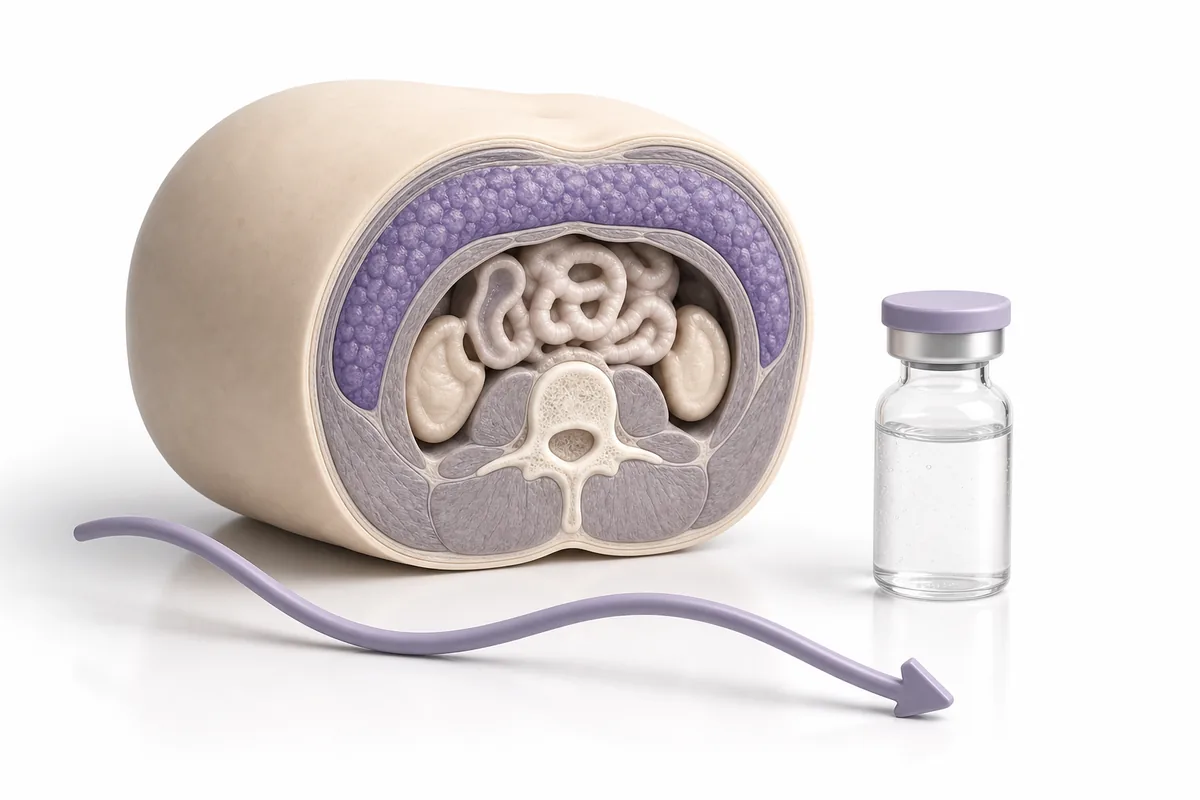
Tesamorelin occupies a distinctive position among growth hormone releasing hormone (GHRH) analogs: it is the one with the most direct clinical trial record, having been approved by the FDA (as Egrifta, and later the once-weekly Egrifta WR / F8 formulation) for reducing excess visceral fat in people with HIV-associated lipodystrophy. That regulatory history makes it an unusually well-documented reference point for researchers studying the GH/IGF-1 axis and its relationship to visceral adiposity. This guide summarizes what tesamorelin is, how it is understood to act at the receptor level, what the trial literature shows, and how it compares with other GHRH-axis peptides. Everything here is written strictly for research and educational purposes only.
What is Tesamorelin?
Tesamorelin is a synthetic 44-amino-acid peptide engineered as an analog of human growth hormone releasing hormone (GHRH). Native GHRH is a 44-amino-acid hypothalamic hormone with a very short circulating half-life because it is rapidly cleaved by the enzyme dipeptidyl peptidase-4 (DPP-4). Tesamorelin’s structure includes an N-terminal modification — a trans-3-hexenoic acid group added to the native GHRH(1-44) sequence — that stabilizes the molecule against this degradation pathway, extending its functional activity relative to unmodified GHRH.
This stabilization is the reason tesamorelin was developed and studied as far as human clinical trials, and ultimately received FDA approval (marketed as Egrifta, and in a reformulated once-weekly presentation as Egrifta WR / the “F8” formulation) specifically for the reduction of excess abdominal visceral fat in adults with HIV-associated lipodystrophy. Outside of that approved clinical indication, tesamorelin is used in laboratory settings as a research reference compound for studying the GHRH receptor, the GH/IGF-1 axis, and visceral adiposity. Research-grade tesamorelin is commonly referenced in 2mg and 5mg vial sizes in laboratory catalogs.
Mechanism of Action
Tesamorelin’s activity follows the same receptor logic as native GHRH, with the added benefit of extended stability:
- Binds the GHRH receptor (GHRH-R), a G-protein-coupled receptor expressed predominantly on somatotroph cells of the anterior pituitary
- Activates adenylate cyclase, raising intracellular cyclic AMP (cAMP) inside the somatotroph
- Stimulates synthesis and pulsatile release of endogenous growth hormone (GH) rather than supplying GH directly
- Circulating GH acts on the liver and peripheral tissues, stimulating hepatic production of insulin-like growth factor-1 (IGF-1)
- Negative feedback via somatostatin and IGF-1 continues to regulate the axis, since tesamorelin works upstream of GH rather than replacing it
- 1
Step 1
Binds the GHRH receptor (GHRH-R) on anterior pituitary somatotrophs.
- 2
Step 2
Activates adenylate cyclase, raising intracellular cAMP.
- 3
Step 3
Stimulates synthesis and pulsatile release of endogenous GH.
- 4
Step 4
Circulating GH drives hepatic IGF-1 production.
- 5
Step 5
Somatostatin and IGF-1 feedback keep the axis self-regulating.
Because tesamorelin engages the physiological GHRH receptor pathway, GH release in response to it retains a pulsatile character rather than producing a flat, sustained elevation — a mechanistic distinction researchers often draw between GHRH analogs and direct GH administration. The downstream GH/IGF-1 axis is the pathway most closely tied to tesamorelin’s studied effects on body composition, including reductions in visceral adipose tissue (VAT).
Research Background & Key Findings
Tesamorelin has one of the more substantial clinical trial records among peptides discussed on this site, largely because it progressed through FDA review for a specific indication.
- Randomized controlled trials in HIV-associated lipodystrophy demonstrated meaningful reductions in visceral adipose tissue with tesamorelin relative to placebo over 26-week treatment periods, alongside increases in IGF-1 consistent with its mechanism as a GHRH receptor agonist (summarized in PMC coverage of tesamorelin and GH management in HIV-associated lipodystrophy).
- A 2025 meta-analysis of randomized controlled trials (search performed through July 2025) pooling data on tesamorelin in HIV-associated lipodystrophy reported a significant reduction in visceral adipose tissue (approximately 27.7 cm² relative to placebo), along with reductions in trunk fat, waist circumference, and hepatic fat, and a modest increase in lean body mass, without significant disruption of glucose parameters (PubMed summary; see also the ScienceDirect record).
- Regulatory development continued into 2025, with the FDA approving an “F8” reformulation of tesamorelin (Egrifta WR) that shifts reconstitution from a daily to a weekly schedule, reducing preparation burden while preserving the same GHRH receptor mechanism (reporting via Contagion Live).
- Additional conference-reported work has examined tesamorelin’s effects on visceral fat and liver fat specifically in people with HIV on integrase strand transfer inhibitor (INSTI) regimens, an area of ongoing interest given rising rates of central adiposity observed with some antiretroviral therapies (PMC abstract).
Collectively, this body of work is the most direct clinical evidence available for any GHRH analog discussed on this site regarding a measurable end organ outcome — visceral fat mass — rather than GH or IGF-1 levels alone. It is important to note that this evidence base is specific to the approved HIV-associated lipodystrophy indication studied in adult clinical trial populations; extrapolation to other populations or contexts remains a matter for further research and is not established by this literature.
Tesamorelin vs GH Secretagogues and Other GHRH Analogs
Tesamorelin belongs to a broader family of compounds that modulate the GH/IGF-1 axis through different receptors, and distinguishing the categories is useful for interpreting the literature.
| Peptide | Class | Receptor | Distinguishing feature |
|---|---|---|---|
| Tesamorelin | GHRH analog | GHRH-R | Stabilized native GHRH(1-44) sequence; the only GHRH analog with FDA-approved clinical trial data for visceral fat |
| Sermorelin | GHRH analog | GHRH-R | Truncated GHRH(1-29) fragment; short-acting, closely mirrors a single natural pulse |
| Ipamorelin | GH secretagogue (GHRP) | Ghrelin receptor (GHS-R1a) | Acts on a distinct receptor pathway; selective for GH with minimal effect on cortisol or prolactin |
The practical distinction is receptor identity. Tesamorelin and sermorelin both engage the GHRH receptor and therefore share the same core signaling cascade, differing mainly in stability and duration of activity — tesamorelin’s structural modification gives it a longer functional half-life than the unmodified GHRH(1-29) fragment used in sermorelin. Ipamorelin, by contrast, acts on an entirely separate receptor (the ghrelin/GHS-R1a pathway), which is why GHRH analogs and GH secretagogues are frequently discussed as complementary rather than interchangeable tools in GH-axis research — co-stimulation of both pathways is a recurring theme in the broader secretagogue literature, distinct from tesamorelin’s specific clinical trial record in visceral adiposity.
Forms, Reconstitution & Handling
Tesamorelin for research use is typically supplied as a lyophilized (freeze-dried) powder that requires reconstitution with bacteriostatic water before use in laboratory protocols. As with other lyophilized peptides, the diluent should be added slowly along the interior wall of the vial rather than directly onto the powder, followed by gentle swirling rather than shaking, to avoid mechanical stress on the peptide structure.
The vial size chosen determines the resulting concentration once reconstituted. Laboratories commonly reference 2mg and 5mg vials, with the diluent volume selected according to the experimental design and desired concentration. For a detailed walkthrough of aseptic technique, diluent selection, and concentration math applicable across research peptides, see our peptide reconstitution guide.
Research Considerations
Tesamorelin’s approved clinical trial history has generated a distinct set of experimental variables that recur in the literature:
- Trial duration — the clinical trials underpinning FDA approval generally ran on the order of 26 weeks, which is the timeframe over which the most-cited visceral fat and IGF-1 changes were observed
- IGF-1 monitoring — because tesamorelin’s mechanism runs through GH-stimulated hepatic IGF-1 production, IGF-1 levels are a commonly tracked biomarker in the associated research literature
- Population specificity — the strongest clinical evidence is specific to adults with HIV-associated lipodystrophy; this is a defined patient population studied under clinical trial conditions, not a general finding extended to other populations
- Glucose parameters — published trial data has generally not shown significant disruption of glucose handling at the studied trial doses, though this remains a monitored parameter given GH’s known role in glucose metabolism
These are documented features of the existing research record, not usage instructions, and none of the material on this page describes a protocol for administration to humans or animals outside of a properly designed and authorized study.
Storage & Stability
Handling conditions materially affect data reproducibility for any GHRH-axis peptide, tesamorelin included:
- Lyophilized powder: store frozen, generally at approximately -20°C, where it is reported to remain stable for extended periods
- Reconstituted solution: refrigerate at 2-8°C; reconstituted GHRH analogs are typically used within a period of weeks rather than months
- Light sensitivity: protect vials from direct and prolonged light exposure
- Handling: avoid repeated freeze-thaw cycles and vigorous agitation, both of which are recognized risk factors for peptide degradation
Because degradation is not always visually apparent, documenting reconstitution dates and storage conditions is standard laboratory practice for maintaining data integrity across a research protocol.
Safety, Legality & Research Disclaimers
Tesamorelin (as Egrifta / Egrifta WR) is an FDA-approved prescription medicine for a specific clinical indication — reduction of excess abdominal visceral fat in adults with HIV-associated lipodystrophy — administered under medical supervision. Separately, tesamorelin sold and labeled as a research chemical is not intended for human or animal administration and is not presented on this page as a substitute for, or equivalent to, an approved medical product. Regulatory status for research-labeled peptides varies by jurisdiction, particularly across the EU, and researchers are responsible for confirming that acquisition, possession, and handling comply with all applicable local laws and institutional requirements.
Nothing in this article constitutes medical advice, and none of it describes a dosing protocol for human or animal use. Material intended for research should be clearly labeled “for research purposes only” and handled exclusively by qualified individuals in an appropriate laboratory setting.
Frequently Asked Questions
Is tesamorelin the same as HGH?
No. Tesamorelin is a GHRH analog that stimulates the pituitary gland to release the body’s own growth hormone. It does not supply growth hormone directly, and it works through the GHRH receptor rather than replacing GH itself.
What makes tesamorelin different from sermorelin?
Both are GHRH analogs acting on the same receptor. Tesamorelin’s structural modification stabilizes it against rapid enzymatic degradation, extending its activity relative to sermorelin, which is a shorter, unmodified GHRH(1-29) fragment with a briefer duration of action.
How is tesamorelin different from ipamorelin?
They act on entirely different receptors. Tesamorelin is a GHRH analog acting on the GHRH receptor, while ipamorelin is a GH secretagogue acting on the separate ghrelin receptor (GHS-R1a). The two mechanisms are studied as complementary pathways within the GH/IGF-1 axis rather than as substitutes for one another.
What is tesamorelin’s approved clinical use?
Tesamorelin is FDA-approved, under the brand name Egrifta (and the reformulated Egrifta WR), specifically for reducing excess visceral abdominal fat in adults with HIV-associated lipodystrophy. This is a defined clinical indication studied in randomized controlled trials and is distinct from any research-chemical use of tesamorelin discussed on this page.
Does tesamorelin affect glucose or IGF-1 levels?
Published trial data has reported increases in IGF-1 consistent with tesamorelin’s mechanism of action, generally without significant disruption of glucose parameters at studied doses. These findings are specific to the clinical trial population and conditions in which they were measured.
How should tesamorelin be stored in a research setting?
As a lyophilized powder, it is generally stored frozen near -20°C. Once reconstituted, it should be refrigerated at 2-8°C, protected from light, and used within a period of weeks, avoiding repeated freeze-thaw cycles.
References
- Meta-analysis of randomized controlled trials on tesamorelin body composition, hepatic fat, metabolic, and safety outcomes in HIV-associated lipodystrophy. PubMed, 2025. Available at: pubmed.ncbi.nlm.nih.gov/41545261
- Growth hormone and tesamorelin in the management of HIV-associated lipodystrophy. PMC, National Center for Biotechnology Information. Available at: pmc.ncbi.nlm.nih.gov/articles/PMC3218714
- Tesamorelin reduces visceral adipose tissue and liver fat in INSTI-treated persons with HIV. PMC, National Center for Biotechnology Information. Available at: ncbi.nlm.nih.gov/pmc/articles/PMC10678288
- FDA approves F8 formulation of tesamorelin (Egrifta WR) for HIV-associated lipodystrophy. Contagion Live, 2025. Available at: contagionlive.com
- Body composition, hepatic fat, metabolic, and safety outcomes of tesamorelin, a GHRH analogue, in HIV-associated lipodystrophy: a meta-analysis of randomized controlled trials. ScienceDirect, 2026. Available at: sciencedirect.com/science/article/abs/pii/S1871403X26000025
Last updated: July 4, 2026
Disclaimer: This information is for educational and research purposes only. Peptides labeled for research are research chemicals not intended for human consumption. For detailed handling references, see our Tesamorelin 5mg research page.