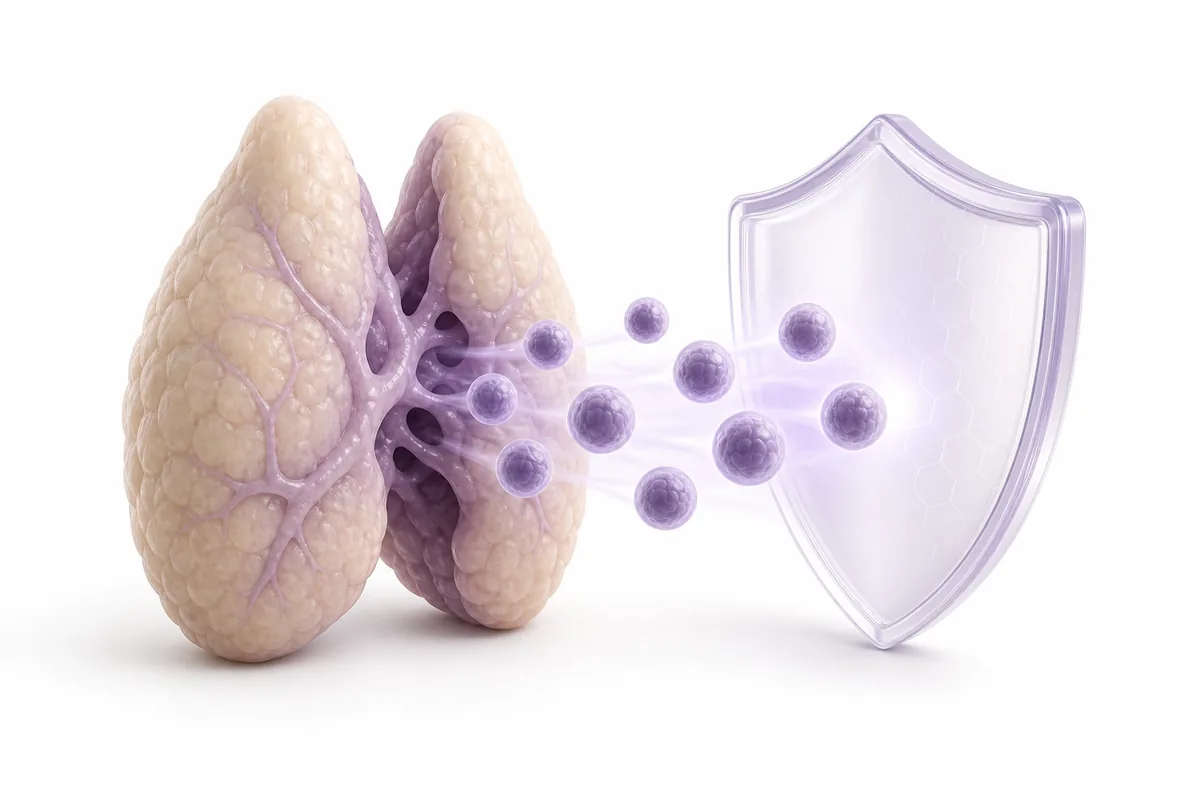
TL;DR: Thymosin alpha-1 (Tα1) is a 28-amino-acid thymic peptide that modulates T-cell function through Toll-like receptor signaling on dendritic cells. Marketed as Zadaxin (thymalfasin) and approved in over 30 countries for chronic hepatitis B and as an immune adjuvant, it remains unapproved in the EU and US, where it is handled as a research compound only.
Thymosin alpha-1 sits in an unusual position among research peptides. Unlike many compounds discussed in peptide circles, it has a decades-long clinical record, an established mechanism, and marketing authorization in dozens of countries under the brand name Zadaxin (generic: thymalfasin). Yet it is not approved as a medicine in the European Union or the United States, which is why it appears here strictly as a research-education reference. This guide summarizes what Tα1 is, how it is thought to modulate the immune system, what the human trial evidence actually shows across hepatitis B, sepsis, and infection, and where its regulatory status stands.
What Is Thymosin Alpha-1?
Thymosin alpha-1 is a 28-amino-acid peptide originally isolated from thymosin fraction 5, a preparation derived from the thymus gland. The thymus is the organ where T lymphocytes mature, so it is unsurprising that a peptide from this tissue would carry immune-signaling activity. The synthetic version used in research and in the approved drug thymalfasin is identical to the naturally occurring sequence, with an acetylated N-terminus.
Tα1 is best understood as an immunomodulator rather than an immune stimulant or suppressant in the simple sense. In preclinical and clinical work it is described as helping to restore balance to an immune system that is either exhausted (as in chronic infection or sepsis-related immunoparalysis) or under-responsive (as in poor vaccine response among older or immunocompromised populations). This “restore toward normal” framing, rather than a one-directional push, is a recurring theme in the literature (Dominari et al., 2020).
Mechanism of Action: T-Cell and Dendritic-Cell Modulation
The most-cited mechanistic account of Tα1 centers on Toll-like receptors (TLRs) expressed on antigen-presenting cells.
TLR signaling on dendritic cells
Thymosin alpha-1 acts as an agonist at Toll-like receptor 9 (TLR9) and Toll-like receptor 2 (TLR2) on myeloid and plasmacytoid dendritic cells, the professional antigen-presenting cells that bridge innate and adaptive immunity. By engaging these receptors, Tα1 influences how dendritic cells present antigen and prime downstream T-cell responses (King and Tuthill, 2016; Dominari et al., 2020).
Effects on T-cell maturation and cytokines
Downstream of dendritic-cell activation, Tα1 is reported to promote the maturation of thymocytes into functional CD4+ and CD8+ T cells and to raise the number and function of CD4+ helper T cells. In cell and animal systems it is associated with increased production of interleukin-2 (IL-2), IL-12, interferon-alpha, and interferon-gamma, cytokines central to antiviral and antibacterial defense. At the same time, some work describes a tolerance-promoting arm, in which distinct TLR engagement drives indoleamine 2,3-dioxygenase (IDO) activity and regulatory T-cell generation. This dual capacity, enhancing effector responses while also supporting regulatory balance, is the mechanistic basis for calling Tα1 a modulator rather than a stimulant.
A note on tissue-repair peptides
Because Tα1 is a thymic peptide, it is sometimes confused with beta-thymosins such as thymosin beta-4 and its fragment TB-500. These are structurally and functionally different: the beta-thymosins are actin-binding peptides studied largely in tissue-repair and angiogenesis contexts, whereas thymosin alpha-1 is an immune-signaling peptide. Sharing the word “thymosin” does not imply a shared mechanism.
What the Research Shows
The evidence base for Tα1 is genuinely larger and more human-oriented than for most research peptides, but it is uneven across indications. Here is an honest breakdown.
| Research area | Strongest evidence | Overall state of evidence |
|---|---|---|
| Chronic hepatitis B | Randomized controlled trials and meta-analyses | Approved indication in many countries; delayed but sustained virological responses reported |
| Sepsis / immunoparalysis | ETASS RCT (2013) and later meta-analyses | Signal of benefit, concentrated in lymphopenic patients; not definitive |
| COVID-19 | Cohort studies and meta-analyses (2020-2022) | Mixed and confounded; no firm conclusion |
| Vaccine adjuvant | Small trials in dialysis and older adults | Suggestive, not established as standard practice |
| Cancer adjuvant | Various combination trials | Exploratory; heterogeneous designs |
Editorial rating of the current evidence base, not an efficacy claim.
Chronic hepatitis B
Hepatitis B is where Tα1 has its most established clinical footing and forms the basis for its approval in many countries. Randomized controlled trials, including work by Chien and colleagues, reported that a course of Tα1 produced delayed but sustained virological responses, with a favorable tolerability profile relative to interferon-alpha (Chien et al., 1998). Cochrane and other systematic reviews have been more cautious, noting that trial quality is variable and that the durability of benefit needs careful interpretation, so the picture is supportive but not unqualified.
Sepsis and immunoparalysis
The landmark human study here is the ETASS trial (Efficacy of Thymosin Alpha 1 for Severe Sepsis), a multicenter randomized controlled trial in China that enrolled 361 patients and reported a reduction in 28-day mortality when Tα1 was added to standard sepsis care (Wu et al., 2013). Subsequent meta-analyses have been more mixed, with the overall signal driven substantially by patients showing lymphopenia, the “immune-paralyzed” phenotype, rather than the broad sepsis population. The mechanistic rationale, reversing sepsis-induced immune exhaustion, is coherent, but a definitive large multinational trial is still lacking.
COVID-19
During the pandemic, Tα1 was studied in COVID-19 on the hypothesis that it could reverse the T-cell lymphopenia and exhaustion seen in severe cases. Some cohort studies reported lower mortality in treated patients, particularly when given earlier in the disease course, while others found no meaningful restoration of CD4+ and CD8+ counts. Systematic reviews pooling these studies concluded that the data are heterogeneous and confounded by non-randomized designs, so no firm efficacy conclusion is warranted. This is a useful case study in how an appealing mechanism does not automatically translate into proven benefit.
Across every one of these areas, the same caution applies: individual positive studies exist, but so do null results, and much of the clinical literature comes from single-country trials with methodological limitations. Readers evaluating Tα1 should weigh the body of evidence rather than any single headline result.
Regulatory Status: Approved, But Not Everywhere
This is the most important practical point for an EU audience.
- Approved (as Zadaxin / thymalfasin): Thymosin alpha-1 is authorized in more than 30 countries, including several in Asia and parts of Latin America and the Middle East, primarily for chronic hepatitis B, as an immune adjuvant, and for immune restoration in immunocompromised patients.
- European Union: Thymosin alpha-1 does not hold central EU marketing authorization as a medicine, and it is not an approved therapy across EU member states.
- United States: It has never received FDA approval; it has held orphan-drug designations for certain indications but is not an approved drug.
Because it is unapproved in the EU and US, any material supplied in these markets is intended for laboratory and educational research use only, not for human administration. Regulatory status can change and varies by jurisdiction, so researchers are responsible for confirming the current rules where they operate.
Forms, Handling, and Research Context
In research settings, thymosin alpha-1 is typically supplied as a lyophilized (freeze-dried) powder in sealed vials, such as the thymosin alpha-1 5mg format. Like other lyophilized peptides, it must be reconstituted with an appropriate diluent, commonly bacteriostatic water, before use in laboratory work. When planning reconstitution volumes and target concentrations for a protocol, a peptide reconstitution calculator helps keep the arithmetic reproducible and well documented.
General handling considerations that apply broadly to peptides like Tα1 include allowing the vial to reach room temperature before reconstitution, adding diluent slowly down the vial wall rather than directly onto the powder, swirling gently rather than shaking, and labeling each vial with the reconstitution date, diluent volume, and resulting concentration. Lyophilized material is generally stored frozen and protected from light, while reconstituted solution is refrigerated and used within a limited window. None of this constitutes dosing guidance for human use.
Researchers comparing immune-signaling peptides with the structurally distinct beta-thymosin family sometimes reference the TB-500 10mg profile to keep the two lineages clearly separated, since the shared “thymosin” name is a frequent source of confusion.
Safety, Legality, and Research Disclaimers
Thymosin alpha-1 has a comparatively large clinical safety record in the countries where thymalfasin is approved, and it is generally described as well tolerated in that regulated context. That regulated experience does not extend to unapproved research-grade material of unknown purity, nor does it authorize human use in jurisdictions where the compound is not approved. In the EU and US it is a research chemical, not a medicine.
Nothing in this article is medical advice, a therapeutic claim, or a recommendation for human use or self-administration. All material is intended strictly for qualified laboratory research and educational purposes, and researchers must comply with their institution’s ethics, biosafety, and procurement requirements as well as applicable law.
Frequently Asked Questions
Is thymosin alpha-1 the same as Zadaxin?
Yes. Zadaxin is a brand name for thymalfasin, the synthetic form of thymosin alpha-1. The peptide sold as a research chemical is the same 28-amino-acid sequence. The key difference is regulatory: Zadaxin is an approved medicine in some countries, while research-grade Tα1 in the EU and US is not approved for human use.
Is thymosin alpha-1 approved in the EU?
No. Thymosin alpha-1 does not hold EU marketing authorization as a medicine and is not an approved therapy in the European Union. It is approved as Zadaxin in more than 30 other countries, but within the EU it is treated as a research compound intended for laboratory and educational use only.
How does thymosin alpha-1 differ from TB-500?
They share the word thymosin but little else. Thymosin alpha-1 is an immune-modulating peptide acting on dendritic cells and T cells. TB-500 is a fragment of thymosin beta-4, an actin-binding peptide studied mainly in tissue-repair and angiogenesis research. Their sequences, mechanisms, and research contexts are entirely distinct.
What is the strongest human evidence for thymosin alpha-1?
Chronic hepatitis B is the best-supported indication and the basis for approval in many countries, with randomized trials reporting delayed but sustained virological responses. The ETASS sepsis trial is the most-cited critical-care study. Evidence in COVID-19 and other areas is more mixed and largely non-randomized.
Does thymosin alpha-1 suppress or boost the immune system?
Neither in a simple sense. It is described as an immunomodulator that can enhance effector T-cell and antiviral responses while also supporting regulatory balance through separate signaling arms. The recurring framing in the literature is restoration toward normal function rather than a single-direction increase or decrease.
Why is thymosin alpha-1 studied as a vaccine adjuvant?
Because it promotes T-cell-dependent antibody production through TLR-2 and TLR-9 signaling on dendritic cells, Tα1 has been examined as a way to improve vaccine responses in populations that respond poorly, such as dialysis patients and older adults. The evidence is suggestive but has not made it a standard adjuvant in routine practice.
References
- Dominari A, Hathaway D, Pandav K, et al. “Thymosin alpha 1: A comprehensive review of the literature.” World Journal of Virology. 2020;9(5):67-78.
- Wu J, Zhou L, Liu J, et al. “The efficacy of thymosin alpha 1 for severe sepsis (ETASS): a multicenter, single-blind, randomized and controlled trial.” Critical Care. 2013;17(1):R8.
- Chien RN, Liaw YF, Chen TC, Yeh CT, Sheen IS. “Efficacy of thymosin alpha1 in patients with chronic hepatitis B: a randomized, controlled trial.” Hepatology. 1998;27(5):1383-1387.
- King R, Tuthill C. “Immune Modulation with Thymosin Alpha 1 Treatment.” Vitamins and Hormones. 2016;102:151-178.
- Liu F, Wang HM, Wang T, Zhang YM, Zhu X. “The efficacy of thymosin alpha1 as immunomodulatory treatment for sepsis: a systematic review of randomized controlled trials.” BMC Infectious Diseases. 2016;16:488.
- Liu Y, Pan Y, Hu Z, et al. “Thymosin Alpha 1 Reduces the Mortality of Severe Coronavirus Disease 2019 by Restoration of Lymphocytopenia and Reversion of Exhausted T Cells.” Clinical Infectious Diseases. 2020;71(16):2150-2157.
- Camerini R, Garaci E. “Historical review of thymosin alpha 1 in infectious diseases.” Expert Opinion on Biological Therapy. 2015;15(sup1):S117-S127.
- Garaci E, Pica F, Rasi G, Favalli C. “Thymosin alpha 1 in the treatment of cancer: from basic research to clinical application.” International Journal of Immunopharmacology. 2000;22(12):1067-1076.
Research-use-only disclaimer: This article is an educational reference for qualified laboratory research. Thymosin alpha-1 is not an approved medicine in the EU or US. Nothing here is medical advice, a therapeutic claim, or a recommendation for human use or dosing.