TL;DR: Klotho is a genuinely important ageing protein with a deep, respectable academic literature — knockout mice age catastrophically fast, overexpressing mice live 20-30% longer, and a single low dose improved memory in aged monkeys. It is also a roughly 130 kDa glycoprotein, which makes the retail “Klotho” vial a hard thing to take at face value. FLGR242 is presented as an albumin-bound follistatin construct; the albumin-binding strategy is real and well-established, but this specific construct has essentially no peer-reviewed literature behind it. The biology is strong. The products are not the biology.
There is one conversation dominating peptide research forums right now, and it is the Klotho + FLGR242 pairing — longevity in one vial, muscle in the other. Threads run to hundreds of posts and tens of thousands of views. What is almost entirely missing from those threads is anyone drawing the line between the science, which is real and interesting, and the products, which are a completely separate question. That distinction is the whole article.
Klotho: the biology is not fringe
Start with what is solid, because a lot of it is.
The klotho gene was identified in 1997 by Kuro-o and colleagues, essentially by accident — a mouse line carrying a disrupted klotho locus developed a syndrome that looked uncannily like accelerated ageing: dramatically shortened lifespan, infertility, skin atrophy, osteoporosis, vascular calcification, emphysema. They named the gene after Clotho, the Greek Fate who spins the thread of life. It was one of those rare findings where a single gene knockout produces something that genuinely resembles premature ageing across multiple organ systems at once.
The mirror-image experiment arrived in 2005. Kurosu and colleagues, publishing in Science, showed that mice overexpressing klotho lived longer than controls — on the order of 20% in females and 30% in males. Mechanistically they tied it to suppression of insulin and IGF-1 signalling, which is one of the most conserved longevity levers known, running from C. elegans through mammals. That paper is the origin of every “klotho extends lifespan by 20-30%” claim you see quoted, and for once the number quoted in forums is roughly the number in the primary literature.
Klotho comes in two forms that matter here. The membrane-bound form sits on cell surfaces — most abundantly in kidney and choroid plexus — where it acts as an obligate co-receptor for FGF23 and governs phosphate handling. The soluble form is produced when that membrane protein is proteolytically clipped from its stalk and released into circulation, where it behaves like a hormone with systemic effects. It is the soluble form that the longevity conversation is about.
In humans, circulating klotho declines with age, and lower levels track with worse kidney function, vascular stiffness, and cardiovascular ageing. The KL-VS genetic variant — carried heterozygously by a meaningful slice of the population — is associated with higher circulating klotho and, in several cohorts, better cognitive performance and larger prefrontal volume. And in 2023, Castner and colleagues reported in Nature Aging that a single subcutaneous injection of klotho improved working memory in aged rhesus macaques within four hours, with effects still measurable at two weeks. Notably, the low dose worked and the high dose did not — an inverted-U response, which is a genuinely odd and interesting result.
The hard problem: klotho is a protein, not a peptide
Here is where the community conversation and the biology part ways.
Almost everything we cover on this site is a peptide — chains of a few dozen amino acids at most. BPC-157 is 15 residues. Semaglutide is 31. Epithalon is 4. These are small, well-characterised, synthesisable by solid-phase chemistry, verifiable by mass spec, and stable enough to ship in a lyophilised vial.
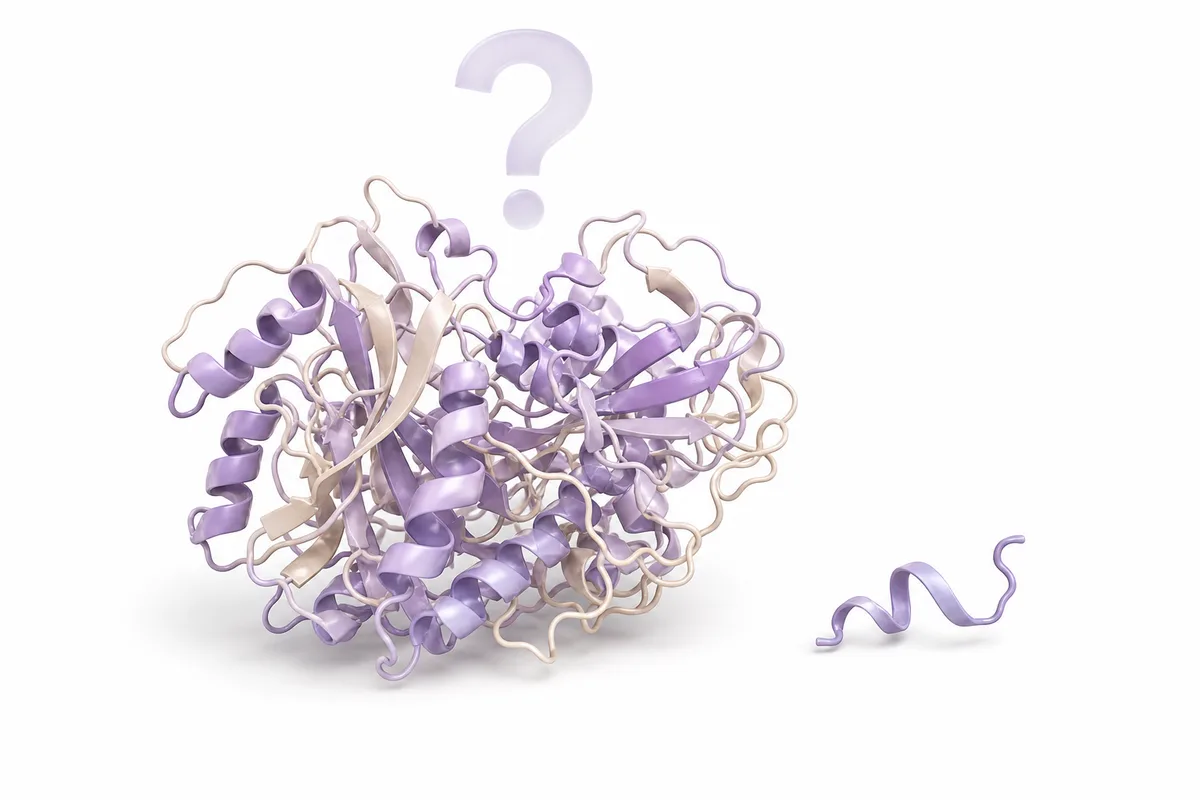
Soluble klotho is ~130 kDa. That is not a peptide; it is a large, heavily glycosylated protein with a complex folded structure. The practical consequences are not subtle:
- It cannot be made by peptide synthesis. It requires recombinant expression in a mammalian system capable of getting the glycosylation and folding right, followed by real purification. This is a bioprocess, not a peptide run — and it is expensive.
- Correct folding is the entire product. A misfolded or aggregated 130 kDa glycoprotein is not “weaker klotho”; it is a different substance with no reason to do anything useful.
- It will not survive oral administration. Nothing that size does.
- It is not expected to cross the blood-brain barrier intact. This is the awkward one, because the cognitive story is the main selling point. Interestingly, klotho seems to affect cognition in animal models anyway — the macaque effect appeared within hours — which suggests some peripheral-to-central signalling relay rather than the protein simply walking into the brain. That is a fascinating open question in the academic literature, and it is also not a reason to assume any given vial does the same thing.
So the honest question about a research-chemical “Klotho” product is not “does klotho work?” It is: what is actually in the vial? A correctly folded, glycosylated, biologically active 130 kDa recombinant human protein, produced at research-chemical prices, is a genuinely demanding thing to deliver. That deserves to be said plainly, without drama: identity and activity are open questions here in a way they simply are not for a 15-residue peptide, and a certificate of analysis showing purity by HPLC does not establish that a large protein is correctly folded.
FLGR242: what it claims to be, and what is documented
FLGR242 is the other half of the stack — the muscle half. It is marketed as a modified, albumin-binding follistatin construct: engineered, per vendor descriptions, to inhibit myostatin without the activin co-inhibition that broader follistatin activity brings, and fused to an albumin-binding element to stretch its half-life.
Take those two pieces separately, because they deserve different treatment.
The rationale is real. Myostatin is a negative regulator of skeletal muscle mass; block it and muscle grows. Follistatin is the body’s own antagonist of that pathway, which is why it has been a research target for years — we cover the underlying mechanism in depth in our follistatin-344 explainer, and the same activin/myostatin logic drives the muscle-preservation angle on drugs like bimagrumab alongside semaglutide. Albumin binding as a half-life-extension strategy is likewise textbook, not novel: it is exactly what the DAC moiety on CJC-1295 does, and fatty-acid acylation on semaglutide and liraglutide works on the same principle — hitch the molecule to serum albumin, and it inherits albumin’s slow clearance. Vendor material cites high-affinity albumin binding (Kd under 20 nM) and a serum persistence measured in weeks. That number, whatever its provenance, is at least mechanistically coherent with how albumin binders behave.
The specific construct is not documented. Search the peer-reviewed literature for FLGR242 and you find nothing. No characterisation paper, no independent pharmacokinetics, no published binding data, no animal study, no structure. The designation appears in vendor catalogues, vendor-adjacent press releases, and forum threads. That is not a claim that it doesn’t exist or doesn’t do anything — it is a claim that nobody outside the supply chain has published anything about it, which means every specific number attached to it traces back to the people selling it.
The gene-therapy sideshow
For completeness: both klotho and follistatin have been offered as gene therapies by offshore clinics, delivered by viral or plasmid vectors, with results reported by the providers themselves. Some of it is a decade old. The endpoints are self-reported, the cohorts are tiny, and none of it has been peer-reviewed. It exists, people bring it up in these threads, and there is nothing published to evaluate. That is the whole of what can honestly be said about it.
The same pattern we keep finding
If this feels familiar, it should. It is the recurring shape of the longevity-peptide space:
| Compound | Mechanistic case | Human evidence |
|---|---|---|
| Klotho | Very strong — knockout, overexpression, primate cognition | Association studies; no controlled human trials of the protein |
| Epithalon | Telomerase / pineal regulation | Old Russian studies, methodologically limited |
| FOXO4-DRI | Elegant senolytic mechanism | Preclinical only |
| Humanin and MOTS-c / SS-31 | Mitochondrial-derived signalling | Early; mostly observational |
| FLGR242 | Borrowed from follistatin biology | None published on this construct |
Compelling mechanism, thin human data. Klotho sits at the top of that table on mechanism and still has no controlled human trial of the administered protein. FLGR242 sits at the bottom, borrowing its plausibility from a pathway it has not been shown to engage in any published work.
The honest verdict
Klotho is one of the most interesting targets in ageing biology. That is not a marketing sentence; it is what the literature supports, and anyone who tells you klotho is nonsense has not read it.
The retail products bearing these names are a separate question, and the answer there is thinner: for Klotho, there is no public evidence establishing that what is in a research vial is correctly folded, active, 130 kDa human protein — and the manufacturing reality makes that a demanding bar. For FLGR242, there is no published characterisation of the construct at all.
The community is running these two questions together, treating the strength of the klotho literature as if it validated the vial. It doesn’t. Being genuinely excited about klotho biology and genuinely sceptical about a klotho product are not in tension — they are the same intellectual position, held consistently.
Frequently Asked Questions
Is klotho a real longevity protein or just marketing?
Real, and not marginally so. It was identified in 1997 through a mouse mutant with a multi-system accelerated-ageing phenotype, and mice overexpressing it live roughly 20-30% longer (Kurosu et al., Science, 2005). Circulating klotho declines with age in humans and correlates with kidney, vascular, and cognitive outcomes, and a 2023 Nature Aging paper reported memory improvement in aged rhesus macaques after a single low dose. The biology is well-supported. The commercial products are what warrant scepticism.
Why does klotho being 130 kDa matter so much?
Because size determines almost everything practical. At ~130 kDa, klotho is a large glycosylated protein rather than a synthesisable peptide: it must be made recombinantly in mammalian cells with correct folding and glycosylation, it cannot survive oral administration, and it is not expected to cross the blood-brain barrier intact. It also means standard peptide-purity testing doesn’t tell you what you need to know — a protein can be “pure” and still be misfolded and inert.
What is FLGR242 supposed to do?
It is described by vendors as a modified follistatin construct that inhibits myostatin selectively, without the activin co-inhibition of native follistatin, and carries an albumin-binding element to extend its half-life. The intended effect is muscle growth via myostatin blockade — the same pathway covered in our follistatin-344 article. Whether the specific construct does any of this is unestablished; there is no peer-reviewed literature on FLGR242.
Is albumin binding a legitimate technique or made-up?
Entirely legitimate and widely used. Binding a drug to serum albumin lets it borrow albumin’s long circulating half-life, which is the mechanism behind the DAC modification on CJC-1295 and the fatty-acid acylation on semaglutide. The technique is not the issue. The issue is that a real technique applied to an undocumented construct still leaves you with an undocumented construct.
Should klotho be grouped with epithalon and FOXO4-DRI?
Mechanistically it is stronger than either — the animal evidence is deeper and the primate data more recent. But it lands in the same place on the thing that matters most: no controlled human trials of the administered protein. The pattern across the longevity-peptide space is remarkably consistent, and klotho is the best version of it rather than an exception to it.
References
- Kuro-o M, Matsumura Y, Aizawa H, et al. Mutation of the mouse klotho gene leads to a syndrome resembling ageing. Nature. 1997;390(6655):45-51. doi:10.1038/36285
- Kurosu H, Yamamoto M, Clark JD, et al. Suppression of aging in mice by the hormone Klotho. Science. 2005;309(5742):1829-1833. doi:10.1126/science.1112766
- Castner SA, Gupta S, Wang D, et al. Longevity factor klotho enhances cognition in aged nonhuman primates. Nature Aging. 2023;3(8):931-937. doi:10.1038/s43587-023-00441-x
- Dubal DB, Yokoyama JS, Zhu L, et al. Life extension factor klotho enhances cognition. Cell Reports. 2014;7(4):1065-1076. doi:10.1016/j.celrep.2014.03.076
- Kuro-o M. The Klotho proteins in health and disease. Nature Reviews Nephrology. 2019;15(1):27-44. doi:10.1038/s41581-018-0078-3
- Lee SJ, McPherron AC. Regulation of myostatin activity and muscle growth. PNAS. 2001;98(16):9306-9311. doi:10.1073/pnas.151270098
- Sleep D, Cameron J, Evans LR. Albumin as a versatile platform for drug half-life extension. Biochimica et Biophysica Acta. 2013;1830(12):5526-5534. doi:10.1016/j.bbagen.2013.04.023
Research use only. This article summarizes published literature and clearly labels vendor claims as vendor claims. It is not medical advice and does not recommend any dose, protocol, or human use. Peptides and proteins discussed here are research materials not intended for self-administration; handle all research materials in accordance with applicable EU regulations and institutional guidance.