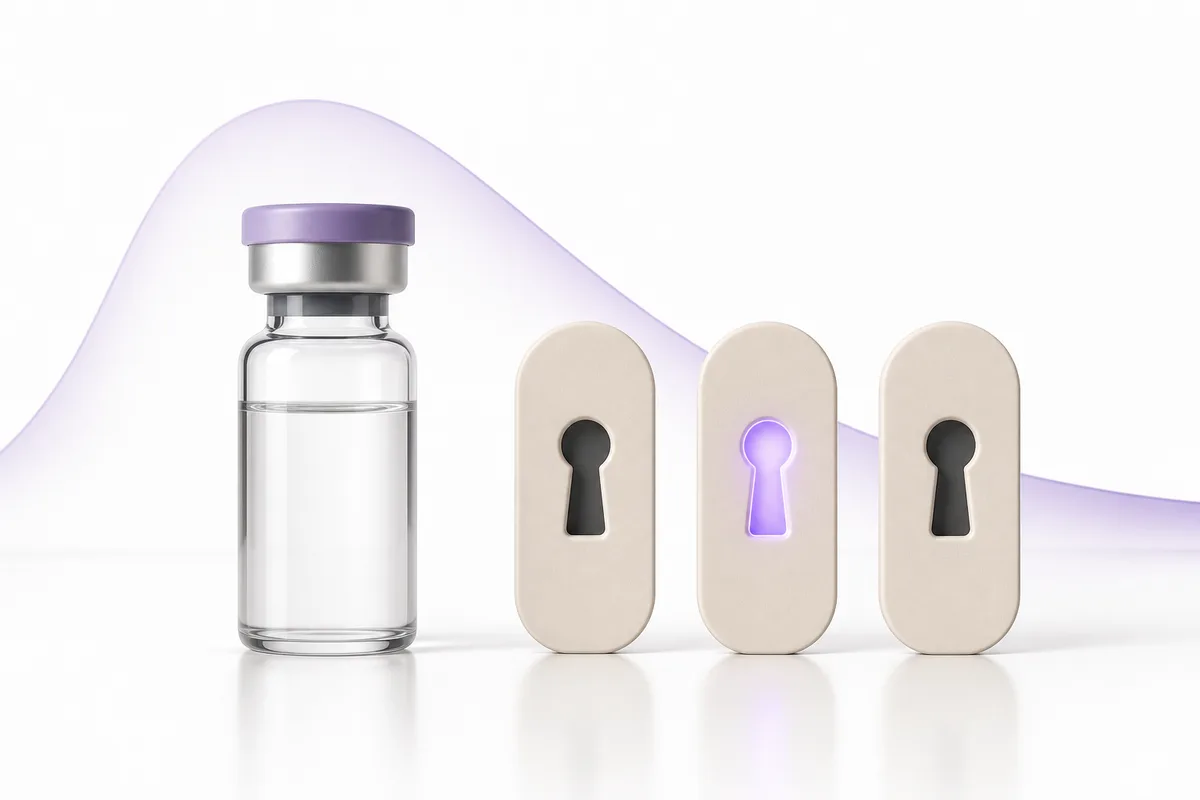
Eloralintide — research code LY3841136 — is a long-acting amylin receptor agonist from Eli Lilly, and the most interesting thing about it is a word that sounds like marketing but isn’t: selective. It is the amylin analog built to hit one receptor rather than several, and in its Phase 2 readout it produced the largest weight change yet reported for an amylin agonist given on its own. This article covers what eloralintide is, how its selectivity differs from cagrilintide’s approach, what the trial record actually shows, and the practical consequence of a half-life measured in weeks.
What amylin does, briefly
Amylin is a hormone co-secreted with insulin by pancreatic beta cells. It promotes satiety, slows gastric emptying and reduces food intake — a set of effects that runs alongside GLP-1 signalling rather than duplicating it. That non-overlap is why the amylin pathway has become the most active area in metabolic peptide research outside the incretins: it offers a second lever rather than a variation on the first.
Native amylin is impractical as a research molecule — it aggregates readily and clears in minutes. Every amylin analog in development is an attempt to solve those two problems at once.
The selectivity question
Amylin’s effects are mediated by receptors built from the calcitonin receptor paired with different RAMP proteins, producing AMY1R, AMY2R and AMY3R. The bare calcitonin receptor is a distinct target in its own right.
This is where eloralintide diverges from its predecessors. In human receptor assays it is roughly:
- 12x more potent at AMY1R than at the calcitonin receptor
- 11x more potent at AMY1R than at AMY3R
- and binds AMY1R with about 8x higher affinity than AMY3R
Cagrilintide, by contrast, is a broader agonist that engages amylin and calcitonin receptors together — sometimes described as a dual-acting amylin and calcitonin receptor agonist.
The half-life is unusually long
Phase 1 measured a half-life of 310-366 hours — about 13 to 15 days — across single subcutaneous doses from 0.4mg to 12mg. For comparison, cagrilintide sits around 7-8 days and semaglutide around a week.
This comes from a C20 fatty diacid attached at Lys26, which binds albumin and keeps the peptide in circulation. The molecule is a 37-amino-acid peptide with three non-coded residues and a methylene thioacetal bridge in place of native amylin’s disulfide — changes that address the aggregation problem.
A two-week half-life dosed weekly has a specific and often-missed consequence: the compound accumulates. Each dose lands while most of the previous one is still present, so the level climbs for weeks before it plateaus. Two practical implications follow. Steady state is not reached quickly, and a dose change takes just as long to fully express — which is precisely why the Phase 2 protocol held each escalation step for four weeks. If you want to see this behaviour rather than read about it, our half-life plotter simulates accumulation for any interval.
What the Phase 2 trial showed
The 48-week dose-finding trial (NCT06230523) randomised 263 participants with a mean baseline weight of 109.1kg.
Phase 2 dose-finding trial, 263 participants, mean baseline weight 109.1kg
Two details in that table are worth more than the headline number.
The dose-response is clean and it hasn’t flattened. From 1mg to 9mg the effect roughly doubles, with no sign of a plateau at the top of the studied range. That’s unusual, and it means 9mg may not be the ceiling.
Escalation didn’t help. The trial also ran escalation arms — 6mg to 9mg finished at -19.9%, and 3mg to 6mg to 9mg finished at -16.4%, both against -20.1% for a fixed 9mg. Escalating is about reaching the dose comfortably, not about landing in a better place.
Lilly also reported the two things the selectivity thesis predicted: improved gastrointestinal tolerability and reduced loss of lean mass relative to broader amylin agonists. Those are the claims most worth watching in Phase 3, because they are the reason to prefer this molecule over a cheaper one.
Where it sits now
Eloralintide is in a broad Phase 3 programme — obesity, obesity with type 2 diabetes, persistent obesity in people already on an incretin, knee osteoarthritis, and obstructive sleep apnoea. There is also Phase 2 combination work pairing it with incretins, which is the configuration most likely to matter commercially: amylin plus GLP-1 is the same logic as CagriSema, with a selective amylin partner instead of a broad one.
Nothing here is approved anywhere. Every number above comes from trials in progress.
Frequently Asked Questions
How is eloralintide different from cagrilintide?
Both are long-acting amylin analogs dosed once weekly, but eloralintide is selective for AMY1R — roughly 11-12x more potent there than at AMY3R or the calcitonin receptor — while cagrilintide engages amylin and calcitonin receptors together. Eloralintide also has a substantially longer half-life (about 13-15 days versus 7-8). They have not been compared head-to-head.
What is eloralintide’s half-life?
About 310-366 hours, or 13-15 days, measured in Phase 1 across subcutaneous doses from 0.4mg to 12mg. This supports once-weekly dosing and means the compound accumulates over several weeks before reaching steady state.
Is eloralintide a GLP-1 drug?
No. It works through the amylin system, which is a separate pathway. The two are complementary rather than interchangeable, which is why amylin agonists are studied both alone and alongside GLP-1 receptor agonists.
Does eloralintide cause muscle loss?
Lilly reported reduced loss of lean mass relative to broader amylin agonists in Phase 2, which is one of the claims the selectivity thesis predicts. This is a trial-reported finding on an investigational molecule, not a settled result — the Phase 3 programme is where it gets tested properly.
What doses were studied?
Phase 2 used 1, 3, 6 and 9mg once weekly as fixed arms, plus two escalation regimens. Phase 1 tested single doses from 0.04mg to 12mg. Our eloralintide calculator converts any of these to syringe units for a given vial size.
Related reading
- What Is Cagrilintide? — the broader amylin agonist eloralintide is implicitly measured against
- Amylin Analogs Explained — the pathway, and why it isn’t a GLP-1 story
- Next-Gen Weight Loss Peptides 2026 — where this fits in the pipeline
- Peptide Half-Life Explained — why a 2-week half-life changes how dosing behaves