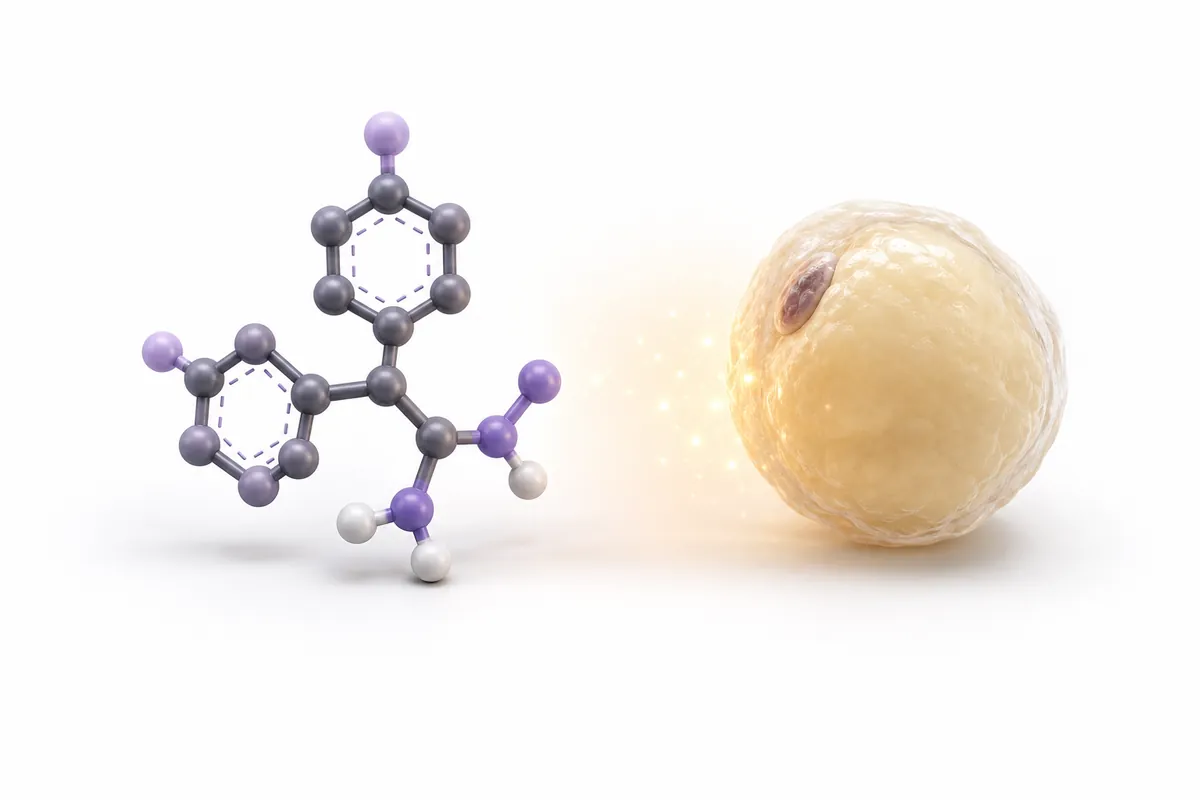
TL;DR: 5-Amino-1MQ is not a peptide. It is a small synthetic molecule — roughly 160 Da — that inhibits NNMT (nicotinamide N-methyltransferase), an enzyme that quietly drains two of the cell’s most important currencies: NAD+ and the methyl donor SAM. Block NNMT and both pools are spared, which in rodent studies shrinks fat cells and raises resting metabolic rate. It gets grouped with fat-loss peptides in search and vendor listings, but the mechanism has nothing to do with GLP-1 and everything to do with metabolic bookkeeping. Every efficacy result so far comes from mice. There are no human trials.
The first thing to get right: it isn’t a peptide
5-Amino-1MQ shows up on the same storefronts as BPC-157 and semaglutide, filed under fat-loss compounds, and it is easy to assume that shared shelf means shared chemistry. It doesn’t. The full name is 5-amino-1-methylquinolinium, a small organic molecule built on a quinolinium ring with a molecular weight around 160 Da. It has no amino-acid backbone and no peptide bonds anywhere in its structure.
That places it in the same broad category as orforglipron or SLU-PP-332 — compounds discussed alongside peptides for similar metabolic goals, while belonging to an entirely different pharmacological class. A peptide gets broken down by peptidases and is usually handled as a reconstituted lyophilized powder. A small molecule like 5-Amino-1MQ follows small-molecule rules: oral bioavailability, receptor- or enzyme-level binding, and hepatic metabolism. The “fat-loss peptide” label is marketing by association, not chemistry.
What NNMT actually does, and why blocking it matters
To understand 5-Amino-1MQ you have to understand the enzyme it switches off. NNMT — nicotinamide N-methyltransferase — takes a molecule of nicotinamide (a form of vitamin B3 and a direct NAD+ precursor) and tags a methyl group onto it, producing 1-methylnicotinamide. To do that, it spends a methyl group borrowed from SAM (S-adenosylmethionine), the cell’s universal methyl donor.
So a single NNMT reaction quietly consumes two valuable things at once: it removes a nicotinamide molecule that could otherwise have been recycled back into NAD+, and it burns a unit of SAM. When NNMT is overexpressed — which happens in the fat tissue and liver of obese and metabolically stressed animals — this drain runs hot. Nicotinamide gets siphoned away from NAD+ salvage, and SAM gets depleted faster than it is regenerated. The result is a fat cell with less NAD+ to run its mitochondria and a skewed methylation balance that favors lipid storage.
5-Amino-1MQ is a cell-permeable NNMT inhibitor. It binds the enzyme and stops that methylation reaction, so nicotinamide stays available for NAD+ salvage and SAM stops being wasted. In effect, inhibiting one enzyme lifts the drain on two separate metabolic pools at the same time. That dual sparing — NAD+ and SAM together — is the entire mechanistic pitch.
The connection to NAD+ biology
This is where 5-Amino-1MQ overlaps with the broader NAD+ story. NAD+ is the coenzyme cells use for redox chemistry, mitochondrial ATP production, and sirtuin signaling, and its levels decline with age and metabolic stress. Most NAD+-raising strategies work from the supply side — feeding cells more precursor, which is why NMN and NR get so much attention as oral NAD+ boosters.
NNMT inhibition attacks the same problem from the opposite end: instead of adding precursor, it stops the leak. Nicotinamide that would have been methylated and excreted stays in the salvage pool, feeding NAD+ regeneration. The two approaches are complementary rather than competing — one turns the tap up, the other plugs the drain. That framing is a large part of why 5-Amino-1MQ trends in the same longevity and metabolic-optimization circles that follow NAD+ precursors, sirtuins, and mitochondrial compounds.
What the mouse data shows
The metabolic findings are specific and worth stating precisely rather than gesturing at.
In the foundational 2018 work from Kraus and colleagues (published in Biochemical Pharmacology), 5-Amino-1MQ inhibited NNMT and, in diet-induced obese mice, reduced fat mass and body weight without changing food intake — pointing to an energy-expenditure effect rather than an appetite one. The mechanism they described tracked the biochemistry above: sparing the NAD+ and SAM pools shifted adipocytes toward burning rather than storing.
Follow-up rodent work through 2024 and 2025 has reinforced and extended that picture. NNMT knockdown and pharmacological inhibition have been reported to shrink adipocyte size, increase resting metabolic rate, improve insulin sensitivity, and reduce hepatic fat accumulation in obese-model mice. The recurring theme is a “non-incretin” fat-loss phenotype: weight comes off through raised metabolic rate and smaller fat cells, not through the appetite suppression and slowed gastric emptying that define GLP-1 drugs.
Qualitative summary of rodent findings (2018-2025). All values are illustrative of reported direction, not pooled trial data.
That is a coherent and genuinely interesting phenotype. It is also, without exception, a mouse phenotype.
Why it trends in the fat-loss and longevity communities
Three things make 5-Amino-1MQ a research-community favorite despite the thin evidence. First, the mechanism is elegant: one enzyme, two spared currencies, a clean metabolic-rate story that reads as “burn more without eating less.” Second, it plugs directly into the NAD+ and longevity conversation that is already running hot, giving it a built-in audience. Third, it is a small molecule with reported oral activity, which makes it easy to imagine as a capsule rather than an injection — a contrast the community notices against the injectable peptide crowd.
None of that changes the evidence tier. An appealing mechanism and enthusiastic forum interest are not clinical data. The honest way to hold this compound is as a mechanistically well-motivated rodent story that hasn’t been tested in people.
The research history so far
- 1
2011-2015
NNMT is characterized as a metabolic regulator, with overexpression linked to obesity and insulin resistance in fat and liver tissue — establishing the enzyme as a plausible drug target.
- 2
2018
Kraus and colleagues report 5-Amino-1MQ as a small-molecule NNMT inhibitor that reduces fat mass and body weight in diet-induced obese mice without changing food intake.
- 3
2020-2023
Further rodent and cell studies map NNMT inhibition to preserved NAD+ and SAM pools, smaller adipocytes, and improved metabolic markers.
- 4
2024-2025
Continued preclinical work reinforces the non-incretin fat-loss phenotype and raised resting metabolic rate, while the compound circulates widely in the research-chemical and longevity communities. Still no registered human trial.
How it differs from GLP-1 fat loss
The contrast with the drugs it gets shelved next to is the clearest way to place 5-Amino-1MQ. GLP-1 receptor agonists — semaglutide, tirzepatide, and the non-peptide orforglipron — drive weight loss primarily by acting on appetite and satiety signaling and by slowing gastric emptying. You eat less, so you lose weight. 5-Amino-1MQ, in the rodent data, does something mechanistically opposite on the intake side: food consumption stays roughly flat while energy expenditure rises. It is an expenditure lever, not an appetite lever.
That distinction is exactly why it draws interest as a potential complement rather than a competitor to the incretin class, and why it slots into the same “what comes after GLP-1” discussion covered in our next-generation weight-loss compounds overview. Whether the mouse expenditure effect survives translation to humans is the open question that no published trial has yet touched.
Where the science actually stands
Strip away the fat-loss-peptide framing and what remains is a legitimate early-stage pharmacology story: a small-molecule NNMT inhibitor that, by sparing NAD+ and SAM at once, reproduces a metabolic-rate-driven fat-loss phenotype in obese mice. The biochemistry is sound and the mechanism is genuinely distinct from the GLP-1 pathway that dominates weight-loss pharmacology right now. But the entire efficacy case sits on rodent data, and mouse adipose metabolism does not read across cleanly to human adipose metabolism. Interesting mechanism, unbuilt human bridge — the same honest posture that fits every preclinical-only compound.
Frequently asked questions
Is 5-Amino-1MQ a peptide?
No. 5-Amino-1MQ (5-amino-1-methylquinolinium) is a synthetic small molecule with a molecular weight around 160 Da and no amino-acid backbone. It gets grouped with fat-loss peptides in search terms and vendor listings because it is studied for similar metabolic goals, but chemically it is an enzyme inhibitor, not a peptide.
What does 5-Amino-1MQ actually do?
It inhibits NNMT (nicotinamide N-methyltransferase), an enzyme that consumes both nicotinamide and the methyl donor SAM. Blocking NNMT keeps nicotinamide available for NAD+ salvage and preserves the SAM pool. In obese mice, this is associated with smaller fat cells, higher resting metabolic rate, and reduced fat mass.
How is 5-Amino-1MQ connected to NAD+?
NNMT drains nicotinamide away from the NAD+ salvage pathway. By inhibiting NNMT, 5-Amino-1MQ lets that nicotinamide feed NAD+ regeneration instead. It is a “drain side” approach to raising NAD+, complementary to “supply side” precursors like NMN and NR that add more raw material.
Has 5-Amino-1MQ been tested in humans?
Not in any published study. Every efficacy finding — fat-mass reduction, smaller adipocytes, raised metabolic rate, improved insulin sensitivity — comes from mouse and cell research. There is no FDA approval, no publicly registered human trial for weight loss, and no published human dosing or safety data.
How is 5-Amino-1MQ different from GLP-1 drugs like semaglutide?
GLP-1 receptor agonists work mainly by suppressing appetite and slowing gastric emptying, so you eat less. In rodent studies, 5-Amino-1MQ leaves food intake roughly unchanged and instead raises energy expenditure — a non-incretin, metabolic-rate-driven mechanism that is essentially the opposite lever on the intake side.
Why does 5-Amino-1MQ get so much attention if there is no human data?
Its mechanism is clean and appealing — one enzyme, two spared metabolic currencies, a “burn more without eating less” story — and it plugs directly into the already-active NAD+ and longevity conversation. That combination generates strong research-community interest, but interest and mechanism are not the same as clinical evidence, which does not yet exist.
References
- Neelakantan H, Vance V, Wetzel MD, et al. Selective and membrane-permeable small molecule inhibitors of nicotinamide N-methyltransferase reverse high fat diet-induced obesity in mice. Biochemical Pharmacology. 2018;147:141-152.
- Kraus D, Yang Q, Kong D, et al. Nicotinamide N-methyltransferase knockdown protects against diet-induced obesity. Nature. 2014;508(7495):258-262.
- Pissios P. Nicotinamide N-Methyltransferase: More Than a Vitamin B3 Clearance Enzyme. Trends in Endocrinology & Metabolism. 2017;28(5):340-353.
- Roberti A, Fernández AF, Fraga MF. Nicotinamide N-methyltransferase: At the crossroads between cellular metabolism and epigenetic regulation. Molecular Metabolism. 2021;45:101165.
- Neelakantan H, Brightwell CR, Graber TG, et al. Small molecule nicotinamide N-methyltransferase inhibitor activates senescent muscle stem cells and improves regenerative capacity of aged skeletal muscle. Biochemical Pharmacology. 2019;163:481-492.