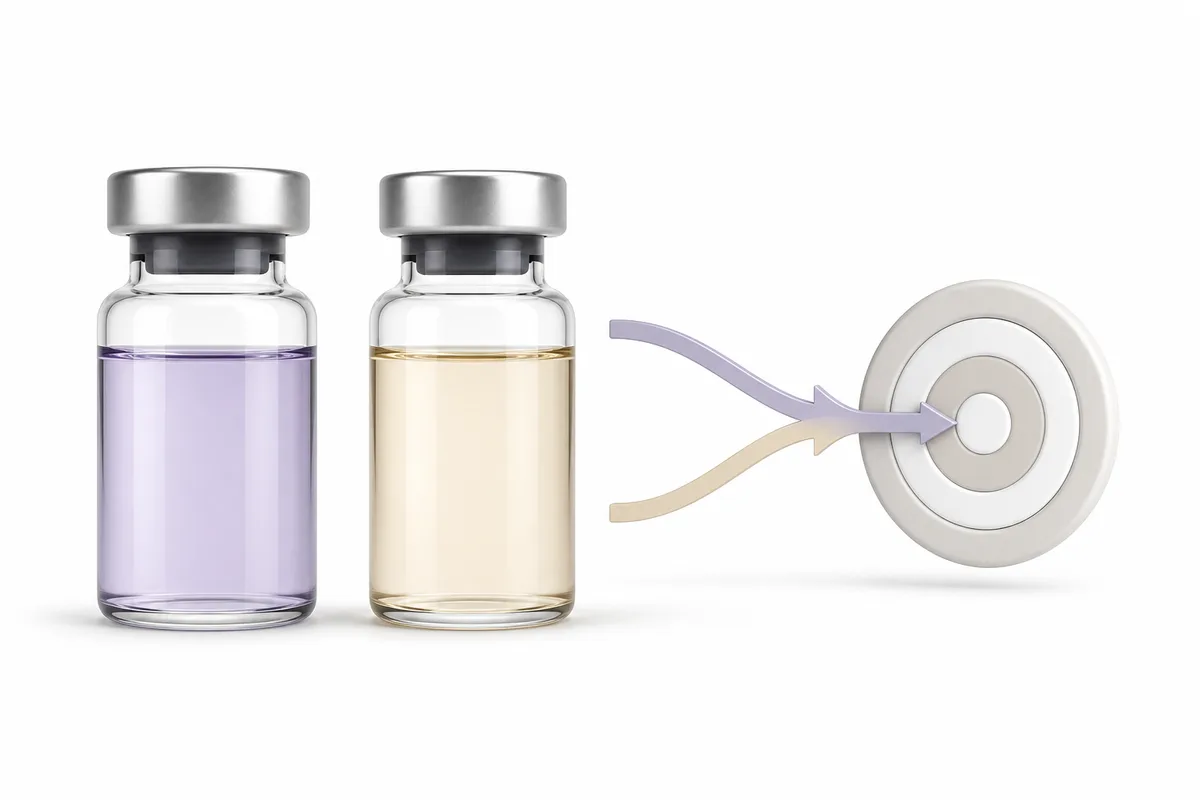
TL;DR: The cagri-reta stack pairs retatrutide, a triple agonist (GLP-1 + GIP + glucagon), with cagrilintide, a long-acting amylin analogue. Adding amylin on top of retatrutide’s three pathways is why the research community nicknames it the “quad-pathway” combination. There is no clinical trial of this specific pairing — CagriSema is the closest studied precedent, and it informs the rationale rather than validating the exact stack. The central practical point is additive tolerability: two appetite-suppressing, gastric-slowing agents compound GI side effects, so observed protocols stagger the ramp rather than escalating both at once. Everything below describes research-community practice, not usage guidance.
Ask around any metabolic-peptide research forum right now and one combination comes up more than any other: cagrilintide plus retatrutide. The appeal is easy to state — retatrutide already hits three receptor systems, cagrilintide adds a fourth that none of the incretin drugs touch, and the two mechanisms look genuinely complementary rather than redundant. This article walks through why the pairing makes pharmacological sense, the physical protocol question the community keeps circling back to (one pre-mixed vial or two separate ones), and the tolerability logic that matters more than any dose number.
Why “quad-pathway”: the mechanism
Retatrutide is a single molecule engineered to activate three separate receptors: GLP-1, GIP, and glucagon. Each contributes something distinct — GLP-1 drives satiety and slows gastric emptying, GIP adds insulinotropic and adipose-handling signaling, and glucagon agonism is studied for an energy-expenditure component that the other two do not appear to replicate. That three-way design is covered in depth in what is retatrutide and in the retatrutide vs tirzepatide comparison.
Cagrilintide is a different animal entirely. It is a long-acting analogue of amylin, the hormone co-secreted with insulin from pancreatic beta cells at mealtimes. It works as a dual amylin and calcitonin receptor agonist (DACRA), engaging a receptor system that sits completely outside the incretin family. Our amylin analogs explained primer and the what is cagrilintide overview go deeper on the pharmacology.
The reason people combine them is that amylin and incretin signaling are complementary, not overlapping. Amylin drives satiety and slows gastric emptying through the hindbrain and hypothalamus via receptors that GLP-1, GIP, and glucagon never touch. Stacking amylin on top of retatrutide’s three pathways therefore adds a genuinely new mechanism to the mix — hence the “quad-pathway” nickname. Add retatrutide’s three receptors plus cagrilintide’s amylin/calcitonin engagement and you get four distinct systems working on appetite and energy balance at once.
The precedent that makes this credible is CagriSema — the fixed-dose combination of cagrilintide with semaglutide. That pairing was studied precisely because amylin plus GLP-1 turned out to be additive rather than redundant, and the phase 1b concomitant-dosing work (Enebo et al., 2021) confirmed the two peptides could be co-dosed on a compatible once-weekly schedule. If amylin adds meaningfully on top of a single GLP-1 agonist, the community reasoning goes, it should add on top of a triple agonist too. That is an extrapolation, not a proven result — more on that below.
Why researchers reach for it
Two motivations come up repeatedly in community discussion.
The first is chasing additive appetite suppression and breaking plateaus. Someone established on retatrutide who has stalled will look for a mechanism that is not already saturated — and since amylin is untouched by any incretin agonist, it is the obvious lever to pull. The stack is framed as adding a new axis rather than pushing an existing one harder.
The second is qualitative: some researchers report that the amylin component seems to smooth appetite in the gaps between retatrutide’s effects, producing a more even day-to-day satiety signal rather than a peak-and-trough pattern. This is anecdotal and self-reported, not a trial endpoint, but it recurs often enough to be worth naming.
The vial question: one pre-mixed or two separate
This is the logistical question the community argues about most, and it maps directly onto the same-syringe versus co-storage distinction covered in mixing peptides in one syringe.
One pre-mixed vial. Some suppliers sell combined cagri-reta vials at a fixed ratio — a set reta:cagri proportion reconstituted together in a single vial or pen. The appeal is convenience: one reconstitution, one draw, one injection. CagriSema itself is a fixed-ratio co-formulation, so there is precedent for combining an amylin analogue and an incretin agent in one container. The trade-off is rigidity. Because the ratio is locked, you cannot move one component without moving the other, which collides directly with the titration logic in the next section.
Two separate vials. The alternative is reconstituting and dosing each peptide independently. This is more work — two vials, two draws (or two injections), more arithmetic — but it buys the one thing the stack most needs: the ability to titrate each component on its own schedule. You can hold cagrilintide flat while stepping retatrutide, or add cagrilintide only after retatrutide is established. For anyone working out the draw volumes across two different concentrations, the peptide blend dosing math walkthrough covers the calculation.
There is also a co-storage dimension, which is exactly the problem mixing peptides in one syringe addresses: combining two peptides in a shared vial raises compatibility and stability questions that dosing them separately sidesteps entirely. A fixed-ratio pre-mix is a bet that the two peptides are stable together over the in-use window; two separate vials makes no such bet.
The tolerability logic — the part that actually matters
Here is the insight that should sit at the center of any cagri-reta discussion: both compounds suppress appetite and slow gastric emptying, and stacking them compounds the gastrointestinal load. Retatrutide’s tolerability signals are the familiar incretin-class ones — nausea, and at higher exposure vomiting and diarrhea. Cagrilintide, through amylin, also slows gastric emptying and can produce nausea. Run both, and those effects are additive rather than independent.
This is why observed community protocols do not escalate both peptides at the same time. The recurring pattern is a staggered ramp: get established and tolerant on one component first, then introduce or raise the second — changing one variable at a time rather than pushing both ceilings simultaneously. It is the same staggered-start principle that governs any sensible two-peptide combination in our common peptide stacks guide, but the stakes are higher here because both agents pull in the same direction on the gut.
Both compounds are also titrated slowly on their own. Retatrutide’s clinical program used gradual dose-escalation to manage GI tolerability, and cagrilintide’s dose-finding work did the same; the retatrutide dosing and titration piece lays out the reasoning behind a slow ramp. When you combine two agents that each demand a cautious escalation, escalating them in lockstep is the fastest route to overwhelming tolerability. The additive-nausea point is the single most important practical takeaway of the entire stack.
The honest evidence picture
This matters and deserves to be stated plainly: there is no clinical trial of cagrilintide plus retatrutide. None. Every efficacy expectation for this specific pairing is an extrapolation.
The closest studied precedent is CagriSema — cagrilintide with semaglutide — which has run through phase 2 and phase 3 programs and demonstrates that amylin plus a GLP-1 agonist is additive. That result is what makes the cagri-reta rationale plausible. But semaglutide is a single GLP-1 agonist and retatrutide is a triple agonist; swapping one for the other and assuming the amylin benefit carries over unchanged is a reasonable hypothesis, not a validated finding. Reta-plus-cagri is a community construct assembled from two separately studied molecules, not a regimen anyone has trialed as a unit.
So treat any specific ratio, dose, or “expected” weight-loss figure for the combination as unverified. The mechanistic story is sound; the combined clinical dataset does not exist.
Retatrutide’s own quirks still apply
Stacking cagrilintide does not cancel anything specific to retatrutide. The paresthesia and dysesthesia reports — the tingling, prickling, or altered-sensation phenomenon that surfaces in retatrutide discussion — remain relevant in the stack, and are covered in retatrutide dysesthesia and tingling. Heart-rate elevation, another signal seen across the incretin class, also carries over. Adding an amylin analogue changes none of that; it layers a second mechanism on top of a compound that already has its own profile to account for.
Frequently asked questions
What does “quad-pathway” actually refer to?
It refers to the total number of distinct receptor systems the stack engages. Retatrutide is a triple agonist covering GLP-1, GIP, and glucagon. Cagrilintide adds the amylin/calcitonin pathway, which none of those three touch. Three plus one gives four separate systems acting on appetite and energy balance, which is where the “quad-pathway” nickname comes from.
Is there any trial data on cagrilintide plus retatrutide?
No. There is no clinical trial of that specific combination. The closest studied precedent is CagriSema — cagrilintide with semaglutide — which shows amylin and GLP-1 signaling are additive. That informs the rationale for cagri-reta, but retatrutide is a triple agonist rather than a single GLP-1 agonist, so the pairing remains a community construct extrapolated from separate datasets, not a trialed regimen.
Should the two peptides go in one vial or stay separate?
Both approaches exist. Pre-mixed vials sold at a fixed reta:cagri ratio are convenient — one reconstitution and one injection — but lock the two components together so you cannot adjust one without the other. Two separate vials require more handling and arithmetic but let you titrate each component independently, which suits the staggered-ramp logic the stack calls for. The same-syringe and co-storage compatibility considerations are covered in the mixing-peptides guide.
Why is nausea the main concern with this stack?
Because both peptides suppress appetite and slow gastric emptying, their gastrointestinal effects are additive rather than independent. Running them together stacks two nausea curves on top of each other. This is why observed protocols stagger the ramp — getting established on one component before introducing or raising the second — rather than escalating both at the same time.
Do retatrutide’s side effects change when cagrilintide is added?
Not really. Retatrutide’s own signals — the dysesthesia and tingling reports, and heart-rate elevation seen across the incretin class — still apply in the stack. Adding an amylin analogue layers a new mechanism on top; it does not neutralize anything specific to retatrutide, so those considerations carry over unchanged.
Research use only. This article describes research-community practice and the pharmacological rationale behind an untrialed peptide combination for laboratory and educational contexts. It is not medical advice and does not recommend any dose, ratio, protocol, or human use. The compounds discussed are research chemicals not intended for self-administration.