TL;DR: Whether a peptide works as a nasal spray is decided mostly by physical chemistry — molecular size and lipophilicity — not by the product page. Small peptides can cross the nasal mucosa; above roughly 1 kDa, absorption falls off sharply without a permeation enhancer. Semax and Selank were designed as intranasal compounds and are the strongest examples. Desmopressin, oxytocin and calcitonin prove the route works for the right molecule. BPC-157 and TB-500 nasal sprays are widely sold, but the systemic-absorption evidence for them by this route is weak to absent. Even where nasal delivery does work, dose-to-dose variability is much higher than with an injection. That is the trade you are making.
Most people arrive at nasal sprays for one reason: they would rather not inject. It is a completely reasonable preference, and for a handful of peptides the nose is genuinely a good door. The problem is that the market does not sort products by whether the molecule can actually get through the mucosa — it sorts them by what people want to buy. So the useful skill is not memorizing a list of “good” nasal peptides. It is understanding the two or three physical properties that decide the outcome, so you can look at any new spray and reason about it yourself.
The core physics: size is the gatekeeper
The nasal cavity offers a large, richly vascularized surface with a thin epithelium and no first-pass liver metabolism. That is the upside. The downside is that this epithelium is a barrier, and it is a barrier that is very good at excluding big, water-loving molecules.
Two properties dominate:
- Molecular weight (in Daltons). Absorption across the nasal mucosa is strongly size-dependent. Small, lipophilic molecules can move transcellularly, straight through the membrane. Larger, hydrophilic molecules like peptides are stuck with the paracellular route — squeezing between cells through tight junctions — and those junctions have a very limited aperture.
- Lipophilicity and charge. A greasier, more neutral molecule crosses a lipid membrane more readily. Peptides are typically polar and often charged, which is exactly the wrong profile.
The rough working rule that comes out of the nasal-delivery literature is that bioavailability drops off sharply above approximately 1 kDa. Below that, meaningful fractions can get across. Well above it, unassisted absorption becomes small enough that the honest description is “not a delivery route.” This is not a hard cliff at a magic number — it is a steep gradient — but it is the single most useful number to carry around.
Run those numbers against the products on sale and the pattern jumps out immediately. Semax and Selank are heptapeptides in the 700-850 Da range. BPC-157 is a 15-amino-acid peptide around 4.5 kDa. TB-500 (the thymosin beta-4 fragment) and full-length TB4 are larger still. The molecules that get sold hardest as sprays are not the ones the physics favors.
Nose-to-brain: the legitimate reason for nasal nootropics
There is a second, more interesting reason to use the nose, and it has nothing to do with avoiding needles.
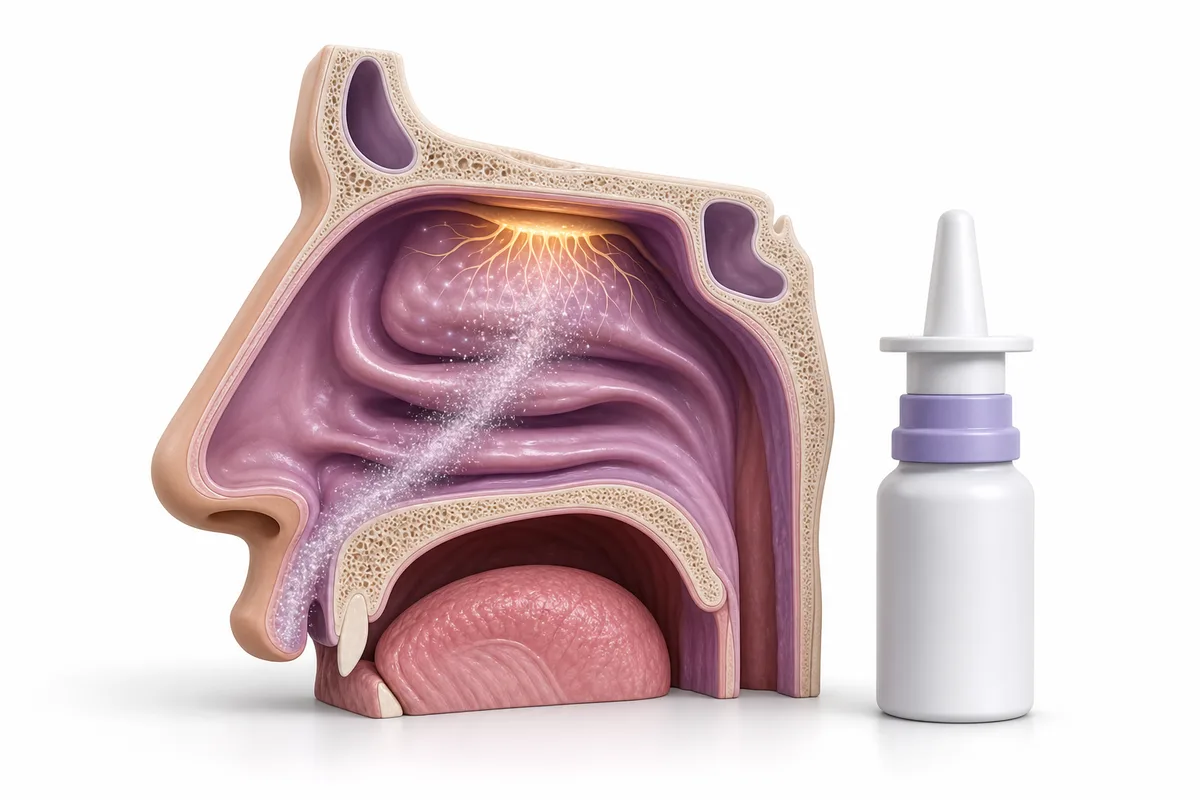
The olfactory region at the roof of the nasal cavity is the only place in the body where neurons are directly exposed to the outside environment. Along the olfactory and trigeminal nerve pathways, molecules can travel from the nasal mucosa toward the brain via perineural and perivascular routes — partially bypassing the blood-brain barrier rather than crossing it. It is a partial bypass, not a teleporter: only a fraction of an applied dose takes this path, and the olfactory region is a small target that a typical spray plume only partly reaches. But the pathway is real and is well described in animal work.
This is the mechanistic reason nootropic peptides are given nasally. Semax and Selank are the flagship cases, and they are worth understanding as a category of their own: both were developed in Russia explicitly as intranasal formulations. Their nasal use is the intended route, not an improvisation by people who dislike syringes. They are small, they were engineered from endogenous fragments (ACTH(4-10) and tuftsin respectively) for stability, and the delivery system was part of the design brief rather than an afterthought. If you want the comparison between them, our Selank vs Semax piece covers where they diverge.
Approved precedents: the route works, and here are its limits
The best evidence that intranasal peptide delivery is real is that several approved products use it. These also show you exactly where the ceiling sits.
| Molecule | Approx. size | What it demonstrates |
|---|---|---|
| Desmopressin | ~1.1 kDa | A small, stabilized analog delivered nasally for years — the textbook case |
| Oxytocin | ~1.0 kDa | Nasal is the standard route in research; also the CNS-access example |
| Calcitonin | ~3.4 kDa | Works nasally, but bioavailability is low single digits — the ceiling in action |
| Bremelanotide (PT-141) | ~1.0 kDa | Started intranasal, ended up subcutaneous — the cautionary case |
Calcitonin is the honest one. It is well over the threshold, it does absorb nasally, and its nasal bioavailability is low — low enough that the nasal dose has to be far larger than the injected dose to do the same work. Nasal delivery of a larger peptide is not always zero; it is often just inefficient enough that it stops being a good idea.
PT-141 is the most instructive precedent of all. Bremelanotide was originally developed as an intranasal formulation, and the intranasal program was discontinued — the nasal route produced variable absorption and, importantly, increases in blood pressure. The approved product is a subcutaneous autoinjector. A molecule that was small enough for the nose, that had a real clinical program behind it, still ended up moving to injection because the nasal route could not deliver a predictable enough exposure. That is not a footnote. It is the central warning about the route. Our PT-141 overview has the fuller history.
The poor candidates: BPC-157 and TB-500 sprays
Here it is plainly. BPC-157 and TB-500 nasal sprays are sold everywhere. The systemic-absorption evidence for these peptides via the nasal route is weak to absent — there is no published human PK to point to, and both molecules sit well above the size range where unassisted nasal absorption is expected to be meaningful.
There is a further wrinkle. Most of what is sprayed into a nose does not stay there. Mucociliary clearance moves the deposited volume backward and down the throat within minutes, where it is swallowed. So a nasal spray of a peptide that does not cross the nasal mucosa is, functionally, an expensive and imprecise way to take that peptide orally — and for most peptides the oral route is close to a dead end, because gastric acid and gut proteases destroy them. If oral delivery is what you are actually interested in for BPC-157, that question deserves its own treatment; we cover it in BPC-157 oral vs injectable, where the gut-local argument is at least a coherent mechanism, which is more than can be said for the nasal one.
None of that means the peptides do nothing. It means the delivery format is doing the work of a marketing feature, not a pharmacokinetic one.
Variability is the route’s real weakness
Suppose the molecule is small enough and the route does work. You have still traded something away, and it is worth naming.
Nasal absorption is unusually sensitive to conditions you do not control:
- Mucus and mucociliary clearance. The clearance half-life of material deposited in the nose is on the order of 15-20 minutes. Whatever has not crossed by then is heading down the throat.
- Congestion, a cold, allergic rhinitis. These change the surface you are dosing onto, sometimes dramatically. A blocked nostril is not a delivery site.
- Spray technique and device. Head angle, depth of insertion, whether you sniff hard (which drives the plume backward into the throat rather than onto the mucosa), how much lands on the septum versus the turbinates.
- Droplet size and plume geometry. A pump that produces fine droplets deposits differently than one producing coarse ones. This is formulation and hardware, not chemistry, and it varies between products.
The consequence: even for peptides that genuinely do absorb nasally, dose-to-dose variability is far higher than with subcutaneous injection. A subcutaneous dose is a known quantity delivered into a known space. A nasal dose is an estimate. That is the actual trade — convenience for consistency — and it is a defensible trade as long as you know you are making it. If your protocol depends on a stable, reproducible exposure, injection remains the tool for that, and injection best practices is the relevant read.
Permeation enhancers, or why formulation beats the peptide
The reason “is this peptide nasally absorbed?” is slightly the wrong question is that the answer depends on the formulation as much as the molecule.
Permeation enhancers are excipients that transiently loosen tight junctions or otherwise increase mucosal permeability: chitosan and its derivatives, cyclodextrins, bile-salt derivatives, surfactants, and various cell-penetrating peptide constructs. A good enhancer can lift the bioavailability of a peptide that would otherwise get essentially nowhere. This is not a theoretical point — it is how the field moves molecules that size alone would exclude.
The corollary is uncomfortable for the nasal-spray market. A peptide dissolved in bacteriostatic water and put in a spray bottle is not a nasal formulation. It is a solution in a bottle. Formulation is where the real work happens, and most sprays sold to researchers have none of it.
Comparing the routes plainly
| Route | Typical peptide bioavailability | Predictability | Notes |
|---|---|---|---|
| Subcutaneous | High | High | The reference standard; consistent, reproducible exposure |
| Intramuscular | High | High | Faster onset than SC for some molecules |
| Intranasal | Highly molecule-dependent — meaningful for small peptides, low to negligible for large ones | Low | Partial nose-to-brain access; sensitive to congestion, technique, clearance |
| Oral | Very low without special formulation | Low | Gastric acid and proteases; oral semaglutide needs the SNAC absorption enhancer and still lands around 1% |
| Sublingual / buccal | Low, molecule-dependent | Low-moderate | Avoids the gut but the mucosa is still a size-selective barrier |
| Topical | Effectively local only | n/a | Skin is a far tighter barrier than any mucosa |
Oral semaglutide is the useful calibration point here, because the figure is solid. Getting a peptide of that size across the gut required a purpose-built absorption enhancer (SNAC) co-formulated with the drug and a specific fasted-dosing procedure — and the result is roughly 1% bioavailability. That is the scale of engineering needed to make a non-injectable route work for a peptide, and roughly 99% of the dose is still lost. When a spray bottle promises the same outcome with no formulation science behind it, that 1% is the number to hold in your head. Our oral vs injectable semaglutide comparison goes deeper on that mechanism.
How to evaluate any nasal-spray claim
A short checklist that will get you most of the way:
- What is the molecular weight? Under roughly 1 kDa, plausible. Several kDa, and you need a very good reason to believe it.
- Was this molecule designed for the nasal route, or adapted to it? Semax and Selank were designed for it. BPC-157 was not.
- Is there a permeation enhancer in the formulation? If the ingredient list is peptide plus water plus a preservative, the answer is no.
- Is there any PK data at all — for this molecule, by this route, in any species? Not “studies show peptides are absorbed nasally,” but PK for this compound.
- Is there an approved precedent at a similar size? Desmopressin, oxytocin and calcitonin set the reference points.
If a product fails questions 1, 3 and 4 together, the spray is a delivery format chosen for how it feels, not for what it does.
The mellow version of all this: the nose is a real route for real reasons, and for a small, well-chosen molecule it can be an elegant one — particularly where CNS access is the point. It is just not a universal substitute for a needle, and no amount of preferring it makes a 4.5 kDa peptide smaller. Get the molecular weight, ask about the formulation, and the rest of the reasoning follows. For the arithmetic that sits underneath any of this, peptide dosing 101 is the companion piece.
Frequently asked questions
Does BPC-157 nasal spray actually work?
The systemic-absorption evidence for BPC-157 via the nasal route is weak to absent. At roughly 4.5 kDa it sits well above the size range where unassisted nasal absorption is expected to be meaningful, there is no published human PK by this route, and typical products contain no permeation enhancer. Most of a nasal dose is cleared backward and swallowed within about 15-20 minutes, so in practice a BPC-157 spray tends to function as an imprecise oral dose rather than a nasal one.
Why do Semax and Selank work as nasal sprays when other peptides don’t?
Both are small — roughly 813 Da and 751 Da respectively — which puts them under the approximate 1 kDa threshold where nasal absorption falls off sharply. Just as importantly, both were developed in Russia explicitly as intranasal formulations, so the route was part of the design rather than a later convenience. The olfactory and trigeminal pathways also give small peptides partial access to the CNS without crossing the blood-brain barrier, which is the mechanistic point of giving a nootropic peptide nasally at all.
Is nasal delivery as reliable as injection?
No, and this is the honest trade. Even for peptides that genuinely absorb nasally, dose-to-dose variability is considerably higher than with subcutaneous injection. Mucus, congestion, a cold, allergic rhinitis, spray technique, droplet size and how much simply drains down the throat all shift how much actually crosses. Subcutaneous delivery puts a known quantity into a known space; a nasal dose is an estimate. You are exchanging consistency for convenience.
What is a permeation enhancer and why does it matter?
It is an excipient that transiently increases mucosal permeability — chitosan derivatives, cyclodextrins, bile-salt derivatives and surfactants are common examples — usually by loosening the tight junctions between epithelial cells. Enhancers can lift the bioavailability of peptides that size alone would otherwise exclude, which is why formulation often matters more than the peptide itself. A peptide dissolved in water and put in a spray bottle is not a nasal formulation.
Why did PT-141 end up as an injection if it started as a nasal spray?
Bremelanotide was originally developed as an intranasal formulation, but that program was discontinued: the nasal route produced variable absorption and increases in blood pressure, and the approved product became a subcutaneous autoinjector. It is the clearest illustration of the route’s limits — a molecule small enough for the nose, with a full clinical program behind it, still moved to injection because nasal dosing could not deliver a predictable enough exposure.
References
- Illum L. Nasal drug delivery — possibilities, problems and solutions. Journal of Controlled Release. 2003;87(1-3):187-198.
- Ozsoy Y, Gungor S, Cevher E. Nasal delivery of high molecular weight drugs. Molecules. 2009;14(9):3754-3779.
- Lochhead JJ, Thorne RG. Intranasal delivery of biologics to the central nervous system. Advanced Drug Delivery Reviews. 2012;64(7):614-628.
- Thorne RG, Pronk GJ, Padmanabhan V, Frey WH. Delivery of insulin-like growth factor-I to the rat brain and spinal cord along olfactory and trigeminal pathways. Neuroscience. 2004;127(2):481-496.
- Diamond LE, Earle DC, Rosen RC, Willett MS, Molinoff PB. Double-blind, placebo-controlled evaluation of the safety, pharmacokinetic properties and pharmacodynamic effects of intranasal PT-141, a melanocortin receptor agonist, in healthy males and patients with mild-to-moderate erectile dysfunction. International Journal of Impotence Research. 2004;16(1):51-59.
- Buckley ST, Bækdal TA, Vegge A, et al. Transcellular stomach absorption of a derivatized glucagon-like peptide-1 receptor agonist. Science Translational Medicine. 2018;10(467):eaar7047.
- Davis SS, Illum L. Absorption enhancers for nasal drug delivery. Clinical Pharmacokinetics. 2003;42(13):1107-1128.
Research use only. This article explains routes of administration and bioavailability for laboratory and educational contexts. It is not medical advice and does not recommend any dose, protocol, or human use. Peptides discussed here are research chemicals not intended for self-administration; handle all research materials in accordance with applicable EU regulations and institutional guidance.