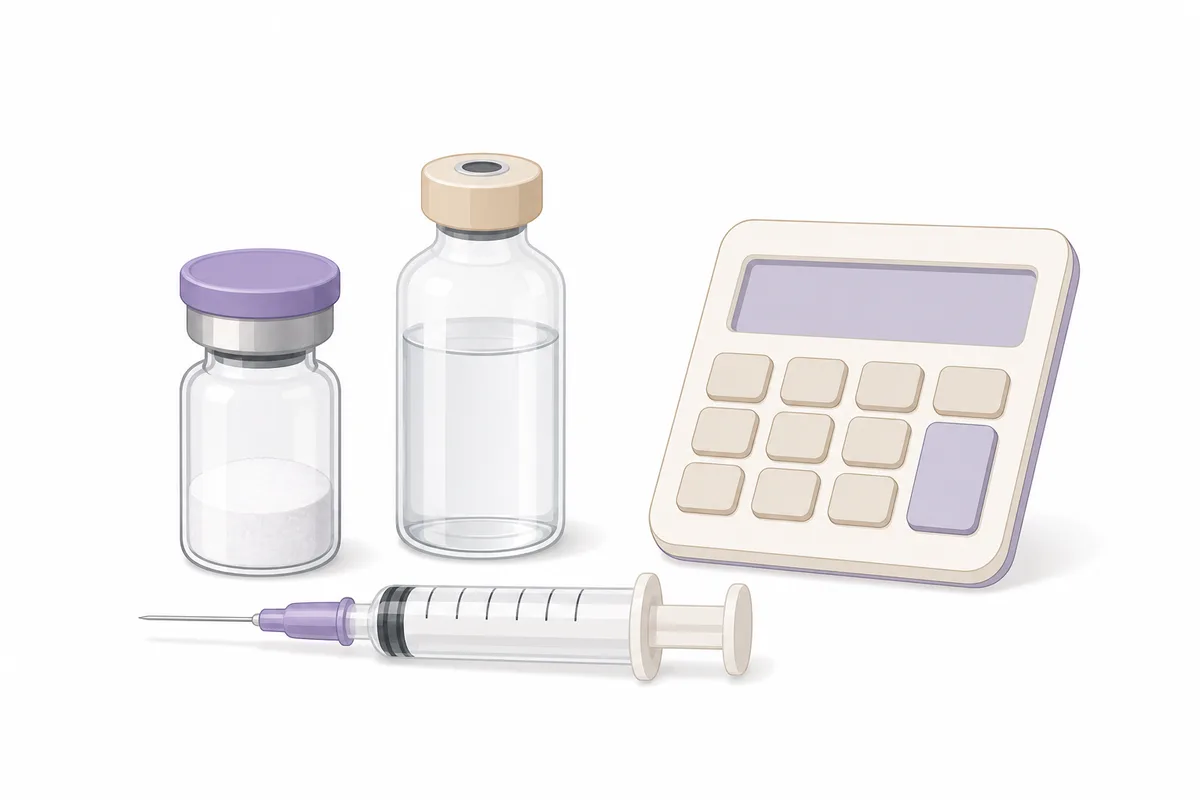
TL;DR: A peptide reconstitution calculator does three arithmetic steps for you: it takes the peptide mass in a vial (mg), divides by the volume of bacteriostatic water you add (mL) to get concentration (mg/mL), then converts a target amount (mcg) into insulin-syringe units. This is pure math for laboratory record-keeping, not dosing advice.
What a reconstitution calculator actually does
A lyophilized (freeze-dried) research peptide arrives as a solid powder inside a sealed glass vial, labeled by mass, for example 5 mg or 10 mg. To measure or aliquot it in a laboratory setting, the powder is dissolved in a liquid diluent. A peptide reconstitution calculator automates the unit conversions involved so you do not have to track decimals by hand.
Under the hood, the tool answers one question at a time:
- What is the concentration? Divide the peptide mass by the diluent volume:
concentration (mg/mL) = vial mg / water mL. - How much liquid contains a target amount? Divide the target by the concentration:
volume (mL) = target mg / concentration (mg/mL). - How many syringe units is that? On a U-100 insulin syringe, 1 mL = 100 units, so
units = volume (mL) x 100.
Every number below follows from those three lines. The calculator simply keeps the decimal places straight, which is where manual errors creep in.
Step 1: Adding bacteriostatic (BAC) water
The most common diluent for research reconstitution is bacteriostatic water: sterile water containing roughly 0.9% benzyl alcohol as a preservative. The benzyl alcohol disrupts microbial cell membranes, which is what allows a sealed vial to tolerate repeated needle withdrawals under aseptic technique, unlike plain sterile water, which is single-use once opened.
The volume of water you add is a choice, not a fixed rule, and that choice sets your final concentration. Adding more water gives a more dilute, larger-volume solution (easier to draw small amounts precisely); adding less water gives a concentrated, small-volume solution. The peptide mass never changes, only the volume it is dissolved in. Our reconstitution chart lays out the common mg-to-mL combinations side by side so you can see how the concentration shifts.
Two practical notes on benzyl alcohol as a preservative. First, it is generally compatible with most peptides at refrigerated storage (2 to 8 degrees C) and does not hydrolyze peptide bonds under normal conditions. Second, benzyl alcohol is not universally inert: the 1982 New England Journal of Medicine report on neonatal “gasping syndrome” documented that preservative-containing diluents are inappropriate for newborns. That is a human-medicine caution and a reminder that “diluent choice matters,” which is precisely why laboratory records track it.
Step 2: Concentration = vial mg / water mL
Concentration is the anchor for every later calculation. Keep the units explicit:
- 5 mg peptide + 2 mL water -> 5 / 2 = 2.5 mg/mL
- 10 mg peptide + 2 mL water -> 10 / 2 = 5 mg/mL
- 10 mg peptide + 5 mL water -> 10 / 5 = 2 mg/mL
Because research targets are usually expressed in micrograms (mcg), it helps to convert mg/mL into mcg per mL up front. There are 1000 mcg in 1 mg, so a 2.5 mg/mL solution is 2500 mcg/mL. A calculator does this conversion silently; doing it yourself once makes the later steps obvious.
Step 3: Converting a target (mcg) into insulin-syringe units
Research handling frequently uses a U-100 insulin syringe because its fine gradations make small volumes readable. The single fact you need:
On a U-100 syringe, 100 units = 1 mL, so 1 unit = 0.01 mL.
That is a fixed property of the U-100 standard, independent of what liquid is inside. To find units for a target amount:
units = (target mcg / concentration in mcg/mL) x 100
Or, equivalently, divide the target by the amount contained in a single unit (0.01 mL) of your solution.
Worked example 1: 5 mg vial, 2 mL water, 250 mcg target
- Concentration: 5 mg / 2 mL = 2.5 mg/mL = 2500 mcg/mL
- Volume for 250 mcg: 250 / 2500 = 0.1 mL
- Units: 0.1 mL x 100 = 10 units
Worked example 2: 10 mg vial, 2 mL water, 500 mcg target
- Concentration: 10 mg / 2 mL = 5 mg/mL = 5000 mcg/mL
- Volume for 500 mcg: 500 / 5000 = 0.1 mL
- Units: 0.1 mL x 100 = 10 units
Notice examples 1 and 2 both land on 10 units for very different targets. That is the whole point of tracking concentration: the same mark on a syringe means different amounts depending on how the vial was reconstituted.
Worked example 3: 10 mg vial, 5 mL water, 300 mcg target
- Concentration: 10 mg / 5 mL = 2 mg/mL = 2000 mcg/mL
- Volume for 300 mcg: 300 / 2000 = 0.15 mL
- Units: 0.15 mL x 100 = 15 units
15 units on a U-100 syringe = 0.15 mL, which holds 300 mcg at 2000 mcg/mL.
Quick-reference: how water volume changes the numbers
The table below reconstitutes the same 10 mg vial three ways and shows the units that correspond to an identical 250 mcg reference amount. It illustrates arithmetic only.
| Vial | BAC water | Concentration | mcg per unit (0.01 mL) | Units for 250 mcg |
|---|---|---|---|---|
| 10 mg | 1 mL | 10 mg/mL (10000 mcg/mL) | 100 mcg | 2.5 units |
| 10 mg | 2 mL | 5 mg/mL (5000 mcg/mL) | 50 mcg | 5 units |
| 10 mg | 5 mL | 2 mg/mL (2000 mcg/mL) | 20 mcg | 12.5 units |
The vial contents are identical in all three rows. Only the water volume, and therefore the concentration and the unit reading, differ. This is why every laboratory log should record the exact reconstitution volume, not just the vial size.
Same vial, same target amount, different reconstitution volume - so the syringe reading changes.
What the research shows
The calculator itself is arithmetic and carries no biological claims. The peptides people reconstitute, however, are genuine research compounds, and the evidence base for them is overwhelmingly preclinical. Take BPC-157, a widely referenced example and one of our most-viewed peptide profiles. It is a synthetic pentadecapeptide first characterized for gastric cytoprotection, and reviews describe reported effects on angiogenesis, collagen synthesis, and tissue repair in animal models (Sikiric et al., 2011; Seiwerth et al., 2021; Gwyer et al., 2019).
The honest framing is that these are animal and in vitro findings. A 2025 narrative review in Current Reviews in Musculoskeletal Medicine and a 2025 Inflammopharmacology analysis both emphasize that controlled efficacy work remains in preclinical models, with no completed, published, controlled human trials establishing safety or efficacy. Separate 2026 formulation literature further notes unresolved biopharmaceutical and stability challenges for translational development. In short: promising mechanistic signals in laboratory systems, an unfinished human evidence story. Our BPC-157 10 mg reference page collects the primary sources so the preclinical-versus-clinical distinction stays visible.
None of this changes the math. A calculator tells you the concentration and the volume; it says nothing about whether any amount is appropriate for any living subject, and it cannot.
Frequently Asked Questions
How do I calculate peptide concentration from mg and mL?
Divide the peptide mass in the vial by the volume of bacteriostatic water you added: concentration (mg/mL) equals vial mg divided by water mL. A 5 mg vial in 2 mL of water gives 2.5 mg/mL. Multiply mg/mL by 1000 to express the result in mcg/mL.
How many units is one full mL on an insulin syringe?
On a U-100 insulin syringe, one full milliliter equals 100 units, so one unit equals 0.01 mL. This ratio is fixed by the U-100 standard and does not depend on the liquid inside. Convert any volume to units by multiplying the milliliters by 100.
Does more BAC water make a peptide stronger or weaker?
Adding more bacteriostatic water makes the solution more dilute, not weaker in total mass. The peptide quantity in the vial is unchanged; it is simply spread across a larger volume, so each unit on the syringe contains fewer micrograms. Less water concentrates the same mass into a smaller volume.
Why use bacteriostatic water instead of sterile water?
Bacteriostatic water contains about 0.9% benzyl alcohol, a preservative that inhibits microbial growth and permits multiple aseptic withdrawals from one vial. Plain sterile water has no preservative and is intended for single use. Some peptides are documented as preservative-incompatible, in which case records should reflect the alternative diluent.
Can a reconstitution calculator tell me a correct dose?
No. A reconstitution calculator performs unit conversions only: mass to concentration, concentration to volume, volume to syringe units. It has no knowledge of any subject and makes no therapeutic judgment. It is a bookkeeping tool for laboratory measurement, not a source of dosing guidance for humans or animals.
What is mcg per unit and why does it matter?
Mcg per unit is how many micrograms sit in a single 0.01 mL syringe increment: concentration in mcg/mL divided by 100. It matters because the same syringe mark represents different amounts at different concentrations, so recording it prevents misreading one reconstitution’s numbers against another’s.
References
- Sikiric P, Seiwerth S, Rucman R, et al. Stable gastric pentadecapeptide BPC 157: novel therapy in gastrointestinal tract. Current Pharmaceutical Design. 2011;17(16):1612-1632.
- Seiwerth S, Milavic M, Vukojevic J, et al. Stable Gastric Pentadecapeptide BPC 157 and Wound Healing. Frontiers in Pharmacology. 2021;12:627533.
- Gwyer D, Wragg NM, Wilson SL. Gastric pentadecapeptide body protection compound BPC 157 and its role in accelerating musculoskeletal soft tissue healing. Cell and Tissue Research. 2019;377(2):153-159.
- Vukojevic J, et al. Concerning BPC-157, a natural pentadecapeptide that acts as a cytoprotectant and is believed to protect the gastrointestinal tract. Inflammopharmacology. 2025. doi:10.1007/s10787-025-01882-z.
- Regeneration or Risk? A Narrative Review of BPC-157 for Musculoskeletal Healing. Current Reviews in Musculoskeletal Medicine. 2025. doi:10.1007/s12178-025-09990-7.
- BPC-157 as an Investigational Peptide Therapeutic: Biopharmaceutical Challenges, Formulation Strategies, and Translational Development Barriers. Pharmaceutics. 2026;18(5):625.
- Gershanik J, Boecler B, Ensley H, McCloskey S, George W. The gasping syndrome and benzyl alcohol poisoning. New England Journal of Medicine. 1982;307(22):1384-1388.
Research use only. This article explains measurement arithmetic for laboratory record-keeping. It is not medical advice and contains no therapeutic or human-dosing recommendations. The compounds referenced are research chemicals not approved for human or veterinary use; consult qualified professionals and applicable EU regulations before handling.