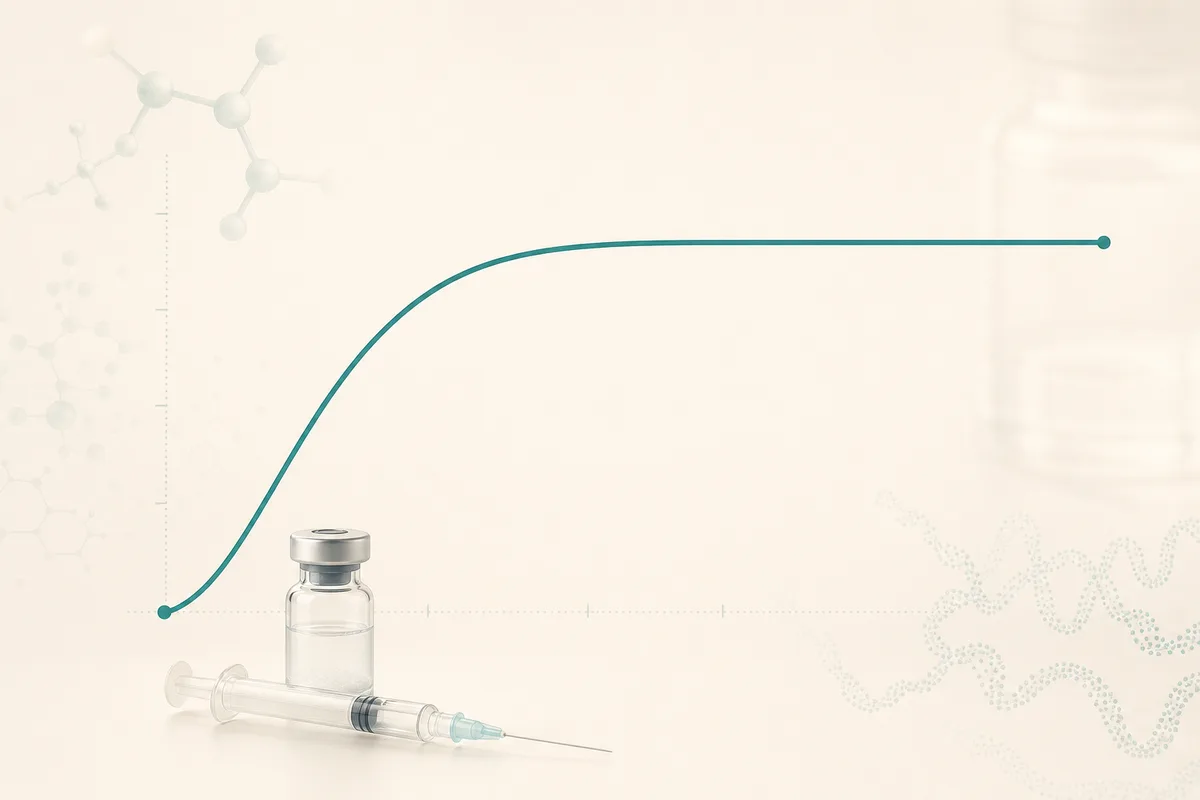
TL;DR: GHRP-2 is a potent growth hormone secretagogue studied for strong, reliable GH release. Its dosing is shaped by a “saturation dose” concept — beyond roughly 100mcg per administration the extra GH release per microgram falls off sharply — and by its off-target effects on cortisol, prolactin, and appetite. This guide covers the research ranges and the reasoning behind them.
GHRP-2 sits in the middle of the growth hormone releasing peptide (GHRP) family: more potent than ipamorelin but far less selective, and defined by a well-documented saturation behaviour that dictates how it is dosed. This guide focuses on the dosing logic; for how it compares with its sibling, see GHRP-2 vs GHRP-6.
What is GHRP-2?
GHRP-2 is a synthetic hexapeptide growth hormone secretagogue that binds the ghrelin receptor (GHS-R1a) on pituitary somatotrophs to trigger GH release. It produces a strong, reliable GH pulse, at the cost of moderate increases in cortisol and prolactin and a noticeable appetite response driven by ghrelin-receptor activation. GHRP-2 research vials are commonly supplied in 5mg and 10mg presentations.
The Saturation Dose Concept
The single most important idea in GHRP-2 dosing is saturation. The GH response does not climb indefinitely with dose — beyond roughly 100mcg per administration, each additional microgram produces progressively less extra GH.
- 1
Below saturation
GH release rises roughly with dose up to about 100mcg.
- 2
At saturation
Around 100mcg per dose captures most of the achievable GH pulse.
- 3
Above saturation
Extra dose yields diminishing GH return while off-target effects keep rising.
The practical consequence, repeated throughout the literature: multiple moderate doses across the day outperform a single large dose. Because the receptor response saturates, splitting the daily amount into two or three ~100mcg administrations captures more total GH than one large injection, which mostly increases cortisol and appetite without a matching GH gain.
Research Dosing Considerations
The figures below reflect general ranges reported in the research literature and are provided for educational context only. They are not medical instructions and are not intended for human use.
| Protocol | Dose | Frequency |
|---|---|---|
| Low | 100mcg | 2x daily |
| Standard | 100mcg | 2-3x daily |
| Higher | 100-200mcg | 2-3x daily |
Qualitative illustration of saturation from the research literature; not a recommendation.
A consistent observation is that GH secretagogues produce a cleaner pulse when administered away from food, since elevated blood glucose and fatty acids blunt the GH response. Any specific protocol should be defined by the research design and applicable oversight, not by generalised figures.
Off-Target Effects to Account For
Unlike the highly selective ipamorelin, GHRP-2 raises several other signals, and research design has to account for them:
- Cortisol and prolactin — moderate increases, which can confound studies trying to isolate GH-specific effects
- Appetite — a marked ghrelin-driven hunger response, less than GHRP-6 but clearly present
- These trade-offs are why researchers needing a clean GH signal often prefer ipamorelin, and why GHRP-2 is chosen when its stronger raw GH release is the priority
GHRP-2 in Combination Research
GHRP-2 is frequently co-studied with GHRH analogs such as CJC-1295, because the two act on complementary receptors — the GHRH analog raises the GH baseline while GHRP-2 amplifies the pulse. Our common peptide stacks guide covers this pairing.
Reconstitution & Handling
GHRP-2 is supplied as a lyophilised powder reconstituted with bacteriostatic water. Because the per-dose research amount (~100mcg) is small relative to the vial (5-10mg), the reconstitution volume sets how precise each draw is. Use the reconstitution calculator to model any vial and dose, and see the peptide reconstitution guide for procedure.
Storage & Stability
- Lyophilised powder: store at -20°C for long-term stability
- Reconstituted solution: store at 2-8°C (refrigerated), protected from light
- Avoid repeated freeze-thaw cycles
See our peptide storage guide for general principles.
Safety, Legality & Research Disclaimers
GHRP-2 is a research peptide. It is not an approved medicine and has not been authorised for therapeutic use in humans. It should be treated strictly as a laboratory research chemical, handled by qualified individuals, and used only for legitimate research purposes. Regulatory status varies by jurisdiction, and researchers are responsible for confirming compliance with applicable local laws and institutional requirements. Nothing here is medical advice.
FAQ
What is the GHRP-2 saturation dose?
Around 100mcg per administration. Beyond that point the growth hormone response per additional microgram falls off sharply, so larger single doses mostly raise cortisol and appetite rather than GH. This is why research protocols favour several ~100mcg doses across the day over one large dose.
How often is GHRP-2 dosed in research?
Commonly two to three times daily, because the receptor response saturates per administration. Splitting the daily amount captures more total GH than a single injection and better matches the natural pulsatile rhythm of GH secretion.
Does GHRP-2 raise cortisol?
Yes, moderately, along with prolactin. This is the trade-off against its strong GH release. Researchers who need a clean GH signal without these off-target effects generally prefer ipamorelin, which leaves cortisol and prolactin near baseline.
Can GHRP-2 be used in humans?
No. It is a research peptide, not an approved medicine, intended for laboratory research purposes only.
References
- Bowers CY, et al. “Growth hormone-releasing peptide-2 and its analogues.” Research literature on GHRP-2 pharmacology and saturation dosing.
- Research literature on GHRP-2 cortisol, prolactin, and appetite effects relative to other secretagogues.
Last updated: July 10, 2026
Disclaimer: This information is for educational and research purposes only. Peptides are research chemicals not intended for human consumption. For vial-specific reconstitution, see our GHRP-2 research page.