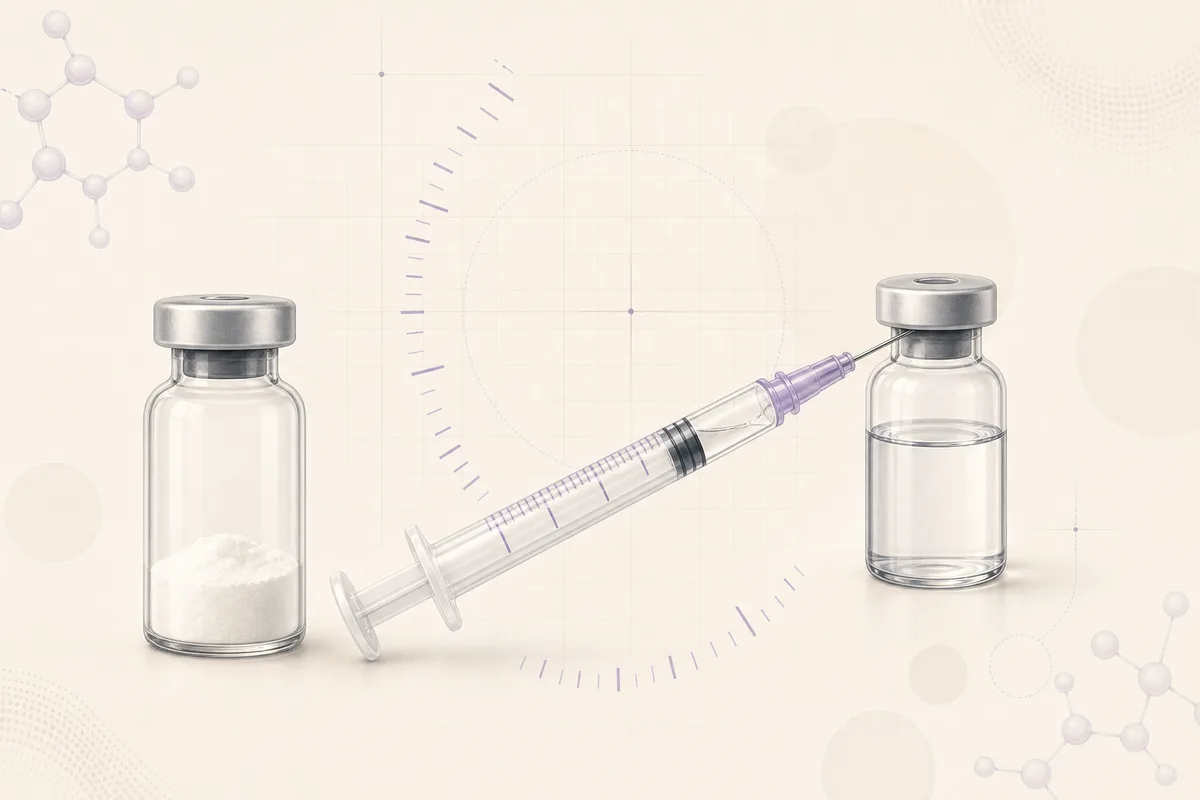
TL;DR: CJC-1295 reconstitution follows the same mass-to-volume maths as any peptide, but the DAC and no-DAC forms change how you use the resulting solution. No-DAC (Mod GRF 1-29) is drawn in small microgram doses several times a day; the DAC form is a larger, less frequent dose. This guide gives the concentration maths for both and shows how the form dictates the draw.
CJC-1295 confuses researchers at reconstitution because two products share the name but behave differently once mixed. The chemistry of mixing is identical; the usage of the solution is not. This guide covers the maths for both, and the reconstitution calculator will model any exact vial and dose. For the underlying biology of the two forms, see CJC-1295 DAC vs no DAC.
The Two Forms Reconstitute the Same, Dose Differently
Both forms are lyophilised powders reconstituted with bacteriostatic water added slowly against the vial wall, then swirled — never shaken. What differs is what you do with the vial afterwards:
- 1
No-DAC (Mod GRF 1-29)
Short half-life; small microgram doses drawn 2-3x daily to preserve the pulse.
- 2
With DAC
Long half-life; a larger dose drawn far less often for a sustained baseline.
- 3
Same vial maths
The concentration calculation is identical; only the volume-per-draw and frequency change.
No-DAC (Mod GRF 1-29) Concentration Maths
No-DAC CJC-1295 is dosed in small amounts (research literature commonly references ~100mcg per administration), so the reconstitution volume determines how precise each tiny draw is. A worked example for a 2mg vial:
| Peptide | BAC Water | Concentration | 100mcg dose = |
|---|---|---|---|
| 2mg | 2mL | 1mg/mL | 0.10mL (10 units) |
| 2mg | 1mL | 2mg/mL | 0.05mL (5 units) |
| 5mg | 2.5mL | 2mg/mL | 0.05mL (5 units) |
A lower concentration (more water) makes each draw larger and easier to measure precisely; a higher concentration keeps the injection volume tiny. For small microgram doses, a slightly larger draw volume is often easier to dose accurately. Model your exact CJC-1295 2mg or 5mg vial in the reconstitution calculator.
DAC Concentration Maths
The DAC form uses the identical mixing maths, but because its half-life is measured in days rather than minutes, the research dose is larger and drawn far less frequently. The same concentration table applies; the difference is that a DAC protocol draws a larger single volume on a much less frequent schedule, rather than small volumes multiple times a day.
Qualitative comparison of how often the reconstituted solution is drawn; not a dosing recommendation.
Reconstitution Step-by-Step
- Clean both vial stoppers with alcohol swabs and let dry
- Draw the chosen volume of bacteriostatic water
- Add slowly against the inside wall of the peptide vial — never spray directly onto the powder
- Dissolve with a gentle swirl; no-DAC CJC-1295 is relatively fragile, so avoid shaking
- Verify the solution is completely clear
- Label and refrigerate immediately
For the full general procedure across peptides, see the peptide reconstitution guide. No-DAC CJC-1295 has a shorter reconstituted shelf life than many peptides (commonly 2-3 weeks refrigerated), so mixing volumes that will be used within that window avoids waste.
Storage & Stability
- Lyophilised powder: store at -20°C for long-term stability
- Reconstituted solution: store at 2-8°C (refrigerated), protected from light
- No-DAC reconstituted stability: generally 2-3 weeks — shorter than many peptides
- Avoid repeated freeze-thaw cycles
See the peptide storage guide for general principles.
Safety, Legality & Research Disclaimers
CJC-1295 (both forms) is a research peptide. It is not an approved medicine and has not been authorised for therapeutic use in humans. It should be treated strictly as a laboratory research chemical, handled by qualified individuals, and used only for legitimate research purposes. Regulatory status varies by jurisdiction, and researchers are responsible for confirming compliance with applicable local laws and institutional requirements. Nothing here is medical advice.
FAQ
How much bacteriostatic water should I use for a 2mg CJC-1295 vial?
For no-DAC CJC-1295, 2mL of bacteriostatic water gives a 1mg/mL concentration, so a 100mcg research dose is 0.10mL (10 units on a U-100 syringe). Using 1mL instead gives 2mg/mL and a smaller 0.05mL draw. The reconstitution calculator will model any vial and dose combination.
Does the DAC version reconstitute differently?
No — the mixing procedure and concentration maths are identical. What differs is usage: the DAC form has a multi-day half-life, so it is drawn as a larger dose far less frequently, whereas no-DAC is drawn in small doses several times a day.
Why does no-DAC CJC-1295 expire faster once mixed?
No-DAC CJC-1295 (Mod GRF 1-29) is more fragile in solution than many peptides, with a reconstituted shelf life commonly cited at 2-3 weeks refrigerated. Reconstituting only what will be used in that window avoids waste.
Can CJC-1295 be used in humans?
No. It is a research peptide, not an approved medicine, intended for laboratory research purposes only.
References
- Teichman SL, et al. “Prolonged stimulation of growth hormone and IGF-I secretion by CJC-1295.” J Clin Endocrinol Metab. 2006.
- Research literature on Mod GRF (1-29) stability and dosing frequency relative to the DAC form.
Last updated: July 14, 2026
Disclaimer: This information is for educational and research purposes only. Peptides are research chemicals not intended for human consumption. Model your vial in the reconstitution calculator.