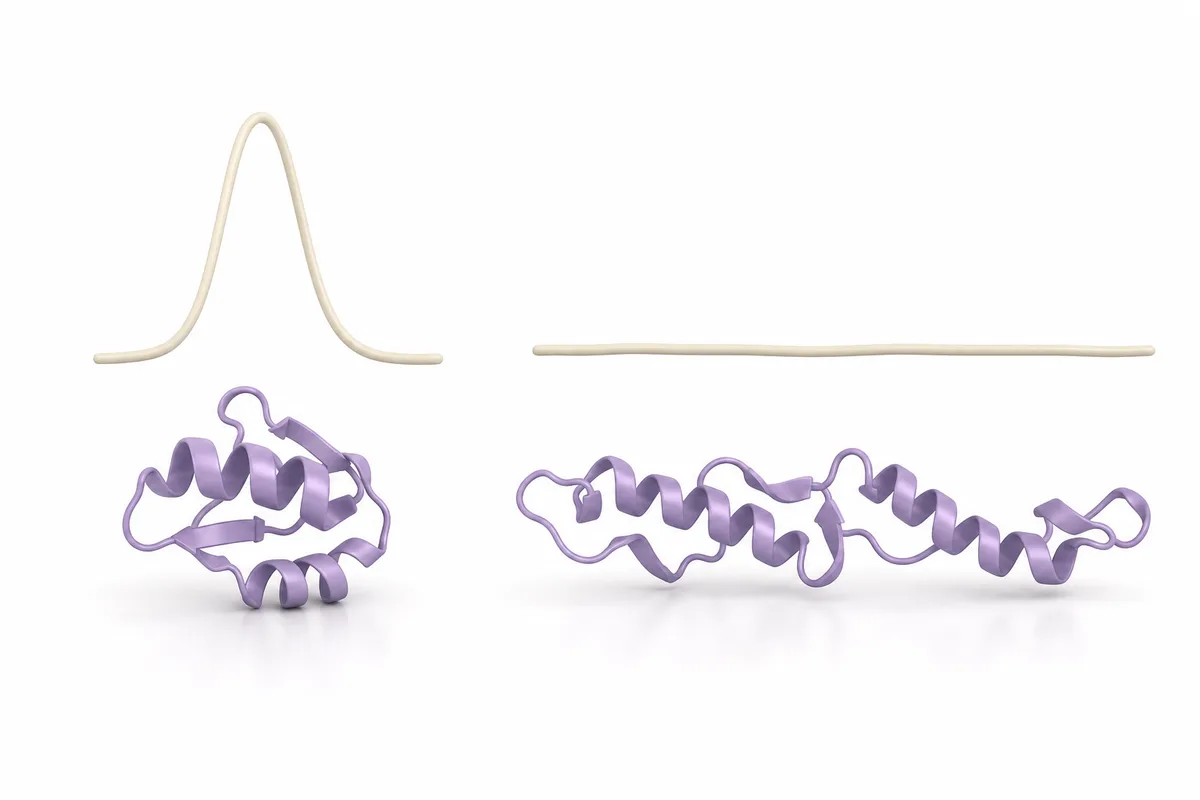
TL;DR: Mod GRF 1-29 (Modified GRF 1-29) is a tetra-substituted analogue of GRF(1-29) — the shortest fully active fragment of growth hormone releasing hormone. It is the same molecule the market sells as “CJC-1295 without DAC,” and that naming overlap is the single biggest source of confusion in this corner of peptide research. Its half-life is roughly 30 minutes, so it produces a sharp, pulse-like GH release rather than the multi-day “bleed” of the DAC version. Everything below is research-context description, not usage guidance.
If you have spent any time reading GH secretagogue research, you have met this compound under at least three names — and probably assumed they were three different things. They are not. Sorting that out is most of what this article is for, and the rest is understanding why a half-life measured in minutes is the entire point of the molecule.
What Mod GRF 1-29 actually is
Growth hormone releasing hormone (GHRH) is a 44-amino-acid peptide secreted by the hypothalamus. It travels to the anterior pituitary and tells somatotroph cells to release growth hormone. Decades of work established that you do not need all 44 residues to do this: the first 29 amino acids, GRF(1-29), retain essentially full biological activity. That fragment is the parent molecule here — and it is also the compound known clinically as sermorelin.
The problem with GRF(1-29) is that it is fragile. In plasma it is cleaved almost immediately, most notably by dipeptidyl peptidase-4 (DPP-4), which chews the peptide from the N-terminus and destroys the receptor-binding end. The result is a functional half-life measured in a few minutes.
Mod GRF 1-29 is the engineered answer to that fragility. Four amino acids in the GRF(1-29) sequence are substituted — positions 2, 8, 15 and 27 — with residues chosen to blunt the specific degradation routes:
- Position 2 blocks DPP-4 cleavage, the dominant clearance pathway.
- Position 8 removes an asparagine prone to rearrangement, improving chemical stability.
- Positions 15 and 27 further resist trypsin-like and chymotrypsin-like breakdown and improve receptor binding affinity.
The result is the same GHRH signal with a meaningfully longer, more reliable window of action — and crucially, a molecule that survives reconstitution and storage far better than plain GRF(1-29).
The naming mess, and why it matters
Here is where almost everyone gets tripped up.
The original CJC-1295 described in the literature was GRF(1-29) with those four substitutions plus a Drug Affinity Complex (DAC) — a maleimido-lysine group that covalently binds cysteine-34 on circulating albumin. Because albumin turns over slowly, that anchor drags the peptide’s half-life out to roughly 6-8 days.
Strip the DAC off and you are left with the tetra-substituted core alone. That is Mod GRF 1-29. Its half-life is roughly 30 minutes.
Vendors, however, widely sell the no-DAC core labelled simply as “CJC-1295.” So a researcher reading two sources about “CJC-1295” may be reading about two molecules whose half-lives differ by a factor of roughly 300. That is not a trivia point — it is the reason people find protocols that contradict each other:
| You see | It usually means | Approx. half-life |
|---|---|---|
| Mod GRF 1-29 | Tetra-substituted GRF(1-29), no DAC | ~30 minutes |
| Modified GRF 1-29 | Same thing, spelled out | ~30 minutes |
| CJC-1295 (no vial qualifier) | Almost always the no-DAC form | ~30 minutes |
| CJC-1295 with DAC / CJC-1295 DAC | The albumin-binding version | ~6-8 days |
| Sermorelin | Unmodified GRF(1-29) | A few minutes |
Mechanism: an amplifier, not a trigger
Mod GRF 1-29 is a GHRH-receptor agonist. It binds the GHRH receptor on pituitary somatotrophs and increases both the synthesis and the release of growth hormone. What it does not do is create a GH pulse out of nothing.
Three signals govern the GH pulse:
- GHRH — the “go” signal. Amplifies the size of a pulse.
- Somatostatin — the “stop” signal. Its rhythmic withdrawal is what permits a pulse to happen at all.
- Ghrelin (and its mimetics) — acting on the GHS-R1a receptor, it both triggers release directly and suppresses somatostatin tone.
A GHRH analogue on its own raises GH only modestly, because somatostatin is still standing on the brake. This is precisely why Mod GRF 1-29 is so consistently paired with a GHS-R1a agonist — ipamorelin, GHRP-2, GHRP-6. The GHRP lifts the brake and pulls the trigger; the GHRH analogue turns up the volume. Together they release substantially more GH than either does alone, and that documented synergy is the entire reason the CJC-1295 and ipamorelin blend exists as a product category at all.
If you want the other half of that pairing in detail, what is ipamorelin covers the GHS-R1a side, and GHRP-2 vs GHRP-6 compares the older secretagogues on selectivity.
Why 30 minutes changes everything
A short half-life is not a weakness here. It is the design goal.
Endogenous GH is secreted in discrete pulses, with the largest arriving in the first hours of slow-wave sleep. A stimulus that clears in about half an hour can slot into that rhythm: it arrives, amplifies a pulse, and leaves. Baseline GH returns to where it was. The pattern looks like physiology.
The DAC version cannot do this. With the peptide tethered to albumin for days, GHRH signalling is continuously elevated, which raises the trough between pulses — the effect researchers describe as a GH “bleed.” Human data suggest pulses still occur on top of that raised floor, but the shape of the curve is fundamentally different.
- 1
0-15 min — absorption and binding
The peptide reaches circulation and engages GHRH receptors on pituitary somatotrophs.
- 2
15-30 min — peak GH release
The amplified pulse crests. When co-administered with a GHRP, the two windows overlap here.
- 3
30-90 min — clearance and decline
Plasma levels fall past the ~30 minute half-life; GH returns toward baseline rather than plateauing.
- 4
2-4 h — signal cleared
No residual GHRH tone. The next administration can drive a fresh, clean pulse.
Three practical consequences follow directly from those kinetics:
- Discrete, divided administration. Because the window is short, research protocols use multiple separate administrations rather than one. Two to three per day is the pattern that recurs.
- Timing is load-bearing. A pulse-amplifying compound is only as good as the pulse it lands on. Pre-sleep administration is emphasised because it coincides with the largest natural surge.
- No sustained elevation. There is no accumulation, no albumin reservoir, no multi-day IGF-1 shelf. Miss an administration and the compound is simply absent.
Somatostatin, glucose and why fasting shows up in every protocol
The reason nearly every Mod GRF 1-29 protocol mentions a fasted window is not folklore — it is somatostatin.
Elevated blood glucose and the insulin response that follows increase somatostatin tone at the pituitary. Somatostatin is the direct antagonist of the GH pulse: with the brake applied, the same GHRH signal produces a smaller GH response. Fat in the bloodstream (elevated free fatty acids) blunts GH release as well.
The practical translation is the convention you see everywhere: administration is timed away from food, typically with a gap of a couple of hours on either side, so the GHRH signal lands when somatostatin tone is at its lowest. It is a straightforward signal-to-noise argument, not a ritual.
Representative research conventions
The following describes what appears repeatedly in research protocols and the literature around this compound class. It is descriptive, not instructional.
Quantities. Studies and protocols involving GHRH analogues commonly reference a saturating-type dose for the GHRH receptor — the figure that recurs is roughly 100 mcg per administration, on the reasoning that beyond that point the receptor population is largely occupied and additional peptide adds little. Administrations are typically divided, one to three times daily, aligned to fasted windows and pre-sleep. The arithmetic for converting between vial concentration and administered volume is covered in peptide dosing 101, and the pairing-specific timing logic in ipamorelin research dosing and timing.
Reconstitution. Supplied as a lyophilised powder, reconstituted with bacteriostatic water directed slowly down the vial wall rather than jetted onto the powder cake — GHRH analogues are sensitive to agitation. Swirl, do not shake. The vial is left to dissolve rather than forced.
Storage. Lyophilised powder is stable refrigerated and for extended periods frozen; once reconstituted, refrigeration is standard and the practical window is a matter of weeks rather than months. Mod GRF 1-29’s four substitutions improve stability relative to plain GRF(1-29), but the reconstituted peptide is still a peptide in water — light, heat and repeated freeze-thaw all degrade it.
Being honest about the evidence
The evidence base deserves a straight answer, because it is often oversold.
The GHRH biology is solid. GRF(1-29) as the minimal active fragment, the GHRH-receptor mechanism on somatotrophs, the somatostatin interaction, and the GHRH-plus-GHRP synergy are all well documented in human physiology work. Sermorelin — the unmodified parent — has a genuine clinical history.
What is thin is human trial data on the tetra-substituted analogue specifically, under the name Mod GRF 1-29. The published human pharmacokinetic work in this family centres on the DAC-bearing version, which is where the 6-8 day half-life figure comes from. The ~30 minute figure for the no-DAC core is consistent with its structure and clearance, and is widely cited, but it does not rest on the same volume of dedicated human trial data.
So the accurate framing is: strong mechanistic grounding, extrapolated from GHRH physiology and sermorelin, with a thin layer of compound-specific human evidence on top. That is a reasonable basis for research interest. It is not the same as a well-characterised drug, and pretending otherwise does nobody any favours. For the closest relative with a real clinical file, see what is sermorelin.
Frequently asked questions
Is Mod GRF 1-29 the same as CJC-1295?
It is the same as CJC-1295 without DAC, and that is how most vendors label it — often dropping the “without DAC” qualifier entirely. It is not the same as CJC-1295 with DAC, which adds an albumin-binding Drug Affinity Complex and carries a half-life of roughly 6-8 days versus Mod GRF 1-29’s roughly 30 minutes. When a source says “CJC-1295” with no qualifier, check the dosing frequency: multiple times daily means no-DAC.
What is the half-life of Mod GRF 1-29?
Roughly 30 minutes, with a functional window of no more than a few hours. That short window is the defining feature — it lets the compound amplify a discrete GH pulse and then clear, rather than holding GHRH receptors under continuous stimulation the way the DAC version does. It is also why research protocols use divided, timed administrations rather than a single infrequent one.
How is Mod GRF 1-29 different from sermorelin?
Sermorelin is GRF(1-29) — the unmodified 29-amino-acid fragment. Mod GRF 1-29 is that same fragment with four amino-acid substitutions that resist enzymatic degradation, notably DPP-4 cleavage. The practical difference is durability: sermorelin is degraded within a few minutes, while the stabilised analogue survives long enough to produce a more consistent, more predictable GH pulse from the same receptor.
Why is Mod GRF 1-29 always paired with ipamorelin or a GHRP?
Because a GHRH analogue amplifies a GH pulse but does not create one. Somatostatin — the inhibitory brake on the pituitary — must withdraw for a pulse to occur. GHS-R1a agonists such as ipamorelin and the GHRPs both suppress somatostatin tone and trigger release directly. Combining the two produces substantially more GH than either alone, and their similarly short windows let the stimuli overlap into a single coordinated pulse.
Why do protocols emphasise fasted administration?
Elevated glucose and insulin raise somatostatin tone at the pituitary, and somatostatin directly blunts a GH pulse. Elevated free fatty acids do the same. Administering in a fasted window means the GHRH signal lands when the brake is off, so the same amount of peptide produces a larger, cleaner response. It is a signal-to-noise decision rather than a safety one.
References
-
Teichman SL, Neale A, Lawrence B, Gagnon C, Castaigne JP, Frohman LA. Prolonged stimulation of growth hormone (GH) and insulin-like growth factor I secretion by CJC-1295, a long-acting analog of GH-releasing hormone, in healthy adults. The Journal of Clinical Endocrinology & Metabolism. 2006;91(3):799-805.
-
Ionescu M, Frohman LA. Pulsatile secretion of growth hormone (GH) persists during continuous stimulation by CJC-1295, a long-acting GH-releasing hormone analog. The Journal of Clinical Endocrinology & Metabolism. 2006;91(12):4792-4797.
-
Veldhuis JD, Keenan DM, Bowers CY. Determinants of GH-releasing hormone and GH-releasing peptide synergy in men. American Journal of Physiology-Endocrinology and Metabolism. 2009;296(5):E1085-E1092.
-
Frohman LA, Downs TR, Heimer EP, Felix AM. Dipeptidylpeptidase IV and trypsin-like enzymatic degradation of human growth hormone-releasing hormone in plasma. The Journal of Clinical Investigation. 1989;83(5):1533-1540.
-
Prakash A, Goa KL. Sermorelin: a review of its use in the diagnosis and treatment of children with idiopathic growth hormone deficiency. BioDrugs. 1999;12(2):139-157.
-
Vance ML, Kaiser DL, Evans WS, et al. Pulsatile growth hormone secretion in normal man during a continuous 24-hour infusion of human growth hormone releasing factor (1-40): evidence for intermittent somatostatin secretion. The Journal of Clinical Investigation. 1985;75(5):1584-1590.
Research use only. This article describes Mod GRF 1-29 for laboratory and educational reference. It is not medical advice, contains no therapeutic claims, and recommends no dose, protocol, or human use. Mod GRF 1-29 is a research chemical and is not an approved medicine.