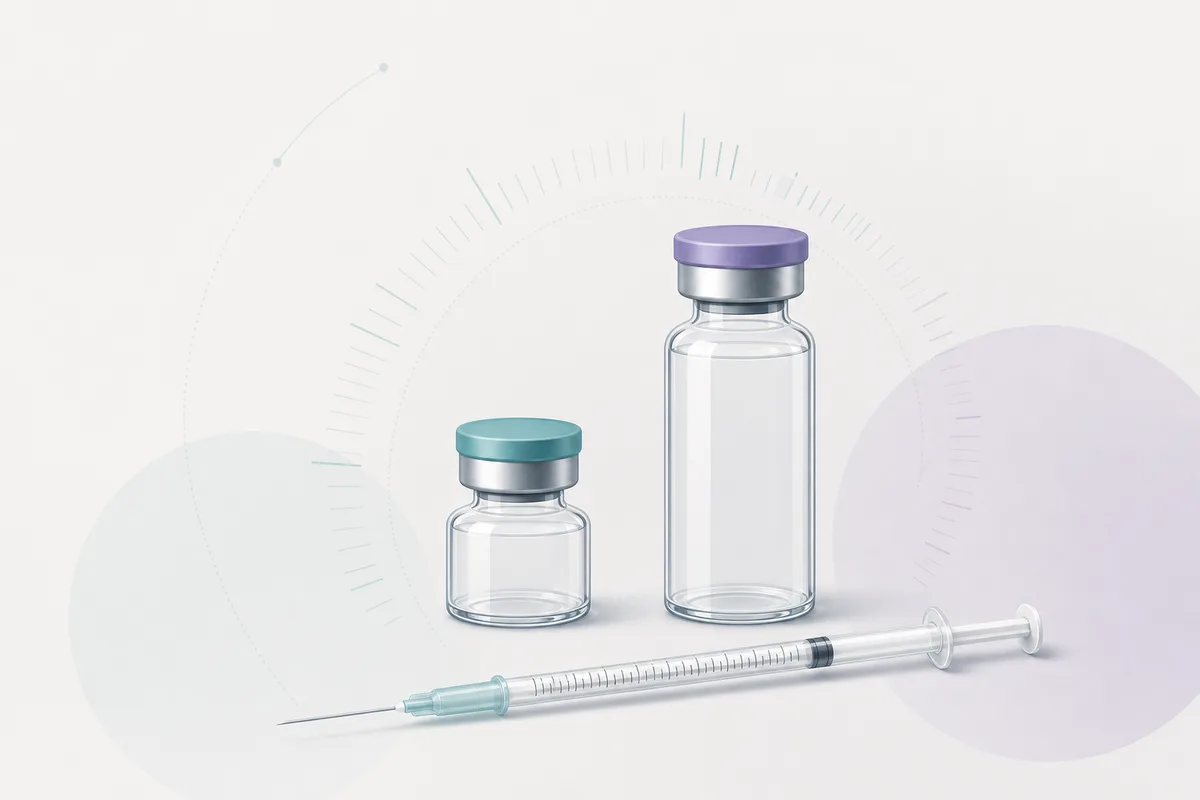
TL;DR: Hexarelin ships in only two sizes — 2mg and 5mg, with no 10mg — on a shelf where 5mg and 10mg between them cover roughly seven listings in ten. Reconstitute the 2mg vial with 2mL and you land on 1 mg/mL, where a 100 mcg dose is a clean 10 units on a U-100 syringe; the 5mg vial in 5mL gives the identical ruler with 50 draws instead of 20. Listed prices are €22.00 and €29.00, so €11.00/mg against €5.80/mg — the big vial is 47.3% cheaper per mg, but only if you finish it inside the reconstituted window. Below roughly 125 mcg a day the small vial wins. The hexarelin calculator redoes all of it for any volume.
Two sizes, and one of them is unusual
Everything here assumes a U-100 insulin syringe, where 1 mL = 100 units and 1 unit = 0.01 mL. State that once and every number follows.
What is unusual about hexarelin is where it stops. Walk the rest of the secretagogue shelf and you find GHRP-2 at 5mg and 10mg, GHRP-6 at 5mg and 10mg, and ipamorelin running the full 2mg, 5mg and 10mg ladder in our catalogue. Hexarelin tops out at 5mg, with a 2mg vial underneath and no 10mg in the catalogue at all. The small format is not itself rare — five compounds in our price index carry a 2mg listing — but hexarelin is the only GHRP among them.
That small format is not an accident. Hexarelin is the most potent GHRP in the class and the one most associated with receptor desensitisation, so protocols in the literature run time-limited rather than open-ended — what hexarelin is and how it works covers the mechanism. A 2mg vial is sized for a short, bounded run. The question is what to put in it.
The two formulas everything rests on
mg/mL = vial strength (mg) ÷ BAC water added (mL)
mcg per unit = (mg/mL × 1000) ÷ 100
Worked example, 2mg vial with 2mL:
- Concentration: 2 ÷ 2 = 1 mg/mL = 1000 mcg/mL
- Per unit: 1000 ÷ 100 = 10 mcg per unit
- A 100 mcg draw: 100 ÷ 10 = 10 units = 0.10 mL
Halve the water instead — 2mg in 1mL — and you get 2 mg/mL, 20 mcg per unit, and the same 100 mcg becomes 5 units or 0.05 mL.
10 units on a U-100 syringe = 0.10 mL = 100 mcg when the vial sits at 1 mg/mL (2mg in 2mL, or 5mg in 5mL).
Note the symmetry: a 2mg vial in 2mL and a 5mg vial in 5mL are the same solution, as are 2mg in 1mL and 5mg in 2.5mL. Pick a pair and your syringe habits carry across sizes unchanged.
Hexarelin dosage chart by vial size
Both vials at the reference volume. Doses per vial assume full recovery and no residual loss.
2mg vial + 2mL BAC water = 1 mg/mL (10 mcg per unit)
| Target dose | Draw volume | U-100 units | Doses per vial |
|---|---|---|---|
| 50 mcg | 0.05 mL | 5 units | 40 |
| 100 mcg | 0.10 mL | 10 units | 20 |
| 150 mcg | 0.15 mL | 15 units | 13.3 |
| 200 mcg | 0.20 mL | 20 units | 10 |
| 300 mcg | 0.30 mL | 30 units | 6.7 |
5mg vial + 5mL BAC water = 1 mg/mL (10 mcg per unit)
| Target dose | Draw volume | U-100 units | Doses per vial |
|---|---|---|---|
| 50 mcg | 0.05 mL | 5 units | 100 |
| 100 mcg | 0.10 mL | 10 units | 50 |
| 150 mcg | 0.15 mL | 15 units | 33.3 |
| 200 mcg | 0.20 mL | 20 units | 25 |
| 300 mcg | 0.30 mL | 30 units | 16.7 |
Halve the water on either vial and every unit count halves too — 100 mcg becomes 5 units, 300 mcg becomes 15 — while doses per vial do not move at all. Water changes the ruler, never the total.
How much water for such a small vial
The case for 2mL in a 2mg vial. At 1 mg/mL a 100 mcg dose is 10 units and a 50 mcg dose is 5, both on printed marks. More usefully, a one-unit misread costs 10 mcg — 10% of a 100 mcg dose — where at 2 mg/mL the same slip costs 20 mcg, or 20%. Diluting does not steady your hand; it shrinks the error as a fraction of the dose.
The case against. You pay for that resolution in barrel real estate. At 1 mg/mL a full U-100 barrel tops out at 1 mg, so a 300 mcg draw eats nearly a third of the syringe — fine alone, awkward the moment you want a GHRH analogue in the same barrel.
The sharper cost is time. A 2mg vial at 100 mcg per draw gives 20 doses, and reconstituted hexarelin is generally treated as holding 2–3 weeks refrigerated at 2–8 °C. At once daily that is 20 days: you finish the vial exactly as the window closes. At twice daily it is 10 days, comfortably inside.
Alternative reconstitution volumes
You are not locked to the reference pair.
| Vial | BAC water | Concentration | mcg per unit | 100 mcg draw |
|---|---|---|---|---|
| 2mg | 1 mL | 2 mg/mL | 20 mcg | 5 units |
| 2mg | 1.5 mL | 1.33 mg/mL | 13.3 mcg | 7.5 units |
| 2mg | 2 mL | 1 mg/mL | 10 mcg | 10 units |
| 5mg | 1 mL | 5 mg/mL | 50 mcg | 2 units |
| 5mg | 2 mL | 2.5 mg/mL | 25 mcg | 4 units |
| 5mg | 2.5 mL | 2 mg/mL | 20 mcg | 5 units |
| 5mg | 3 mL | 1.67 mg/mL | 16.7 mcg | 6 units |
| 5mg | 5 mL | 1 mg/mL | 10 mcg | 10 units |
The 5mg vial in 1mL is there for completeness, not as a suggestion: at 50 mcg per unit, 100 mcg is 2 units and 50 mcg is a single one. No room left to be wrong.
The per-mg gap, and what it is really measuring
Our EU price index lists both hexarelin sizes — more than we can say for most compounds here.
- 2mg vial: €22.00 → 22.00 ÷ 2 = €11.00 per mg
- 5mg vial: €29.00 → 29.00 ÷ 5 = €5.80 per mg
A 47.3% drop across one rung — steeper than the 31.3% that GHRP-2 and GHRP-6 both post going from 5mg to 10mg (€4.80/mg down to €3.30/mg). The reason is not that the 5mg hexarelin vial is cheap; it is that the 2mg format carries a small-vial premium. The same €22.00 buys a 2mg sermorelin vial in the same index, also €11.00/mg. Below a certain size you pay for the vial and the freeze-drying more than for the peptide.
Listed EU price-index figures: hexarelin 2mg at EUR 22.00 and 5mg at EUR 29.00; GHRP-2 and GHRP-6 both at EUR 24.00 for 5mg. No 10mg hexarelin exists in our catalogue.
Hexarelin’s 5mg vial is also 20.8% more per mg than GHRP-2 or GHRP-6 at the same size — a class premium that holds at every rung we can measure, so if per-mg cost is the thing you are optimising, the GHRP-2 versus GHRP-6 comparison is the more useful page.
Per 100 mcg dose the gap is €22.00 ÷ 20 = €1.10 against €29.00 ÷ 50 = €0.58. Clean, and misleading — it assumes you use the whole vial.
The break-even is a rate, not a size
With a 2–3 week reconstituted window, that assumption breaks at low daily rates — and it breaks on the bigger vial first.
Take a 21-day window and a 100 mcg once-daily draw. The 5mg vial delivers 21 × 100 mcg = 2.1 mg before the window closes, so 29.00 ÷ 2.1 = €13.81 per delivered mg — a 138% premium over its own headline rate, and worse than the small vial’s listed price. The 2mg vial at that rate empties in 20 days and delivers all 2mg, holding €11.00/mg exactly.
Move to 100 mcg twice daily and it inverts. The 5mg vial now delivers 21 × 200 mcg = 4.2 mg, so 29.00 ÷ 4.2 = €6.90 per delivered mg, while the 2mg vial runs dry in 10 days and is still €11.00/mg. The big vial wins by 37%.
The crossover sits near 125 mcg per day on a 21-day window, moving up to roughly 190 mcg per day on a conservative 14 days. Either way the rule is short: at 100 mcg once daily the 2mg vial is the cheaper delivered milligram; at twice daily or more, the 5mg vial is.
What our data does not have
Three gaps worth stating plainly rather than papering over.
No 10mg hexarelin. The catalogue holds 2mg and 5mg, both priced. There is no larger format, so no third point on the per-mg curve.
No like-for-like ipamorelin comparison. Our index lists ipamorelin only at 10mg (€54.99, or €5.50/mg), so the cross-class comparison above leans on GHRP-2 and GHRP-6, which do have matching rungs.
No human half-life. Our dataset records hexarelin at roughly 120 minutes terminal half-life in dogs, intravenous — an animal figure from Boghen et al. in Peptides, 1995. Human hexarelin studies report growth hormone pharmacodynamics, not drug clearance, and the “~55 min” and “~70 min” human numbers in circulation appear to conflate the GH response curve with elimination of the peptide itself. The half-life chart marks the evidence grade on every compound for that reason.
The dose figures used above — 100 mcg once to three times daily — are general ranges reported in the literature, not a validated per-kilogram schedule. The arithmetic is exact; the inputs are conventions.
Hand it to the calculator
The hexarelin calculator takes vial strength, BAC volume and target dose and returns mg/mL, mcg per unit and the exact syringe mark; every other compound sits behind the same calculator index. The money half lives in the cost calculator, the pricing table in the price index, and the snapshot method in our methodology.
Frequently Asked Questions
How much bacteriostatic water do I add to a 2mg hexarelin vial?
2mL is the reference here, giving 1 mg/mL and 10 mcg per unit, so a 100 mcg dose is a flat 10 units. Using 1mL doubles the concentration and halves every draw to 5 units — compact, but a one-unit misread then costs 20 mcg instead of 10.
How many units is 100 mcg of hexarelin?
It depends only on concentration, never on the vial label. At 1 mg/mL (2mg in 2mL, or 5mg in 5mL) it is 10 units, or 0.10 mL. At 2 mg/mL (2mg in 1mL, or 5mg in 2.5mL) the same 100 mcg is 5 units.
How many doses are in a 2mg hexarelin vial?
Twenty, at 100 mcg per draw — forty at 50 mcg, ten at 200 mcg. Water volume changes none of those counts, only how many units each draw occupies.
Is the 5mg hexarelin vial better value than the 2mg?
Per listed milligram, clearly: €5.80/mg against €11.00/mg. Per delivered milligram it depends on your rate — below about 125 mcg a day on a 21-day window the 5mg vial strands peptide and the small vial ends up cheaper.
Why does hexarelin come in a 2mg vial when GHRP-2 starts at 5mg?
Hexarelin protocols in the literature tend to be time-limited rather than continuous, since it is the GHRP most associated with receptor desensitisation. A 2mg format fits a short bounded run, and the 2–3 week reconstituted window, better than a 5mg vial does.
What is hexarelin’s half-life?
Our dataset records about 120 minutes terminal half-life in dogs after intravenous dosing, graded as animal evidence. No human pharmacokinetic half-life has been published — human studies measured the growth hormone response instead.
References
- Ghigo E, Arvat E, Gianotti L, et al. “Growth hormone-releasing activity of hexarelin, a new synthetic hexapeptide, after intravenous, subcutaneous, intranasal, and oral administration in man.” Journal of Clinical Endocrinology and Metabolism, 1994;78(3):693-698.
- Imbimbo BP, Mant T, Edwards M, et al. “Growth hormone-releasing activity of hexarelin in humans: a dose-response study.” European Journal of Clinical Pharmacology, 1994;46(5):421-425.
- Boghen MF, et al. Hexarelin pharmacokinetics in the dog. Peptides, 1995 (PubMed 8545255) — source of the roughly 120 minute terminal half-life in our dataset. No equivalent human figure exists.
- Arvat E, di Vito L, Maccagno B, et al. “Effects of GHRP-2 and hexarelin on GH, PRL, ACTH and cortisol levels in man.” Peptides, 1997;18(6):885-891.
- Rahim A, O’Neill PA, Shalet SM. “Growth hormone status during long-term hexarelin therapy.” Journal of Clinical Endocrinology and Metabolism, 1998;83(5):1644-1649.
- PeptiMap. “EU Peptide Price Index” — build-time snapshot of listed European research-supply pricing. The €22.00 and €29.00 figures come from that dataset, not from literature.
This article is a research and educational reference only; hexarelin is not an approved medicine, this is not medical advice, and it is not for human consumption.